Founder Archive

12.6K posts

Founder Archive banner
Founder Archive

Founder Archive

@Founder_Archive

Archiving legendary Founder stories, insight & advice | Learn from the greatest minds and be inspired.

Inscrit le Ekim 2022
86 Abonnements375.9K Abonnés
Tweet épinglé
Founder Archive
Founder Archive@Founder_Archive·
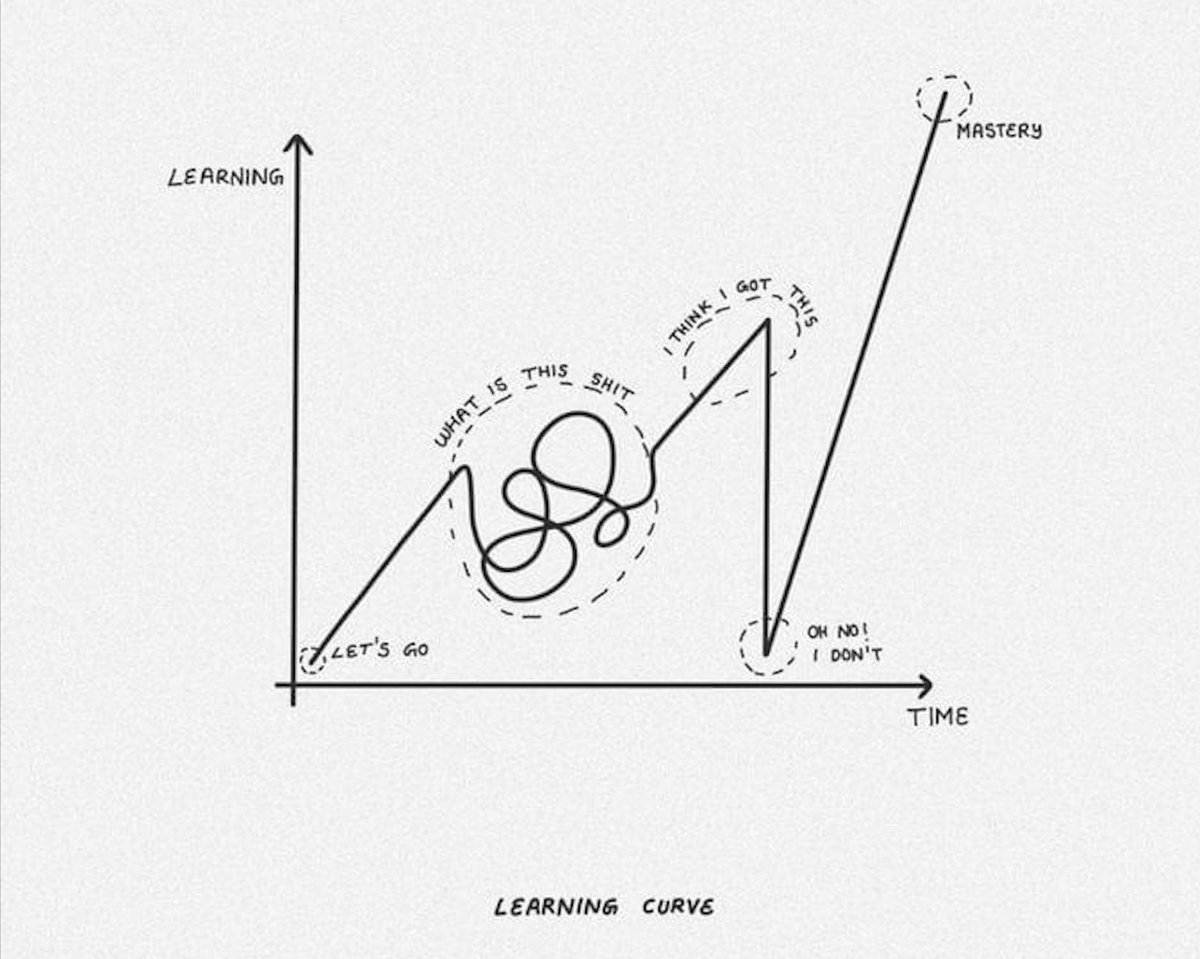
Walt Disney got fired for "lacking imagination." James Dyson created 5,127 failed prototypes. Sara Blakely was told no by every manufacturer. Elon Musk nearly went broke funding Tesla and SpaceX. Jack Ma failed his college entrance exam twice. Here's the truth nobody admits: Every founder you admire failed their way to success. The only difference? They understood failure is tuition, not a verdict.
Founder Archive tweet media
English
19
42
141
31.7K
Founder Archive retweeté
Hosun Chung
Hosun Chung@hosun_chung·
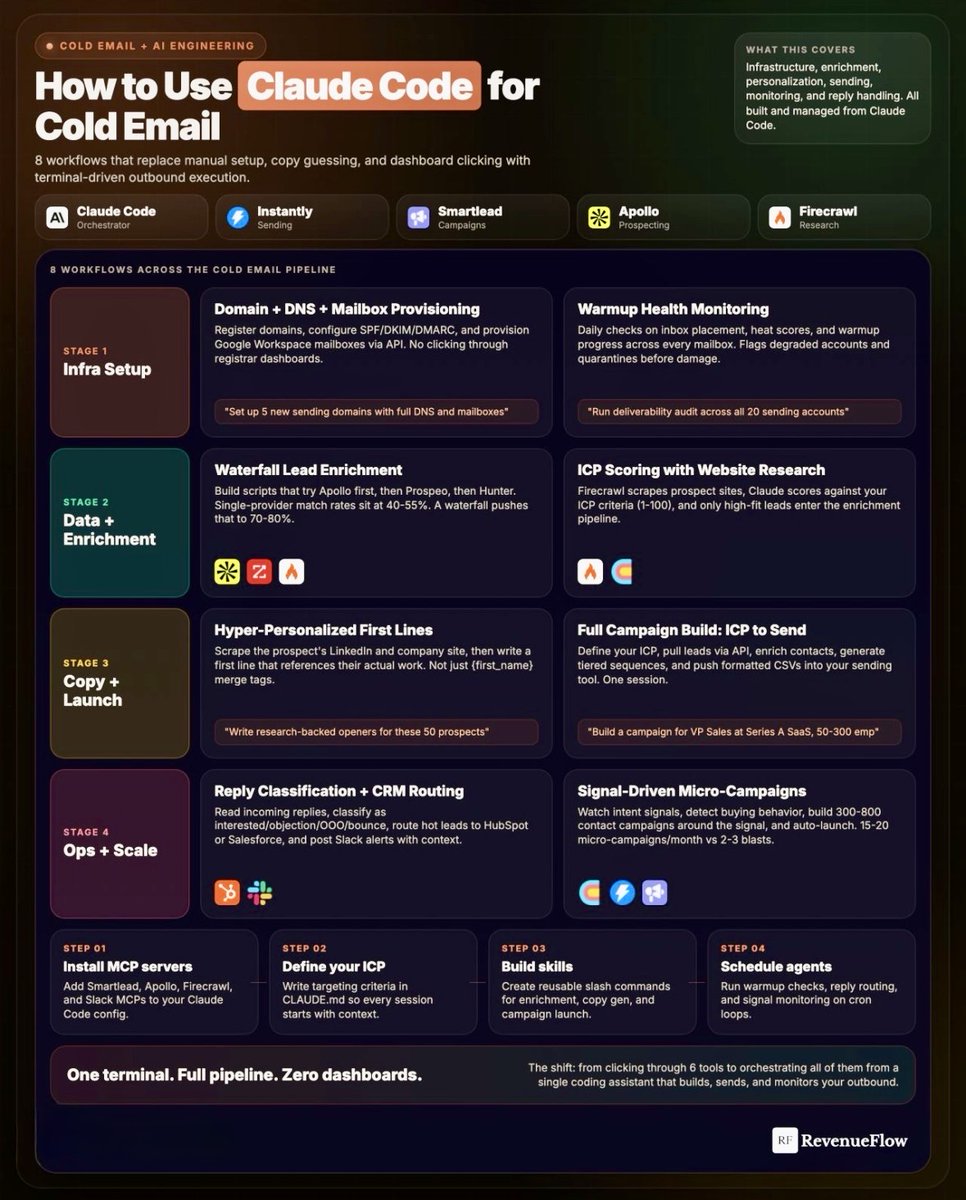
Most outbound teams run their pipeline across 6 tools, 12 tabs, and a full day of manual work. We replaced all of it with Claude Code running from one terminal. 8 workflows that used to need a person: 1. Domain + DNS + mailbox setup via API 2. Warmup monitoring with auto-quarantine 3. Waterfall enrichment across multiple data sources 4. ICP scoring with live website research 5. Personalized first lines at scale - not templates 6. Full campaign builds from ICP definition to send 7. Reply classification with CRM routing and Slack alerts 8. Signal-driven micro-campaigns that auto-launch The setup: install MCP servers, define your ICP in Claude, build reusable skills per workflow, schedule agents for daily monitoring. 15-20 targeted micro-campaigns per month instead of 2-3 big blasts. One terminal. Full pipeline. Zero dashboards. Full system mapped in the infographic below:
Hosun Chung tweet media
English
0
10
12
1.8K
Founder Archive retweeté
Clint Jarvis
Clint Jarvis@clinjar·
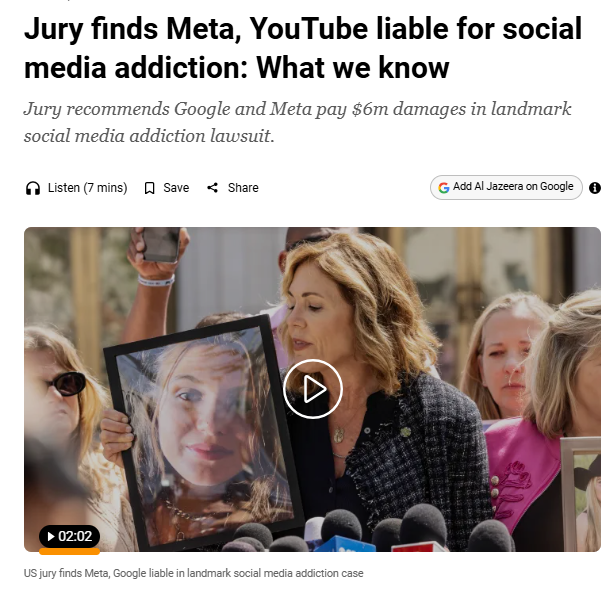
A jury just awarded $6 million to a woman who got addicted to Instagram and YouTube as a kid. She started using YouTube at 6 years old. Instagram at 9. What the trial revealed about these apps is deeply disturbing:
Clint Jarvis tweet media
English
2
11
19
2.6K
Founder Archive retweeté
Terry Lynch
Terry Lynch@terrybali·
Sometimes you go looking for one thing and find something else entirely. We were drilling regional reconnaissance in the Hinge/Hydro Lands area, targeting Ni-Cu mineralization. Hole PMX-25-016 intersected 34.6 g/t Au over 1.50m from 273.5m to 275.0m — with visible gold in a foliation-parallel stringer. That high-grade hit sits inside a broader 33-meter zone of anomalous gold, hosted in a felsic-intermediate volcanic unit that our geologists have mapped on surface over several kilometers of strike. The same unit showed up in hole PMX-25-015 about 500m to the east. We're relogging and resampling both holes now. It gets better. A deep hole (PML-25-021X) also cut through this unit roughly 600m below PMX-25-016, with possible indications of mineralization. Assays are pending. And the Ni-Cu story in this area is strong too. All four Hinge holes hit anomalous arsenic and tungsten — classic Sudbury camp pathfinder minerals — in or near high magnesium basalts and gabbros. We saw Pd up to 0.10 g/t, Pt 0.11 g/t, and Au 0.36 g/t in the high Mg rocks. That's across 2+ km of strike with holes hundreds of meters apart. Follow-up drilling is underway. Our primary focus is Ni-Cu-PGE. But 34.6 g/t gold over 1.5m with visible gold, in a unit that extends for kilometers? That's not something you ignore. $PNPN
Terry Lynch tweet media
English
0
11
24
1.6K
Founder Archive retweeté
GC Cooke
GC Cooke@Gccooke·
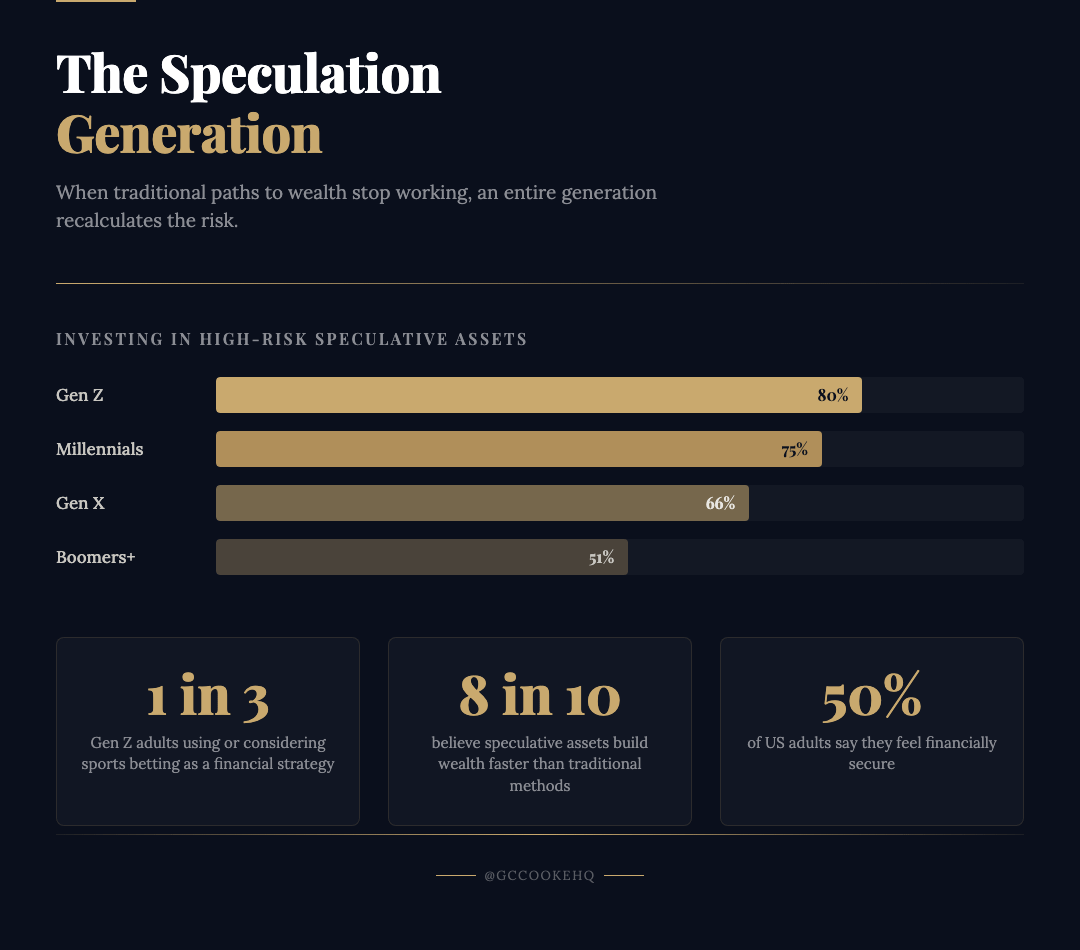
Gen Z isn't bad with money. They've run the numbers on 'playing it safe,' and the math doesn't work anymore. Nearly 4 in 5 Gen Z investors are allocating capital to alternative, higher-upside assets — crypto, options, memecoins — because they feel financially behind, and conventional paths aren't closing the gap. One in three is also exploring sports betting as a wealth-building tool. And it's not just Gen Z. Three-quarters of Millennials say the same thing. Two-thirds of Gen X. Even half of Boomers. The younger you are, the wider the gap feels — but the sentiment runs across every generation. 8 out of 10 people pursuing these assets believe they'll reach financial security faster than through traditional methods. Meanwhile, only half of American adults feel financially secure at all. These two data points tell the whole story. Think about what 'playing it safe' actually looks like for a 25-year-old today. $400/month into an index fund while rent takes 40% of gross income. Housing prices are growing 3-4x faster than wages. Student loan payments are kicking in. The conventional path doesn't build wealth - it barely maintains it. This gets labeled a financial literacy problem. It's not. It's a financial math problem. The traditional equation — save, compound, wait 40 years — assumes you can accumulate capital slowly. For a generation that watched 2008 destroy that promise, the equation changed. The real story isn't that young people are taking bigger swings. It's that the economy gave them so little margin that asymmetric bets became the highest expected-value play. When your downside is already priced in, you start optimizing for upside. We're not watching a generation make irrational decisions. We're watching rational actors recalculate. And until the underlying math changes, the appetite for asymmetric upside will only grow.
GC Cooke tweet media
English
1
11
15
2.3K
Founder Archive retweeté
Jordan Saunders
Jordan Saunders@jsaunders_·
ALDI looks like the cheapest grocery store in America. That's not an accident. It's the strategy. And it's the reason they keep winning during recessions. Here's how:
Jordan Saunders tweet media
English
1
11
18
3.2K
Founder Archive retweeté
Mark Woodland
Mark Woodland@MarkAWoodland·
Steven Bartlett just had one of the most successful serial entrepreneurs in the UK on his podcast. Daniel Priestley explained why AI is about to flip the economy upside down and make plumbers earn more than lawyers. His 15 insights on what is coming and how to survive it:
Mark Woodland tweet media
English
1
10
11
1.6K
Founder Archive retweeté
Clint Jarvis
Clint Jarvis@clinjar·
A JAMA study scanned 47 kids' brains, ages 3–5. All regular screen users. It found real, physical changes in their brains. And the heaviest users showed something hard to ignore:
Clint Jarvis tweet media
English
2
13
26
4.6K
Founder Archive retweeté
Hosun Chung
Hosun Chung@hosun_chung·
Claude Code has replaced my junior hire. I'm not sure how to feel about it. It did in 4 hours what used to take a full week - not a prototype, not a rough draft, but production-ready work that would have passed human review. This isn't a story about one tool or something unique to our business. It's about the equation changing underneath every company that still budgets by headcount. The gap is accelerating: A team of 8 with AI can now produce what used to require 80. The gap between companies using these tools and companies ignoring them is growing every week. Sales teams spend 70% of their day on work AI already handles better - prospecting, enriching, sequencing, reporting. All of it is intelligence work - operational, repeatable, automatable. None of it requires real human judgment. The next decade belongs to companies that draw the line between intelligence work and judgment work. Most haven't. What's the one task your team is still doing manually that AI could handle tomorrow?
English
4
10
22
5.7K
Founder Archive retweeté
SammyArmstrong
SammyArmstrong@SammyRArmstrong·
Jeff Bezos is 62 years old. In his 30s, he ate cans of Pillsbury biscuits for breakfast and never read a nutrition label. Today he's in the best shape of his life and investing billions into reversing ageing. Here's what changed:
SammyArmstrong tweet media
English
3
13
51
25.6K
Founder Archive retweeté
Martin Felando
Martin Felando@MartinFelando·
In one film, a man returns from death to avenge the woman he loved. In the other, three damaged men make choices that cost them everything to protect what they believe in. The Crow and Sin City. Two films on what it costs to stand alone:
Martin Felando tweet media
English
1
9
14
2.5K
Founder Archive retweeté
Walker Deibel
Walker Deibel@walkerdeibel·
I can usually tell within 5 minutes whether a buyer will ever close. It has nothing to do with their resume or how many books they've read (even mine). Here are the 6 mistakes that kill deals before they start:
Walker Deibel tweet media
English
3
10
11
3.3K
Founder Archive retweeté
Jon Willbanks
Jon Willbanks@jonwillbanks·
The #2 ingredient in hospital tube feeding formula is corn syrup. The same cheap sweetener you find in a bottle of Coca-Cola. This is what hospitals pump into patients who are unconscious and can't say no. Wait until you see the full ingredient list (&why it matters so much):
English
1
13
19
3.5K
Founder Archive retweeté
Clint Jarvis
Clint Jarvis@clinjar·
7 genuine signs of intelligence you can’t fake: 1. Admitting when you're wrong
English
1
12
45
16.6K
Founder Archive retweeté
Marc Gravely
Marc Gravely@MarcGravely·
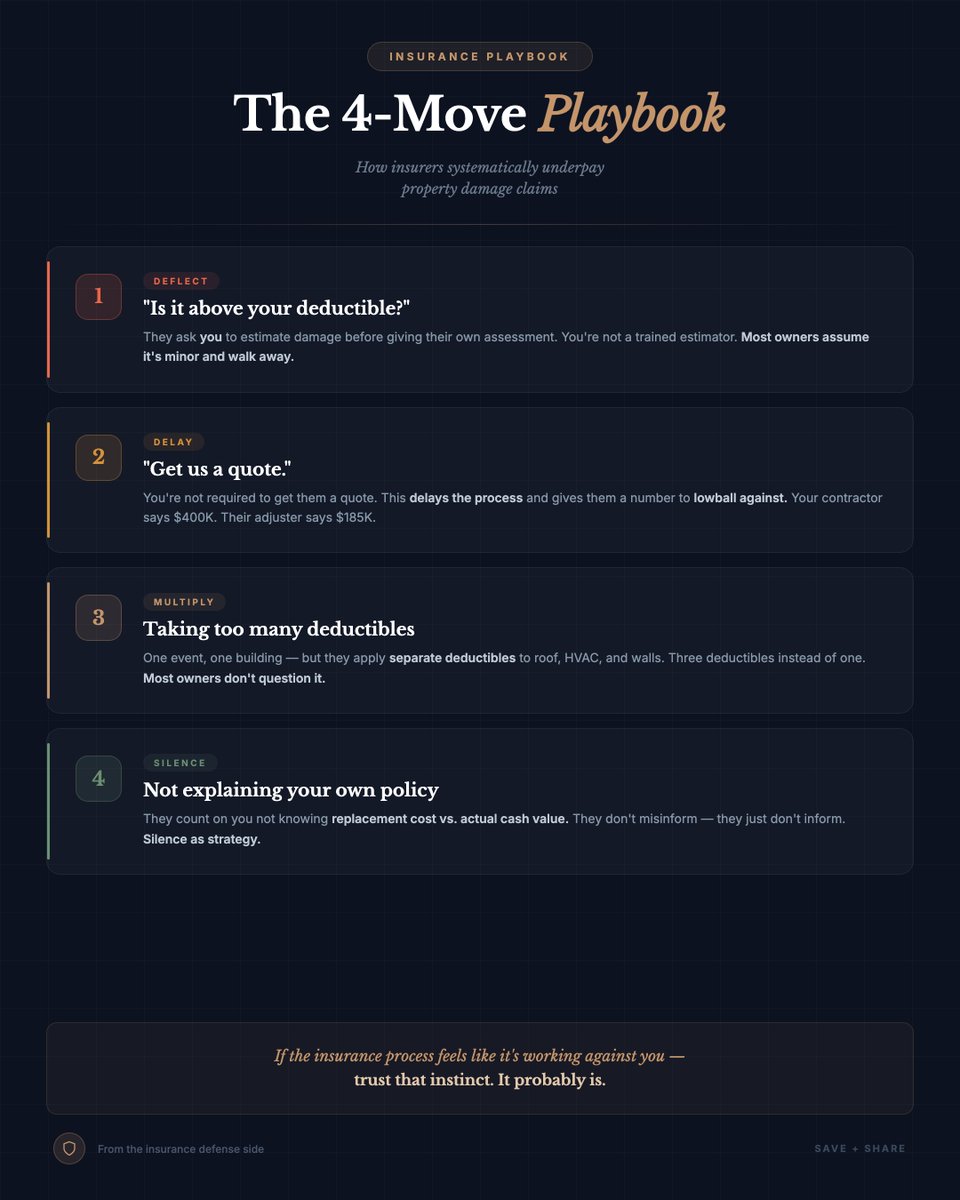
I spent years on the insurance defense side. I know how the system works from the inside. And I can tell you: there is a playbook. It's not written down anywhere. But every adjuster knows it. Every carrier follows it. Here are the 4 moves they use to underpay property damage claims: Move 1: "Is it above your deductible?" This is the first thing they'll ask. It sounds reasonable. But here's the problem — how are you supposed to know that? You're not a trained estimator. You don't have Xactimate. You don't know the difference between actual cash value and replacement cost on a line-item basis. They're trained estimators. But instead of giving you their estimate first — which is their job — they put the burden on you. Many owners hear this question, assume the damage is minor, and walk away. That's the point. Move 2: "Get us a quote." You are not required to get them a quote. They are supposed to provide you with their own estimate. That's what you pay premiums for. But they'll ask you to go find a contractor, get a bid, and send it over. This does two things: it delays the process (which benefits them), and it gives them a number to lowball against. Your contractor says $400,000. Their desk adjuster says $185,000. Now you're negotiating from their number, not yours. Move 3: Taking too many deductibles. On a large property with multiple buildings or systems, insurers will sometimes apply separate deductibles to what should be a single claim. A hail event damages the roof, the HVAC units, and the exterior walls of one building — and suddenly there are three deductibles instead of one. Most owners don't question it. They should. Move 4: Not explaining your own policy. Insurance companies have a duty to explain policy terms to their policyholders. They are the experts. You bought a product you trusted them to explain. But when it comes time to pay, they count on you not understanding the difference between replacement cost and actual cash value. Between stated value and agreed value. Between occurrence and claims-made. They don't misinform you. They just don't inform you. And silence, when you have a duty to speak, is its own kind of deception. I've seen this dance hundreds of times. Schools. Hospitals. Apartment complexes. Commercial property owners of every size. The pattern is always the same. If you've had property damage and the insurance process feels like it's working against you — trust that instinct. It probably is.
Marc Gravely tweet media
English
1
12
17
2.2K
Founder Archive retweeté
Terry Lynch
Terry Lynch@terrybali·
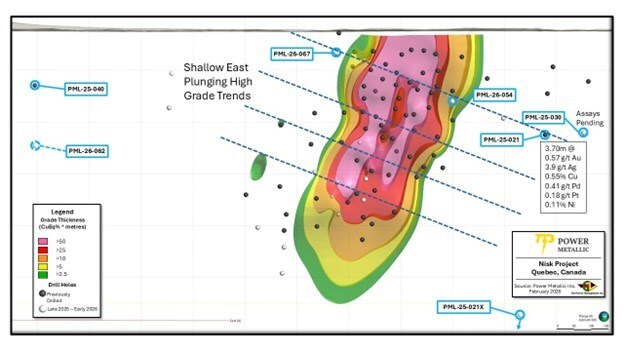
We've been saying for a while that the Lion Zone had more to give. Now the structural work is proving it. Our geologists identified shallow easterly plunging trends in the Lion Zone drill core that appear to control where the highest grades sit. Four of these structures have been mapped so far — and we've only tested the shallowest one. The results speak for themselves. PML-26-054, drilled east of Lion along this trend, hit 5m of Lion-style mineralization with visible copper. PML-26-067, on the western edge — an area we previously thought was low grade — hit 1m of massive copper sulphides at about 50m depth, plus 3.3m of disseminated copper. Both holes are getting follow-up drilling right now. What really caught our attention: this easterly structure lines up with mineralization we hit 350m east of Lion back in November 2025 (hole PML-25-021). That's potentially hundreds of meters of strike along just this one trend. And we have three more trends below it that haven't been touched. Our VP of Exploration Joe Campbell put it well — this plunge trend isn't just expanding Lion. It's pointing us toward a potential large Ni-Cu source deposit. That's the long-term prize. Over in Lion West, hole PML-25-040 hit massive nickeliferous sulphides grading 2.42% Ni, 1.83 g/t Pd, and 0.11% Cu in a tonalite dyke. That's the same style of 'rafted' rip-up blocks we see at Tiger — which tells us there's a Ni-Pd-Cu deposit somewhere below. We've moved the drill north and that hole is turning right now. Lion keeps growing. $PNPN
Terry Lynch tweet media
English
2
14
47
5.1K
Founder Archive retweeté
SammyArmstrong
SammyArmstrong@SammyRArmstrong·
Construction productivity has grown just 10% in 22 years. In the same period, manufacturing grew 90%. The trades are one of the least digitised industries on the planet. Here's why that's a massive problem, and a massive opportunity:
SammyArmstrong tweet media
English
1
9
18
3.7K
Founder Archive retweeté
GC Cooke
GC Cooke@Gccooke·
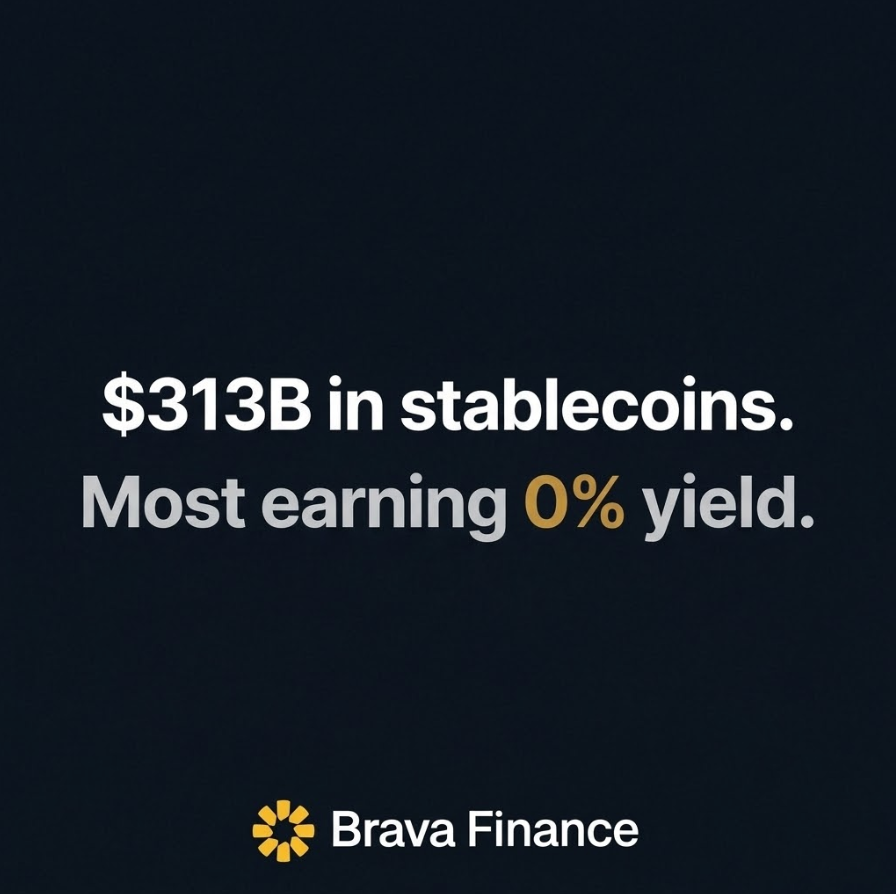
The stablecoin market just crossed $313 billion. Most of that capital is earning nothing. In traditional finance, no competent treasurer leaves hundreds of billions in non-yielding instruments. Money market funds, short-duration government securities, overnight repo -- institutional cash management is built on making idle capital productive. Stablecoins have scaled as settlement infrastructure. They haven't scaled as treasury instruments. Three dimensions to the yield gap: 1. $313B in dollar-linked digital assets — one of the largest pools of uninvested liquidity in global finance. Growing weekly. 2. Institutional allocators increasingly hold stablecoin positions for settlement and collateral, but most yield products lack the regulatory clarity and audit standards institutions require. 3. As stablecoins become settlement rails for tokenized securities (Nasdaq x Kraken this week), idle digital dollar capital pools will only grow. The settlement layer is being built. The treasury layer is still missing. The gap between stablecoin settlement and stablecoin treasury management is where the next wave of institutional value gets created.
GC Cooke tweet media
English
3
9
26
4.2K
Founder Archive retweeté
Mark Woodland
Mark Woodland@MarkAWoodland·
The RBA just hiked again. 4.10%. Back to back. 5-4 split. One vote in it. Bullock fronted the cameras and said she cannot rule out a recession. The Big Four reckon May is another hike. Three in a row. We have not seen that since 2023. Everyone is talking about the number. I am not interested in the number. I am interested in the thing nobody questions. We built this country's entire wealth strategy around a single bet. Buy a house. Sit on it for 30 years. Hope for the best. That is the plan. That is what we tell young Australians to do with their money. Your repayments are tied to a rate you do not control. The banks pass it on before the RBA even finishes the press conference. You are locked into a 30 year variable commitment set by nine people in a room in Martin Place. In any other asset class we would call that insane. One position. No diversification. No exit without massive cost. Completely at the mercy of monetary policy and global conflict. But we do not call it insane. We call it the Australian dream. Now look at what is actually happening out there. War in the Middle East. Fuel through the roof. Chalmers cannot even rule out rationing. Inflation that was supposed to be falling is climbing again. And the RBA's answer is to make your mortgage more expensive. As if you started the war. As if you set the oil price. A 600k mortgage just went up 91 bucks a month. Average loan is now costing 4,410 a month. First home buyers on 5% deposits are sitting on almost no equity. APRA numbers show 95% LTV loans jumped from 3.3 billion to 5.4 billion in the December quarter. We gave these people a ladder and told them to climb. Now we are shaking it. The RBA meets again in May. Iran is not calming down. Fuel is not coming down. And a lot of Australians are about to find out what happens when the only plan they were given stops working. We do not need another rate debate. We need a better system.
English
2
10
25
5.8K