

Scott Dodson
2.3K posts

Scott Dodson
@ProfDodson
Horace O. Coil Chair in Litigation and Geoffrey C. Hazard Jr. Distinguished Professor of Law, UC Law – San Francisco (formerly UC Hastings Law)
San Francisco, CA Inscrit le Ocak 2014
245 Abonnements1.1K Abonnés

English
@mpeltz In civil cases, requiring the direction of counsel would be contrary to Rule 26(b)(3)
English

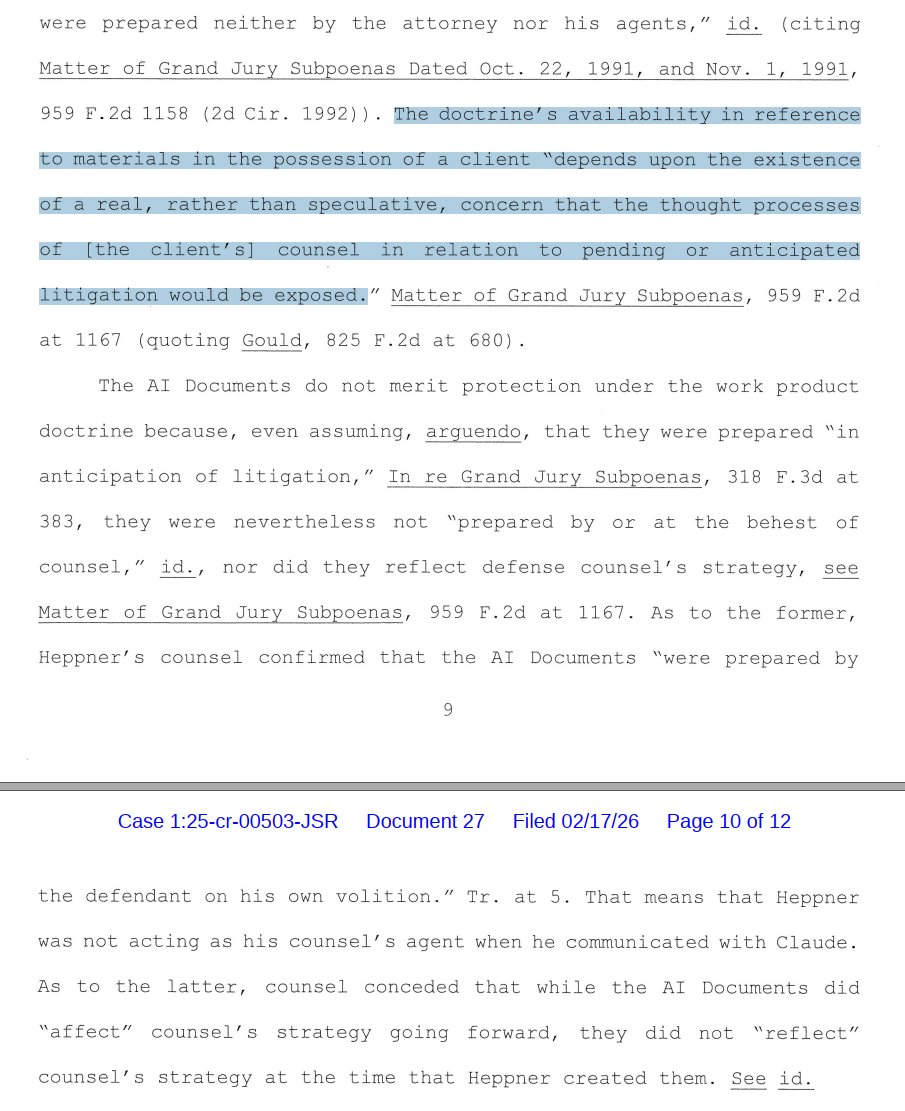
Yes, materials can be created by the party, but Judge Rakoff views Second Circuit precedent as requiring that those materials still need to be created "by or at the behest of counsel," and that was admittedly not the case here. Rakoff rejected the Shih case which had extended WP without showing an attorney directed the work.
English
Judge Rakoff just issued a written order affirming his bench decision, that:
1.Claude is not an attorney, so no attorney-client relationship exists.
2.The communications were not confidential given that Anthropic’s privacy policy permits data collection, use for training, and disclosure to third parties including government authorities.
3.Heppner was not seeking legal advice from Claude (which itself disclaims providing legal advice), even if he later shared outputs with counsel.
4. On work product doctrine: Even assuming the documents were prepared in anticipation of litigation, they were not prepared by or at the behest of counsel, nor did they reflect counsel’s strategy. Heppner acted on his own volition, so Claude was not functioning as counsel’s agent.
Key takeaway: as discussed over the past week, the novelty of AI does not exempt its use from longstanding legal principles. Professionals and litigants should be aware that their AI conversations may be discoverable.
storage.courtlistener.com/recap/gov.usco…
English
@smmarotta This (and the electronic-timeliness change) seem the most important for practitioners. @smmarotta has the goods
English

5. You used to be able to waive by simply not responding to the petition. Now, corporate respondents must either file a brief in opposition or a waiver form including the corporate disclosures. Silence isn't an option any longer.
English
A quick #thread from a practitioner perspective on the upcoming #SCOTUS rule changes. Stay for the deep dive on stock tickers, but stay for a big timing change for filings at the end. If you're working on a story about this, happy to chat!
supremecourt.gov/filingandrules…
English
Presumably, Kinsella knew this was going to happen when he agreed to take the job, but I am amused that he gets to list "United States Attorney for the Northern District of New York, February 11, 2026-February 11, 2026" on his resume forever.
Anna Bower@AnnaBower
Here is the notice announcing the appointment of Donald Kinsella, posted on the district court’s website just a few hours ago. Now Blanche, the #2 official at DOJ, says Kinsella is “fired.”
English
@ilan_wurman The main reason it appears to be discoverable, as opposed to work product, which it otherwise would be, is not because it was directed by a party but because the Claude terms of service rendered the protection waived. That waiver would apply even if your directed it.
English

I don’t know if this is true (the ruling isn’t linked, and maybe it was an oral ruling) but if it is then this is also job protection for lawyers. People can’t use AI on their own because it might be discovered. So you have to have lawyers use the AI for you.
Moish Peltz@mpeltz
Your AI conversations aren't privileged. Yesterday, Judge Jed Rakoff ruled that 31 documents a defendant generated using an AI tool and later shared with his defense attorneys are not protected by attorney-client privilege or work product doctrine. The logic is simple: an AI tool is not an attorney. It has no law license, owes no duty of loyalty, and its terms of service explicitly disclaim any attorney-client relationship. Sharing case details with an AI platform is legally no different from talking through your legal situation with a friend (which is not privileged). You can't fix it after the fact, either. Sending unprivileged documents to your lawyer doesn't retroactively make them privileged. That's been settled law for years. It just hadn't been tested with AI until now. And here's what really hurt the defendant: the AI provider's privacy policy (Claude), in effect when he used the tool, expressly permits disclosure of user prompts and outputs to governmental authorities. There was no reasonable expectation of confidentiality. The core problem is the gap between how people experience AI and what's actually happening. The conversational interface feels private. It feels like talking to an advisor. But unless you negotiate for an enterprise agreement that says otherwise, you're inputting information into a third-party commercial platform that retains your data and reserves broad rights to disclose it. Judge Rakoff also flagged an interesting wrinkle: the defendant reportedly fed information from his attorneys into the AI tool. If prosecutors try to use these documents at trial, defense counsel could become a fact witness, potentially forcing a mistrial. Winning on privilege doesn't make the evidentiary picture simple. For anyone advising clients or managing legal risk, this is a wake-up call. AI tools are not a safe space for clients to process their counsel's advice and to regurgitate their legal strategy. Every prompt is a potential disclosure. Every output is a potentially discoverable document. So what do we do about it? First, attorneys need to be proactive. Advise clients explicitly that anything they put into an AI tool may be discoverable and is almost certainly not privileged. Put it in your engagement letters. Make it part of onboarding. Don't assume clients understand this, because most don't. Second, if clients want to use AI to help process legal issues (and they clearly will, increasingly), then let's give them a way to do it inside the privilege. Collaborative AI workspaces shared between attorney and client, where the AI interaction happens under counsel's direction and within the attorney-client relationship, can change the analysis entirely. I'm excited to be planning this kind of approach, and I think it's where the industry needs to head. storage.courtlistener.com/recap/gov.usco…
English
@OrinKerr The curve issue implicates another assumption based on equity: grade ranges across certain similar courses (especially across sections) should not vary based on the professor.
English

Lots of discussions of grade inflation and curves on X over the last few days, prompted by the Harvard faculty proposal. These conversations tend to reflect competing assumptions about what grades are for, and I figured it might be helpful to make those competing assumptions explicit.
Here are the four I see most often:
(1) *Grades are a signal of how much a person knows.* On this thinking, the point of grades is to reveal how much a person knows about a topic. An A should signal they know the topic well, a B that they know it but less well, a C that they don't know it that well, etc.
(2) *Grades are a signal of relative performance.* On this thinking, the point of grades is to signal a student's degree of mastery and fluency with material relative to other students. Grades are for future employers, grad school programs, etc. who want to know how students compare, and grades should provide that information.
(3) *Grades are means to provide an incentive to learn.* On this thinking, the goal of grades is to create the right incentives to learn material. Students want the benefits that come with high grades, and students have to learn the material as best they can to try to do as well as they can on exams.
(4) *Grades are rewards for hard work.* On this thinking, high grades are a reward to students for studying hard and completing the course. A student who has put in the effort to learn material and has shown their efforts deserves the high grade as an indicator of their effort.
How you come out on grade inflation and mandatory curves depends a lot on which of these goals you adopt, I think.
English

@ProfRobAnderson This is very funny until we are all out of jobs.
English

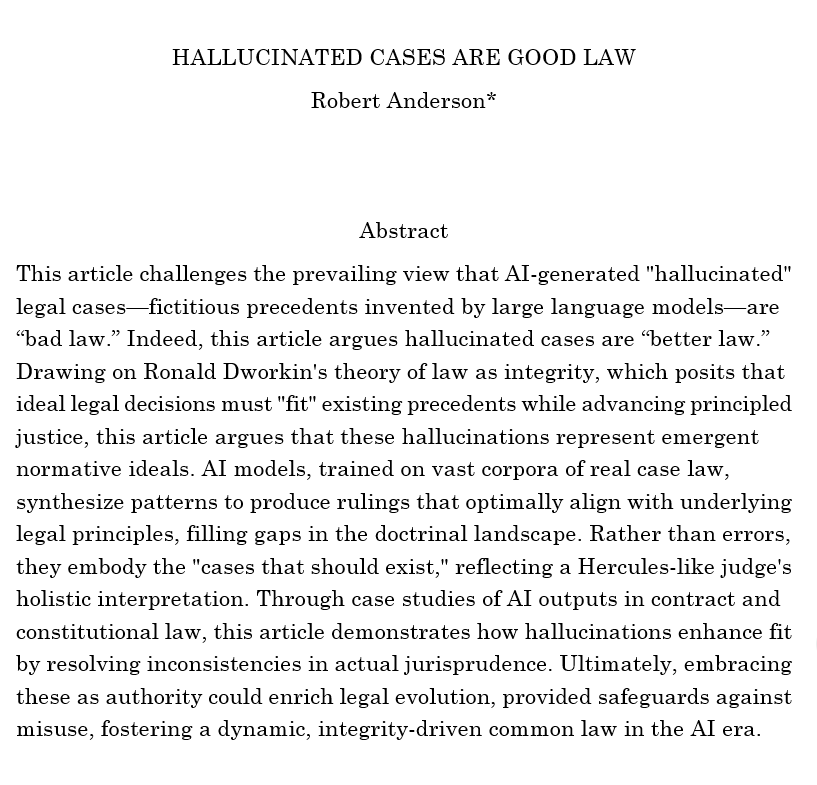
Proud to announce my new article, "Hallucinated Cases Are Good Law," forthcoming in the Princeton Law Review.
English
@OrinKerr I think the law student perspective on this is nuanced. I’ve had A students complain that grade inflation makes their A less valuable. (Though it’s hard for individual students to know for sure whether they are more harmed than helped by the inflation.)
English
Maybe we lawprofs have an idiosyncratic take, as this practice is common in law schools, but mandatory curves do seem to be the best answer to the problem of grade inflation. /1
Nicholas Bagley@nicholas_bagley
@OrinKerr three thoughts 1. ain't much but better than nothing 2. the forces that led to grade inflation are unaddressed, so the decline in A grades is unlikely to persist 3. need a mandatory grade curve or you're not serious about the problem
English
@OrinKerr Compromise: don’t submit to your home institution unless you commit to accept an offer if one is made. For that and other moralizations: papers.ssrn.com/sol3/papers.cf…
English
One of my least popular periodic tweets: If you're a law professor, you might consider not submitting your articles to your own school's law review. Doing so can be unfair to authors elsewhere, as your home law review may evaluate your scholarship under a more lenient standard.
English
Did Gorsuch just call Loper Bright “an obscure administrative law case”?

English

This is what a wet owl looks like after getting caught in a rainstorm

English
@smmarotta @adam_shniderman This is the most reasonable take. But consent under the 14th is a question of federal law, not state law, and potentially federal law could define consent as registration regardless what state law says.
English
@adam_shniderman Whether the state registration statute requires a registering corporation to consent to general jurisdiction is an antecedent question of state law before Mallory. Sheesh.
English
My guess to explain this trend: The more $$$ people have, the more they are focused on gaming elite college admissions—and one of the ways you do that is through being a recruited athlete.
Marc Porter Magee 🎓@marcportermagee
Are the children of millionaires naturally better athletes? Probably not. So what’s going on here?
English
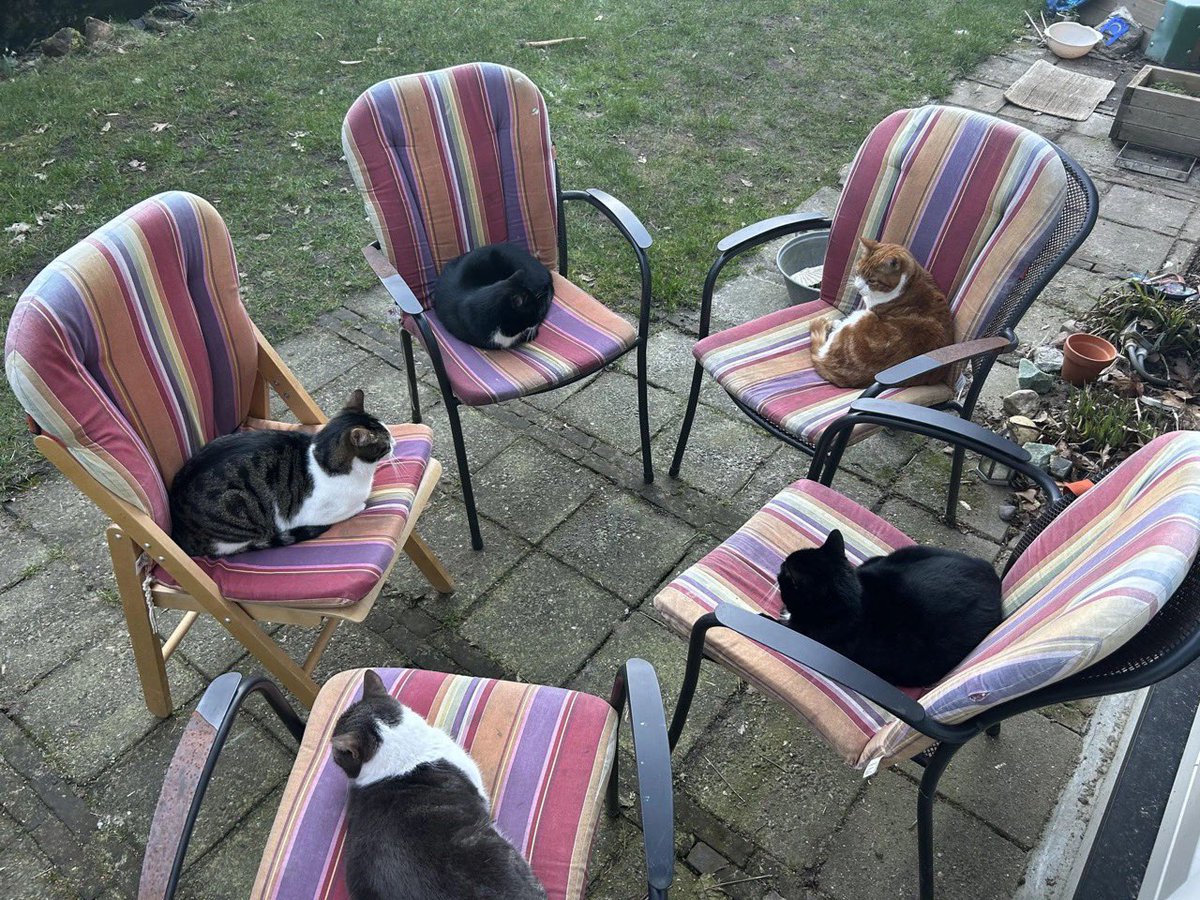
@puppiesDoglover Pretty much everything you need to know about cats and dogs
English

@LSULawCenter @capricelroberts @LSULawProfs This is not a meaningful statistic, and @LSULawProfs should know better.
English

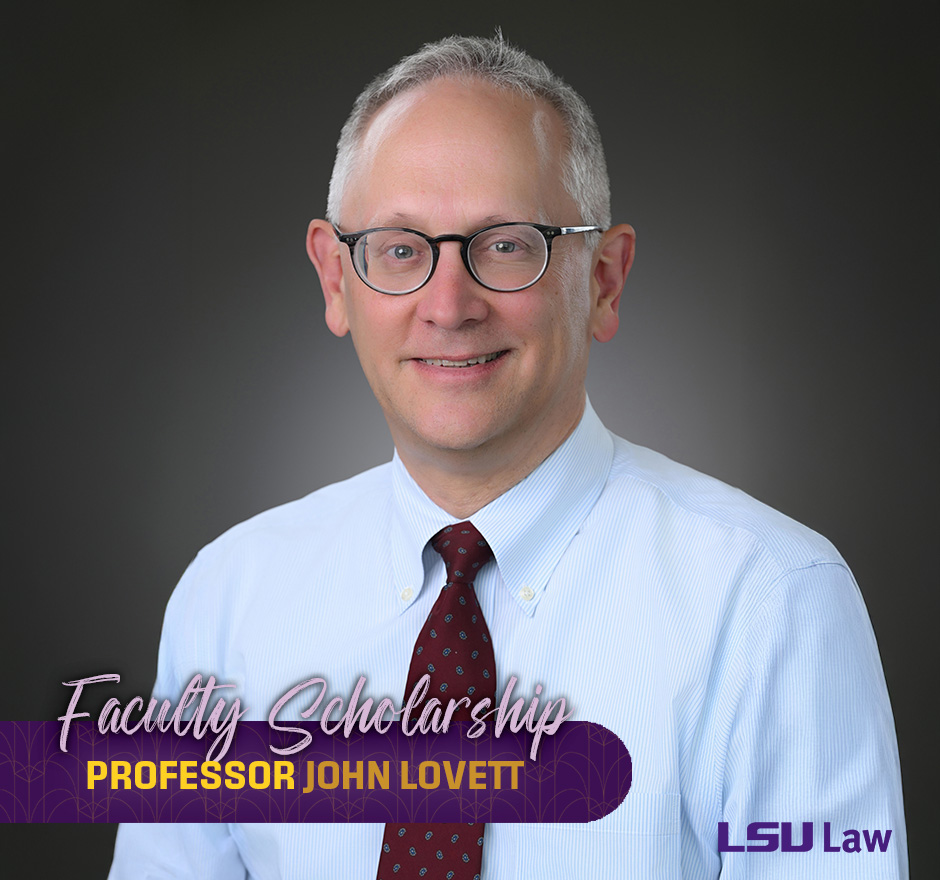
#FacultyScholarship @LSULawProfs John Lovett’s article “‘Bloom on My Peaceful Grave’: Forthtay Limited Employee Trust V Scottish Ministers," co-authored with Dr. Jill Robbie, was listed on SSRN's Top Downloads five times for the ejournal Property, Land Use & Real Estate Law.
English
The Erin Brockovich story of our time. A must read. 👇👇
Elizabeth Chamblee Burch@elizabethcburch
Meet the brave women at the heart of a real-life legal thriller, THE PAIN BROKERS. Each received eerily similar phone calls. The callers knew their names, birthdays, medical histories, even their doctors. They were told they had a "ticking time bomb" inside them.
English