
Brandon Roth | Capital Markets @ IPA

1.4K posts

Brandon Roth | Capital Markets @ IPA banner
Brandon Roth | Capital Markets @ IPA

Brandon Roth | Capital Markets @ IPA

@RothCRE

Capital Markets @ IPA

Sign up for newsletter Inscrit le Ağustos 2023
149 Abonnements9.8K Abonnés
Tweet épinglé
Brandon Roth | Capital Markets @ IPA
Quick intro for those who don't know me yet. I've been working in commercial real estate since 2006. I started with appraisal, moved to CRE lending with Wells Fargo, and then into debt and equity brokerage in 2012 with HFF who eventually was acquired by JLL in 2019. I joined IPA today to focus on debt and equity placement across the country and will be based out of their office in Palo Alto, CA. In February, I started a podcast called "Recap with Brandon Roth" where I interview CRE capital providers about their company, buckets of capital, how they're sizing and pricing deals, market outlook, etc. You can find it here: Spotify - open.spotify.com/show/4n6oBfG8t… Apple - podcasts.apple.com/us/podcast/rec… Lastly, I've been writing a capital markets email every ~3 weeks where I talk about the latest changes to interest rates and why, recent quotes, lender conversations, etc. If you're interested in checking it out, you can subscribe at RothRecap.com.
English
6
0
58
14.7K
Brandon Roth | Capital Markets @ IPA
This week JV equity investors shared 29 deals they closed in Q1. I'll share an overview in Monday's capital markets newsletter. If you're interested in joining, you can subscribe using the link on my profile.
Brandon Roth | Capital Markets @ IPA tweet media
English
0
0
1
488
Brandon Roth | Capital Markets @ IPA
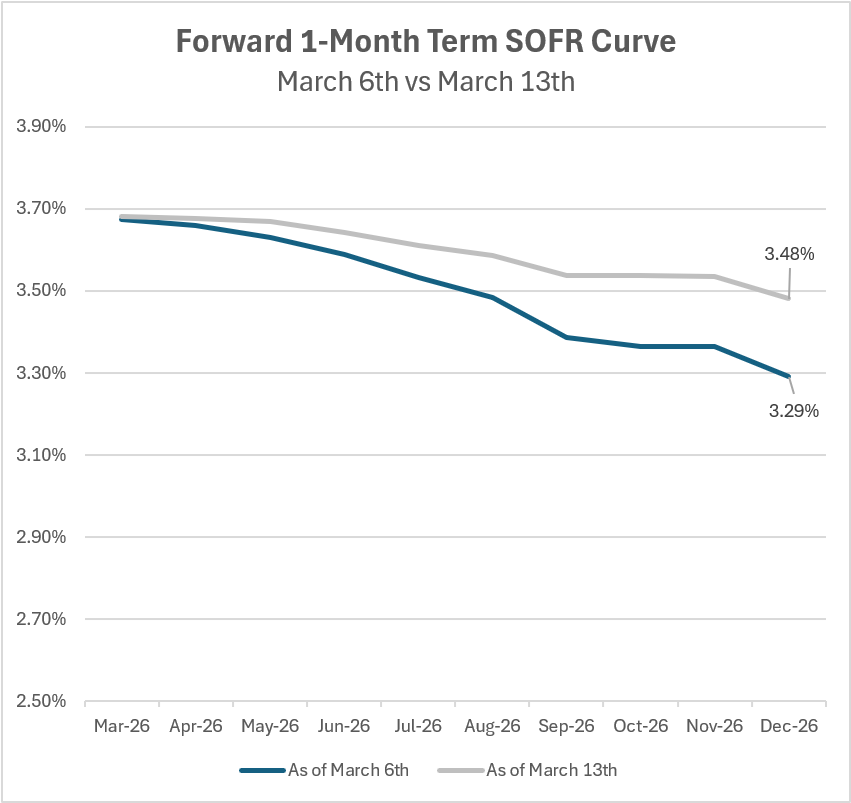
Don't shoot the messenger, but it's important to be aware that the forward SOFR curve has meaningfully shifted over the past week. The market is now projecting 1-month Term SOFR to end the year at 3.48%, which is 19 bps higher than last week. The likelihood the Fed holds rates unchanged through the end of July has increased from 18% a month ago to 62% today. This is largely being driven by rising oil prices and concerns about inflation. Just an anecdote, but gas is $6+ in my town.
Brandon Roth | Capital Markets @ IPA tweet media
English
0
0
1
412
Brandon Roth | Capital Markets @ IPA
Last week lenders shared 102 examples of quotes they issued in February. Here are the top 5: - $40M construction loan for a spec industrial development. 63% LTC priced at SOFR + 2.50%. (Insurance) - $90M bridge loan for a new industrial project in lease-up and 40% occupied. 65% LTV priced at SOFR + 2.60%. (Insurance) - $85M construction loan for multifamily development. 63% LTC priced at SOFR + 2.35% burning down to SOFR + 1.95% at stabilization. (Bank) - $100M construction loan for multifamily development. 74% LTC priced at SOFR + 3.50%. (Foreign pension fund) - $99M bridge loan for a near-stabilized MF property. Going-in at a 7% debt yield stabilizing to 8%. Priced at SOFR + 2.15%. (Debt fund) It's also worth noting that there were a few very cheap agency quotes with spreads ranging from 1.25% to 1.39% with no buydown.
English
0
0
6
1.6K
Brandon Roth | Capital Markets @ IPA
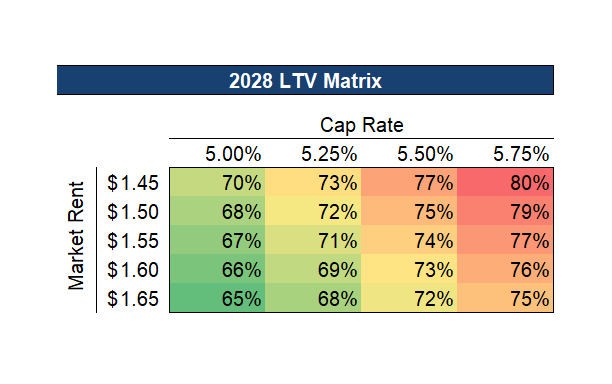
When working on bridge or construction deals where you're projecting a future stabilized LTV, I recommend creating a matrix showing the range of potential outcomes based on various rents and cap rates. The reality is the future is uncertain, and it's far easier for lenders to get comfortable if they can see they're still protected in a downside scenario. If it'd be helpful to see a video showing how to create this in Excel, please let me know and I'll pull it together.
Brandon Roth | Capital Markets @ IPA tweet media
English
0
0
4
699
Brandon Roth | Capital Markets @ IPA
When a business owes you funds but they can't find you for a long time, they transfer those funds to the state, which holds them as a custodian until the rightful owner claims them. This can include: - Utility refunds or deposits - Uncashed checks - Old bank accounts - Overpayments I just checked the database and had 4 claims dating back 10-20 years that totaled to $400+. I checked for each of my family members and they all had $200+. My sister had $970. The database is managed by the National Association of State Treasurers and you can check it out at missingmoney.com. It's a bit of a hokey name that sounds like a scam, but it's legit. After you claim the various accounts that are yours, you receive an email from your state government with an official form to submit to get the cash. Good luck! P.S. Even if you don't care about this for yourself, check for your friends and family - especially the ones not quite as tech-savvy as you.
Brandon Roth | Capital Markets @ IPA tweet media
English
0
0
1
585
Brandon Roth | Capital Markets @ IPA
Every Monday I send out a capital markets update based on my firsthand experience and conversations with capital providers. I think it's a decent way to stay informed on new lenders and equity investors in the market, changes to loan programs, recent quotes, etc. If you're interested in checking it out, you can subscribe using the link on my profile. The next one will go out today around 11am PT. Thank you!
Brandon Roth | Capital Markets @ IPA tweet media
English
0
0
0
901
Bill Van Eman
Bill Van Eman@billve92·
@RothCRE This year? I’m not sure it’s been below 4.00 since 2023. If it stays that low or goes down further, it may signal a real change in the rate curve. Mortgage rate are next.
English
1
0
0
29
Brandon Roth | Capital Markets @ IPA
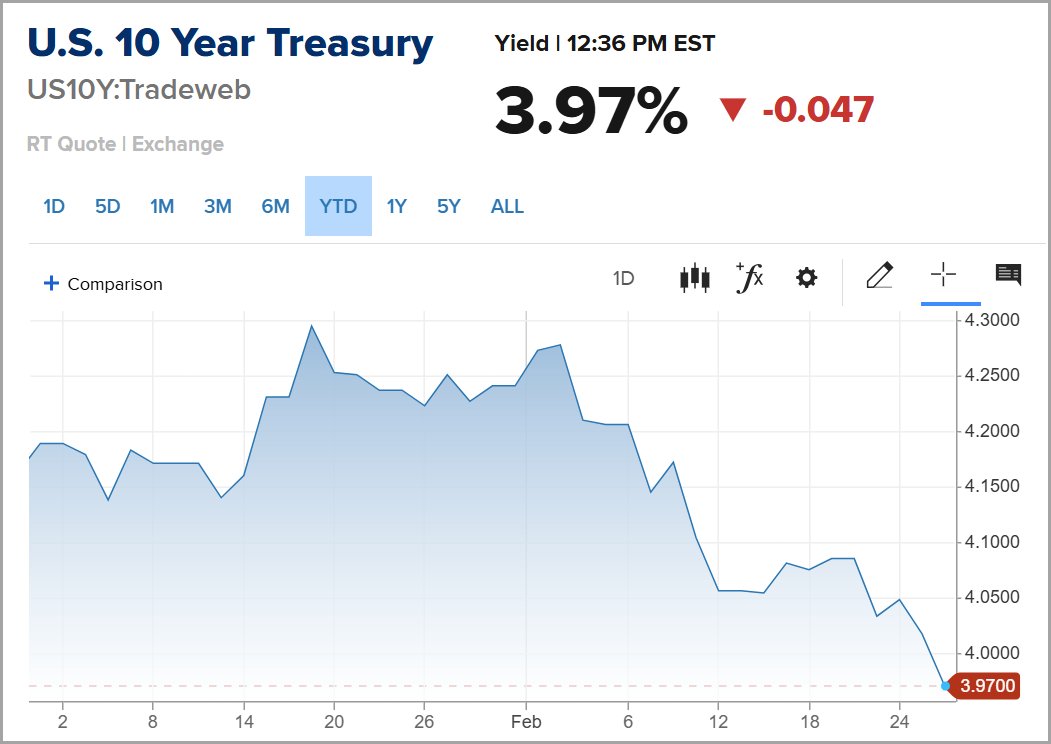
The 10-year Treasury yield just dipped below 4% for the first time this year. Investors are moving capital to Treasuries as a safe haven. Here are two major reasons: 1) Concerns about AI disrupting entire industries, job losses, etc. See Jack Dorsey's post from yesterday about laying off nearly half their workforce. 2) Concerns about a conflict between the US and Iran. On Polymarket, the odds of a US strike on Iran before March 31st has increased from 30% two weeks ago to 66% today.
Brandon Roth | Capital Markets @ IPA tweet media
English
1
1
11
2.2K
Brandon Roth | Capital Markets @ IPA
I talk to developers frequently about construction financing, so I pulled together this graphic to highlight how I think about the market today. There are always exceptions to the rule, but this covers 90% of it. The pricing below would apply to multifamily and industrial. Riskier asset types like condos, hotels, etc. would have a pricing premium. FYI, you can go beyond 80% LTC for a higher cost. 85%-ish typically includes some upside profit participation.
Brandon Roth | Capital Markets @ IPA tweet media
English
0
0
13
2.1K
Brandon Roth | Capital Markets @ IPA
Just got off a call with an insurance company that provides both debt and common equity (no pref or mezz). Here's what they shared: - For equity, they see more value in ground-up development than buying existing assets. They're primarily focused on MF, BTR, & industrial, and are looking to deploy $20M-50M checks with strong regional or national sponsors that have a pipeline where they can do repeat deals. - On the debt side, they're focused on $25M to $75M loans for industrial and MF, but open to grocery-anchored retail as well. Over 60% of their portfolio is industrial. - They can offer construction, bridge, and permanent financing. They closed ~$2.1B last year and will do more this year. - Construction is 60-65% LTC with pricing around S+3.0% on a non-recourse basis. They've done several spec industrial construction deals. - Bridge for them typically means light value-add or near-stabilization deals. As an example, they can price MF with a DY in the high 7s as low as SOFR+"high 100s". They can also offer a 3-year fixed rate product at 3-year UST + 1.60% to 1.80%, which would be 5.04% to 5.24% today. - Permanent financing is typically pricing as Treasuries + 1.40% to 1.60% with an average LTV around 55%.
English
1
0
21
4.1K
Brandon Roth | Capital Markets @ IPA
There's a common error that I see in some Excel models today that results in a property being undervalued. Since property values have fallen in many markets over the last few years, a new buyer's NOI will likely be higher than the existing owner's NOI because the new buyer's property taxes will be lower. If you were to estimate the value of your property based on a cap rate and the in-place NOI without adjusting the property taxes for the new buyer, then you're likely going to undervalue the property. There's a simple shortcut to estimate the new buyer's NOI based on a reset tax basis without creating a circular reference. Step 1: Add the Property Tax Expense back to the NOI Step 2: Add the Tax Rate to the Cap Rate Step 3: Divide the higher NOI by the higher cap rate This will equal the same result as using your original cap rate with the buyer's NOI inclusive of the reset property taxes. Note: Property tax calculations based for a new purchase will vary state to state. In California, the property taxes will be based on the new purchase price.
English
5
0
43
11.3K
Brandon Roth | Capital Markets @ IPA
It's easy to calculate your loan amount when it's based on a certain debt yield. However, it's less intuitive when the loan sizing is based on a specific rate, amortization, and DSCR. That's why I convert the traditional DSCR sizing to the "Debt Yield Equivalent". This video shows how to do it quickly. A few definitions: 1) Loan constant = annual debt service divided by loan amount. 2) Debt yield = NOI divided by the loan amount. 3) DSCR = Debt Service Coverage Ratio. This is your NOI divided by the annual debt service. --- Step 1: Calculate the Loan Constant by calculating your annual debt service using $1 as your loan amount. Here's the formula: =PMT(rate/12,amortization*12,-1)*12 Just link "rate" and "amortization" to the cells with this info. --- Step 2: Multiply the Loan Constant by the DSCR to get the Debt Yield Equivalent. --- Step 3: Calculate your loan amount by dividing the NOI by the Debt Yield. --- So if a lender tells you that they're sizing to a 1.25x DSCR using a 5.5% rate and 30-year amortization, then all you need to do is divide your NOI by 8.5% to get the same loan sizing. If mortgage rates fall to 5.00%, then the debt yield requirement improves to 8.0% and you'll qualify for higher proceeds.
English
1
3
37
7.3K
Brandon Roth | Capital Markets @ IPA
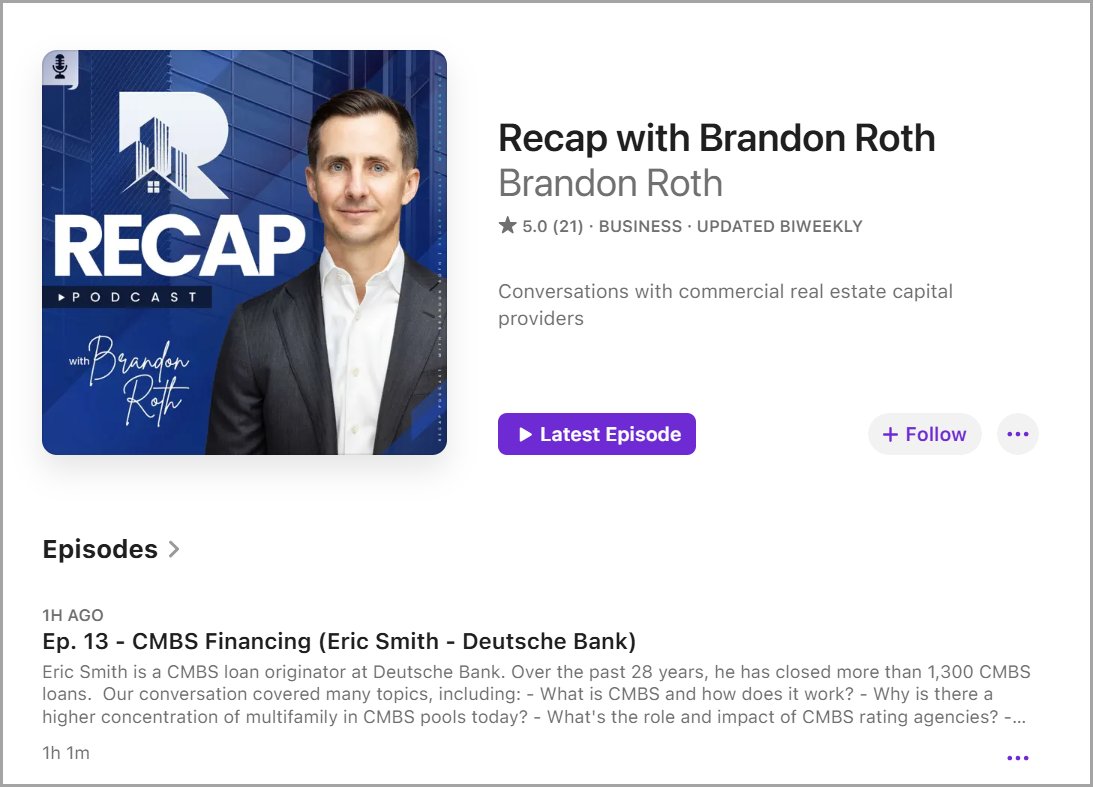
Eric Smith is a CMBS loan originator at Deutsche Bank. Over the past 28 years, he has closed more than 1,300 CMBS loans.  We recorded a podcast on Friday that covered many topics, including: - What is CMBS financing and how does it work? - Why is there a higher concentration of multifamily in CMBS pools today? - What's the role and impact of CMBS rating agencies? - Why is Fitch the primary rating agency? - What is a B-piece? - History of CMBS (1.0 vs. today) - Is CMBS becoming more borrower-friendly post-closing? - What are the most common asset types for CMBS? - What are the typical loan sizes, leverage, and pricing? - What are the primary benefits for a borrower? - Takeaways from MBA CREF in San Diego If you're interested in checking it out, search "Recap with Brandon Roth" on Apple or Spotify. Thank you!
Brandon Roth | Capital Markets @ IPA tweet media
English
0
0
4
838
Brandon Roth | Capital Markets @ IPA
I'm at the MBA CREF conference right now in San Diego. After meeting with lenders all day yesterday, a couple of themes stood out: 1) Most lenders had a strong 2025 and plan to increase their volume 25-50% in 2026. 2) This increased liquidity in the market is leading to much more borrower-friendly terms as groups compete to win deals. This means: - Higher leverage - Lower pricing - More flexible prepayment terms - Less structure In addition, the groups that can't compete on the lowest pricing are expanding to new secondary/tertiary markets where they can still earn a little more yield. The table below shows 40 of the most attractive quotes that were received last week as part of the January debt quote survey.
Brandon Roth | Capital Markets @ IPA tweet media
English
0
1
9
2K
Brandon Roth | Capital Markets @ IPA
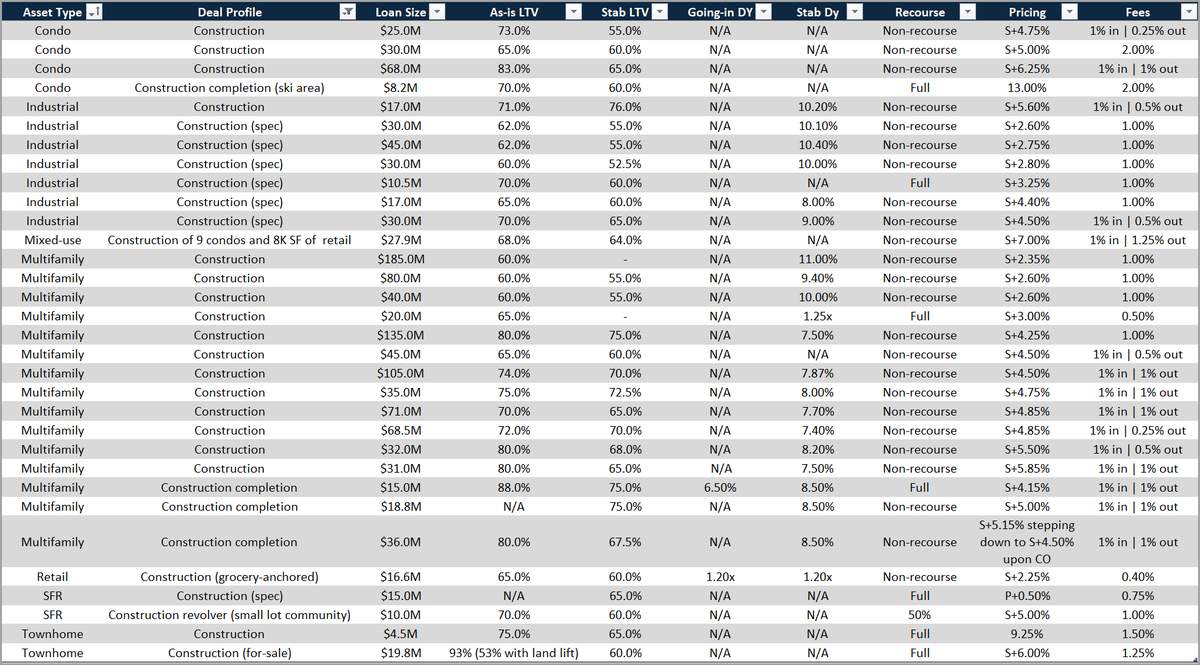
Last week, I asked lenders about deals they quoted in January. They shared 159 examples, which I aggregated into a filterable table. The screenshot below shows a subset of 32 construction loan quotes. The full dataset includes 10+ asset types and a wide variety of deal profiles. I'll share access to the full Excel table in Monday's newsletter.
Brandon Roth | Capital Markets @ IPA tweet media
English
0
0
4
982
Brandon Roth | Capital Markets @ IPA
If you'd like to learn about: - 2025 Bay Area multifamily recap & what's driving more sale transactions - Buyer profiles and target returns - How NOAH deals work (Property Tax Welfare Exemption) - Submarkets in highest demand - Property performance trends - Demand drivers in the Bay Area - Undewriting (rent growth, exit caps, etc.) - Acquisition financing - NMHC recap - Rent-to-income ratios - 2026 forecast Check out the podcast I recorded yesterday with Alex Tartaglia. He's part of Institutional Property Advisors (IPA)'s multifamily investment sales team in Northern California. They've sold approximately 50% of all institutional multifamily sales in the Bay Area over the past 10 years, including $2B in 2025. You can listen on: Apple - podcasts.apple.com/us/podcast/ep-… Spotify - open.spotify.com/episode/3DiAb2…
English
0
0
2
771
Brandon Roth | Capital Markets @ IPA
I had a great conversation yesterday with Stephen Siri from The Martin Group. The main topic I wanted to explore for you is how and why they created their GP fund, the benefits, lessons learned, etc. In addition, we also covered: - Their overall investment strategy - Oakland multifamily market - Berkeley student housing market - 3 case studies If you're unfamiliar, The Martin Group is a highly respected real estate investment firm in the Bay Area that specializes in multifamily, student housing, and mixed-use real estate projects. Apple: podcasts.apple.com/us/podcast/ep-… Spotify: open.spotify.com/episode/2Dmy0b… Please give it a listen and let me know what you think - thank you!
Brandon Roth | Capital Markets @ IPA tweet media
English
0
0
2
953
Brandon Roth | Capital Markets @ IPA
Lenders shared the terms for 76 deals they quoted in November. The asset types include: - BTR - Condo - Office - Gas Station Portfolio - Hospitality - Industrial - Land - MHC - Mixed-use - Multifamily - NPL - Office - Retail - Self-storage - Seniors Housing Here are a few outliers: 1) A bank quoted a $29.6M loan to refi a stabilized MF property at a 9.0% in-place debt yield. Pricing is the 5-year Swap + 1.30% with a 0.40% origination fee. 2) A debt fund quoted a $50M loan for a MF property that's stabilized with a heavy concession load. The property currently has a 6.4% in-place debt yield and is projected to stabilize at 8.1%. Pricing is SOFR + 2.35%. 3) The same lender as #2 also quoted another concession burn-off deal at much lower debt yields. This one is a $90M loan at a 5.9% debt yield stabilizing to 6.50%. Pricing is SOFR + 2.75%. 4) Each month, I normally receive 2-3 land loan quotes. However, this time I received 11. Not sure yet if that's just a coincidence, or early indicator that there will be more ground-up development in 2026. If you'd like to download the full table, I'm going to include it in today's newsletter. You can join using the link on my profile.
English
0
0
4
941
Brandon Roth | Capital Markets @ IPA
I spoke to an investment management firm this morning that has two lending products: - 3 to 5-year bridge loans (floating and fixed). - CPACE They have a traditional bridge product that competes with the lower-cost debt funds (S+2.25% to 2.75%), but there were a couple of other interesting structures they can offer. 1) If your in-place debt yield is at least 6.0% and will stabilize at 7.5%, they can offer 3 to 5-year fixed-rate financing with pricing at 2.25% to 2.75% over the corresponding Treasury. This could work well for deals that are in lease-up or have heavy concessions and aren't qualifying for agency financing. As an example, we talked about a multifamily concession burn-off deal in a secondary market with a 7% in-place debt yield that will stabilize to >7.5%, and they thought that would price around a 2.35% spread, which would be a 5.90% fixed-rate today at proceeds that are much higher than the agencies. 2) They can provide a full capital stack solution with CPACE and bridge/construction financing. They have the ability to structure the CPACE to be repayable within 5 years, so it functions as a financing tool rather than a burden to the next buyer or lender. I just added their full overview to next Monday's capital markets newsletter, which will include their source of capital, loan size ranges, leverage, asset types, recent deals, competitive advantages, etc.
English
1
0
3
813
Brandon Roth | Capital Markets @ IPA
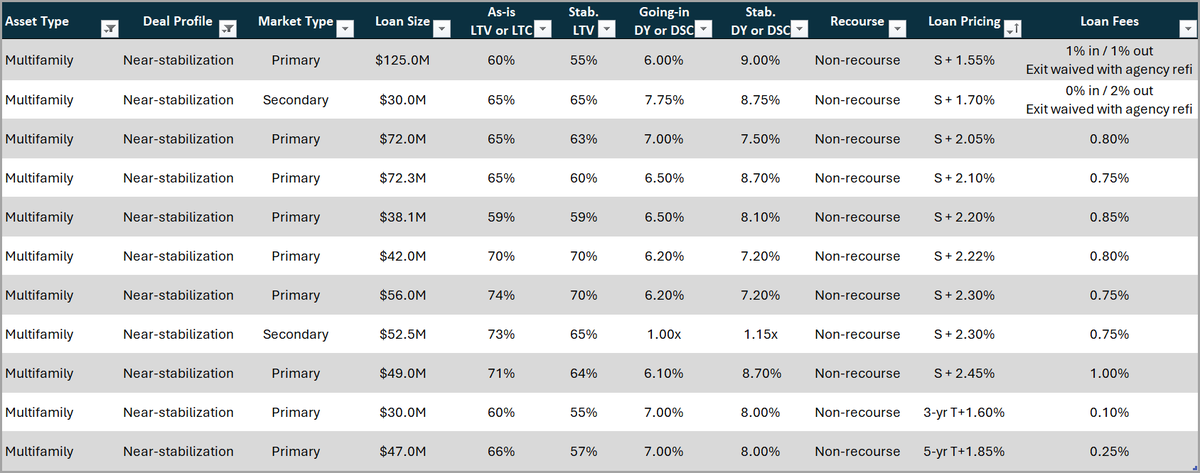
Over the past few days, lenders shared over 60 debt quotes as part of a monthly survey. The multifamily "near-stabilization" quotes stood out to me as being particularly interesting. This category includes deals that are either a) finishing lease-up or b) have reached stabilized occupancy but still need to burn off concessions. The lender types include a mix of banks, debt funds, and insurance companies. The lowest cost of capital for this deal type is coming from the bridge-to-agency groups that are pricing in the mid-to-high 100s over SOFR. Their loans include an exit fee that's waived if they handle the agency refi. It's effectively a feeder program for their agency business. It's worth noting that these groups are also chasing deals that have just started lease-up or are at TCO (doesn't need to be near-stabilization). If a sponsor intends to sell an asset in 12-24 months, then the bridge-to-agency lenders wouldn't be the best fit. Insurance companies and debt funds are providing better options with flexible prepayment and pricing in the low 200s over SOFR.
Brandon Roth | Capital Markets @ IPA tweet media
English
2
0
9
2K