
Steven Sanders

6.2K posts

Steven Sanders banner
Steven Sanders

Steven Sanders

@SLSanders88

The Productivity Manager | I teach you how to manage your unique productivity to master the most important project of all - your life.

Join my free newsletter 👉 Inscrit le Ekim 2021
198 Abonnements175 Abonnés
Tweet épinglé
Steven Sanders
Steven Sanders@SLSanders88·
🧵 11 sleep tips from an insomniac: Simple tips that will help you get the best night's sleep since you were a kid. 1. Go to bed on time every single night. • The body loves consistency. • The body rewards consistency. • I have one alarm for "get ready for bed" and another one for "get in the bed." • We'll explore these below. 👇 2. Aim for 8 hours of sleep. • You may need a little more. • You may need a little less. • Plan for 8, and then can adjust as needed. • Eventually, you'll get to the point where you'll just wake up without an alarm clock. 3. Wake up at the same time every single day. • Actually get out of the bed. • Turn on some lights, go use the restroom, do a lap or two around your living space to get the blood flowing, drink some water to rehydrate. • Even better, go outside for some fresh air and sunlight. • Moving the body and introducing stimulus is what will wake you up. It will get easier. 4. Exercise. • Similar to the mind, the body has a "use it or lose it" bias. • Do something every single day. • Stretch, lift, try to get 10,000 steps in. • Your body will adjust and remember that sleep is the best time to recover. This will train it to look forward to going to sleep on time. 5. Coffee. • Try avoid this during the first hour of being awake. • You want your body to be able to do its wake-up thing all by itself. • Learn what your tolerance is, and then try to stay a half-cup or more below that sweet spot. • No coffee after noon. Adjust this benchmark based on your sleep needs and tolerance levels. 6. Wind down. • This is my "get ready for bed" alarm. • Mine is set 45 minutes before the "get in the bed" alarm. Adjust as needed. • We want to slow things down and get the body prepped for sleep. • Things to do: dim the lights/ turn the overhead ones off, take a warm bath or shower, read, avoid bright/ blue light, meditate, do deep breathing, turn the thermostat down (see tip 8 below)... Do whatever will help calm down and relax the mind and body. 7. Go to bed. • This is the "go to bed" alarm. PRO TIP: make it soft but audible. You don't want to introduce a sudden stimulus here. • Actually go get in your bed. Be horizontal. Head on the pillow, covers up. • Things to do: close your eyes and relax, listen to rain or ocean sounds, breathe deeply and slowly, imagine your body relaxing from your head down to your toes. • If your thoughts are too much, ask yourself slowly, "I wonder what my next thought will be?" Imagine yourself asking this in a very sleepy voice. If you yawn, you're doing it right. 8. Sleep hygiene. • Make your bed specifically for sleep (and activities with a partner of your choice). No eating in bed. No tv in bed. No phone in the bed. No clocks (that you can see) in the bedroom. • Do whatever you need to to make your bed comfortable. It may be time for a new set of sheets or even a new mattress. • Use blackout curtains for the windows. Total darkness is ideal. • Keep the temperature at approximately 18C or 65F, and use heavy blankets. The body naturally cools when it sleeps, and this will help that process to happen. • Do not eat anything 3 hours before bed. • Do not drink anything 2 hours before bed. (A sip of water with nighttime medication is fine.) 9. What if it goes wrong? • Do not panic or watch the clock. Do not pick up your phone. • Slowly stretch your whole body from head to toe. You may have some stress to release. • Focus on slow and deep breathing. • If all else fails, go to the bathroom, and then go read in another room for a little while. When you begin to feel sleepy, go back to bed. 10. Maintenance. • Consistency is your friend, and your body will reward this. • Set your two alarms and be strict on keeping them. • Keep a journal at the beginning to make adjustments as needed. (Maybe you need less sleep than your thought, maybe 45 minutes between alarms isn't enough time to wind down.) • Know that it is hard to make a new habit in the beginning. It will get easier over time. 11. Sleep aids. • There is a time and place for sleep aids, but in general, we do not want to become reliant on them. • If you need 5mg of over the counter Melatonin in the beginning, take it with your "get ready for bed" alarm. Note that you may have to adjust the timing on this, just like you may have to adjust the space between those two bedtime alarms. • I go through phases where I need this on the nights before my 9-5. • Do not take them on other days. You want to train your body to get ready for bed by itself, and you do not want to become resistant to this when you may need it in the future. What do you think? Did I miss anything? Be sure to follow for more content like this. 👉 @SLSanders88🧵 And please let me know if you'd be interested in learning more about this in greater detail. 🙏
English
24
16
204
9K
Steven Sanders
Steven Sanders@SLSanders88·
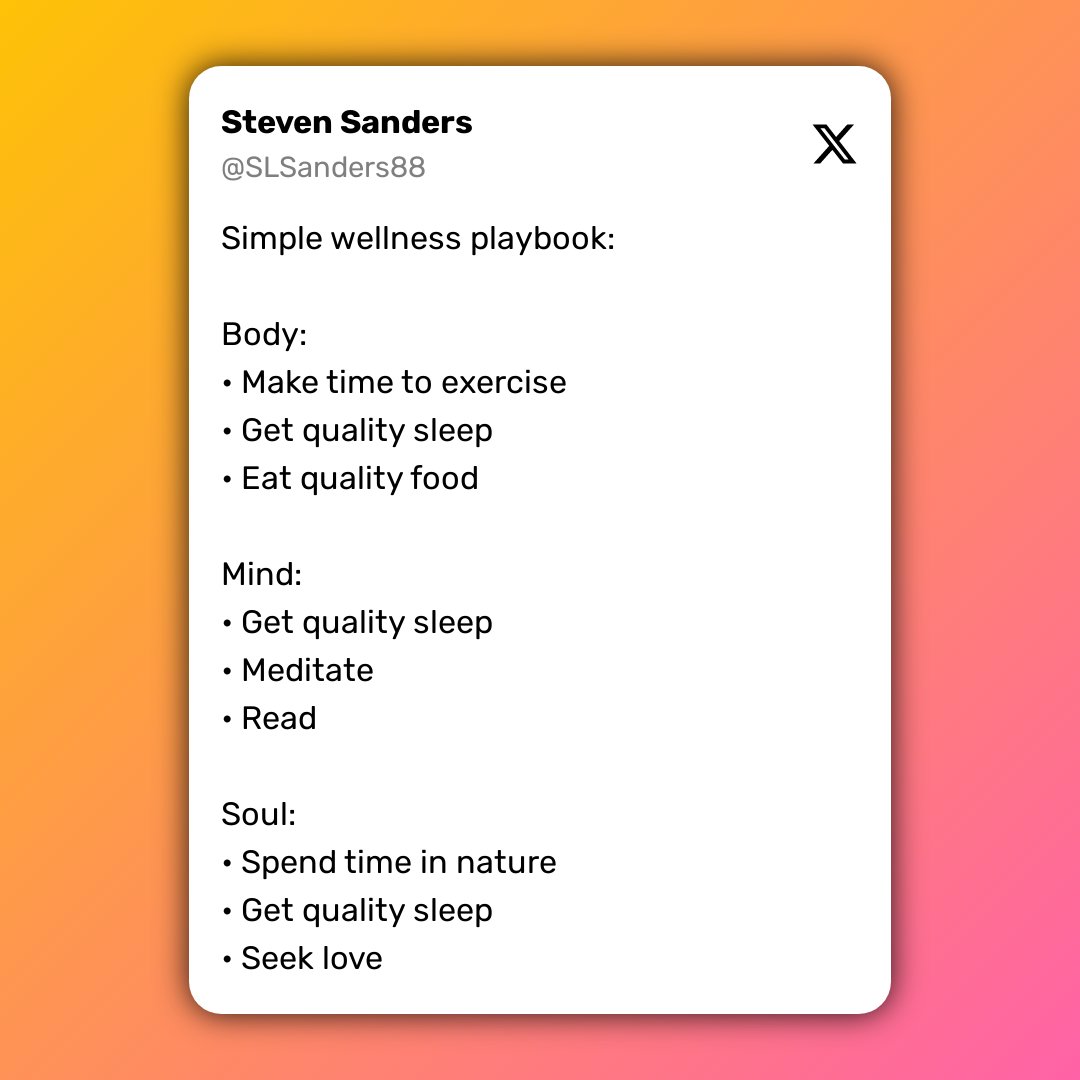
Simple wellness playbook: Body: • Make time to exercise • Get quality sleep • Eat quality food Mind: • Get quality sleep • Meditate • Read Soul: • Spend time in nature • Get quality sleep • Seek love
Steven Sanders tweet media
English
1
0
5
178
Steven Sanders
Steven Sanders@SLSanders88·
What about you? Do you have any experiences in which you had to learn fast?
English
0
0
0
28
Steven Sanders
Steven Sanders@SLSanders88·
I learned how to learn and how to focus on the next practical step. Eventually, that led to me becoming more open to new experiences and taking more calculated risks. Now, I seek out these circumstances because they shortcut the path to learning.
English
1
0
0
31
Steven Sanders
Steven Sanders@SLSanders88·
"Events that demand a leap of action before we're ready often have the happy effect of boosting us on to the next stage of development in spite of ourselves." - Gail Sheehy This is in line with the old “sink or swim” mantra.
Steven Sanders tweet media
English
1
0
1
78
Steven Sanders
Steven Sanders@SLSanders88·
The biggest cheat code in life is to find someone who has already done what you want to do and is following that path. The fun part is using their path as a guideway while you make the journey your own.
Steven Sanders tweet media
English
1
0
5
97
Steven Sanders
Steven Sanders@SLSanders88·
Procrastination is a gap in urgency and importance When I was in school, I usually saved my papers until the day before. They were certainly important, but they weren’t urgent until the timer was unavoidable. On the other hand, something urgent but not important may be responding to an email that doesn’t directly involve you. If we agree this is all true, then let’s combine these conditions so that you can stop procrastinating. 1. Make it urgent - give yourself a deadline. 2. Make it important - remind yourself why this matters. I think urgency is easier to accomplish. Here are some ways to keep yourself accountable with a deadline: 1. Promise yourself a reward for meeting the deadline. (Maybe a piece of candy?) 2. Make a deal with a friend - if you don’t follow through, you have to give them $20. (Sometimes a threat of loss is a great motivator.) Here are some ways to find importance: 1. Briefly ask yourself “why?” up to 7 times. This will drill down to a root cause. 2. Ask yourself, “Who else will benefit from this when I finish?” 3. Ask yourself, “Who will suffer if I don’t complete this?” Pair these up, and you’re off to a great foundation for getting great work done in a much better timeframe.
English
0
0
2
55
Steven Sanders
Steven Sanders@SLSanders88·
💪 Featured Productivity Tool The Do Not Do List. I’m sure you remember me talking unendingly about the to-do list. I make them every day, and I love accomplishing my tasks… But this idea hit me recently: What do I do about distractions or unimportant things that I should not focus on now? If I don’t write them down, they’ll keep buzzing around my head and distracting me anyways. But if I write them down, I feel like I need to do them. The solution? Write them down on a very specific list for another time. You’ll still have your daily to-do list of your top, most important tasks, but we need a holder for the little ones that have to wait. Examples may be: • catch up on emails and DMs • fold and put away the laundry • buy groceries for the week and prep tomorrow’s lunch These things aren’t going to move you forward in a major way, but they do need to be done. Assuming you’re going to do these things yourself, schedule time outside of your critical morning hours to get these little things accomplished. By sequestering them away from the big tasks and scheduling a time for them, your mind can focus on the important things. You’ll feel better by getting things done by order of importance.
English
1
0
4
86
Steven Sanders
Steven Sanders@SLSanders88·
Procrastination can seduce you into doing nothing, and in doing nothing, you accomplish nothing. If you're into productivity like me, let this be my invitation to you to join my weekly newsletter. Seven cool things just for you, delivered every Saturday morning at 07:07AM ET.
English
1
0
0
13
Steven Sanders
Steven Sanders@SLSanders88·
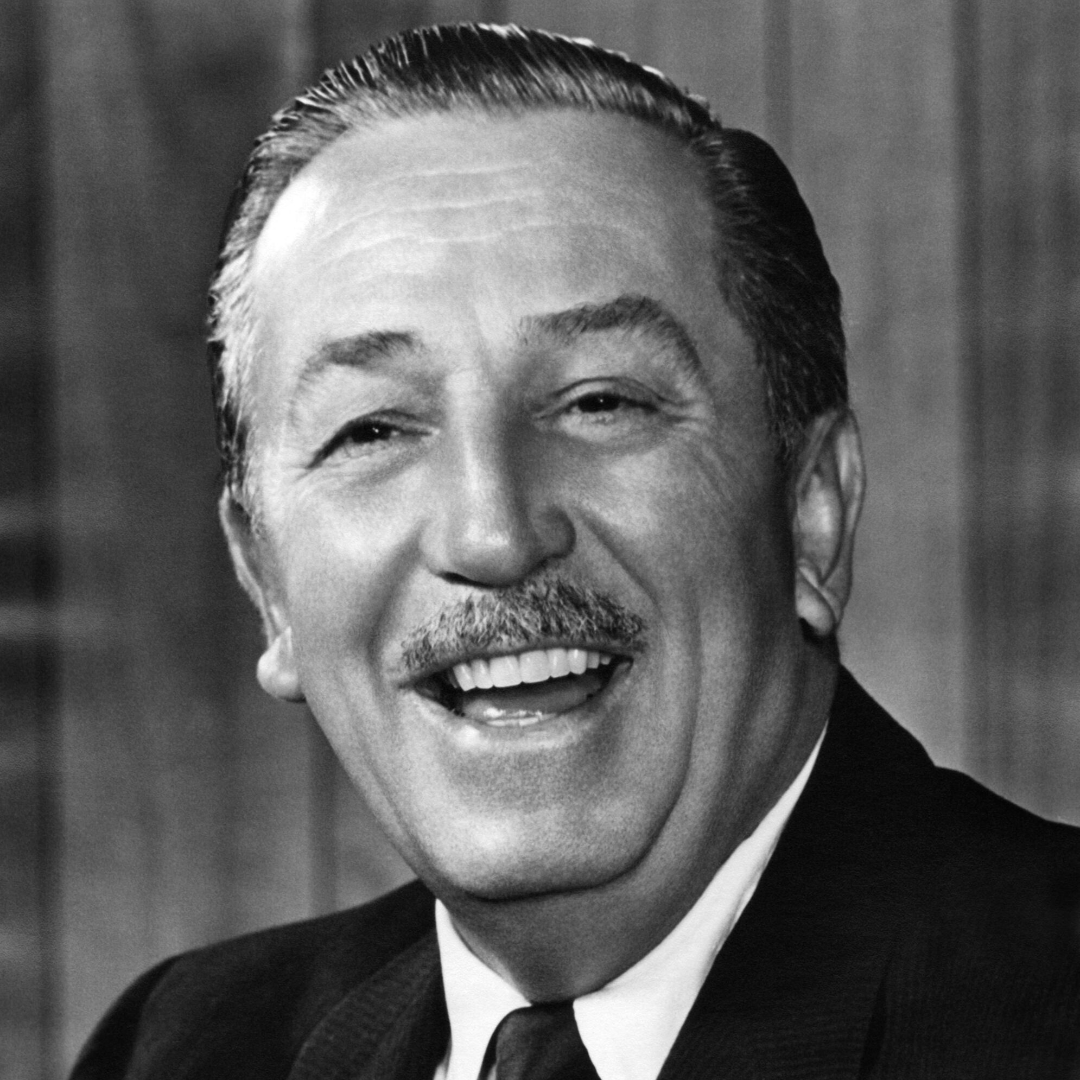
"The way to get started is to quit talking and begin doing." - Walt Disney I’ve got to hand it to Walt: he’s not mincing his words! There is real pleasure in planning to do something.
Steven Sanders tweet media
English
1
0
1
32
Steven Sanders
Steven Sanders@SLSanders88·
Why not shift gears and become specialists in finding the info we need? But what do you think? What things should we endeavor to always keep in mind?
English
0
0
0
12
Steven Sanders
Steven Sanders@SLSanders88·
Why take up “space” in our brain with trivial information when we can sharpen the skill of quickly referencing something? We’re transitioning into an age of data curation. There’s so much information out there, that it would be impossible to hold it all in our minds.
English
1
0
0
15
Steven Sanders
Steven Sanders@SLSanders88·
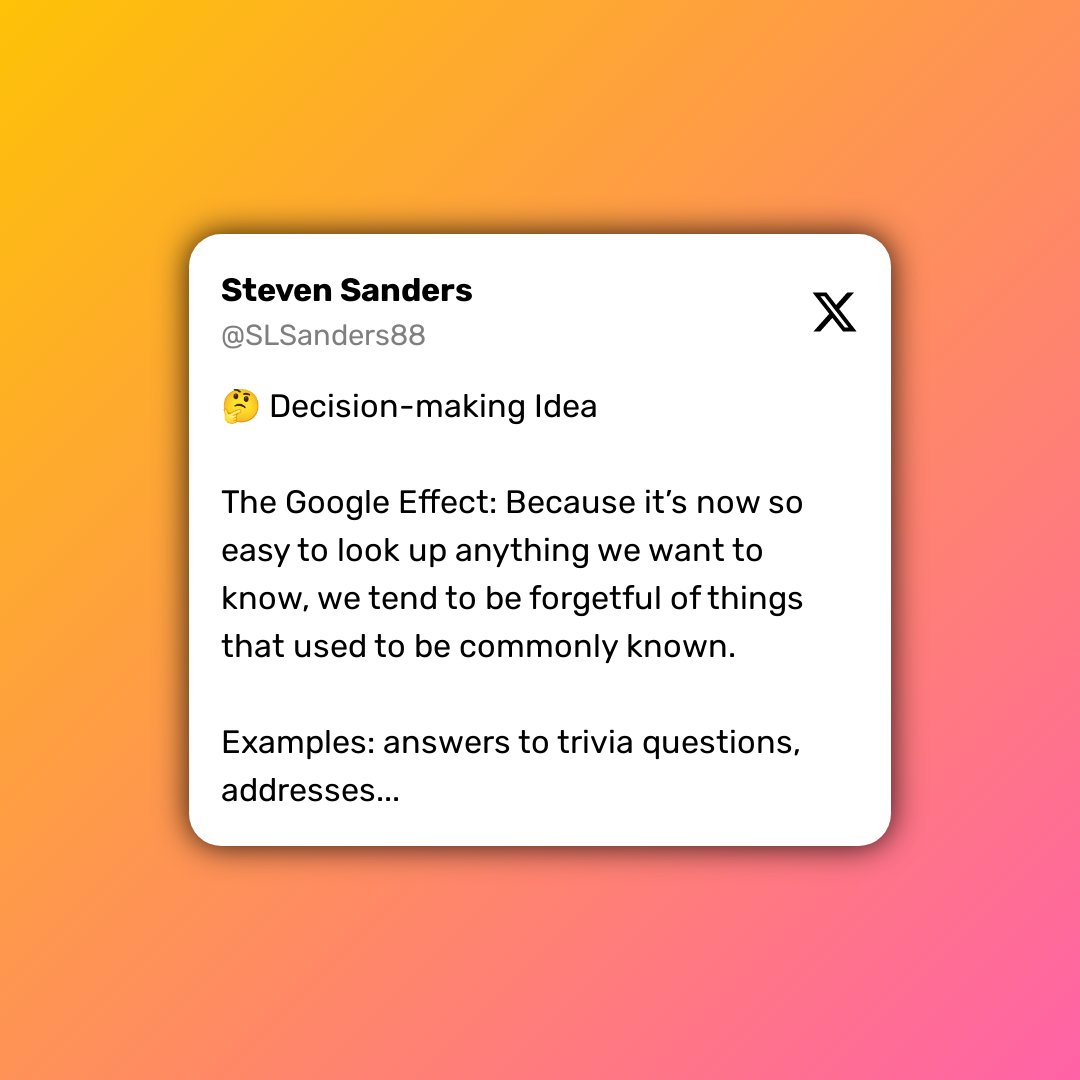
🤔 Decision-making Idea The Google Effect: Because it’s now so easy to look up anything we want to know, we tend to be forgetful of things that used to be commonly known.
Steven Sanders tweet media
English
2
0
2
39
Steven Sanders
Steven Sanders@SLSanders88·
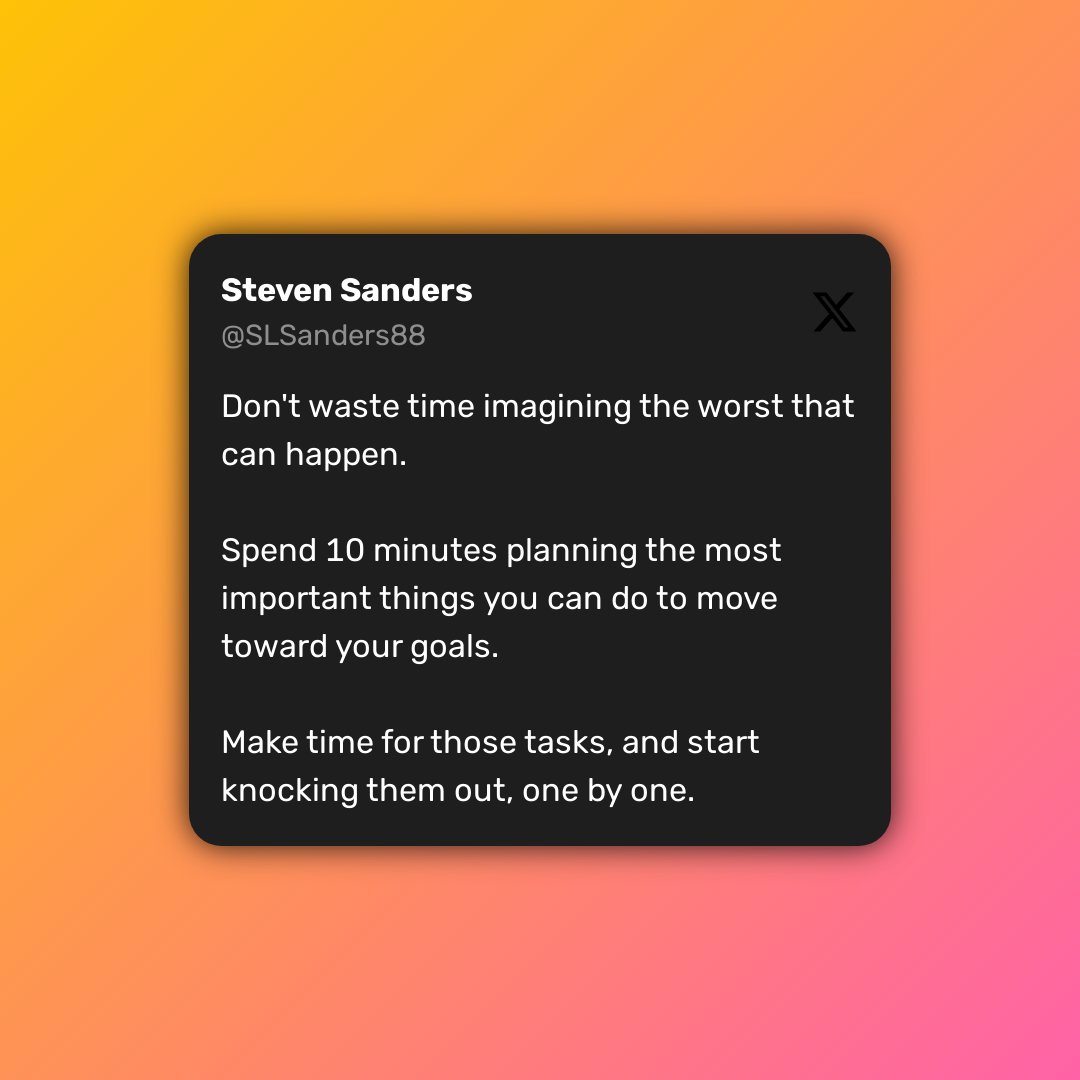
Don't waste time imagining the worst that can happen. Spend 10 minutes planning the most important things you can do to move toward your goals. Make time for those tasks, and start knocking them out, one by one.
Steven Sanders tweet media
English
0
0
2
46
Steven Sanders
Steven Sanders@SLSanders88·
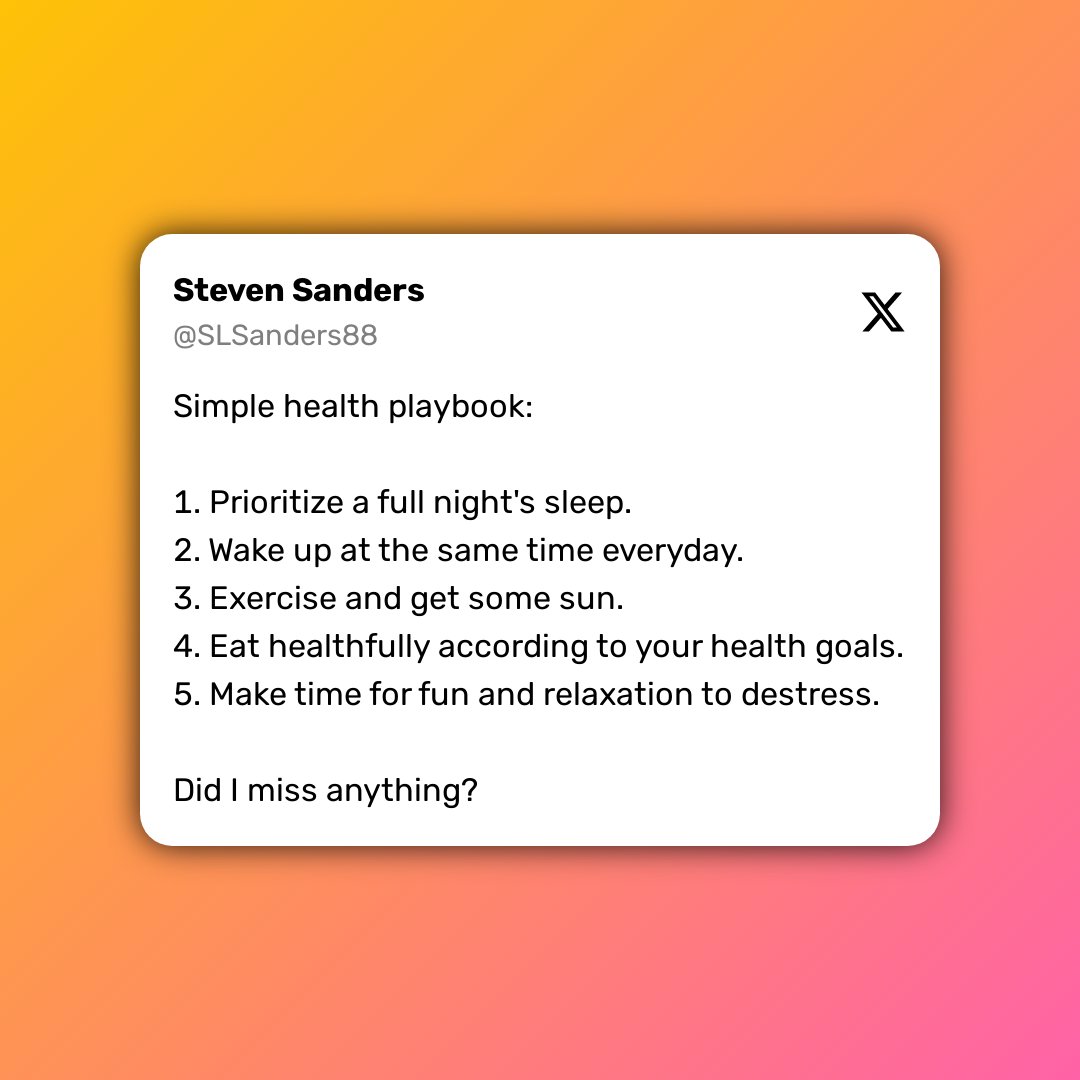
Simple health playbook: 1. Prioritize a full night's sleep. 2. Wake up at the same time everyday. 3. Exercise and get some sun. 4. Eat healthfully according to your health goals. 5. Make time for fun and relaxation to destress. Did I miss anything?
Steven Sanders tweet media
English
0
0
2
40
Steven Sanders
Steven Sanders@SLSanders88·
If you need to make a change, do it smartly, and commit to it. Each bit of effort will take us somewhere, we just need to be sure of where we’re going and to check on the progress as we go.
English
0
0
0
11
Steven Sanders
Steven Sanders@SLSanders88·
"You cannot change your destination overnight, but you can change your direction overnight." - Jim Rohn Step by step and bit by bit, a little becomes a lot. For me, this is a reminder to keep making steady progress, day by day...
Steven Sanders tweet media
English
1
0
1
34