Michael Shellenberger

32.3K posts

Michael Shellenberger banner
Michael Shellenberger

Michael Shellenberger

@shellenberger

CBR Chair of Politics, Censorship & Free Speech @UAustinOrg : Dao Journalism Winner : Time, "Hero of Environment" : Author, “Apocalypse Never,” "San Fransicko"

Berkeley, CA Inscrit le Mayıs 2014
1.8K Abonnements1.4M Abonnés
Tweet épinglé
Michael Shellenberger
Michael Shellenberger@shellenberger·
The Hormuz crisis is the precipitating factor in the current energy crisis, but the underlying cause is too little oil and gas production outside the Persian Gulf. Had the world spent the past decade building the oil, gas, LNG, pipeline, and fertilizer infrastructure that engineers designed and companies proposed, the Hormuz crisis would still be a serious geopolitical event, but it would not threaten to cause a recession. North America — The Atlantic Coast Pipeline, a 600-mile natural gas line from West Virginia to North Carolina, saw its cost double from $4.5 billion to $8 billion during years of environmental litigation before Duke Energy and Dominion Energy cancelled it in July 2020. — The Constitution Pipeline from Pennsylvania to New York died the same year. — The PennEast Pipeline won its case at the United States Supreme Court in 2021 and still could not get built because New Jersey refused to issue state permits. — In Canada, TransCanada abandoned the $15.7 billion Energy East pipeline in 2017 after the National Energy Board required an unprecedented review of upstream and downstream emissions. — In January 2024, the Biden administration paused all pending approvals for LNG export terminals shipping to non-free-trade-agreement countries, freezing projects representing tens of billions of cubic feet per day of potential capacity. — Venture Global’s CP2 terminal in Louisiana, designed for 20 million tonnes per annum, sat in regulatory limbo for over a year. — NextDecade’s Rio Grande LNG in Texas, with 48 MTPA of planned capacity, stalled alongside it. — PTT Global Chemical’s proposed $10 billion ethane cracker in Belmont County, Ohio, first announced in 2015, remains on indefinite hold after failing to attract financing partners amid climate-driven investor sentiment. — Across the US Gulf Coast, nearly 60% of planned plastic and petrochemical production projects sit on hold. — LNG Canada, the Shell-led terminal at Kitimat, British Columbia, took over six years from construction start to first cargo, with its pipeline running 263% over budget. Environmental review, Indigenous disputes, and contractor cost escalation all contributed. — Pieridae Energy’s Goldboro LNG project in Nova Scotia, a 10 MTPA facility first proposed in 2012, was abandoned in November 2023 after more than a decade of permitting and financing obstacles. Australia — Australia’s Santos’s Barossa gas project was halted midway through construction after a Federal Court ruling overturned its environmental approval. — Woodside’s Scarborough project faces ongoing litigation from the Australian Conservation Foundation seeking to block it on climate grounds. Africa — Perhaps nowhere has the damage been more consequential than in Africa. At COP26 in 2021, wealthy nations pledged to halt overseas development finance for gas projects, a commitment that fell hardest on the continent least responsible for climate change and most in need of energy infrastructure. — The World Bank stopped financing oil and gas extraction in 2019 and imposed restrictive conditions on downstream gas projects. — The European Investment Bank announced a complete ban on unabated fossil fuel financing by the end of 2021, with its president declaring that “gas is over.” — At least 21 other development finance institutions followed suit. As a result: — TotalEnergies’ Mozambique LNG project sat under force majeure for four and a half years after the UK Export Credit Agency and other backers withdrew climate-motivated financing. — The East African Crude Oil Pipeline lost financing commitments from more than 30 major international banks under pressure from climatists. Europe — France prevented the completion of a third gas interconnector with Spain, citing climate neutrality goals. — The United Kingdom imposed a moratorium on fracking in 2019 despite sitting atop one of Europe’s most promising shale gas formations. — Germany, which shuttered its last three nuclear plants in April 2023, compounded its gas dependency by refusing to develop domestic shale resources. — CF Industries permanently shut the UK’s largest ammonia plant at Billingham, a facility that also produced 60% of Britain’s food-grade CO2. — Yara International curtailed output across plants in France, Italy, and Belgium before permanently closing its 400,000 tonne per year ammonia facility at Tertre, Belgium, in October 2024. These closures occurred because European climate policy made gas too expensive for the domestic industry to survive.
Michael Shellenberger@shellenberger

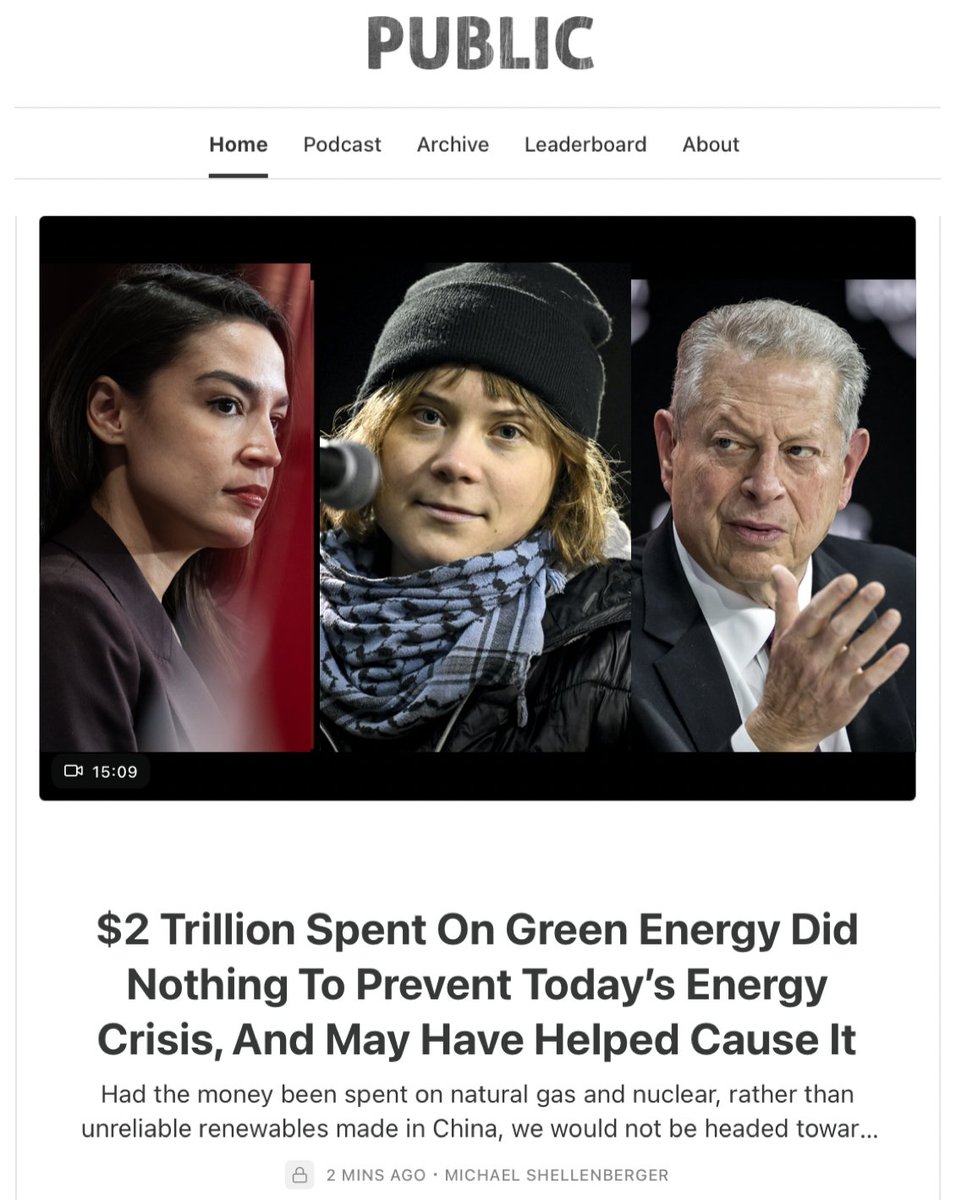
We should have spent more on green energy, say the media. No, we shouldn't have. The $2 trillion we spent did nothing to prevent the energy crisis and may even have caused it.

English
300
2.6K
7.7K
455.7K
Michael Shellenberger
Michael Shellenberger@shellenberger·
Australian PM to address nation on fuel crisis
Michael Shellenberger tweet media
English
8
2
25
13.3K
Michael Shellenberger
Michael Shellenberger@shellenberger·
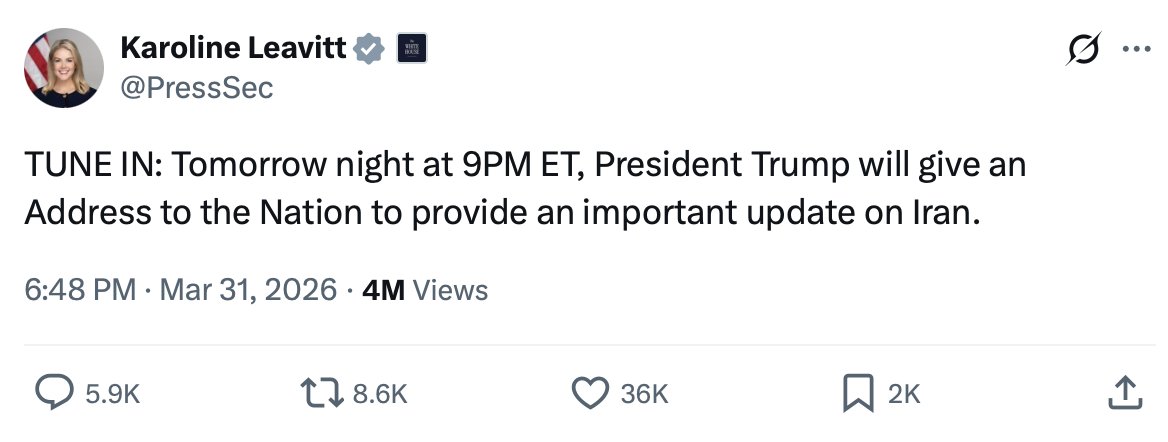
Remarkable acceleration of events 7:48 pm ET: White House announces Trump speech on Iran for prime time tomorrow 9 pm: WSJ reports UAE will use force to open Hormuz 9:57 pm: Iranian drones hit fuel tanks at Kuwaiti airport, says government. (X posts in Central Time)
Michael Shellenberger tweet mediaMichael Shellenberger tweet mediaMichael Shellenberger tweet media
Michael Shellenberger@shellenberger

The Hormuz crisis is the precipitating factor in the current energy crisis, but the underlying cause is too little oil and gas production outside the Persian Gulf. Had the world spent the past decade building the oil, gas, LNG, pipeline, and fertilizer infrastructure that engineers designed and companies proposed, the Hormuz crisis would still be a serious geopolitical event, but it would not threaten to cause a recession. North America — The Atlantic Coast Pipeline, a 600-mile natural gas line from West Virginia to North Carolina, saw its cost double from $4.5 billion to $8 billion during years of environmental litigation before Duke Energy and Dominion Energy cancelled it in July 2020. — The Constitution Pipeline from Pennsylvania to New York died the same year. — The PennEast Pipeline won its case at the United States Supreme Court in 2021 and still could not get built because New Jersey refused to issue state permits. — In Canada, TransCanada abandoned the $15.7 billion Energy East pipeline in 2017 after the National Energy Board required an unprecedented review of upstream and downstream emissions. — In January 2024, the Biden administration paused all pending approvals for LNG export terminals shipping to non-free-trade-agreement countries, freezing projects representing tens of billions of cubic feet per day of potential capacity. — Venture Global’s CP2 terminal in Louisiana, designed for 20 million tonnes per annum, sat in regulatory limbo for over a year. — NextDecade’s Rio Grande LNG in Texas, with 48 MTPA of planned capacity, stalled alongside it. — PTT Global Chemical’s proposed $10 billion ethane cracker in Belmont County, Ohio, first announced in 2015, remains on indefinite hold after failing to attract financing partners amid climate-driven investor sentiment. — Across the US Gulf Coast, nearly 60% of planned plastic and petrochemical production projects sit on hold. — LNG Canada, the Shell-led terminal at Kitimat, British Columbia, took over six years from construction start to first cargo, with its pipeline running 263% over budget. Environmental review, Indigenous disputes, and contractor cost escalation all contributed. — Pieridae Energy’s Goldboro LNG project in Nova Scotia, a 10 MTPA facility first proposed in 2012, was abandoned in November 2023 after more than a decade of permitting and financing obstacles. Australia — Australia’s Santos’s Barossa gas project was halted midway through construction after a Federal Court ruling overturned its environmental approval. — Woodside’s Scarborough project faces ongoing litigation from the Australian Conservation Foundation seeking to block it on climate grounds. Africa — Perhaps nowhere has the damage been more consequential than in Africa. At COP26 in 2021, wealthy nations pledged to halt overseas development finance for gas projects, a commitment that fell hardest on the continent least responsible for climate change and most in need of energy infrastructure. — The World Bank stopped financing oil and gas extraction in 2019 and imposed restrictive conditions on downstream gas projects. — The European Investment Bank announced a complete ban on unabated fossil fuel financing by the end of 2021, with its president declaring that “gas is over.” — At least 21 other development finance institutions followed suit. As a result: — TotalEnergies’ Mozambique LNG project sat under force majeure for four and a half years after the UK Export Credit Agency and other backers withdrew climate-motivated financing. — The East African Crude Oil Pipeline lost financing commitments from more than 30 major international banks under pressure from climatists. Europe — France prevented the completion of a third gas interconnector with Spain, citing climate neutrality goals. — The United Kingdom imposed a moratorium on fracking in 2019 despite sitting atop one of Europe’s most promising shale gas formations. — Germany, which shuttered its last three nuclear plants in April 2023, compounded its gas dependency by refusing to develop domestic shale resources. — CF Industries permanently shut the UK’s largest ammonia plant at Billingham, a facility that also produced 60% of Britain’s food-grade CO2. — Yara International curtailed output across plants in France, Italy, and Belgium before permanently closing its 400,000 tonne per year ammonia facility at Tertre, Belgium, in October 2024. These closures occurred because European climate policy made gas too expensive for the domestic industry to survive.

English
21
95
546
103.5K
Michael Shellenberger
Michael Shellenberger@shellenberger·
In a small village in the Punjab, a girl of about eight years old crouches over a clay stove, feeding it patties of dried cow dung. Smoke billows into her face. She coughs while feeding the fire. There is no reliable electricity. When the family gets a little extra money, they buy liquified petroleum gas (LPG), which burns cleanly, as natural gas does in stoves in the wealthy West. Unfortunately, that LPG just got priced out of reach for hundreds of millions like her. The 2026 Iran war and the closure of the Strait of Hormuz were the triggers for the current energy crisis, but the underlying cause is the chronic underinvestment and underdevelopment of oil and gas resources by poor, developing, and rich nations alike over the last ten years. Policymakers diverted that money into green energy, which failed to prevent the crisis. Zion Lights, the author of an essential new book, Energy Is Life, watched the above scene during a visit to her parents’ ancestral village in India. Her parents had emigrated to Birmingham, England, in the late 1960s and 1970s to work in factories. The factories gave them wages, dignity, and a foothold in the developed world. The family they left behind in the Punjab remained trapped in a poverty so total that it touched everything: health, education, opportunity, lifespan. At the root of it all is the lack of energy. The energy crisis will hurt poor people in poor nations far more than anyone in the U.S. or the rest of the West. Asian countries receive 80 percent of their energy supply through the Strait of Hormuz. For Bangladesh, which sources 72 percent of its LNG from Qatar and the UAE, the supply disruption translates to an extra $760 to $830 million in monthly import costs. “All poverty is energy poverty, when you think about it,” Lights said in our new podcast. “They’re living in 40-degree Celsius heat. No air conditioning. You can give them an air conditioner, you can give them money for an air conditioner, but how’s it going to work if you don’t have the electricity?” It would be unfair to entirely blame the lack of oil and gas supplies on Western climate policy. Beyond the Iran war, governance failures, corruption, conflict, and infrastructure decay all play important roles. India’s power sector dysfunction predates any climate agreement. Pakistan’s circular debt crisis has roots in decades of mismanagement and subsidy distortions. Sub-Saharan Africa’s electricity deficit reflects bad governance, underinvestment, and the difficulty of building transmission infrastructure across vast, sparsely populated territories. But climate policy has been the dominant priority in wealthy nations’ engagement with the developing world for two decades, and Western green NGOs have even blocked the construction of hydroelectric dams, which tend to be the first reliable source of power that poor nations develop as they rise the development ladder. Beginning in the early 2010s and accelerating sharply after the 2015 Paris Agreement, Western development banks, private financial institutions, and national governments began systematically restricting financing for oil, gas, and coal projects in the developing world. The stated rationale was climate change. The practical effect was to deny poor countries the energy infrastructure that every wealthy nation used to climb out of poverty... x.com/shellenberger/… Please subscribe now to support Public's award-winning investigative journalism, watch the full podcast, and read the rest of the article. x.com/shellenberger/…
English
13
88
493
36.2K
Michael Shellenberger
Michael Shellenberger@shellenberger·
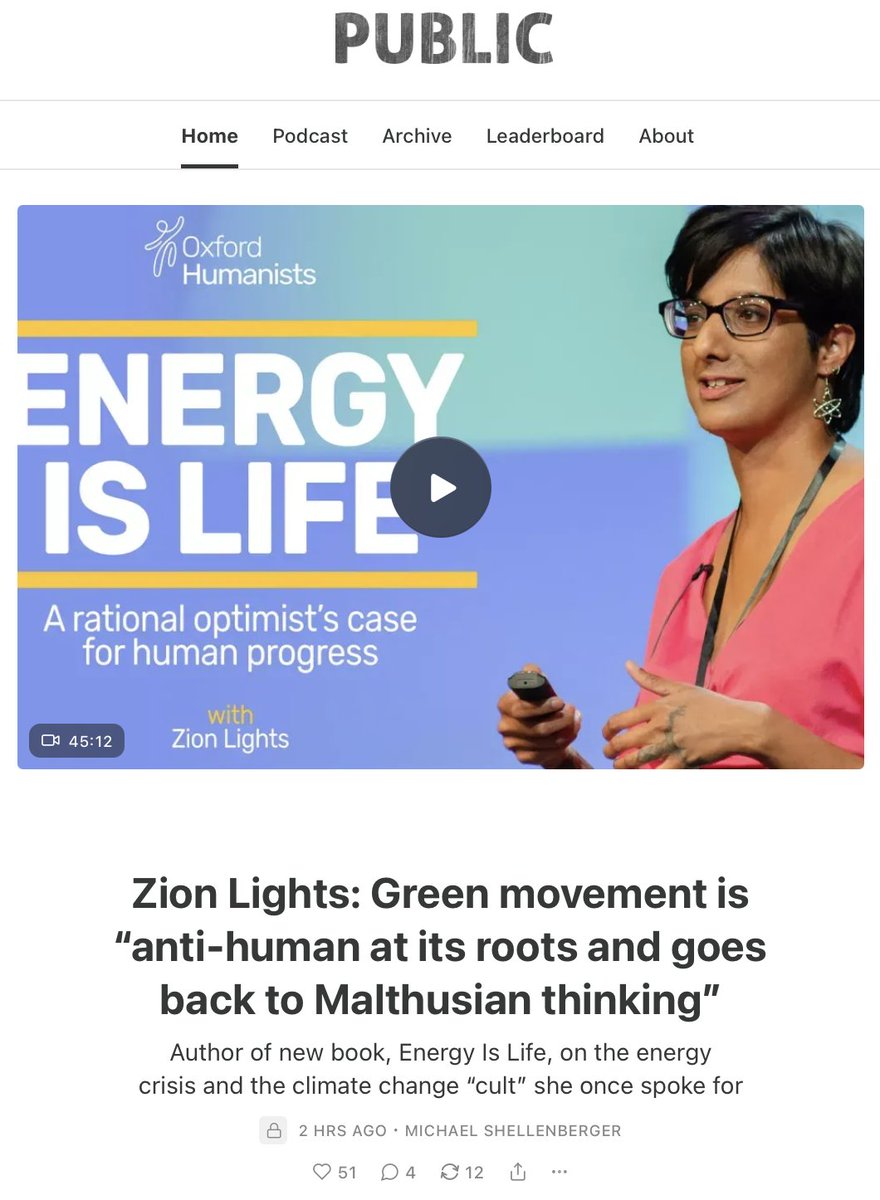
The Iran conflict triggered the energy crisis, but its roots lie in the West's opposition to the production of oil and gas outside the Persian Gulf. The climate movement is, says former radical environmentalist @ziontree, "fundamentally anti-human in its thinking."
Michael Shellenberger tweet media
English
14
200
890
43.9K
Michael Shellenberger
Michael Shellenberger@shellenberger·
Maurice Cousins@MDC12345678

To be absolutely clear, the looming fertiliser and food price crisis has not happened to us. We have done this to ourselves. In 2014, I worked with the UK’s shale gas sector and the fertiliser industry. Our warning was very simple: without domestic gas, you lose ammonia; lose ammonia, you lose fertiliser; lose fertiliser, you hit food supply. Ammonia is also needed to make... explosives - which are quite handy when you need to re-arm. Westminster, green campaigners and national media journalists scoffed. It was dismissed by anti-fracking campaigners as “scraping the barrel”. Then reality intervened in 2021–22 with the war in Ukraine. In June 2022, fertiliser producers went into administration because they could not secure feedstocks at viable prices. By 2023, CF Fertilisers (which acquired Grow How) announced the permanent closure of its UK operations. And now, in 2026, we are told the problem is Donald Trump and disruption to the Strait of Hormuz. This is classic obscurantism. Shift the focus to the trigger. Avoid the structural cause: domestic energy policy, climate policy (Net Zero) and deindustrialisation. And continue to deny the potential of shale and the North Sea. Our media and political elites do this because confronting the actual cause is too uncomfortable. Conservatives, Labour and the Liberal Democrats all chose, over time, to make this country more dependent. Not always explicitly, not always deliberately, but consistently. Sabotage fracking. Ban it in 2019. Vandalise the North Sea with the EPL. Allow energy-intensive industry, including fertiliser, to be offshored. Accept higher costs and greater reliance on imports as the price of policy. And if you are Ed Davey, boast to journalists that you are “proud” to have played your part in sabotaging the sector as Energy Secretary. SW1 can dress it up however they like. They can continue to point to geopolitics, wars, foreign leaders. But the chain was known in the 2010s. The risks were flagged. The capacity was allowed to wither anyway. Now the whole country will pay for it. See the @NWTaskforce briefing note from 2014 here: d3n8a8pro7vhmx.cloudfront.net/nwenergy/pages…

QME
4
25
172
26.2K
Michael Shellenberger
Michael Shellenberger@shellenberger·
The Hormuz crisis is the precipitating factor in the current energy crisis, but the underlying cause is too little oil and gas production outside the Persian Gulf. Had the world spent the past decade building the oil, gas, LNG, pipeline, and fertilizer infrastructure that engineers designed and companies proposed, the Hormuz crisis would still be a serious geopolitical event, but it would not threaten to cause a recession. North America — The Atlantic Coast Pipeline, a 600-mile natural gas line from West Virginia to North Carolina, saw its cost double from $4.5 billion to $8 billion during years of environmental litigation before Duke Energy and Dominion Energy cancelled it in July 2020. — The Constitution Pipeline from Pennsylvania to New York died the same year. — The PennEast Pipeline won its case at the United States Supreme Court in 2021 and still could not get built because New Jersey refused to issue state permits. — In Canada, TransCanada abandoned the $15.7 billion Energy East pipeline in 2017 after the National Energy Board required an unprecedented review of upstream and downstream emissions. — In January 2024, the Biden administration paused all pending approvals for LNG export terminals shipping to non-free-trade-agreement countries, freezing projects representing tens of billions of cubic feet per day of potential capacity. — Venture Global’s CP2 terminal in Louisiana, designed for 20 million tonnes per annum, sat in regulatory limbo for over a year. — NextDecade’s Rio Grande LNG in Texas, with 48 MTPA of planned capacity, stalled alongside it. — PTT Global Chemical’s proposed $10 billion ethane cracker in Belmont County, Ohio, first announced in 2015, remains on indefinite hold after failing to attract financing partners amid climate-driven investor sentiment. — Across the US Gulf Coast, nearly 60% of planned plastic and petrochemical production projects sit on hold. — LNG Canada, the Shell-led terminal at Kitimat, British Columbia, took over six years from construction start to first cargo, with its pipeline running 263% over budget. Environmental review, Indigenous disputes, and contractor cost escalation all contributed. — Pieridae Energy’s Goldboro LNG project in Nova Scotia, a 10 MTPA facility first proposed in 2012, was abandoned in November 2023 after more than a decade of permitting and financing obstacles. Australia — Australia’s Santos’s Barossa gas project was halted midway through construction after a Federal Court ruling overturned its environmental approval. — Woodside’s Scarborough project faces ongoing litigation from the Australian Conservation Foundation seeking to block it on climate grounds. Africa — Perhaps nowhere has the damage been more consequential than in Africa. At COP26 in 2021, wealthy nations pledged to halt overseas development finance for gas projects, a commitment that fell hardest on the continent least responsible for climate change and most in need of energy infrastructure. — The World Bank stopped financing oil and gas extraction in 2019 and imposed restrictive conditions on downstream gas projects. — The European Investment Bank announced a complete ban on unabated fossil fuel financing by the end of 2021, with its president declaring that “gas is over.” — At least 21 other development finance institutions followed suit. As a result: — TotalEnergies’ Mozambique LNG project sat under force majeure for four and a half years after the UK Export Credit Agency and other backers withdrew climate-motivated financing. — The East African Crude Oil Pipeline lost financing commitments from more than 30 major international banks under pressure from climatists. Europe — France prevented the completion of a third gas interconnector with Spain, citing climate neutrality goals. — The United Kingdom imposed a moratorium on fracking in 2019 despite sitting atop one of Europe’s most promising shale gas formations. — Germany, which shuttered its last three nuclear plants in April 2023, compounded its gas dependency by refusing to develop domestic shale resources. — CF Industries permanently shut the UK’s largest ammonia plant at Billingham, a facility that also produced 60% of Britain’s food-grade CO2. — Yara International curtailed output across plants in France, Italy, and Belgium before permanently closing its 400,000 tonne per year ammonia facility at Tertre, Belgium, in October 2024. These closures occurred because European climate policy made gas too expensive for the domestic industry to survive.
Michael Shellenberger@shellenberger

We should have spent more on green energy, say the media. No, we shouldn't have. The $2 trillion we spent did nothing to prevent the energy crisis and may even have caused it.

English
300
2.6K
7.7K
455.7K
Maurice Cousins
Maurice Cousins@MDC12345678·
To be absolutely clear, the looming fertiliser and food price crisis has not happened to us. We have done this to ourselves. In 2014, I worked with the UK’s shale gas sector and the fertiliser industry. Our warning was very simple: without domestic gas, you lose ammonia; lose ammonia, you lose fertiliser; lose fertiliser, you hit food supply. Ammonia is also needed to make... explosives - which are quite handy when you need to re-arm. Westminster, green campaigners and national media journalists scoffed. It was dismissed by anti-fracking campaigners as “scraping the barrel”. Then reality intervened in 2021–22 with the war in Ukraine. In June 2022, fertiliser producers went into administration because they could not secure feedstocks at viable prices. By 2023, CF Fertilisers (which acquired Grow How) announced the permanent closure of its UK operations. And now, in 2026, we are told the problem is Donald Trump and disruption to the Strait of Hormuz. This is classic obscurantism. Shift the focus to the trigger. Avoid the structural cause: domestic energy policy, climate policy (Net Zero) and deindustrialisation. And continue to deny the potential of shale and the North Sea. Our media and political elites do this because confronting the actual cause is too uncomfortable. Conservatives, Labour and the Liberal Democrats all chose, over time, to make this country more dependent. Not always explicitly, not always deliberately, but consistently. Sabotage fracking. Ban it in 2019. Vandalise the North Sea with the EPL. Allow energy-intensive industry, including fertiliser, to be offshored. Accept higher costs and greater reliance on imports as the price of policy. And if you are Ed Davey, boast to journalists that you are “proud” to have played your part in sabotaging the sector as Energy Secretary. SW1 can dress it up however they like. They can continue to point to geopolitics, wars, foreign leaders. But the chain was known in the 2010s. The risks were flagged. The capacity was allowed to wither anyway. Now the whole country will pay for it. See the @NWTaskforce briefing note from 2014 here: d3n8a8pro7vhmx.cloudfront.net/nwenergy/pages…
Maurice Cousins tweet media
Sky News@SkyNews

'It's a really serious situation': Warning food prices are set to spike in the UK Read more 🔗 trib.al/jJ6uJ86

English
63
934
2.2K
121.4K
Gavin Newsom
Gavin Newsom@GavinNewsom·
This aged well!
Gavin Newsom tweet media
English
2.3K
2.5K
25.7K
587.6K
Michael Shellenberger
Michael Shellenberger@shellenberger·
The Iran conflict is a reminder that we must accelerate the transition away from fossil fuels, say many in the media. Iran’s disruption of shipping through the Strait of Hormuz means the world is now losing 13 million barrels per day of oil and refined products, which is over 10% of global consumption. After QatarEnergy, the world’s largest LNG exporter, declared force majeure on all exports after Iranian drone strikes, Asian buyers scrambled to redirect orders to Australia. But then, last week, a cyclone slammed into Australia’s LNG corridor, forcing shutdowns at three of the country’s largest facilities. David Wallace-Wells in the New York Times noted, “No one has ever started a war over solar panels.” But nobody goes to war over solar panels for the same reason nobody goes to war over candles: they cannot power the things that economies, civilizations, and wars run on. A gallon of jet fuel contains 34 kilowatt-hours of energy in a package weighing six pounds. A lithium-ion battery storing the same energy weighs 250 pounds. That density gap is why every military on earth runs on liquid hydrocarbons, why every container ship crossing the Pacific burns bunker fuel, why every combine harvester in Iowa runs on diesel, and why every 747 landing at Heathrow runs on kerosene. The fact that nobody wages war over solar panels is evidence of their limitations, not superiority. Many respond by claiming that fossil fuels persist because of government subsidies and political favoritism. The IMF says global fossil fuel subsidies total $7 trillion. UN Secretary-General Antonio Guterres cited that number when he called for eliminating “fossil fuel subsidies that distort markets and lock us into the past.” But the $7 trillion figure is almost entirely fictional. The IMF’s own data show that only 18% of its subsidy estimate reflects actual government spending or undercharging for supply costs. The remaining 82% consists of what the IMF calls “implicit subsidies,” a theoretical construct that assigns a dollar value to the environmental and social costs of burning fossil fuels and then treats the failure to tax those costs as a subsidy. By that logic, any product whose price does not reflect the full externalized cost of its production is “subsidized.” The real problem is that the world overinvested in green energy and underinvested in oil and gas. Globally, the IEA’s World Energy Investment 2025 report documented that $2.2 trillion flowed to clean energy in 2025, exactly double the $1.1 trillion invested in oil, natural gas, and coal combined. In the U.S., federal tax expenditures for green energy end users in fiscal year 2025 alone totaled $57.9 billion. That figure exceeds the aggregate of all federal fossil fuel tax expenditures over the 31-year period from 1994 to 2025, totaling $50.8 billion. The oil and gas extraction sector generated $1.8 trillion in total U.S. revenues in 2024, meaning that the $3 billion in actual government support represents 0.17% of industry revenue, an economic rounding error. Renewable energy hardware is overwhelmingly manufactured in China, creating a supply chain dependency that is more precarious than the oil dependency it purports to replace. China’s share of global polysilicon, ingot, and wafer production has reached approximately 95%. China controls 91% of rare earth processing and 94% of the permanent magnet production essential for wind turbines. China dominates more than 75% of global solar cell and module manufacturing and is projected to control nearly 60% of all critical mineral refining by 2030. In 2025, Beijing weaponized this dominance, and bismuth prices surgednearly 500% overnight. Had the world spent the past decade building the oil, gas, LNG, pipeline, and fertilizer infrastructure that engineers designed and companies proposed, the Hormuz crisis would still be a serious geopolitical event, but it would not threaten to cause a recession. The Atlantic Coast Pipeline, a 600-mile natural gas line from West Virginia to North Carolina, saw its cost double from $4.5 billion to $8 billion during years of environmental litigation before Duke Energy and Dominion Energy cancelled it in July 2020. The Constitution Pipeline from Pennsylvania to New York died the same year. The PennEast Pipeline won its case at the United States Supreme Court in 2021 and still could not get built because New Jersey refused to issue state permits. In Canada, TransCanada abandoned the $15.7 billion Energy East pipeline in 2017 after the National Energy Board required an unprecedented review of upstream and downstream emissions... x.com/shellenberger/… Please subscribe now to support Public's award-winning investigative journalism, watch the full video, and read the rest of the article! x.com/shellenberger/…
English
48
157
738
56.9K
Michael Shellenberger
Michael Shellenberger@shellenberger·
We should have spent more on green energy, say the media. No, we shouldn't have. The $2 trillion we spent did nothing to prevent the energy crisis and may even have caused it.
Michael Shellenberger tweet media
English
236
2.2K
8.5K
514.1K