Devendra Singh Mahra

3.8K posts

Devendra Singh Mahra banner
Devendra Singh Mahra

Devendra Singh Mahra

@devendrasm

उद्यमो भैरव: Udyamo bhairavaḥ (Vigorous, continuous effort leads to the realization of the divine consciousness) @IndusForward | @UdyamoX | @GoljyuX

उत्तराखण्ड, भारत Inscrit le Şubat 2019
918 Abonnements248 Abonnés
Zion
Zion@zionszzn·
Getting older is crazy. One wrong pillow angle and your neck is disabled for the entire week. 😭
English
585
20.8K
125.7K
1.9M
Ajey Gore
Ajey Gore@AjeyGore·
In haven’t used IDE in 3 months. Only opened to understand some code, maybe 4-5 times. Why people are using IDEs?
English
20
3
40
7.5K
Hitesh Oberoi
Hitesh Oberoi@hitobs·
My current mental model basis what I am seeing around me and at InfoEdge in all our verticals - Naukri, 99acres, Jeevansathi and Shiksha. 1) AI is fundamentally deflationary for businesses. 2) When the cost of intelligence drops toward zero, the cost of doing many things drops with it. 3) Everyone becomes more productive but no one stays differentiated for long. 4) The natural outcome? Price compression. Margin pressure, Commoditization. 5) We’ve seen this with the internet, cloud, SaaS. AI is doing it to cognition itself. But this is only half the story. 6) AI is deflationary for existing markets and expansionary for new ones The big mistake 7) Using AI just to do the same things cheaper. That’s a race to the bottom. 8) The real question is, What becomes possible now that was previously impossible? Three ways I see AI creating real advantage 1) Solving problems that were too expensive to solve or not solvable earlier 2) Serving customers who couldn’t be served before 3) Delivering experiences and quality that wasn’t possible to deliver before In other words Don’t just lower costs. Expand the market. Because when capabilities commoditise , value shifts to, – Distribution and Customer Relationships – Brand – Trust – Proprietary data – Ecosystems The winners in the AI era won’t be the most companies which are the most efficient. They’ll be companies with the best imagination
English
43
175
1.7K
758.2K
Amit Paranjape
Amit Paranjape@aparanjape·
@sbikh Agree... well put. Focus on expanding markets, new products/services/solutions... rather than just reducing costs and improving efficiency. "The winners in the AI era won’t be the most companies which are the most efficient. They’ll be companies with the best imagination."
English
1
0
2
871
Devendra Singh Mahra
Devendra Singh Mahra@devendrasm·
@prakdadlani Till it remains easier to make money in other ways, manufacturing won't be first choice for people.
English
0
0
0
15
Devendra Singh Mahra
Devendra Singh Mahra@devendrasm·
@prakdadlani Mostly not going to happen. The education and training 2nd generation gets is not same as what first generation gets. Options both had are different.
English
1
0
1
400
Prakash Dadlani
Prakash Dadlani@prakdadlani·
India & China both have the same problem. The 2nd generation factory owners are often not as passionate. The first generation built with struggle. They took risks, worked long hours, and fought to survive. The second generation inherits comfort. The factory is already running. Money is already there. The market is already built. So, the hunger drops. A lot of them: - don’t want to run operations - were pushed into the family business - like ownership more than responsibility And slowly, strong factories are becoming average factories. Meanwhile, new founders enter the same industry with more energy, speed, and ambition. That is why many old businesses decline while newcomers rise. A business cannot survive on family name alone. Every generation must earn it again. What needs to change to solve this?
English
17
23
201
9.5K
Devendra Singh Mahra
Devendra Singh Mahra@devendrasm·
@x_rahulraj I would highly recommend everyone to start taking guest lectures regularly with some measurable goal in mind at nearby colleges to develop a better understanding of what the actual problems are.
English
0
0
0
12
Devendra Singh Mahra
Devendra Singh Mahra@devendrasm·
How will such university sustain itself? Govt funded or funded by fees paid by students? A world class university is difficult when it has to make money also. These ideas are great in theory, very difficult to implement on ground with its own set of challenges. How do you make people original thinker when the major focus is getting employment. If a university's success is measured by placements and packages, and other activities to attract students, that is what they will need to optimize for
English
1
0
0
104
Rahul Raj
Rahul Raj@x_rahulraj·
The next wave of progress will be driven by fundamentals. Basic science, mathematics, and core engineering will become critical. AI is a powerful tool, but overreliance on it will make majority of people intellectually passive over time. As deglobalisation reshapes economies, nations will be forced to return to first principles. Rebuilding manufacturing, technologies, and supply chains from the ground up. That shift will demand a strong ecosystem of capable teachers, rigorous engineers, and curious, disciplined students working closely with industry. A truly world-class university will cultivate original thinkers, people who question assumptions, focus, cut through noise, and, most importantly, operate with a clear sense of purpose.
Devendra Singh Mahra@devendrasm

@x_rahulraj What would a world-class university look like in AI and deglobalization era?

English
1
11
48
3.2K
Rahul Raj
Rahul Raj@x_rahulraj·
Wise Prime Minister and CMs would create opportunities for the best talent to stay and build world-class universities and companies, providing the facilities, security, and infrastructure they need so they don’t feel compelled to move to the United States. Instead, we remain stuck in corruption, appeasement, and sycophancy.
English
4
8
28
1.7K
Colonel AD, SM🇮🇳
Colonel AD, SM🇮🇳@simply_mixed_up·
My first new car at the age of 53...🥴 EMI for 5 years, at least the loan guys will pray for my good health 😎😎😁😜😜
Colonel AD, SM🇮🇳 tweet media
English
315
173
3.8K
77.4K
Devendra Singh Mahra
Devendra Singh Mahra@devendrasm·
@svembu @veryrv75 @svembu Ji, that is true only for companies in pure play digital space. It was much harder earlier, but it is still not as smooth it needs to be to address our nation's needs.
English
0
0
0
117
Sridhar Vembu
Sridhar Vembu@svembu·
@veryrv75 We can start companies much more easily now. We can do it from a very low cost of living place too. If you have talent, you can make it in India today. That was much harder in the socialist raj days.
English
7
26
211
6.1K
Sridhar Vembu
Sridhar Vembu@svembu·
In the 1980s, most IITians would go abroad. In 1989, when I graduated from IIT Madras, I remember feeling extremely dejected about our country. Punjab, Kashmir and Assam were all burning. My heart was not in engineering. I was mostly reading books in Economics and Philosophy - we had a good library. The burning question in my mind was "Why are we so poor?" Some of my classmates and I wrote an article in the IIT campus newspaper in late 1988-early 1989 (there were two newspapers, Focus and Spectator, and I believe we published in Focus, they were reproduced using "cyclostyling" machines - please look them up!). In my vague recollection, the thrust of the article was that the IIT system was failing to serve the needs of the country and the country itself was facing a profound stagnation (I wish I could get that article now - a copy may be in some dusty basement in IIT). I want to know what I thought and said as a 21 year old in 1989 that I agree with and what I disagree with today. By 1989, I had become a committed anti-socialist, having lived through the socialist stagnation of India. By 1989, the collapse of the Soviet Union was on, and China was in turmoil - the Tinananmen student protests and their forced suppression. By 1991, India needed an emergency IMF loan. The 1991 economic reforms by Shri Manmohan Singh happened due to pressure from the IMF. So you can imagine the mood in 1989. That was the India I left in 1989. I was feeling miserable to leave but hopeless to stay. In 1990, I came home for a visit and thought of dropping out of my PhD and staying home. I was home sick. I started to study Singapore and Japan during 1990-94 in my PhD years - the "Why are we so poor" question. By 1994, I decided I would be in the private sector and took up an R&D job in Qualcomm.
English
132
547
4K
197K
Sridhar Vembu
Sridhar Vembu@svembu·
We have been poor because we waste our talent on a truly massive scale. Zoho is built by very ordinary Indians from very humble backgrounds. That kind of talent pool is there everywhere in India. We have to tap it to create tens of thousands of companies like this. At that point, we will be shockingly wealthy as a nation.
English
12
39
238
6.9K
@jason
@jason@Jason·
We started an AI founder twitter group... reply with "I'm in" if you're a founder and want to be added
English
10.7K
133
4.5K
861.2K
Sridhar Vembu
Sridhar Vembu@svembu·
Raju Narayana Swamy was my classmate in IIT Madras. He also had a very high rank in IIT JEE 1985, my recollection was AIR 10 and he came from small town Kerala and most top rankers were from the big cities so he stood out. Most of our classmates - including me - went abroad. He chose to stay in India.
Sann@san_x_m

His name is Raju Narayana Swamy. In 1991 he secured AIR 1 in UPSC. The best rank in the country that year. He had a computer science degree from IIT Madras. MIT offered him a scholarship. He turned it down. He said the poorest Indians had paid for his IIT education through their taxes. He owed them something back. So he joined IAS. His first posting: a real estate developer wanted to fill a paddy field. Sixty poor families said they would flood. He refused permission. He was transferred. He exposed illegal land deals by the children of Kerala’s Public Works Minister. The minister resigned. He was transferred. He uncovered corruption at the Coconut Development Board. Officers were suspended. He was transferred. He fought corruption in civil supplies. He was removed before he could finish. 32 transfers in 34 years. He once wrote formally asking why he was being paid a salary for work that was never assigned to him. In 2025 the Supreme Court dismissed his plea for promotion to Chief Secretary. Despite AIR 1. Despite 30 years of service. He also wrote 34 books. Won the Sahitya Akademi Award. Holds a PhD in law. MIT offered him America. He chose the people. India’s system sent him one message for 34 years. Honesty will cost you everything. He paid it every time. Follow for real stories India never makes headlines about.


English
120
1.3K
7.2K
575K
Nilesh Trivedi
Nilesh Trivedi@nileshtrivedi·
Humanities jobs will survive AI. The joke is on STEM for making their theories and work verifiable. 😁 /s
English
1
1
5
487
Devendra Singh Mahra
Devendra Singh Mahra@devendrasm·
@svembu May be not in the same form. New age AI native services firms coming up selling outcomes instead of time/effort
English
0
0
0
304
Swapna Kumar Panda
Swapna Kumar Panda@swapnakpanda·
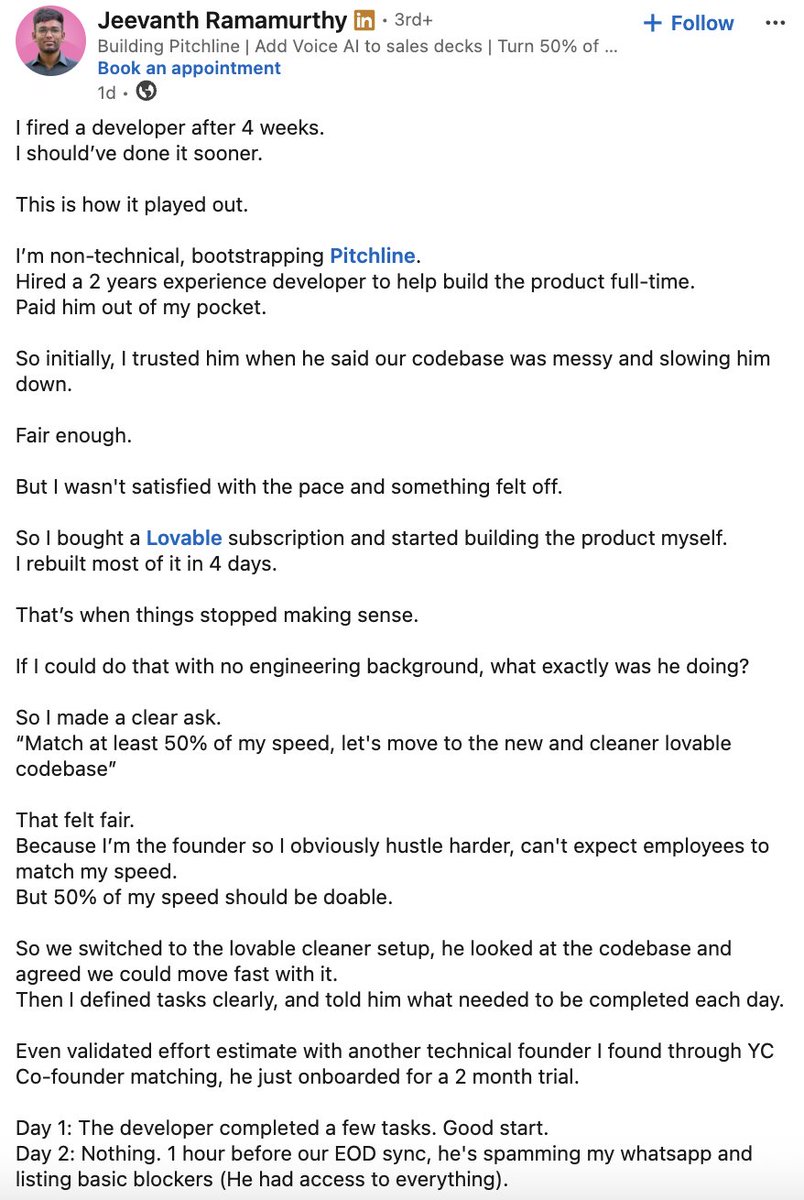
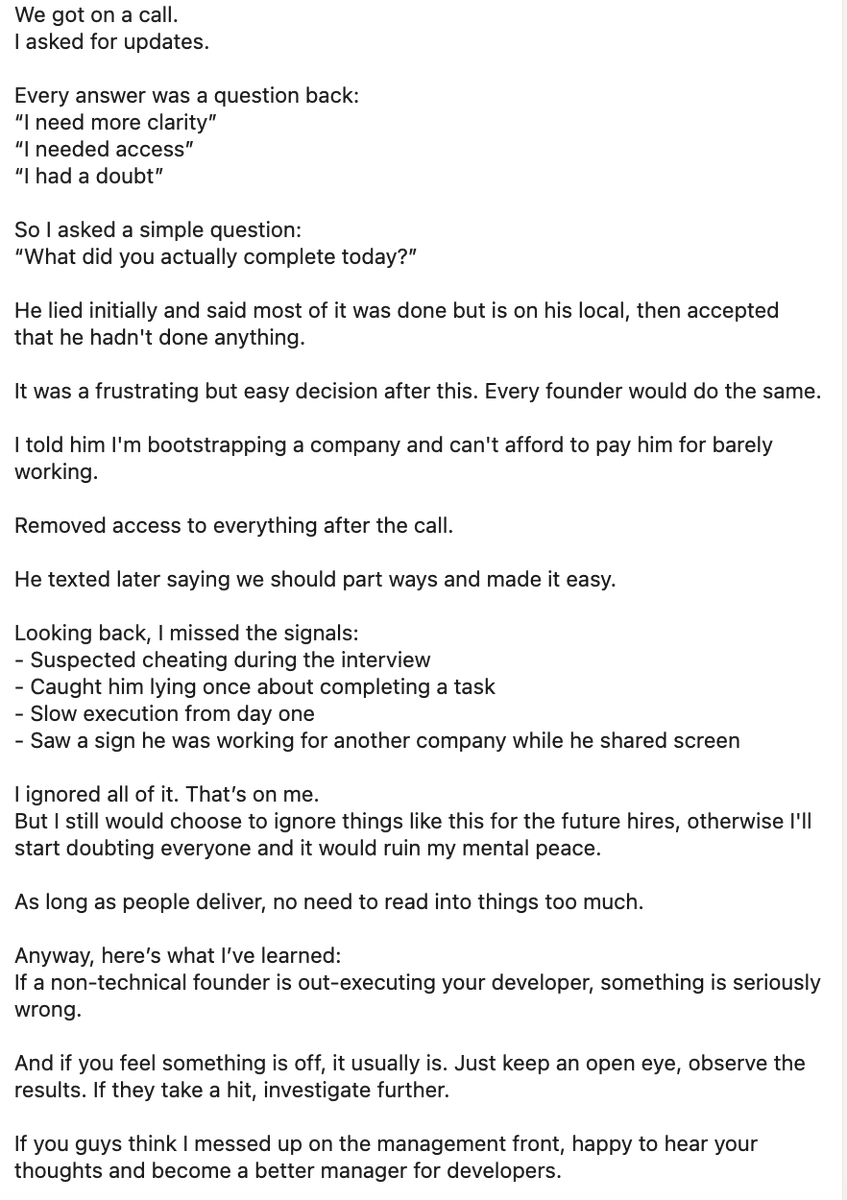
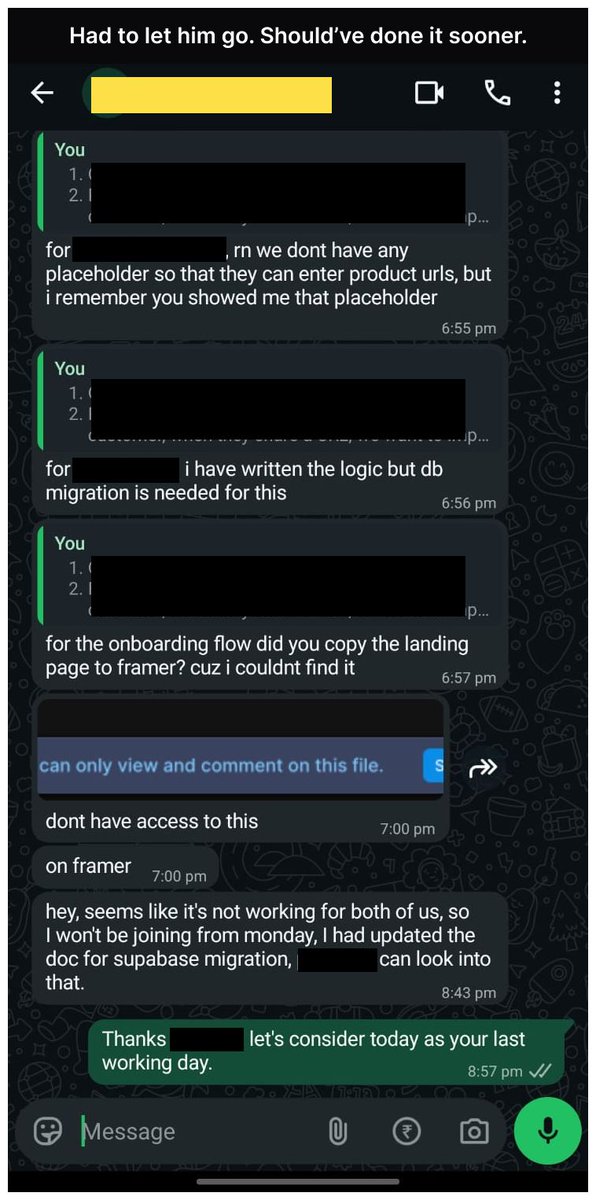
A founder in India fired an employee in just 4 weeks after hiring. The founder used Lovable and accused the employee isn't performing at even 50% of his speed. The same Lovable that was found yesterday of a big cyber security breach. Who will tell these founders, AI may run faster, but you need a human to build a secured production-grade system?
Swapna Kumar Panda tweet mediaSwapna Kumar Panda tweet mediaSwapna Kumar Panda tweet media
English
59
29
336
72.6K
Devendra Singh Mahra
Devendra Singh Mahra@devendrasm·
@vijayshekhar I think building/assembling is the easier part, getting to orders and sustainable revenue stream is the tougher part.
English
0
0
0
5