Fireside Alpha

77 posts

Fireside Alpha banner
Fireside Alpha

Fireside Alpha

@firesidealpha

Summary and synthesis of the best business, technology, and consumer conversations
United States Inscrit le Haziran 2026
47 Abonnements354 Abonnés
Fireside Alpha
Fireside Alpha@firesidealpha·
Maverick Capital, Lee Ainslie's Tiger cub, co-PMs Ben Silver and David Tykocinski on how durable the AI buildout is and where they're focused now. Their thoughts here (save/watch this): 1/ The co-CIO model came from Lee Ainslie, who had watched their chemistry and bet that their differences would help. Tykocinski says Ainslie had a read on their natural chemistry approaching critical decisions together well before he executed the transition, and a view that the similarities and differences between the two of them would give the culture a useful counterpoint. The handoff was deliberate, built on a couple of years of incubating ideas about organization and investment philosophy. 2/ Their styles split along the sectors they came up in, and the split is the point of pairing them. Tykocinski frames the difference as a function of different sector universes rather than personality. > Silver came up in healthcare and cyclicals, where end-market secular growth is thinner, managerial decisions swing earnings power, and you oscillate around a macro operating cycle that has run for seven decades. His focus is highly specialized, idiosyncratic, novel ideas. > Tykocinski came up in TMT, where secular trend, operating momentum, and thematic dominance govern, because when a sector trend is in your favor the multiples re-rate in the same direction as the fundamental revisions. His mold is closer to classical thematic investing. 3/ They manage to the optimal portfolio, not the optimal sector allocation, and the risk machinery is unrecognizable from the early days. Tykocinski says risk is run holistically and at the sector level, together with Ainslie and two other longstanding members, but what they solve for is the whole portfolio. When Ainslie started he watched net and beta-adjusted net exposures by sector. They now run a 20-plus-page risk report on idiosyncratic contribution to volatility, sliced every way, across every factor, including factors they build themselves. 4/ More has stayed the same than changed in 30-plus years, and the main change was pulling back to first principles. Tykocinski says the first slide of the marketing deck is unchanged since inception, alpha rather than market timing or big sector bets, long-term view, deep diligence, partnering with good management. The one real course correction came in the roughly five years since they took over, reversing a stretch when near-term valuation metrics had become pervasive, a deviation from Maverick's first 15 years or so. 5/ The AI trade is no longer just GPUs, it is the whole hardware, energy, and software complex on both sides of disruption. Asked about the sustainability of the four-year rally, Tykocinski reframes the surface area. The trade now spans the broader hardware infrastructure and energy ecosystem, plus all the services and software perceived to sit on the other end of disruption. That breadth is why the durability question is the critical one. 6/ The cleanest difference from the dotcom bubble is who funds the spend, though the gap is tightening. Tykocinski puts numbers on the contrast and then concedes the offset. > In the dotcom bubble, cumulative CapEx ran roughly 200% of operating cash flow, so it was almost definitionally externally funded. > Over the last couple of years the AI figure has run well under 100%, funded by the largest, most well-capitalized companies in the world. > The offset arrived recently, a multi-trillion-dollar market cap company tapping equity markets for the next tranche of the buildout, so the difference holds but a little tighter than before. (they can't name on a public broadcast but it is almost certainly $GOOG) 7/ The risk a believer should respect is an air pocket in the handoff from training infrastructure to real applications. Tykocinski says the heart of the question is the ROI on the spend and how it translates, and that the danger sits in the interim as money moves from building training infrastructure to the applications that are actually transformational for productivity. So far the pickup in agentic inference like coding has been commensurate with the second-derivative slowing in training, but that use case still has to break into the broader knowledge workspace to support the out-year projections. 8/ The way to monetize the trade has been to chase the bottleneck upstream as demand outran capacity. Tykocinski lays out the migration as a sequence. > Early on, with demand still inside existing production capacity, the explosive growth showed up in downstream physical outputs like GPUs. > Once demand crossed industry production capacity, the bottleneck moved up to fabrication, then to the tools that make the chips, then even to obscure materials listed on a Japanese stock exchange. > The sharpest revision torque now sits in those upstream names, frequently companies that started from a very low margin basis. 9/ Their forward call is that the migration swings back downstream, toward servicing AI and the application layer. Tykocinski says they are starting to see the bottleneck begin to move the other way, back toward infrastructure and applications where the work is transforming businesses with productivity gains. In practice AI agents are not islands, they are LLMs integrated into the preexisting enterprise workflow and stack, which makes CPUs and the databases they talk to the critical chokepoints and pushes value closer to the edge and the end user. That is where they are heavily focused now. 10/ Capital has drained out of healthcare into AI, but Silver likes life-science tools as both an AI and a reshoring winner. Silver describes a large sucking sound of money leaving healthcare, then points to the companies that supply the products to discover and manufacture complicated drugs. > A shift to reshore drug manufacturing from outside the US to the US should drive a CapEx boom in manufacturing equipment, starting to show roughly three to six months out and driving a strong revision cycle. > Early-stage drug discovery is already showing a pickup in consumable usage. > More discovery leads to more drugs manufactured downstream, which Silver casts as a modern mercantilist winner alongside the AI angle. 11/ The same space has consolidated for 20 years, and the left-for-dead survivors look ripe for M&A. Silver says the life-science-tools group has been consolidating for two decades and the remaining companies are priced as if dead, but there are real-money buyers, three to five big consolidators depending on definition. A number of names in the $5-10 billion range look ripe for M&A if fundamentals do not turn fast enough, and the historical pattern is that when biotech sells off, pharma comes in and rights it within six months to a year. 12/ Asked the one risk they worry about most, they name US political polarization and China as an industrial counterweight. This is the host's direct reframe, and both answer. > Silver leads with the division inside the US and the difficulty of making rational long-term decisions against short-term political incentives. > Tykocinski's concern is China as an industrial counterweight to the infrastructure trade, because root hardware and materials commodify over time while IP historically lived at the application layer. > He worries specifically about spaces ripe for Chinese competition, lasers and optics and analog semiconductors and the maniacal hunt for the next bottleneck like memory, and about investors underrating the structural industry differences of the businesses driving so much of today's equity appreciation. 13/ The partnership holds because each wants a counterweight against his own excesses. Tykocinski says almost every investor believes his own style is the right one, and that he is glad to have someone who might see things differently to protect him from his excesses in one direction, with Silver getting the same protection in return. They agreed from day one to disagree and commit, with Ainslie as a third sounding board, on the view that no single investment philosophy is perfect in a vacuum. 14/ The investors they admire are also the lesson, that the great ones are entrepreneurs who build real businesses. Asked which investor they admire most, both first name Stan Druckenmiller and "Uncle Steve" Cohen, the Mets owner, before Silver puts Ainslie and Keith Meister of Corvex, where he previously worked, in his personal hall of fame, both unusually quick on hard concepts and very commercial. The underrated trait he flags is that the best investors build genuinely good businesses, that they are phenomenal business builders as much as investors. 15/ What they are most excited about is AI itself, over a 10-to-20-year horizon they call hard to fathom. Silver says he is willing to go with consensus when it makes sense, and that the impact of AI on the world over the next 10 to 20 years will probably be more profound than we can imagine, a mix of exciting and a little scary. Tykocinski adds that the conversation is too often flattened into monetary terms or a dystopian frame, when the open-ended upside optionality is the part that excites him. Lastly, the lightning round. David Tykocinski names his strength as balancing fundamental analysis with commercial intuition, neither too academic nor too much of a trader, while Silver names getting deep in the weeds on how businesses make money and then pulling back to the strategic picture. Tykocinski's best advice came from his oldest sister, that no one is really thinking about you all that much, which he finds freeing at key decisions. Silver's came from a grandfather who survived the Holocaust, an attitude of keep going, persevere, and be grateful for what you have. Outside the office it is mostly young kids for both, with Tykocinski keeping up an interest in the humanities and Silver in watching and playing sports.
English
1
2
17
2.4K
Fireside Alpha
Fireside Alpha@firesidealpha·
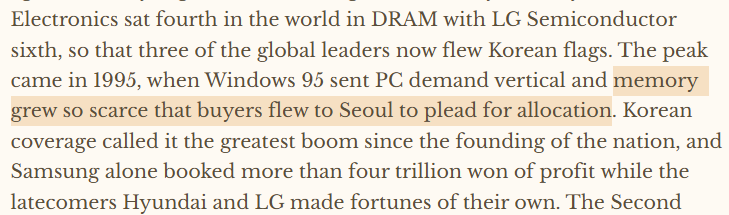
Sneak peak on a piece I'm writing on the Memory Wars. Amazing how history rhymes. Go back to the mid 90's during the memory cycle during then, people flying to Seoul for allocation... who's been doing that recently...(see reply)
Fireside Alpha tweet media
English
1
0
6
315
Fireside Alpha
Fireside Alpha@firesidealpha·
@semidoped He was also on a podcast called The Long View, the day before. Similar information but still interesting. Notes here: x.com/firesidealpha/…
Fireside Alpha@firesidealpha

Great listen: $INTC Lip-Bu Tan x T Rowe's Long View podcast. He's been active on the podcast circuit, and with today's announcement makes sense why. In terms of arc, Tan is a guy who seemingly keeps taking jobs he did not plan to take. He wrote one resume in his life, raised $3.3 million for a fund that now runs more than $4 billion, signed up for a 3-month interim CEO stint at Cadence that became 15 years, and took the Intel seat against the advice of 80% of the people he asked because one friend told him to save the company before he retired and it touched his heart. Some number before the takes: a 5-yr turnaround plan he says he finished in 14 months, a US government stake now up more than 5x, and a CPU-to-GPU ratio he watches moving from 1:8 in training toward 1:1 in inference. 1/ He grew up the youngest of five in Malaysia, the one child his strict mother let off the hook. Tan says he was born in Muar, Johor, just north of Singapore, and followed his mother to Singapore for school before coming to the US for graduate work. His siblings were pushed through piano to the level of performance and composition, and his brother played violin in an orchestra, but Tan says he was too lazy for the piano and spent his time catching spiders and playing basketball and volleyball instead. Being the youngest, he says, came with a lot of freedom, and the music he skipped he now backs from the other side, having served on the board of the San Francisco Opera. 2/ His mother sent him to Chinese school while the other four went to English school, and he still frames his English as a survived second language. Tan says she chose, for some reason he does not fully explain, to send the last child to Chinese school to learn Confucian theory, and that she would apologize to him that his English was not good because it was a second language. He says he survived it. The detail is important to the later story because the same man who frames his English as a handicap is the one who walked into a room with President Trump and talked his way from a resignation demand into a partnership. 3/ He chose physics, then switched to nuclear engineering, partly to escape being measured against his brother. Tan says he started in physics at Nanyang Technological University because he was good at mathematics and physics was good training, and he finished it in three years. But his teachers kept telling him his brother, a Rhodes scholar who went to Cambridge and Oxford and became a cardiologist working on artificial hearts, was better. So he switched fields to do something different, applied to graduate school in the US, was rejected by Berkeley and Stanford, and was accepted at MIT for nuclear engineering, which is the only reason he says he pursued it. 4/ A nuclear accident ended his PhD and a placement officer pushed him into the job market with one company name. Tan says he never finished his PhD because of the Three Mile Island accident, which gutted the prospects for nuclear power plant work. He tells it as comedy: he liked doing homework in the placement office because it had air conditioning, the bored placement director asked his department, heard "nuclear engineering," and told him to get out because nothing was being built. Tan says he wrote exactly one resume in his whole life, to a firm the director named, EDS Nuclear, got flown out for a three-day trip, and took the job. The thread he is drawing is that the defining moves of his career were not planned, they were doors that opened. 5/ He was recruited into his first startup over a no-business lunch at 21 or 22, with nothing to lose. Tan says that during a rotation program at that first company, three executive vice presidents invited him to lunch, and he assumed they wanted to talk budget until they promised no business. The lunch was a pitch to join them in founding a startup. He says he was only 21 or 22 at the time and had nothing to lose, so he went, and that became his first startup experience. He uses it to set up a pattern he repeats across the interview, that the right people pulling you in is more important than the plan you had. 6/ He started Walden by offering to work for free and raising $3.3 million, and built it brick by brick to visit his mother. Tan says that when he turned to venture capital, he knocked on every door and got no offers, so he found a small SBIC firm and told the two partners they did not have to pay him, he would pay for himself. He raised about $3.3 million to start Walden International, which he says now manages more than $4 billion, and across his watch he and his colleagues recorded 153 IPOs and 126 successful M&A exits. Asked his master plan for building out Asia, he says he had none, he just wanted to go visit his mother in Singapore. 7/ Cadence is where he learned to turn a company around, and he became its CEO entirely by accident. Tan says he hesitated to even join the Cadence board because it was the number-two player behind Synopsys, and a friend at Synopsys told him to join the number one instead. He joined number two anyway, then got a call that the CEO had been fired and he was now interim CEO, with the stock at $2.42. He signed up for three months, tried to hand the chairman the key once a search was done, and was told to keep it. He says that three-month stint became 15 years, 12 and a half as CEO and two as executive chairman. As a first-time CEO he read three "CEO for dummies" books cover to cover, opened his inbox to all employees, and says he got more than 3,000 emails a day and promised to answer every one. 8/ One friend's appeal, not the upside, is why he took the Intel job, and 80% of his advisors told him not to. Asked directly why he did it, Tan says about 80% of the CEOs and executives he consulted told him not to take the job, on two grounds: there was no guarantee of success, and he had already proven himself at Cadence, so a failure at Intel would define the rest of his career because people only remember the last one. The thing that moved him was a thoughtful note from a friend and customer in Seattle who wrote that with all his success, Intel is an iconic company critical to the industry and the country, and asked him to save it before he retired. Tan says that touched his heart. He adds that his wife, who had said no when he was a finalist five years earlier, supported him this time because she could see his heart was already in it. 9/ His first act at Intel was structural: pull all of engineering under himself and force bad news to travel fast. Tan says that from day one he had all of engineering report directly to him, the same move he made at Cadence, so he could see for himself where the product, the foundry, and the customer problems actually were. He pairs it with a rule he repeats to the team, that they must bring him the bad news first, because if a customer tells him something his own team withheld, that person is in deep trouble. He frames it as a saying: bad news needs to travel fast, good news can always be celebrated later. Customers, he says, handed him a list of "14 screwed up" mistakes Intel had made, and he wrote down every one and went back to them item by item. 10/ Asked whether Intel's problem was strategy or execution, he answers with culture: too many layers and too many meetings. The host asks directly whether he diagnosed Intel as a strategy problem, an execution problem, or something else. Tan goes at the culture. He says he found management stacked north of 10 layers deep and pushed it down toward five so people would actually be accountable, because in a finger-pointing culture nobody owns the failure. He says more than 100 former top executives told him they spent 89% of their time in meetings, and that the same presentation had to be repeated 36 times before anyone decided anything, often by a decision-maker with no grasp of the product. His fix is what he calls the speed of light: move like a startup, kill meetings with no agenda or deliverable, and read the material himself beforehand so a meeting is five questions and done. 11/ Asked what changes when the US government owns 10% of you, he says it starts with a morning call demanding he resign. The host asks how it affects running the company to have the US government as a large shareholder. Tan answers with the origin: an early-morning phone call telling him the President wanted him to resign over a conflict of interest, which disrupted the gym-and-swim he usually starts the day with. His move was to take himself out of the picture, on the logic that he did not need the job and came to save Intel, then get a meeting with Trump. He says he explained that he was born in Malaysia, grew up in Singapore, went to MIT, and never lived in China, and his children and grandchildren all live in the US, and they listened. The outcome he describes is the government taking 10% against his two-year turnaround pledge, with Trump giving him from Monday to Friday to work out the terms with Commerce Secretary Howard Lutnick and Treasury Secretary Scott Bessent, on commercial terms with no board seat, a stake he says is now up more than 5x. 12/ Asked where Intel's edge is now, he points to a CPU demand reversal and to building purpose-built silicon across the stack. The host asks where Tan sees his competitive advantage as AMD, Nvidia, and the hyperscalers all push into CPUs. Tan says CPUs became important again with agentic AI and inference, and that the ratio he watches has moved from one CPU to eight GPUs in training toward roughly one-to-one in inference. He concedes the field is crowded, with AMD well respected and Arm-based players including Nvidia moving in. His answer to it is to quietly build inside Intel, hiring top CPU and GPU architects to make purpose-built silicon tuned to different workloads, on the argument that owning CPU, GPU, advanced packaging, and the foundry lets Intel assemble surgical, workload-specific chips no pure-play can. 13/ Asked how he gets back on the foundry treadmill Intel fell off, he sequences it: balance sheet, then talent, then capex. The host frames foundry as a treadmill where the speed jumps every couple of minutes and asks how Intel catches back up. Tan says the first move was strengthening the balance sheet, because the talent he tried to recruit early on told him plainly they would not join a near-bankrupt company. With the balance sheet fixed he could attract leading technologists, force a proud organization to start sharing its data, and send people to physically sit at the weak older-node fabs and not come back until the problem was fixed. He says he raised capex to buy equipment given the long lead times, and ties it back to geography: advanced-technology foundry has only one US player, Intel, while more than 90% of leading-edge manufacturing sits in Taiwan, and the memory crisis is the live reminder of what depending on one geography costs. 14/ The vision is not three Intel businesses, it is one system platform, run like a basketball team. Tan says Intel is described today as a PC business, a data-center business, and a foundry, but the direction is to stitch those into a full system platform, with software, that sells more than a chip. He points to his Foxconn partnership announcement and to his Computex keynote, where he says he deliberately handed parts of the speech to colleagues. He describes his own role as a conductor or a basketball coach, cheering an executive team to deliver rather than doing everything himself, and says the goal is a championship team like the New York Knicks. The point he keeps returning to is that he cannot do it alone, so he is building a deep bench, including potential successors, the same way he did at Cadence. 15/ Asked what would eventually end this capex cycle, he says the brake is applications without ROI, not chips. This is the host's what-breaks-it question, and the highest-signal answer in the interview. Tan says the AI buildout reminds him of the internet but bigger, and that the internet produced a few big winners, an Amazon and a Netflix, who won by being laser-focused on a real application that disrupted an industry. He says he just joined the MIT CEO advisory board, where two professors presented research arguing that companies today do not yet see the ROI or the performance improvement from AI, and that while he may not agree, it keeps him alert. His conclusion is to look past the infrastructure to the application: figure out what the application and the ROI are, then design the silicon down from there, which is how he says he formed Intel's strategy. 16/ He finished the board's five-year plan in 14 months, and reset the clock to ten years on purpose. Tan says the board and he built a five-year plan when he arrived, and at a recent board meeting he was told he had accomplished it in 14 months and needed to aim bigger. So he says he is now drawing up a five- and ten-year plan and telling his team to operate as if he will be there for a decade, so nobody assumes he is leaving. He pairs the longer horizon with succession, saying he will gradually bring in talent who could replace him, the way he did at Cadence. The reset is the candid version of the same instinct elsewhere in the interview, that he raises the target the moment he clears it. 17/ The lightning round is where the operator shows: meditation while swimming, durian, and Star Wars. Asked his one word for Intel today, Tan says technology, and the first technology he loved he gives as quantum. He names Netflix as the non-tech company he most admires, which lines up with the Netflix-and-Amazon framing he used for AI winners. His must-read turns out not to be reading at all but meditation, morning and evening, and he says he does the morning session while swimming. His guilty food is durian, specifically the bitter Mao San Wang or "mountain cat" variety, which he compares to a strong cheese, and his science-fiction pick is Star Wars. Lastly, he keeps making investing calls in the room, including telling Lisa Su to take the AMD job. Tan says that when Lisa Su asked him whether she should take the CEO job at AMD, he told her that her market cap could not end up lower than the company he chaired and had to be higher, and that she went on to do a fabulous job. It is a small aside, but it captures how he treats relationships as the asset, the same instinct that has him recruiting every senior Intel hire himself and crediting his old friend the Seattle customer for the decision that put him in the chair.

English
0
0
3
174
Semi Doped
Semi Doped@semidoped·
Re-engineering the Semiconductor Supply Chain with Intel CEO Lip-Bu Tan No Priors (Sarah Guo & Elad Gil). Lip-Bu Tan on why he took the Intel job at 66, the government equity stake, Terafab with Elon Musk, and why agentic AI is turning CPUs into demand drivers again. One of the more candid CEO conversations you'll find on Intel's turnaround. @austinsemis @vikramskr
English
2
1
17
2.6K
Fireside Alpha
Fireside Alpha@firesidealpha·
What part of the semis supply chain is Elon most concerned about? "I'd say my biggest concern actually is memory. So I think the path to creating logic chips is more obvious than the path to having sufficient memory to support the logic chips." This was 4 months ago and it's only gotten worse.
Fireside Alpha@firesidealpha

x.com/i/article/2067…

English
0
0
3
381
Fireside Alpha
Fireside Alpha@firesidealpha·
Stacy Rasgon (Bernstein, @Srasgon) re semis: "I've been hearing the word supercycle my entire career, and maybe this is the first one I've actually seen." He says there's 4 distinct cycle types, and that we're in a Demand cycle, a genuine surge in end demand. For the other 3 cycle types and more notes from his chat you can read more here (link to conversation in notes): x.com/firesidealpha/…
Fireside Alpha@firesidealpha

x.com/i/article/2068…

English
1
0
10
1.7K
Fireside Alpha
Fireside Alpha@firesidealpha·
Elon: "It's not that [the Chinese] have not replicated TSMC. They have not replicated $ASML. That's the limiting factor." He was asked if the fact that China hadn't replicated TSMC, if that gave him pause about the difficulty
Fireside Alpha@firesidealpha

x.com/i/article/2067…

English
0
0
7
453
Fireside Alpha
Fireside Alpha@firesidealpha·
@breadcrumbsre Robert Smith/Vista pretty sober about it as well. He basically says some will find ways to expand topline, others to cut cost of service/delivery, and then others shouldn't exist if they don't own the data or workflow. x.com/firesidealpha/…
Fireside Alpha@firesidealpha

SaaS considerations- Robert Smith (Vista Equity) sees enterprise software ending up in 3 states: 1) Agentic state, agentic workflows 2) Enabling delivery of software at lower cost (dev, CS, GTM) 3) No right to exist if no sovereignty of workflows and datasets.

English
0
0
2
266
Bread Crumbs Research
Bread Crumbs Research@breadcrumbsre·
I’m a tourist in software but based on everything I’ve heard so far the most balanced take on AI has been from Mark Leonard: “AI is both a threat and an opportunity”. No doom. No singularity BS.
English
7
1
38
4.3K
Fireside Alpha
Fireside Alpha@firesidealpha·
Vista has a "factory" they've been sending their companies through (54 so far, 20 remaining). He sees 4 archetypes of agents within software: 1) Fixer that never sleeps 2) Orchestration agent who manages multiple agents 3) Workhorse agent who works on complex projects 4) Sidekick, working alongside human
English
0
0
1
118
Fireside Alpha
Fireside Alpha@firesidealpha·
Agentic companies to see more economic rent capture via labor/services capture -- he called out an insurance business using agents to solve for better outcomes, which is where pricing models are headed vs seats. But for now, market still re-rating now as not enough proof points yet.
English
1
0
1
134
Fireside Alpha
Fireside Alpha@firesidealpha·
SaaS considerations- Robert Smith (Vista Equity) sees enterprise software ending up in 3 states: 1) Agentic state, agentic workflows 2) Enabling delivery of software at lower cost (dev, CS, GTM) 3) No right to exist if no sovereignty of workflows and datasets.
English
1
0
2
465
Fireside Alpha
Fireside Alpha@firesidealpha·
Great fireside: Bill Ackman (@BillAckman, Pershing Square) on Markets, AI, and Concentrated Investing (notes below, link in reply) Ackman spoke about the closed-end structure, why concentration earns its differentiated record, and on AI including his $MSFT investment. He owns the hyperscalers he can value at high returns on capital, worries about the model companies rather than the infrastructure builders, and is rebuilding Howard Hughes into an insurance compounder modeled on Berkshire. More from him: 1/ Permanent capital is the edge because everyone else is a forced seller. Ackman says markets have turned increasingly short-term, with capital concentrated in multi-manager pod shops paid on near-term performance under tight risk limits, and in index funds that pull an increasing share of companies out of the active flow. When a few marginal buyers and sellers set the price, very high-quality businesses can trade at deeply discounted prices, and short-term capital gets forced out at exactly the wrong moment. Nearly 100% of Pershing Square's capital now sits in permanent structures so the firm can buy when others have to sell. 2/ A good business is an infinite-life entity, so owning it for a month or two means missing the point. Ackman frames a company as an infinite-life entity whose value is the present value of the cash it generates. Holding it for a month or two forfeits the significant opportunities that come from owning it through the cycle. The permanent-capital base is what lets him act on that time horizon rather than talk about it. 3/ He keeps a library of high-quality companies, and right now they are cheap. When a host suggested he keeps ideas in a stable ready to bring onto the field, Ackman corrected the metaphor to a library, a set of very high-quality companies he would love to own at the right price. He says the firm is going through a period where exactly those businesses are available at very attractive prices. The discipline is patience until the forced selling shows up. 4/ Most active managers cannot beat the market, and his 22-year record is built on accepting that he will look different. Ackman grants that the substantial majority of active managers cannot beat the index, while a minority can, and the opportunity set for that minority grows as short-term capital crowds the field. Over 22 years, he says, the concentrated strategy has compounded at roughly 600 to 700 basis points per annum above the index. Year to date the divergence runs the other way, the S&P up about 6.5 percent on the morning he checked while Pershing Square sits in negative territory, which he treats as the expected cost of a highly concentrated book deploying into a cheap market. 5/ The SpaceX listing is a live example of the forced-seller mechanic he profits from. Ackman walks through an endowment that holds SpaceX in its private book, watches the position move to public at a much higher value on the IPO, and is then forced to sell to bring its public allocation back into line. He credits S&P for declining to fast-track SpaceX and other mega-IPOs while their free float stays very low, and contrasts that with NASDAQ caving to the marketing opportunity to win the listing from the New York Stock Exchange. The low free float, he and the hosts agree, will likely drive dramatic price moves. 6/ Benchmark the trust to the index, but over years, not months. A host floated the idea that an index is the wrong yardstick for a concentrated vehicle, and Ackman pushed back directly. He says an index is the right comparison, only the time horizon should be several years rather than several months. Judged over months, a concentrated book will diverge hard in both directions, which tells you nothing about the strategy. 7/ Concentration into 8 to 12 names is obvious arithmetic, and the crowd avoids it because differentiation gets people fired. Ackman says peers regularly tell him they would run money exactly his way for themselves but their clients will not let them. His logic is plain, own more of idea one, two, or three rather than idea twenty. Most managers diversify for a smoother outcome and hug the index, because adverse-to-others performance is the way to get fired, and a closed-end structure removes the overnight redemption that punishes that divergence. 8/ Twenty years of track record turned activism from public letters into private conversations. Ackman recalls the early days when nobody knew Pershing Square and a CEO would not return his calls even after a 10% stake. After two decades, companies know who he is and welcome the firm, so the work that once needed an open letter or a ballroom now happens behind closed doors. He adds that he can build a portfolio today of already-well-run, high-quality businesses with what he estimates is a forward expected return in the mid-to-high 20s percent. 9/ Corporate America now has to navigate a more interventionist president. Ackman points to the Intel case, where the Biden administration made a grant to support a struggling chipmaker and Trump responded by wanting government ownership in exchange for the taxpayer investment, the deal that converted unpaid CHIPS Act grants into a government equity stake. The lesson he draws is that you do not want to get on the wrong side of the president, and corporate America is paying attention to politics from that angle. He frames it as a feature of the current capital-markets environment rather than a passing episode. 10/ He credits the Iran strike as a long-term win paid for with short-term pain at the pump. Ackman says Trump knew the strike would push world oil and therefore gasoline prices higher, a cost the consumer feels every few days when the price at the pump swings 20 to 30 percent. He rates a nuclear Iran the larger risk to the United States, so he reads the move as a generationally positive decision taken at the cost of short-term political risk. He expects the war to resolve before the midterms, with energy prices and shipping rates reverting quickly once it does. 11/ On tariffs he backed the goal and faulted the execution, and says the 90-day pause was his idea. Ackman agrees the United States let trade partners take advantage over time and that tariffs are a reasonable tool to fix it. The overnight imposition of massive tariffs struck him as very high risk, and he says he initiated the 90-day pause idea that the president then took up. He notes the Supreme Court has constrained the president's ability to use tariffs without Congress, which limits the tool going forward. 12/ AI does not have an image problem, in his read, it has the fastest adoption in history. A host put it to Ackman that AI is unpopular with US consumers, and he disagreed flatly. Consumers reacted incredibly favorably and actually use the product, with the original OpenAI rollout the fastest adoption of any product in history by user count. He concedes a real fear of job loss, stronger than for any technology in his lifetime, but says he is increasingly confident AI will be a large net boom for job growth as people adapt. 13/ The hyperscaler capex is not a balance-sheet gamble, it is the price of staying in the superintelligence race. Ackman distinguishes Microsoft, Google, and Meta sharply from the startups, saying they are not risking their balance sheets and are spending into enormous demand. The first company to superintelligence holds an enormous competitive advantage, so none of them can afford to lose the race. He separates this growth investment from value-destroying maintenance capex, comparing it to a retailer forced to upgrade every store, because the hyperscaler spend buys compute the market will pay for at returns vastly above cost of capital, the Buffett definition of a great business. 14/ He worries far more about the LLM business model than about the companies building the infrastructure. Ackman does not question the enormous demand for compute or the power of the tool, and expects plenty of money to be lost because not every AI-adjacent private company becomes the next Anthropic. The frontier keeps moving, with OpenAI first, Anthropic seeming to pull ahead, and Gemini making it a race, while the vast majority of users will not need the best model for what they actually do. His worry sits with the model layer, not the picks-and-shovels. 15/ The Webvan parallel is the warning, all-you-can-eat pricing only lasts while you can raise capital. Ackman compares early OpenAI to Webvan, the dot-com grocery business whose massive consumer subsidy worked only as long as it could raise money. Early AI adoption rode the same all-you-can-eat pricing, and the move to per-token pricing for enterprise customers is exposing the bill, with departments burning through their budgets fast. He expects far more price sensitivity from corporate customers as a result. 16/ Language models are commoditizing, and for most jobs the free model is good enough. Ackman says there has been effectively no differentiation in everyday use, where people just click the most powerful model out of habit. Open-source and free models are good enough for many use cases, and you do not need Anthropic's top Claude Mythos model to find a restaurant on vacation. A host adds that Silicon Valley startups are increasingly using China's cheaper models, sharpening the pricing pressure on returns. 17/ Alphabet's 80 billion dollar raise looked unnecessary to him, until he read it as opportunism. Ackman says he was surprised Alphabet issued 80 billion dollars of stock it did not need. His read is that Alphabet looked at its valuation, saw a wall of new money coming to market as AI rivals were forced to raise, and issued into the froth to harden its competitive position. Pershing Square exited its own Alphabet stake this quarter, he says, at 31 to 32x earnings after making roughly three-and-a-half to four times its money over three to four years, and rotated the capital into a large Microsoft position. 18/ Google's real weapon against OpenAI and Anthropic is the token price. Ackman argues Alphabet could cut token pricing significantly given its balance-sheet advantage, which would make life genuinely hard for the model companies that have been burning huge amounts of cash. He reads OpenAI as more challenged than Anthropic, with Anthropic pushing into enterprise and seeming to overtake OpenAI, and Gemini already defending Google's position well. The model labs are reliant on capital markets to fund the burn, which is why they are now going public. 19/ Microsoft becomes the gateway to AI in the enterprise, and the seat price is the moat. Ackman frames a typical Microsoft 365 enterprise seat at about 20 dollars for a bundle that would cost 50 dollars or more bought piecemeal from Zoom, Gmail, and the rest, across what he puts at something approaching half a billion users. With Copilot, Microsoft becomes the platform through which people access AI at work, the way Uber became the default for rides, pointing the CIO to the lowest-cost model that does the job. Software is a company-by-company call, where high-cost niche products priced at 10 to 30 thousand a year per user are highly replaceable while scaled low-cost platforms are the winners. 20/ Howard Hughes is being rebuilt into an insurance compounder on the Buffett model. Ackman explains the legacy, Pershing Square bought 25% of General Growth after the stock fell 99.5% in the financial crisis, led the restructuring, and made its most successful equity investment ever, with Howard Hughes spun out to hold the unwanted assets. Pershing Square now controls about 47% of Howard Hughes and is converting it from a pure-play real-estate owner into a diversified holding company led by the specialty insurer Vantage, a roughly $2.1 billion acquisition that closed the week before the recording. The plan copies Buffett, invest the insurance float in short-term treasuries at effectively no risk and the surplus in common stocks the Pershing Square way, the engine that compounded Berkshire's per-share value at about 20% over 60 years. 21/ The reason other insurers do not run this playbook is that the investing talent never shows up. Ackman says the best investors do not take jobs at insurance companies, because the pay and prestige steer them to hedge funds and long-only managers instead. Buffett's edge was being a great investor who owned an insurer and could manage the float at no cost, and Pershing Square is doing the same for Vantage. Owning so much of Howard Hughes makes managing that portfolio for free directly in the firm's own interest, which he calls the competitive advantage.
English
2
0
3
623