Building Data Pipelines has levels to it:
- level 0
Understand the basic flow: Extract → Transform → Load (ETL) or ELT
This is the foundation.
- Extract: Pull data from sources (APIs, DBs, files)
- Transform: Clean, filter, join, or enrich the data
- Load: Store into a warehouse or lake for analysis
You’re not a data engineer until you’ve scheduled a job to pull CSVs off an SFTP server at 3AM!
level 1
Master the tools:
- Airflow for orchestration
- dbt for transformations
- Spark or PySpark for big data
- Snowflake, BigQuery, Redshift for warehouses
- Kafka or Kinesis for streaming
Understand when to batch vs stream. Most companies think they need real-time data. They usually don’t.
level 2
Handle complexity with modular design:
- DAGs should be atomic, idempotent, and parameterized
- Use task dependencies and sensors wisely
- Break transformations into layers (staging → clean → marts)
- Design for failure recovery. If a step fails, how do you re-run it? From scratch or just that part?
Learn how to backfill without breaking the world.
level 3
Data quality and observability:
- Add tests for nulls, duplicates, and business logic
- Use tools like Great Expectations, Monte Carlo, or built-in dbt tests
- Track lineage so you know what downstream will break if upstream changes
Know the difference between:
- a late-arriving dimension
- a broken SCD2
- and a pipeline silently dropping rows
At this level, you understand that reliability > cleverness.
level 4
Build for scale and maintainability:
- Version control your pipeline configs
- Use feature flags to toggle behavior in prod
- Push vs pull architecture
- Decouple compute and storage (e.g. Iceberg and Delta Lake)
- Data mesh, data contracts, streaming joins, and CDC are words you throw around because you know how and when to use them.
What else belongs in the journey to mastering data pipelines?
This video really made me teary 🥹
There are friends who truly add color to our lives,may God bless them for us.
He was dancing on stage when his friend noticed his slippers was worn out, so his friend reached out to their other friend for his own( obviously,his slippers were bad too, that’s why he couldn’t give him his)
He was literally smiling until he sighted his friend’s feet💔
Genuine friendships are rare🥺
Data Engineers,
You’ll understand this when full load starts hurting. I once inherited a pipeline that did full processing daily.
At ~10k users, no problem.
Then the business grew to ~500k users in 2 years.
AWS analytics cost started raising questions… and I was the one being asked what’s going on.
I checked the architecture.
We were reprocessing data that would never change… every single day.
At that point:
~1M+ cooking session records daily.
I redesigned it:
• Introduced incremental load
• Partitioned data properly on S3
Cost dropped significantly after this update.
Big O is not a joke.
It’s the economics of systems.
I received a call this morning from Professor Celestine Iwendi. He is a Professor of Artificial Intelligence. He is also the Head of Centre of Internet of Things at the University of Greater Manchester.
When I say Nigerians are the smartest in the world, I am not lying 🇳🇬🇳🇬🙌🙌
We will bring everybody back to change Nigeria, mark my words!
Bandits will be decimated
We will settle herders farmers clash
No single terrorist will be spared
Kidnappers Orun lala!
We will make Nigeria Great Again!
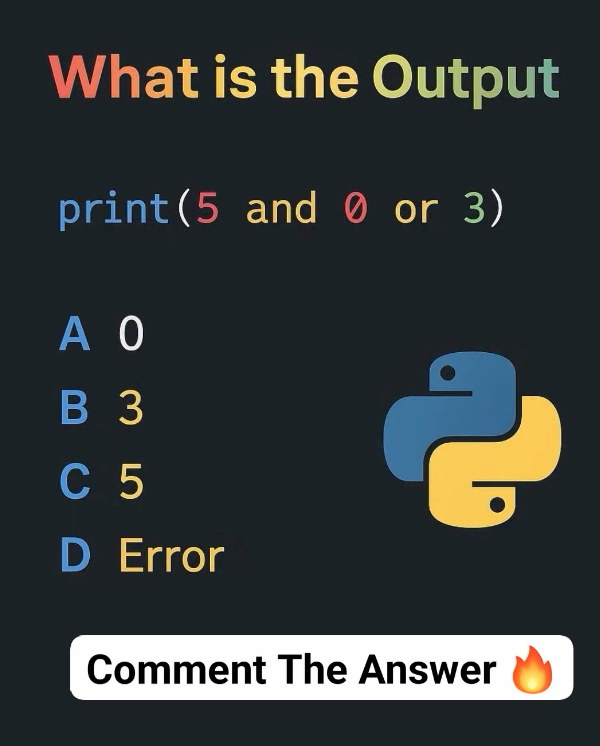
@PythonPr B.
5 and 0 evaluates to 0 because ‘and’ returns the first falsy value.
Then 0 or 3 evaluates to 3 because or returns the first truthy value.
So the output is 3.
B is correct.
SQL doesn’t execute top-to-bottom — it follows its logical execution order:
FROM (get data)
WHERE (filter rows)
GROUP BY (create groups)
HAVING (filter groups)
SELECT (pick columns / aggregates)
ORDER BY (sort results)
LIMIT (restrict output)
That’s why aggregates like AVG() work in HAVING but not in WHERE.
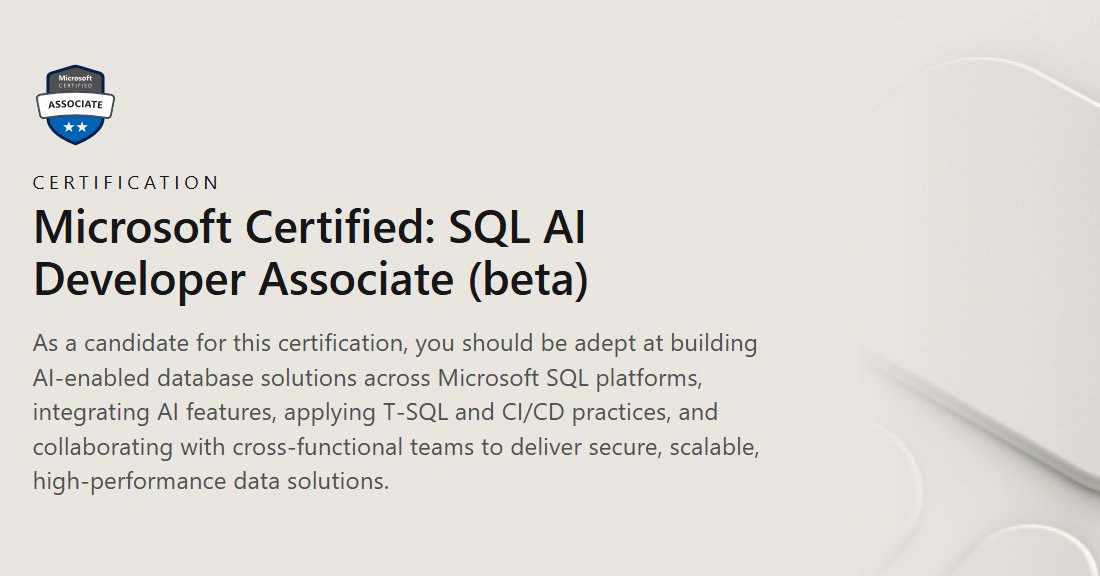
Keep the learning 🎓 going after #SQLCON with the new SQL AI Developer Associate certification, now in Beta.
Design and develop AI-enabled database solutions across #MicrosoftSQL.
Get started today: msft.it/6016QqXxQ
Are you relying on your own strength, or on God’s strength?
There are some levels of God’s power you cannot experience until He becomes your main source - not just a backup plan or someone you turn to only in emergencies, but the foundation you depend on every day.
Build Your First Machine Learning Project [Full Beginner Walkthrough]
In this tutorial We'll learn how to build an end-to-end machine learning project. We'll cover the main steps in building a machine learning project, then walk you through writing the Python code to create the project.
youtube.com/watch?v=Hr06nS…