

Boaz Almog
209 posts

Boaz Almog retweeté

London.
Christmas Day.
Your home and dear ones.
What if it were you?
English
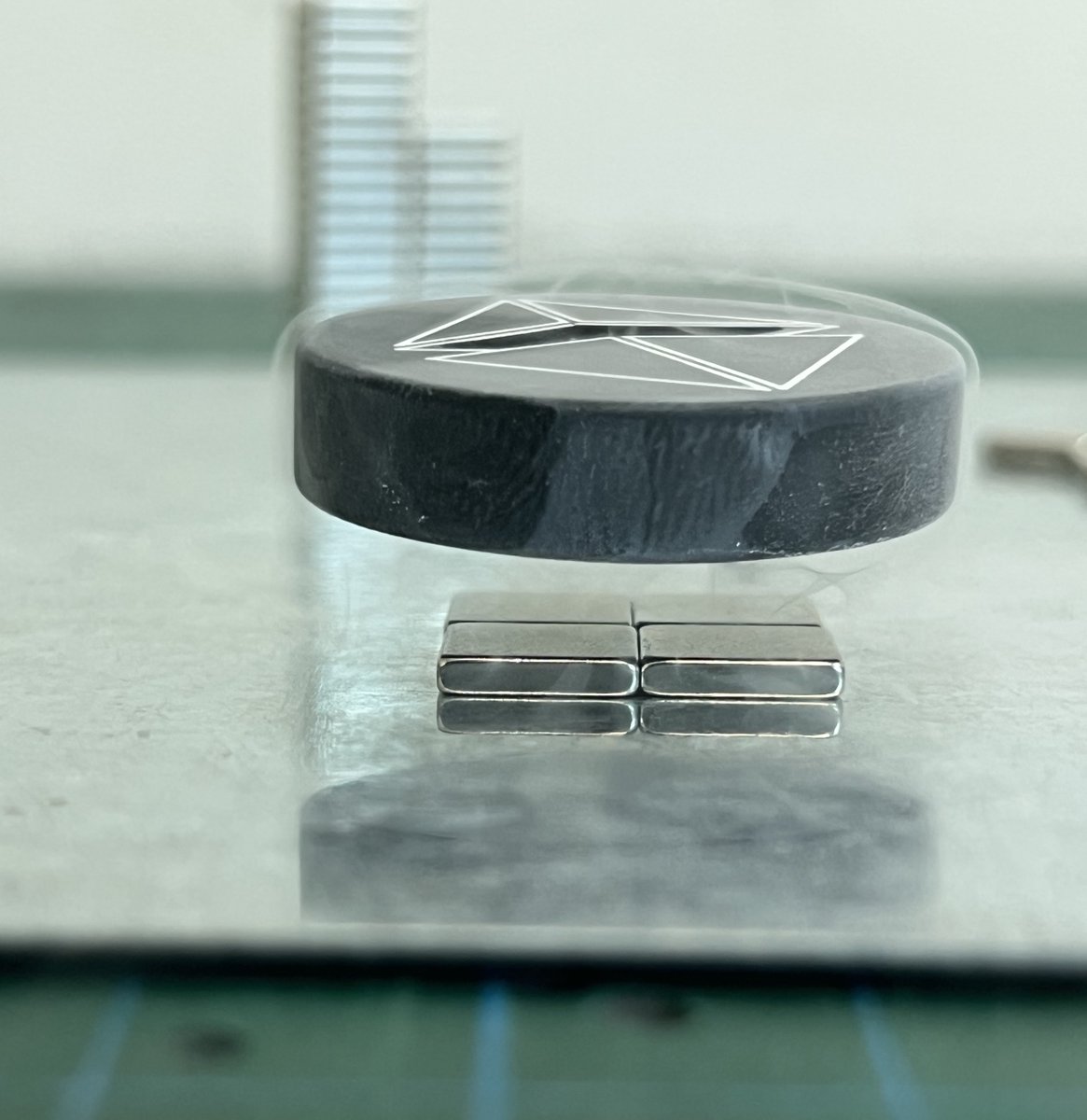
Quantum Locking - magnetic field lines inside the superconductor get pinned in certain areas locking the superconductor in place
mailchi.mp/2e91d2b8f568/w…
GIF
English
Boaz Almog retweeté

@A_J_Higgins Not sure what we’re seeing in the video (superconductor? Single magnet?). But flux pinning on a single magnet should be like that.
GIF
English

Either this is a very well-done fake, or we really did just enter the era of room temperature superconductors. What is seen here (stable levitation above a dipole magnet) can *only* be a result of flux pinning. If the sample was a previously known low temp SC that had been chilled—at this tiny size—it would quickly warm and quench. Also, no sign of condensation in the air.
Green Pill@DarkPillDigest
Unverified fully levitating #lk99 from China
English
@Andercot This is how flux pinning on a single magnet looks like. The magnetic field is uniform and the SC moves freely across the magnet and not locked.
GIF
English

First video of LK-99 Full Levitation, aka flux-pinning
This video was just posted to the Chinese video-sharing site BiliBili and claims to be a highly pure synthesized sample of LK-99.
What is the physical phenomenon behind this and what does it mean?
Levitation of superconducting materials is a phenomenon unique to what is called Type-II superconductors, and is an effect whereby magnetic field lines becomes 'trapped' as it passes through the material, providing the force needed to levitate. These are the popular images and videos of cryogenically-cooled discs floating above a magnet frequently seen online and in the pinned post on my profile.
You can think of this like strands of hair being caught in gum - the gum is suspended in mid-air by adhering strongly to the hair as the hair passes through it. The hair in this case is magnetic field lines and the gum is the Type-II superconductor. Just like hair comes in individual strands, or in other words hair is 'quantized' or 'discrete', so is the flux trapped at the 'pinning centers' quantized in what are called 'magnetic vortices' - the quantization of pinned flux lines is a key property and distinguishing characteristic of Type-II superconductors (although technically can occur in Type-I superconductors if the material thickness is smaller than the London penetration depth, which is indeed very small - specifics for the physics nerds out there).
Flux-pinning is entirely unique to superconductors and is also wholly distinct from the Meissner effect. It is not a property of diamagnets or diamagnetism.
At @TRIUMFLab I contributed to flux-pinning studies in Niobium crystal superconducting radio-frequency cavities used for particle acceleration. In that application, trapped flux poses an issue by increasing the remnant surface resistivity of the cavity, which has the effect of decreasing its effective quality factor or Q-factor, which is a measurement of a resonators efficiency. SRF cavities typically have Q-factors of 10E10 and trapped flux at pinning centers reduces the maximum effective accelerating electric field used to drive charged particle bunches close to the speed of light.
Flux pinning is thought to arise in some Type-II superconductors by small imperfections in the crystal, also called volume defects, that enable flux to penetrate the material. In SRF cavities an issue that arises is any magnetic field that is passing through the material, e.g. by the Earth's background field, can become pinned or trapped inside the cavity as it transitions into a superconducting state. See some attached plots in the comments from a study showing how the surface resistivity of SRF cavities increases the more there is a background field as the cavity transitions into superconducting state.
This is the first video I am aware of that claims to show the flux-pinned levitation of a LK-99 sample. If this is in fact what is happening, then it is a very unique and promising finding of this new materials properties and potential for future study.
If this is real then it is truly ground-breaking
English


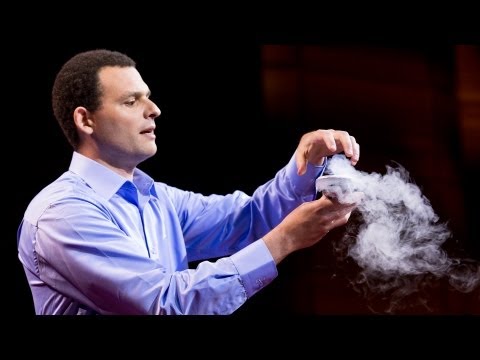
Agree that this looks to be the most compelling LK-99 video so far. I found this to be an approachable/fun explainer of what's happening: youtube.com/watch?v=PXHczj…
YouTube
Andrew Côté@Andercot
First video of LK-99 Full Levitation, aka flux-pinning This video was just posted to the Chinese video-sharing site BiliBili and claims to be a highly pure synthesized sample of LK-99. What is the physical phenomenon behind this and what does it mean? Levitation of superconducting materials is a phenomenon unique to what is called Type-II superconductors, and is an effect whereby magnetic field lines becomes 'trapped' as it passes through the material, providing the force needed to levitate. These are the popular images and videos of cryogenically-cooled discs floating above a magnet frequently seen online and in the pinned post on my profile. You can think of this like strands of hair being caught in gum - the gum is suspended in mid-air by adhering strongly to the hair as the hair passes through it. The hair in this case is magnetic field lines and the gum is the Type-II superconductor. Just like hair comes in individual strands, or in other words hair is 'quantized' or 'discrete', so is the flux trapped at the 'pinning centers' quantized in what are called 'magnetic vortices' - the quantization of pinned flux lines is a key property and distinguishing characteristic of Type-II superconductors (although technically can occur in Type-I superconductors if the material thickness is smaller than the London penetration depth, which is indeed very small - specifics for the physics nerds out there). Flux-pinning is entirely unique to superconductors and is also wholly distinct from the Meissner effect. It is not a property of diamagnets or diamagnetism. At @TRIUMFLab I contributed to flux-pinning studies in Niobium crystal superconducting radio-frequency cavities used for particle acceleration. In that application, trapped flux poses an issue by increasing the remnant surface resistivity of the cavity, which has the effect of decreasing its effective quality factor or Q-factor, which is a measurement of a resonators efficiency. SRF cavities typically have Q-factors of 10E10 and trapped flux at pinning centers reduces the maximum effective accelerating electric field used to drive charged particle bunches close to the speed of light. Flux pinning is thought to arise in some Type-II superconductors by small imperfections in the crystal, also called volume defects, that enable flux to penetrate the material. In SRF cavities an issue that arises is any magnetic field that is passing through the material, e.g. by the Earth's background field, can become pinned or trapped inside the cavity as it transitions into a superconducting state. See some attached plots in the comments from a study showing how the surface resistivity of SRF cavities increases the more there is a background field as the cavity transitions into superconducting state. This is the first video I am aware of that claims to show the flux-pinned levitation of a LK-99 sample. If this is in fact what is happening, then it is a very unique and promising finding of this new materials properties and potential for future study. If this is real then it is truly ground-breaking
English
Here's a video of a more traditional SC sample which is cooled down, showing the same kind of shakiness when slightly perturbed.
English
Boaz Almog retweeté

Vote Now!
🗳️Pivot Interactives is a finalist in the Edtech Readers' Choice Awards- public voting is open through April 19th!
🔗future.swoogo.com/2023edtechvoti…
English
Boaz Almog retweeté
🎉Time to celebrate🎉
Peter Bohacek, co-founder of Pivot Interactives, won the @edtechdigest 2023 Startup Founder Leadership Award!
He is electrical engineer by training, a #PAEMST award-winning physics teacher, and an innovative edtech leader.

English
Boaz Almog retweeté

. @cbsmornings featured @tamuphysastr’s own Dr. Tatiana on their #womenshistorymonth segment this morning! With a little physics magic and a lot of fun, she inspires new generations of women in STEM here at @tamu and beyond 🔭
Full segment here! #x" target="_blank" rel="nofollow noopener">cbsnews.com/video/texas-a-…
English


Boaz Almog retweeté
Boaz Almog retweeté

A very interesting story for those who did not follow. I followed it closely since Dirk van der Marel was involved in the investigation and I had several discussions with him on this affair.
science.org/content/articl…
English
Boaz Almog retweeté

Boaz Almog retweeté

We got to watch @QuantumLevitate rearrange salt with different tones at the #AAPTSM22! Who can explain why this happens? #iteachphysics
English
Boaz Almog retweeté
Check out our first demo with @quantumlev! They use electromagnetic and quantum levitation to levitate the superconducting discs you see in the video! This is an awesome demo for the classroom and even in culinary displays! Get more information at ow.ly/WClV50K1Ew5
English