Robin Jia

338 posts

Robin Jia banner
Robin Jia

Robin Jia

@robinomial

Assistant Professor @CSatUSC | Previously Visiting Researcher @facebookai | Stanford CS PhD @StanfordNLP

Los Angeles, CA Inscrit le Haziran 2018
914 Abonnements4.6K Abonnés
Robin Jia retweeté
Johnny Tian-Zheng Wei
Johnny Tian-Zheng Wei@johntzwei·
Hi all, I wrote a Claude code tutorial for ML researchers who have never done SWE in their life: sunny-goal-aba.notion.site/claude-code-tu… I never learned SWE myself, so maybe there are others in the same boat. This is NOT just tips on how to write CLAUDE.md. 70% of my notes are on SWE principles
English
2
5
32
1.5K
Robin Jia retweeté
Robin Jia retweeté
Qingchuan Yang
Qingchuan Yang@qcyang20xx·
𝗣𝗿𝗶𝘃𝗮𝘁𝗲 𝘀𝘆𝗻𝘁𝗵𝗲𝘁𝗶𝗰 𝘁𝗲𝘅𝘁 𝗴𝗲𝗻𝗲𝗿𝗮𝘁𝗶𝗼𝗻 has had the same problem for a while: privacy, quality, or efficiency - pick two 😵‍💫 We think 𝐄𝐏𝐒𝐕𝐞𝐜 changes that 🚀 Paper: arxiv.org/abs/2602.21218
Qingchuan Yang tweet media
English
1
5
12
2.7K
Robin Jia retweeté
Johnny Tian-Zheng Wei
Johnny Tian-Zheng Wei@johntzwei·
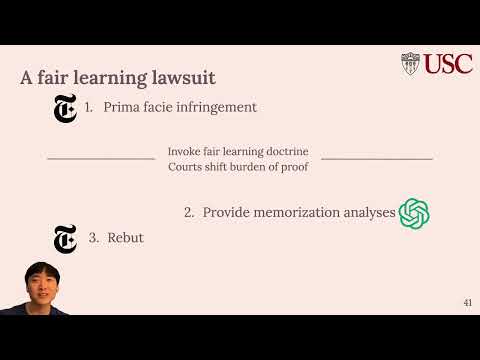
How might the law hold AI accountable? How can we promote the development of responsible AI? The copyright challenge to AI reveals some clues, and I gave my perspective in a recent talk @stanfordnlp: youtu.be/9_I--Qg3_cA?si… Feel free to reach out if you have questions!
YouTube video
YouTube
English
1
2
15
829
Robin Jia retweeté
Qinyuan Ye
Qinyuan Ye@qinyuan_ye·
Now accepted to ICLR 2026! Looking back, stepping into mechanistic interpretability in my final PhD year was such a risky bet. But it turned out to be very rewarding and I enjoyed every bit of it. (Working on a blog post to share this winding journey...)
Qinyuan Ye@qinyuan_ye

1+1=3 2+2=5 3+3=? Many language models (e.g., Llama 3 8B, Mistral v0.1 7B) will answer 7. But why? We dig into the model internals, uncover a function induction mechanism, and find that it’s broadly reused when models encounter surprises during in-context learning. 🧵

English
1
4
80
9.2K
Robin Jia retweeté
Deqing Fu
Deqing Fu@DeqingFu·
Fourier Number Embedding (FoNE) is accepted to #ICLR2026. Super excited! Check it out here: fouriernumber.github.io
Deqing Fu@DeqingFu

In our recent NeurIPS 2024 paper (openreview.net/forum?id=i4Mut…), we find pretrained LLMs use Fourier Features to add numbers (some called it helix recently). Is this representation truly powerful that LLMs naturally prefer it? Introducing FoNE (Fourier Number Embedding): one token is all you need to encode any number, precisely. 🖇️Blog post: fouriernumber.github.io

English
0
4
22
2.2K
Robin Jia retweeté
Stanford NLP Group
Stanford NLP Group@stanfordnlp·
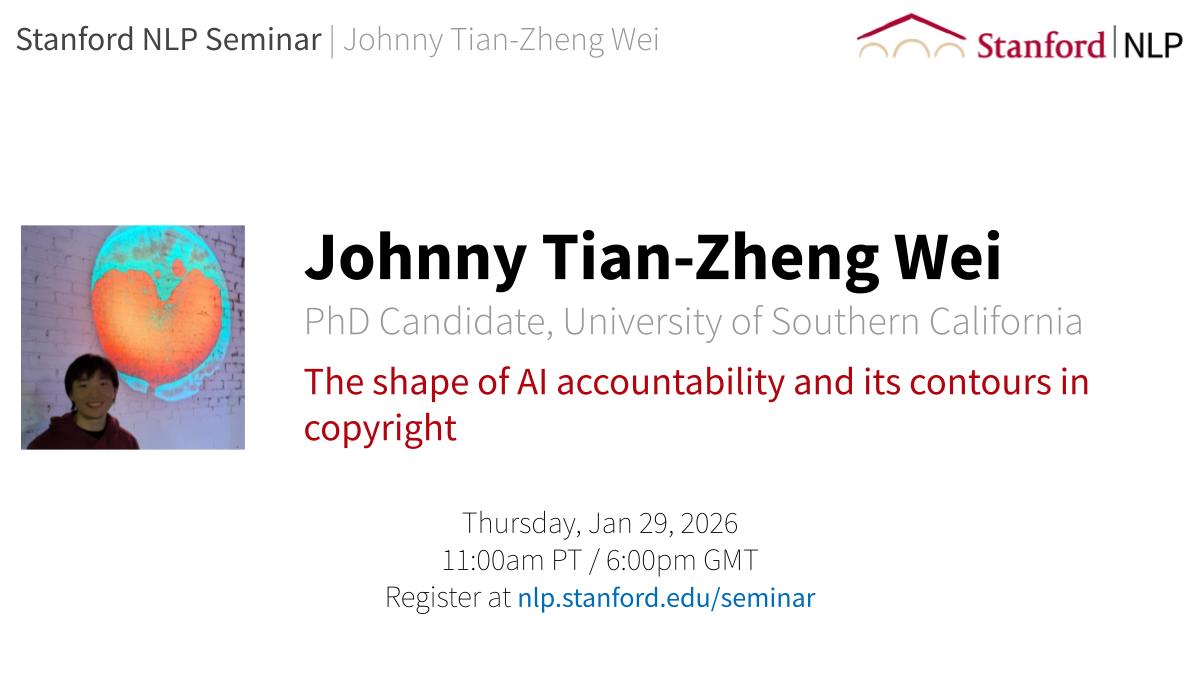
Hi everyone! For this week's seminar, we are excited to host @johntzwei from USC! Title: The shape of AI accountability and its contours in copyright Abstract: How do we establish accountability for AI? While the shape of AI accountability at large remains amorphous, its contours are revealed in the ongoing copyright challenge to AI. In this talk, I’ll outline a legal theory of change and situate two works in this context. The first work focuses on the legal setup, theorizing how the judiciary can establish copyright accountability for LLMs by interrogating LLM training decisions and examining how they affect the model's memorization. Further progress in copyright then depends on deriving best practices for auditing and mitigating undesirable memorization. The second work focuses on scientific follow up and our release of Hubble, a model suite to advance the study of LLM memorization. Hubble models are trained on English but also with controlled insertions of text designed to emulate key memorization risks. I’ll summarize the main findings and conclude on the potential of controlled insertions for safety-critical concerns beyond copyright. Date and Time: Thursday, 01/29, 11:00AM — 12:00 PM PST. Zoom: stanford.zoom.us/j/93941842999?… Excited to see everyone at the seminar!
Stanford NLP Group tweet media
English
1
9
37
4.6K
Robin Jia retweeté
Andrew Gordon Wilson
Andrew Gordon Wilson@andrewgwils·
Bach is so timeless because he wasn't writing for people, he was writing for a higher power. Try writing your next paper for God. Imagine how many rubbish papers we wouldn't see anymore. Your audience sees your every thought and intention. There would be no ego, no pretense.
English
5
21
284
36K
Robin Jia
Robin Jia@robinomial·
@Kangwook_Lee Hi Kangwook, cool work! You may be interested in our ACL Findings 2025 paper aclanthology.org/2025.findings-… we measure metric/judge bias and study bias reduction when the calibration and test data have outputs from different systems (the judge has to be applied to new systems' outputs)
English
1
0
4
507
Kangwook Lee
Kangwook Lee@Kangwook_Lee·
github.com/UW-Madison-Lee… Please find our preprint & code here. Any feedback would be greatly appreciated!
Kangwook Lee@Kangwook_Lee

LLM as a judge has become a dominant way to evaluate how good a model is at solving a task, since it works without a test set and handles cases where answers are not unique. But despite how widely this is used, almost all reported results are highly biased. Excited to share our preprint on how to properly use LLM as a judge. 🧵 === So how do people actually use LLM as a judge? Most people just use the LLM as an evaluator and report the empirical probability that the LLM says the answer looks correct. When the LLM is perfect, this works fine and gives an unbiased estimator. If the LLM is not perfect, this breaks. Consider a case where the LLM evaluates correctly 80 percent of the time. More specifically, if the answer is correct, the LLM says "this looks correct" with 80 percent probability, and the same 80 percent applies when the answer is actually incorrect. In this situation, you should not report the empirical probability, because it is biased. Why? Let the true probability of the tested model being correct be p. Then the empirical probability that the LLM says "correct" (= q) is q = 0.8p + 0.2(1 - p) = 0.2 + 0.6p So the unbiased estimate should be (q - 0.2) / 0.6 Things get even more interesting if the error pattern is asymmetric or if you do not know these error rates a priori. === So what does this mean? First, follow the suggested guideline in our preprint. There is no free lunch. You cannot evaluate how good your model is unless your LLM as a judge is known to be perfect at judging it. Depending on how close it is to a perfect evaluator, you need a sufficient size of test set (= calibration set) to estimate the evaluator’s error rates, and then you must correct for them. Second, very unfortunately, many findings we have seen in papers over the past few years need to be revisited. Unless two papers used the exact same LLM as a judge, comparing results across them could have produced false claims. The improvement could simply come from changing the evaluation pipeline slightly. A rigorous meta study is urgently needed. === tldr: (1) Almost all LLM-as-a-judge evaluations in the past few years were reported with a biased estimator. (2) It is easy to fix, so wait for our full preprint. (3) Many LLM-as-a-judge results should be taken with grains of salt. Full preprint coming in a few days, so stay tuned! Amazing work by my students and collaborators. @chungpa_lee @tomzeng200 @jongwonjeong123 and @jysohn1108

English
5
16
170
33.4K
Robin Jia retweeté
Alex Spangher @ Neurips2025
Alex Spangher @ Neurips2025@AlexanderSpangh·
✨ Very overdue update: I'll be starting as an Assistant Professor in CS at University of Minnesota, Twin Cities, Fall 2026. I will be recruiting PhD students!! Please help me spread the word! [Thread] 1/n
Alex Spangher @ Neurips2025 tweet media
English
40
142
744
91.6K
Robin Jia retweeté
Ian Magnusson
Ian Magnusson@IanMagnusson·
So excited to check out this suite of models! Systematic and open experiments like these are how we will actually crack the science of language modeling! Great work @johntzwei and team 🤩
Johnny Tian-Zheng Wei@johntzwei

Announcing 🔭✨Hubble, a suite of open-source LLMs to advance the study of memorization! Pretrained models up to 8B params, with controlled insertion of texts (e.g., book passages, biographies, test sets, and more!) designed to emulate key memorization risks 🧵

English
1
2
5
857
Robin Jia retweeté
Johnny Tian-Zheng Wei
Johnny Tian-Zheng Wei@johntzwei·
We are building a research stack on top of Hubble 🔭! TokenSmith consolidates our code used to perturb our datasets and lets you view, edit, and search through pretraining data. Work led by @Aflah02101 and @ameya_godbole1, Aflah will be at #EMNLP2025 !! aflah02.github.io/TokenSmith/
Johnny Tian-Zheng Wei@johntzwei

Announcing 🔭✨Hubble, a suite of open-source LLMs to advance the study of memorization! Pretrained models up to 8B params, with controlled insertion of texts (e.g., book passages, biographies, test sets, and more!) designed to emulate key memorization risks 🧵

English
0
4
20
4.6K
Robin Jia retweeté
Percy Liang
Percy Liang@percyliang·
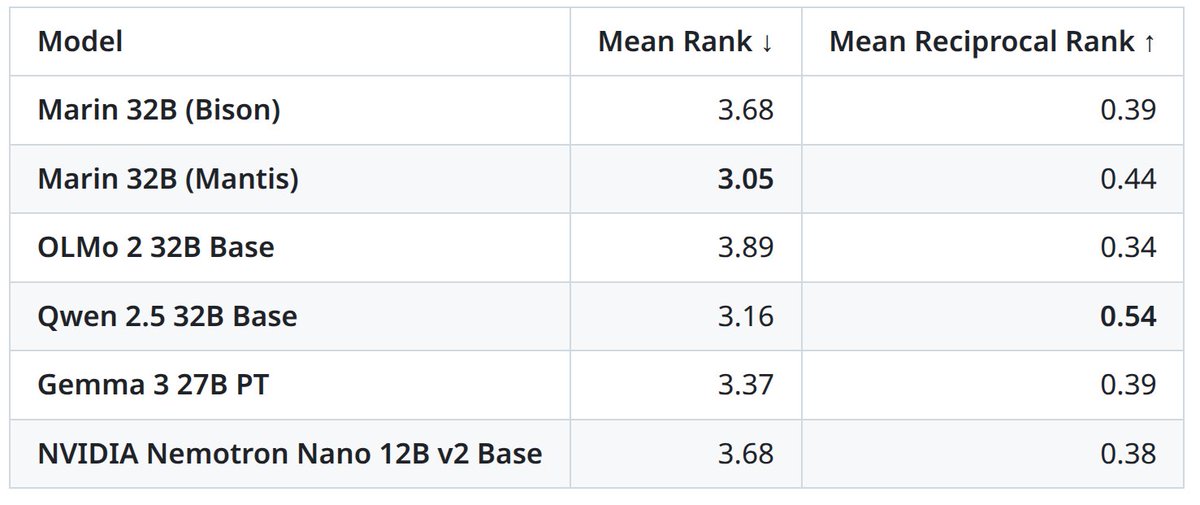
⛵Marin 32B Base (mantis) is done training! It is the best open-source base model (beating OLMo 2 32B Base) and it’s even close to the best comparably-sized open-weight base models, Gemma 3 27B PT and Qwen 2.5 32B Base. Ranking across 19 benchmarks:
Percy Liang tweet media
English
20
87
599
126.6K
Robin Jia retweeté
Qinyuan Ye
Qinyuan Ye@qinyuan_ye·
If you work on LLM memorization, membership inference, or unlearning, ✨ Hubble 🔭 is here for you — fully open-source models pre-trained with controlled perturbations, built to power your scientific exploration!
Johnny Tian-Zheng Wei@johntzwei

Announcing 🔭✨Hubble, a suite of open-source LLMs to advance the study of memorization! Pretrained models up to 8B params, with controlled insertion of texts (e.g., book passages, biographies, test sets, and more!) designed to emulate key memorization risks 🧵

English
0
2
8
1.5K
Robin Jia retweeté