HedgeFund Hustle

9 posts

HedgeFund Hustle

HedgeFund Hustle

@HedgeInsight

Retired PM at multi-billion L/S fund. Sharing career advice and insights to help aspiring analysts break into the hedge fund world. Not Investment Advice

शामिल हुए Haziran 2024
0 फ़ॉलोइंग1.7K फ़ॉलोवर्स
पिन किया गया ट्वीट
HedgeFund Hustle
HedgeFund Hustle@HedgeInsight·
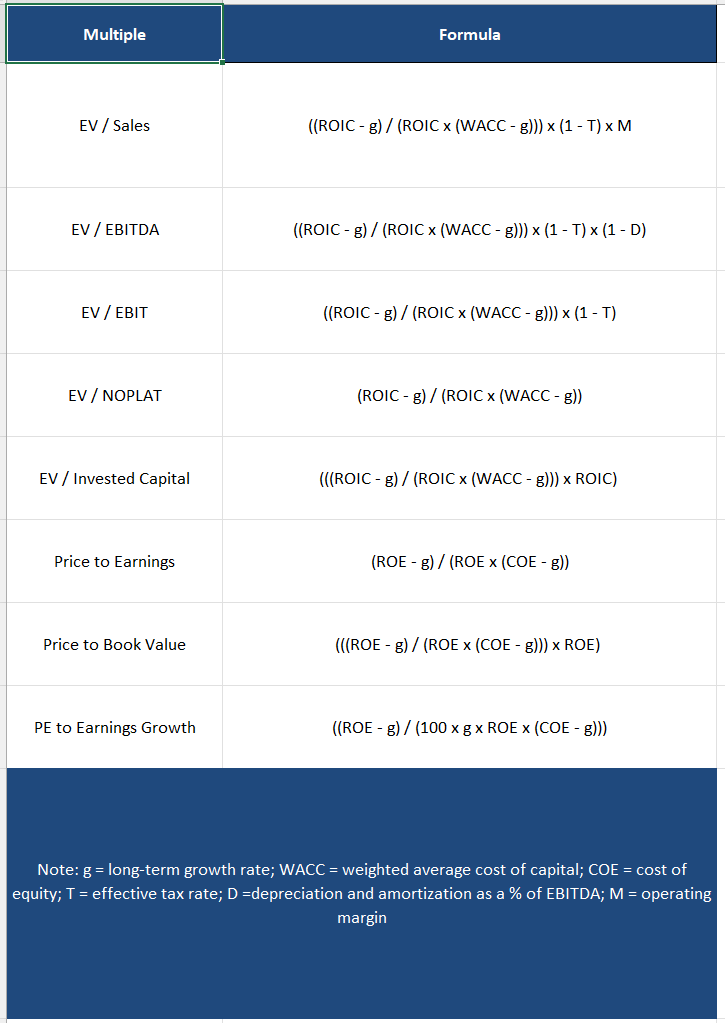
Using a quantitative framework to understand which factors have the greatest impact on valuation multiples Important quantitative drivers of a valuation multiple are return on capital, cost of capital, growth, and duration of growth. From a quantitative perspective, it is important to understand which factors will have the greatest impact on a company's valuation multiple - What is the impact to the multiple from a 1% change in the return on capital? What is the impact from 2 points of long term growth to the multiple? Target multiples can be derived based on these underlying drivers using the formulas below. The formulas below assume that value-adding growth will continue perpetually. This is a simplifying assumption but more realistic two-stage versions of the formulas can be used which incorporate an initial growth period followed by a terminal period. Comment below if you'd like the excel file with the one stage formulas, two stage formulas, and their derivations.
HedgeFund Hustle tweet media
English
119
43
433
87.5K
Jared L Kubin
Jared L Kubin@JaredKubin·
@HedgeInsight Sands Capital is legendary. I’d put Tom Trentman up against anyone in TMT that has longer than a 1Q horizon. And a super awesome person which is rare in HF industry.
English
1
0
0
608
HedgeFund Hustle
HedgeFund Hustle@HedgeInsight·
Great podcast with Brian Christiansen from Sands Capital. Insightful discussion regarding the firm's approach to growth investing and the six investment principles that the firm employs: Sustainable above-average earnings growth Leadership position in a promising business space Significant competitive advantages/unique business franchise Clear mission and value-added focus. Financial strength Rational valuation relative to the market and business prospects capitalallocators.com/podcast/high-c…
English
1
0
17
3.3K
HedgeFund Hustle
HedgeFund Hustle@HedgeInsight·
Time Arbitrage: Is time on their side? Does time benefit the company by bringing significant opportunities closer (i.e. significant growth in demand, market share gains, cost deflation, margin expansion, etc) ? OR Does time work against them and is the business a melting ice cube (i.e. market share losses, declining demand, technological disruption)? The market is often good at discounting the near term, but greater opportunity often exists in the mid and long term where there is greater variability in earnings estimates When so much attention is focused on the quarter itself, think through the post-earnings print setup: Who is the incremental buyer/seller post print and what are they playing for? Will conditions improve or deteriorate from this point? What does the rate of change and second derivative look like going forward? Transition / restructuring years can present excellent opportunities, often sooner than expected. Fast money often sell or short stocks that are in these transition periods, opening up exciting arbitrage opportunities for those who believe the company will emerge stronger On the flip side, stocks can swiftly rise to price in management’s long-term goals presented at analyst day events. Think of this as a free put option on management’s execution skills. Shorting these situations is especially potent for companies with weak track records or overly optimistic forecasts
English
0
1
6
1.6K
HedgeFund Hustle
HedgeFund Hustle@HedgeInsight·
Key concepts to understand how L/S equity multi managers think about risk: $Vol: Rather than thinking of a portfolio solely in terms of gross capital, many L/S PMs think about their portfolio in terms of $Vol. $Vol is the standard deviation of the portfolio's returns in dollar terms (% Annual Vol X Gross Capital). So assuming a $1bn portfolio at 4% vol is $40mm in terms of $Vol. An average PM with a 1.0 Sharpe Ratio thus should be putting up $40mm of P&L on an average year on this portfolio. Risk Model: Factor models are used to dissect the sources of volatility and limit unintended exposures (style factors like growth, value, momentum, size, etc) and concentrate risk related to the core ideas that cannot be explained by style factors (idiosyncratic volatility). Requirements are typically put in place such that a portfolio's volatility must be sourced from a certain idio threshold (60-85%) to minimize factor risk. Leverage: More leverage is used on portfolios with lower volatility and less on those with higher volatility all else equal. Typically leverage ranges from 2x to 5x on a given portfolio. Liquidity: It's crucial to be able to exit positions quickly upon realization of your thesis OR when the facts have changed and your thesis is broken. Rule of thumb: Limiting the size of a position to 30% of one day's ADTV (average daily trading volume) ensures you can exit within ten trading days without significantly impacting the stock price (by being ~3% of volume per day) Concentration: There are obviously a wide range of concentration limits and investing styles across the industry on how big an individual position can be of a portfolio, but a key rule of thumb: if a position is so large it dictates how your day is going and your focus, then it's too big and you will inevitably take your eyes off the ball from the rest of your portfolio and coverage. #HedgeFunds #RiskManagement #Volatility #Leverage #Liquidity #Concentration
English
5
26
232
60.9K
HedgeFund Hustle
HedgeFund Hustle@HedgeInsight·
Hedge fund titan Seth Klarman shakes up Baupost Group: 19% of investing team cut in biggest restructuring in firm history. Layoffs concentrated in the real estate and equities units. Shifting focus to distressed debt, special situations, private investments, and capital solutions
English
0
0
11
2.6K
Rich Falk-Wallace
Rich Falk-Wallace@richfalkwallace·
"Orthogonalization" The problem statement is: You have a risk model that divides both forward risk and historical performance into systematic and idiosyncratic components. And you have decided to manage those core model factors in whatever way you want, anywhere along a spectrum from simple awareness to intraday neutralization. But you would now like to drill deeper into the idiosyncratic component of risk & performance: 1) Are there any systematic exposures buried inside idio not already captured by the factors you are using in your core risk model? 2) Can you explain some of the realized historical idiosyncratic performance as a function of aspects that are not purely company-specific? The first question runs into an ongoing debate about 'parsimony' in risk models: what set of risk factors explains systematic risk without overloading a factor model with so many (and so rapidly changing a set of) factors that it is impossible to actually manage a portfolio against? The second runs up against the deeper question of what it means for a return to be factor-driven vs. idiosyncratic. Ultimately, how to truly divide alpha and beta. The details of those debates can be settled another time. But in the context of those questions, “orthogonalization" (or "residualization") exists to allow yet another layer of decomposition more granular than factor vs idio, this time to decompose the idiosyncratic component itself. Why would you want to do this? A few reasons: For discretionary investors, the reality is you are intimately aware of many more systematic drivers of your stocks than can be captured in core style & industry factors. Orthogonalization captures exposures & performance associated with industry-specific datasets or macros you care about, nuances around consensus estimate revisions, varying momentum windows, options signals, and of course, crowding - either globally or sector-relative. In principle, each of those items could of course be integrated into a core risk factor set, explicitly limiting exposures & pro forma vol against each of those more nuanced, custom factors. But in practice, most firms that care intensely about these topics perform this separation of factor-types using orthogonalization: A relatively parsimonious set of core style & industry risk factors against which books must be managed. And a more extensive set of custom orthogonal factors that are used as awareness and insight tools, but do not limit risk taking. All of which produces a proactive as opposed to reactive approach to factor risk & performance, and to understanding the drivers before they become the only thing you can focus on. The sheet walks through orthogonalization math, building from the earlier factor model to layer in custom loadings, returns, and attribution. With strong engineering & data infrastructure, the math is doable. What you do with it is a different question. Let know if you'd like the excel.
Rich Falk-Wallace tweet media
English
28
18
164
23.2K
Rich Falk-Wallace
Rich Falk-Wallace@richfalkwallace·
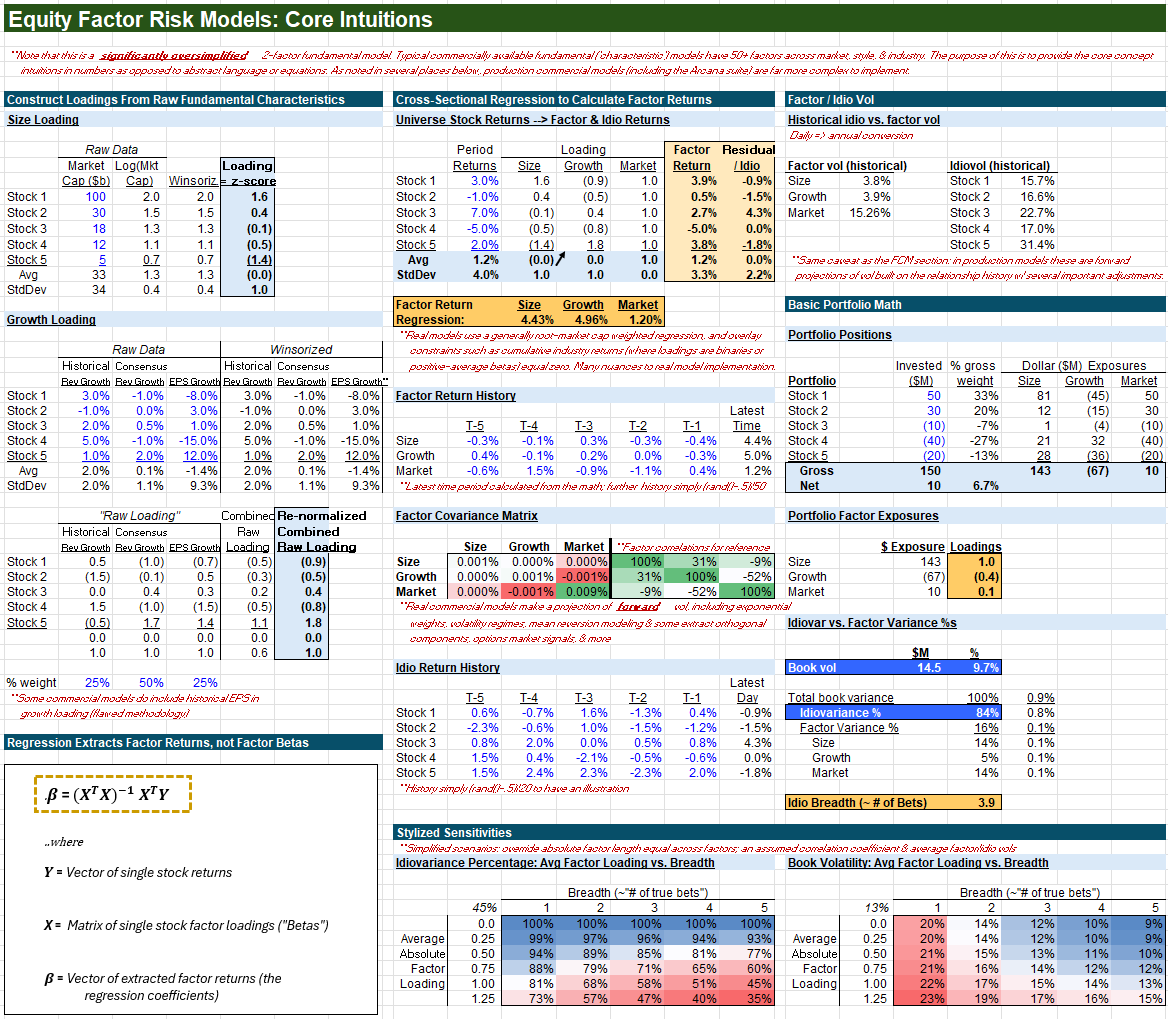
Risk models increasingly drive the behavior of fundamental long short equity investors. @__paleologo's 'Advanced Portfolio Management' is the most efficient primer to understand the internals of what is happening. Chapter 1-4 bullets, with math & comments. Let know if you'd like the excel. *1) Risk, alpha, factors, & performance (Ch 1-3)* "Any argument in favor of conflating beta and alpha is weaker than the simple argument in favor of decomposing them." In the simple version, stocks contain components of both: 1) Systematic (factor) returns driven by common attributes across names, and 2) Idiosyncratic (residual) returns driven by specific attributes of each. Most investors accept this distinction at a high level. But the nuance is: How sophisticated should your modeling of this "systematic" component be? The first intellectual step beyond simple benchmarking is to look at historical beta: running a univariate regression between stock & market. But simple betas are imprecise for several reasons, among them that they conflate one-time idio moves with recurring systematic relationships; and they also gloss over other often large systematic drivers (industry, growth, value, momentum). Factor models in principle address those limitations: If a simple benchmark "gives us a way to describe performance and variation of stock returns," the solution is "factor models[, which] capture these two intuitive facts, make it rigorous, and extend them in many directions." *2) How to build a factor model (Ch 4)* There are many flavors of plausible factor models, and Gappy outlines 3 (fundamental/characteristic, statistical, time-series). As Gappy points out: "Each of these approaches has its merits and drawbacks" and he covers several of the core tradeoffs at the outset of the chapter. But "the characteristic model has the benefit of being interpretable by the managers" and "can be extended with new characteristics and perform quite well in practical applications." The result is that "because of these two decisive advantages, the fundamental (or characteristic) method is by far the most used model by fundamental managers." To build a fundamental factor model, the starting point are company attributes which are transformed into "loadings" (betas) of a stock to that attribute's returns. For example: The "size" loading is the simplest factor, and starts with the log of the stock's market cap compared to other market caps in the universe you care about. The size loading is then its z-score (# of standard deviations away from avg) in that universe. (In the weeds, data is winzorized, may use EWMAs, and more). But armed with those loadings, the model then pulls factor returns by running cross-sectional regressions of stock returns against their loadings. Restated in math: The Y vector is each stock in the universe's return over the period, The X matrix is all of their loadings. The time series of those extracted factor returns then drives factor covariances (the FCM), residual returns, mimicking portfolios, idiovar%s, breadth, vol, and more. There is much more worth spending time on here, but particularly to arm the fundamental investor with the basic mathematical intuitions, I've attached a very simplified fundamental factor model. Will cover many other topics Gappy touches on another time: attribution, sizing skill, factor detail, PCAs & non-linearity, Sharpes & ICs, optimization, vol, & leverage. But stepping back, the reason this all matters is simple: "empirically, most PMs have no skill in style factors whatsoever, and a few have very moderate skills in having exposures to industries or sectors." The book's meta theme is intellectual honesty: "The simplest and deepest challenge is to understand the limits of your knowledge." Factor models rigorously separate what analysts can predict about single stocks, from what they cannot. As Gappy points out, "you are entering an industry in transition." Let know if you'd like the excel.
Rich Falk-Wallace tweet media
English
275
92
763
298K