Mitch

1.7K posts

Mitch banner
Mitch

Mitch

@benjaminprinter

just a retard pushing buttons | b2b degen

शामिल हुए Kasım 2023
42 फ़ॉलोइंग10.3K फ़ॉलोवर्स
पिन किया गया ट्वीट
Mitch
Mitch@benjaminprinter·
Here is the reason why many agencies/consultants are allergic to 6 figure deals : (should be behind a paywall) The problem isn’t your offer, it’s your fundamental misunderstanding of how corporate money actually moves When you position yourself as an "optional marketing expense," you're already drowning Top-tier agencies and consultants NEVER sell themselves this way Instead, they position their service as a MANDATORY MARKET PROTECTION strategy Let me cook The psychological shift is MASSIVE When you say "We'll improve your marketing," clients ask themselves "Do I need this?" which ALWAYS results in a no But when you say "Your biggest competitor just restructured their positioning and is capturing 80% of deals in your space" The conversation shifts from “Do I need this ?” to “How much am I ALREADY losing ?” And decision makers don’t like to feel behind They don’t need “better marketing” They need competitive insurance Here’s what 99% of agencies & consultants fail to understand : EVERY company has multiple budget pools with millions sitting there They just haven't allocated it to YOU yet because you haven't framed your offer correctly The growth budgets alone can be $2M+ in most medium-sized businesses The compliance & risk mitigation reserves often remain untapped These are GOLDMINES, while everyone and their mum fights over the scraps in oversaturated marketing budgets Your prospects don't have a money problem, they have a PRIORITY problem Fix that and watch budgets magically appear And keep in mind that most business owners and CEOs don’t think logically about budgets They allocate money based on : - perceived urgency (fire drills always get funded first) - power struggles (whichever department makes the most noise wins) - boardroom politics (whoever has the CEO’s ear controls cashflow) But when you show an executive how their current strategy is booty cheeks and that they NEED work on budget allocation, they don't "find new money" - they REALLOCATE from lower priorities and underperforming initiatives Stop selling your solution and start selling better allocation of EXISTING resources : 1 - Find an underperforming spend (ex : outdated ad spend, underutilized tech, inefficient labor costs etc) 2 - Expose the financial leakage (ex : your team spends $500k/year on outbound prospecting, but 78% of those leads never convert because of poor nurturing systems) 3 - Redirect that money to you (ex : If we just reallocate 15% of that, we can turn it into $2M net profit within 6 months) Now the company sees ZERO new spending, just a smarter budget move Executives love this because it makes them look like financial geniuses (they’re not) Most consultants sell a single benefit but you gotta sell CHAIN REACTIONS inside the company BUDGET MOVES LIKE DOMINOES So if you can prove that spending money in one area will create multiple financial gains across departments, the company has NO CHOICE but to approve your deal $$$
English
26
30
654
89.7K
Mitch
Mitch@benjaminprinter·
If you want to : - Build offers rich people chase you to buy - Close $30K-$100K+ deals without showing your face - Turn every social platform into your personal ATM - Outsmart every clown in your market DM “SOVEREIGN” to get access to our private program
English
0
0
0
152
Mitch
Mitch@benjaminprinter·
Feedback loops are the only way to develop taste, judgment, and conviction You can't think your way into knowing what works You have to run the play, see what happens, extract the signal, adjust, and run again The operators who develop what looks like intuition didn’t get it from "rebuilding their website" They got it from 500 reps of sending, calling, pitching, failing, adjusting Intuition is just pattern recognition built on massive volume
English
3
1
28
679
Mitch
Mitch@benjaminprinter·
Find two or three semi-retired executives in your target industry Ask them to join your advisory board Offer a small equity stake or a referral fee Their names on your website, your proposals, and your pitch deck instantly signal credibility that would normally take five years to build You just acquired authority for the cost of a few dinners and a revenue share agreement
English
13
30
628
36.5K
Mitch
Mitch@benjaminprinter·
If you want to : - Build offers rich people chase you to buy - Close $30K-$100K+ deals without showing your face - Turn every social platform into your personal ATM - Outsmart every clown in your market DM “SOVEREIGN” to get access to our private program
English
0
0
1
208
Mitch
Mitch@benjaminprinter·
There's a reason the most expensive restaurants in the world have the smallest menus 6 items Maybe 8 Each one perfect The presentation is immaculate The waiter doesn't rush you The bill arrives without you asking Everything is curated Everything communicates "we have decided what excellence looks like and we refuse to dilute it" Now look at your service menu You offer lead generation, outbound, content, funnels, positioning, sales support, and “strategy” That's a buffet And buffets are cheap Nobody walks into a buffet expecting a $200/plate experience The moment you list 8 services, you've told the buyer you're a generalist who'll do whatever they'll pay for Strip it to one thing The one outcome you produce better than anyone Present it with the precision of a 6-item menu at a Michelin restaurant That constraint is what creates the perception of mastery And mastery is what commands premium pricing
English
2
1
27
942
Mitch
Mitch@benjaminprinter·
Let me run the math on your life right now Because most of you are hiding behind a topline number that sounds solid while living an economic reality that's quietly devastating You say you make $20K/month That sounds like $240K/year That sounds like "I'm doing okay" Mf you're not doing okay You bring in $20K a month, then you pay for tools, software, and infrastructure, which is easily around $1,000 You pay for contractors and fulfillment because you can’t do everything yourself anymore, which realistically lands somewhere between $3K and $5K You spend another $500 to $1,000 just to keep your pipeline alive through tools or light acquisition Now you’re sitting somewhere around $13K to $15K before taxes Then taxes hit Depending on how you’re structured and where you live, you’re losing roughly 25 to 35 percent, which brings you down to around $8K to $10K That’s your real monthly income, not the $20K you like to quote Now life starts You pay rent, which is easily around $2.5K if you’re being conservative You spend $600 to $800 on food, another $500 on transport, and $400 to $600 on phone, internet, and insurance Add basic lifestyle expenses and helping your family, and you’re quickly at $4.5K to $6K a month without doing anything extravagant What’s left is $2K to $4K That’s your entire financial margin That’s what you have to save, invest, handle emergencies, fund growth, and absorb volatility One client leaves and half of that disappears One bad month and you’re tight Two bad months and you’re in a hole Now look at the exact same operator with the exact same skills, but in a different market with a different buyer and a different pricing structure That same mf is making $50K a month, not through volume but through positioning, with three clients paying between $15K and $18K Their costs go up slightly because they have better support and delivery, so they’re spending around $8K total That leaves them at $42K before taxes and roughly $25K after They’re living a better version of the same life, spending maybe $8K a month across rent, food, transport, and everything else, but they’re left with around $17K in actual surplus Not revenue, but real money left after everything is paid Now compare the two realities The $20K model leaves you with roughly $3K a month, while the $50K model leaves you with around $17K That’s a $14K monthly gap, or roughly $168K a year, created without working more or learning new skills Over three years, that difference compounds into something structural The $20K model might leave you with $100K total surplus on paper, but in reality a large part of that gets eaten by life, bad months, and unexpected costs, so you end up with maybe $40K-$60K if you’re disciplined The $50K model generates over $580K in surplus across the same period, and even after living better and spending more, you’re still sitting on $300K+ in deployable capital That’s the difference between having options and constantly managing risk Between being able to invest, take time off, or pivot when needed, and being one bad quarter away from going backwards And nothing changed except who you sell to, how you position yourself, and what you charge Same brain, same hours, different coordinates If you want to rebuild this around better buyers, better pricing, and actual margin, DM “SOVEREIGN” and we’ll show you how to fix it
English
1
0
28
2.7K
Mitch
Mitch@benjaminprinter·
If you want to : - Build offers rich people chase you to buy - Close $30K-$100K+ deals without showing your face - Turn every social platform into your personal ATM - Outsmart every clown in your market DM “SOVEREIGN” to get access to our private program
English
0
0
0
171
Mitch
Mitch@benjaminprinter·
Your price depends on what happens to money after your work is delivered Most consultants still build pricing around effort They calculate hours, assign a rate, and multiply the two A forty-hour project at $150 per hour becomes a $6,000 engagement That logic comes from employment An operator approaches the same situation differently The question shifts toward the financial impact created once the work exists inside the business If the system changes the company’s revenue trajectory by $400K per year, the price reflects that shift A $40K engagement aligns naturally with that outcome The deliverable stays identical The hours stay identical The anchor changes Pricing anchored to labor creates immediate friction The buyer starts breaking down inputs They evaluate how many hours are truly required, compare alternatives, and look for ways to reduce the scope The conversation revolves around cost control Pricing anchored to capital movement produces a different reaction The buyer evaluates the relationship between the outcome and the investment If $40K produces $400K, the conversation moves toward execution rather than negotiation The anchor determines how the price is perceived There are five ways your work affects capital inside an organization Every consulting offer fits into at least one of these categories Pricing should always reference the one with the highest financial weight The first is revenue expansion The work increases revenue by improving conversion, increasing deal size, shortening sales cycles, or opening new markets This lever gets used frequently, but it often lacks urgency Growth feels optional when the business already performs well The argument becomes stronger when the current trajectory looks weak compared to the market A company growing at 15% inside a market growing at 30% loses position every quarter That gap compounds over time The engagement becomes a way to recover lost ground rather than chase marginal growth The second is revenue protection The work reduces loss Churn decreases Retention improves Existing revenue stays inside the business This carries more weight than expansion because the loss already exists A company generating $10M with 15% churn loses $1.5M annually before growth even starts Reducing that loss creates immediate impact The price aligns with the revenue preserved The third is revenue stability The work makes revenue predictable Pipeline becomes consistent Forecasting improves Volatility decreases When revenue is unpredictable, the company can't hire with confidence So they either over-hire (burning margin) or under-hire (burning opportunity) They can't forecast inventory, capacity, or cash flow They make reactive decisions instead of strategic ones Banks and investors see volatile revenue and assign higher risk premiums The cost of capital goes up Credit terms get worse None of this shows up on a P&L line item called "instability cost" But it's there In every hiring mistake, every missed forecast, every interest rate premium, and every quarter spent reacting to revenue swings instead of building the business When you stabilize revenue, you fix the entire decision-making infrastructure of the company "Your revenue has fluctuated between $600K and $1.1M per month for the last 18 months. That variance is making it impossible to forecast, hire, or negotiate favorable credit terms. My engagement installs pipeline infrastructure that compresses that variance to $800K-$1M. When your CFO can predict next quarter within 10% accuracy instead of 40%, your cost of capital drops, your hiring efficiency improves, and your leadership starts managing growth" The fourth is operational efficiency Your work eliminates wasted time, redundant processes, misallocated resources, or inefficient workflows Every company above $5M has senior people doing $30/hour tasks The VP of Sales spending 10 hours/week updating a spreadsheet The operations director manually routing orders The CFO reconciling invoices by hand because nobody ever built the integration That VP's time is worth $300/hour He's spending 10 hours/week on $30/hour work That's $2,700/week in misallocated capital $140K/year And he's not doing the $300/hour work (closing deals, building partnerships, developing strategy) because the $30/hour work is eating his calendar So the real cost isn't just the $140K in wasted salary It's the $300/hour activities he's NOT doing If 10 hours of recovered senior time produces $500K in deals per year, the total cost of the drag is $640K "Your three senior people are spending a combined 30 hours per week on tasks that should be automated or delegated to a $50K/year coordinator. That's $400K/year in misallocated senior capacity plus the deal flow and strategic output they're not producing because their calendars are full of admin. My $25K engagement restructures your workflow and recovers 30 hours/week of senior time. The ROI isn't my fee versus the automation cost. It's my fee versus the $400K+ in trapped capacity that gets released" The fifth is risk reduction The work reduces exposure to financial, legal, or operational risk Regulatory penalties, compliance failures, and capital loss all fall into this category The scale of risk often exceeds the size of the engagement A company facing multi-million exposure treats the fee as protection rather than expense The price aligns with the magnitude of the risk removed Using this framework during a sales conversation requires a shift in sequence The discussion starts with a diagnostic Questions map how capital currently moves through the business Pipeline, conversion rates, deal sizes, churn, operational time allocation The numbers come from the client Once the data is clear, the financial impact becomes visible Missed deals, lost revenue, misallocated time, and churn combine into a measurable cost That number frames the entire conversation The engagement fee sits against that number The buyer compares the investment to the cost of maintaining the current situation The decision becomes obvious The work stays the same The price changes because the reference point changes The conversation moves from cost to capital And once that shift happens, the real risk inside the room is no longer the fee It is everything that continues to happen if nothing changes
English
4
0
31
968
Mitch
Mitch@benjaminprinter·
If you want to : - Build offers rich people chase you to buy - Close $30K-$100K+ deals without showing your face - Turn every social platform into your personal ATM - Outsmart every clown in your market DM “SOVEREIGN” to get access to our private program
English
0
0
1
186
Mitch
Mitch@benjaminprinter·
Use LinkedIn's "People also viewed" sidebar to map your prospect's entire vendor network Go to the prospect's profile Look at who LinkedIn suggests alongside them You'll see their lawyer, their accountant, their current consultant, their PR firm LinkedIn clusters people by relationship proximity Now you know every advisor in their ecosystem Reach out to the ones who aren't competitors and propose a referral partnership You just mapped a deal network in 3 minutes that would take most people 6 months of “networking” to uncover
English
2
2
30
1.8K
Mitch
Mitch@benjaminprinter·
If you want to : - Build offers rich people chase you to buy - Close $30K-$100K+ deals without showing your face - Turn every social platform into your personal ATM - Outsmart every clown in your market DM “SOVEREIGN” to get access to our private program
English
0
0
1
224
Mitch
Mitch@benjaminprinter·
This is a method I’ve personally used to enter industries I wasn’t familiar with and still close $20K+ deals Step one Pick the top 5 agencies or consultants already selling into your target vertical Build a simple one-page website for a company in that space and create a matching email address Now book sales calls with all 5 as a prospect for their service Go through their entire sales process Ask everything What’s included, how they price, what results they push, their timeline, who they’ve worked with Record the calls Within a few days, you now have the full playbook of the best operators in your market Their pricing, their objection handling, their delivery model, their close process Your offer is ready to be assembled Step two Now switch sides Book calls with companies in that same vertical These are your actual future clients This time, position yourself as a potential customer of their business Go through their entire sales process from the buyer side Experience their funnel, their follow-up, their pitch, their proposal, their pricing Now compare what you experienced with the offer you built in step one You’ve just identified where their revenue system is leaking by going through it yourself Step three Go back to those same companies, this time as a consultant “I went through your sales process as a buyer. Here are three points where you’re losing deals and what that’s likely costing you per quarter” Nobody else approaches them like this The level of specificity alone gets you the meeting
Mitch tweet media
English
3
2
56
2K
Mitch
Mitch@benjaminprinter·
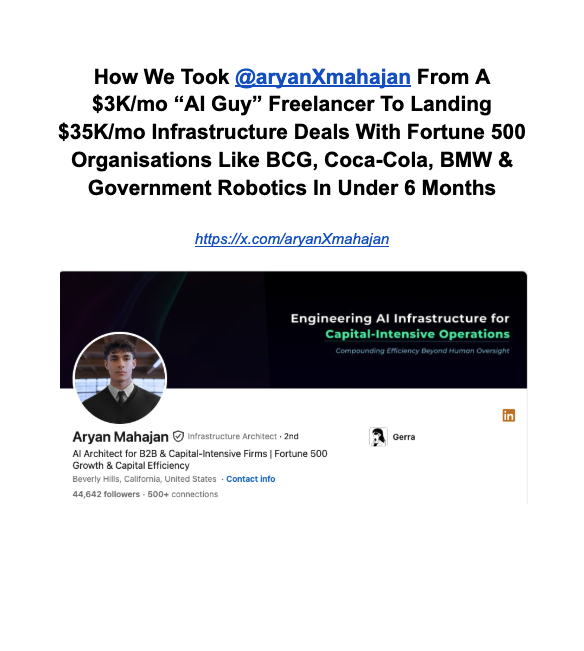
Alright mfs, just crafted a banger How we took a client from a $3K/mo "AI guy" to $100k/mo+ by landing $35K/mo deals with Fortune 500s like BCG, Coca-Cola, BMW in under 6 months Full 17-page breakdown of the exact repositioning framework + how you can apply it (even if you’ve got zero case studies) RT + follow & comment "Doc" and I'll send it
Mitch tweet media
English
506
271
485
37.7K
Mitch
Mitch@benjaminprinter·
If you want to : - Build offers rich people chase you to buy - Close $30K-$100K+ deals without showing your face - Turn every social platform into your personal ATM - Outsmart every clown in your market DM “SOVEREIGN” to get access to our private program
English
0
0
1
340
Mitch
Mitch@benjaminprinter·
Government procurement portals publish every contract awarded, every vendor selected, and every scope of work approved You can see exactly what a municipality paid for a consulting engagement, what the deliverables were, and how the RFP was structured That's the blueprint for your next proposal, pricing, scope, language, all of it The information is free It's just ugly and tedious to find, which means your competition will never look
English
1
0
22
1.4K
Mitch
Mitch@benjaminprinter·
If you want to : - Build offers rich people chase you to buy - Close $30K-$100K+ deals without showing your face - Turn every social platform into your personal ATM - Outsmart every clown in your market DM “SOVEREIGN” to get access to our private program
English
1
0
1
543
Mitch
Mitch@benjaminprinter·
“Big companies won’t take me seriously” They won’t take your current positioning seriously A “marketing agency” pitching a $40M logistics firm is a joke A “logistics commercial advisory firm” presenting a diagnostic on $2.3M in annual acquisition waste gets a meeting Same person Different label Different economic frame
English
4
0
87
4K
Mitch
Mitch@benjaminprinter·
If you want to : - Build offers rich people chase you to buy - Close $30K-$100K+ deals without showing your face - Turn every social platform into your personal ATM - Outsmart every clown in your market DM “SOVEREIGN” to get access to our private program
English
2
1
7
2.4K
Mitch
Mitch@benjaminprinter·
If you want to : - Build offers rich people chase you to buy - Close $30K-$100K+ deals without showing your face - Turn every social platform into your personal ATM - Outsmart every clown in your market DM “SOVEREIGN” to get access to our private program
English
1
0
1
288
Mitch
Mitch@benjaminprinter·
The agency owner or consultant who understands how corporate money moves collects cash 3x faster Timing does most of the work Large companies operate on fixed cycles, internal approvals, and budget windows that repeat every year Once you understand those windows, cash flow stops being unpredictable Every company runs on a fiscal calendar Most follow January to December, some operate July to June Inside that structure, there are periods where budget gets deployed quickly and periods where everything slows down A proposal sent during an active window moves fast The same proposal sent during a slow window sits untouched for weeks while finance delays the decision The difference comes from timing The year starts with the strongest window January through March marks the moment where budgets are fresh Departments receive their allocation and start deploying it immediately Managers already know what they want to fix because they spent the previous months planning A proposal landing in January or February reaches someone with budget, intent, and approval power Deals close faster because the money is already allocated and waiting to be used The second quarter shifts the dynamic April through June becomes a period of adjustment Q1 results are reviewed Teams that used budget effectively can request more Others tighten spending This period favors expansion Existing clients who produced results in Q1 gain access to additional budget A second phase or an upsell aligns naturally with internal conversations happening at that time The third quarter slows everything down July through September creates friction for new deals Budgets are partially used Decision makers are in Greece or the south of France on holiday Remaining funds are reserved for initiatives already planned later in the year Proposals sent during this period rarely get rejected They simply sit idle Time gets wasted following up on deals that were never going to move This period works better for building relationships and pipeline Calls, diagnostics, and conversations happen here Closures usually happen later The final quarter changes the psychology completely October through December creates urgency inside the company Managers review their remaining budget and realize unused funds disappear at the end of the fiscal year Losing that budget often reduces next year’s allocation Spending becomes necessary Projects that were postponed suddenly move forward Decisions accelerate because the alternative is losing money entirely A well-positioned offer in November competes against the risk of unused budget That dynamic closes deals The same logic applies to invoicing Large companies process payments on fixed schedules Some run payments twice per month Others follow monthly cycles Each company has internal cutoffs Invoices submitted before the cutoff get processed in the current cycle Invoices submitted after get pushed to the next one A delay of one day can extend payment by several weeks Understanding the processing schedule allows you to control when cash actually arrives Sending invoices a few days before that date consistently shortens the payment cycle Stacking all of these timing elements creates a predictable system End of year outreach aligns with budget deployment pressure Start of year conversations convert into fast closures Mid year periods support expansion Summer months build pipeline for the next cycle Cash stops coming in randomly Each phase of the year serves a clear purpose Revenue becomes easier to forecast Decisions improve because financial pressure decreases Discounting disappears Client selection improves Negotiation shifts in your favor The work remains the same The difference comes from understanding when money moves and placing yourself directly in front of it
English
4
2
47
2.7K