
पिन किया गया ट्वीट
/dev/null
4.2K posts
/dev/null
@wrongbyte
Trying to code and failing miserably since 2021. I love books, mathematics and a bit of chaos. I also write (bad) Rust 🦀
Brazil शामिल हुए Kasım 2021
721 फ़ॉलोइंग819 फ़ॉलोवर्स
/dev/null रीट्वीट किया

You all are overthinking your app ideas.
This app makes your Mac moan when you slap it -> it made $5,000 in 3 days.
Just ship it.

English
/dev/null रीट्वीट किया

Terence Tao spent a year at the Institute for Advanced Study - no teaching, no random events of committees, just unlimited time to think. But after a few months, he ran out of ideas.
Terence thinks that mathematicians and scientists need a certain level of randomness and inefficiency to come up with new ideas.
English
/dev/null रीट्वीट किया

Didn’t read this until Friday, but I found it interesting, especially because it touches on something I’ve been noticing since I was a kid in the 90s. I remember visiting relatives in rural Utah and Idaho and being struck by how many locals were fully gothed out, and wondering why this aesthetic was so well represented in rural and impoverished places.
Mariani has good observations and anecdotes, but I think the underlying dynamic is simpler than the framework he builds. The diner goth is one manifestation of what I’d call the “ethnically online.” Not something entirely new, but something that has become visible enough to register as a recognizable type.
The internet didn’t invent cross-regional, self-constructed identities. Those have existed for a long time in subcultures, fandoms, and other mediated communities. What’s changed is that you can now clearly see a kind of person whose primary reference points, including humor, aesthetics, and norms, are shaped in and through the internet. And now we are seeing the first cohorts of people who have grown up online from the start, which gives this identity a kind of continuity and inheritance it didn’t previously have.
What we’re seeing is something like an ethnogenesis. A group of people whose “homeland” is the internet, and whose sense of style, behavior, sense of sexual morality, and taste reflects what they learned there, much like earlier identities reflected what people absorbed from place, religion, or inherited culture.
There’s also a practical side to it. For some, this functions as a kind of default or fallback identity. If stronger forms of belonging, rooted in place or tradition, are weak or unavailable, the Nation of Online offers a ready-made set of signals, norms, and affiliations that can be adopted with relatively low cost.
I don’t think this group is dominant. In many ways it is still marginal. But it is increasingly legible. Seen this way, the diner goth sensibility is less an abrupt rupture and more the point at which this ethnically online identity becomes visible everywhere.
The New Atlantis@tnajournal
You’re not hallucinating the great weirding of America. The visual evidence is everywhere.
English
/dev/null रीट्वीट किया

don’t make me tap the sign
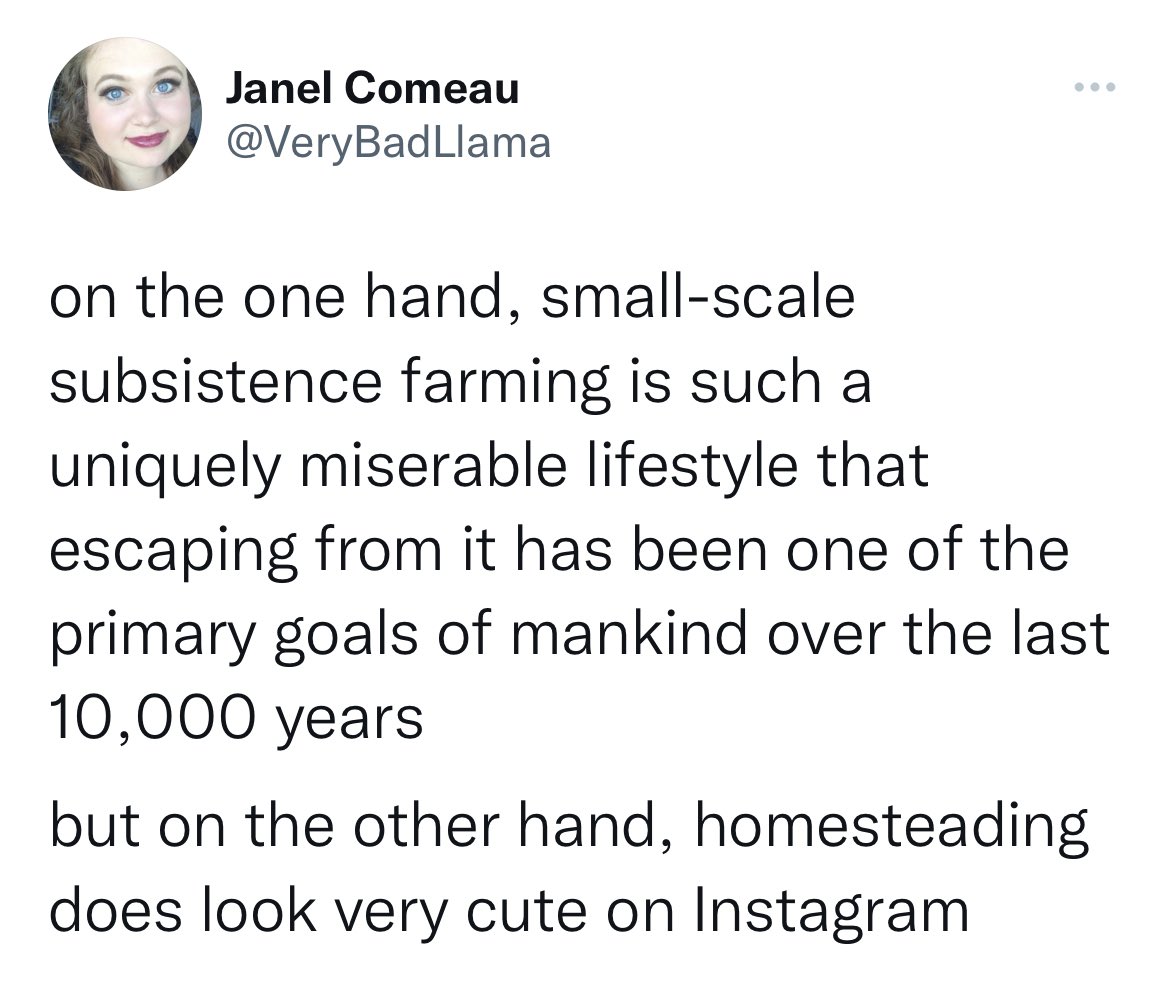
Pamela@PamelaBies
Advice to the younger generation: Skip the degree. Buy land. Become a farmer.
English
/dev/null रीट्वीट किया

/dev/null रीट्वीट किया

/dev/null रीट्वीट किया

/dev/null रीट्वीट किया


I have a problem controlling my caffeine intake, if I have a cup of coffee at hand I will drink it until I die. Thinking on switching to caffeine pills.
English
/dev/null रीट्वीट किया

There's a fairly common assumption that to know yourself better, you should attend to yourself more—journal, introspect, meditate on your patterns. And there's something to this.
But also. The more you make yourself an object of attention, the more you reinforce the narrating self—the self that has problems, the self that needs fixing, the self with its story of development.
I notice that when I, instead, sort of forget about myself and attend deeply to the outer world (when I unself as Murdoch would say) I actually see myself more clearly in a paradoxical way.
If I engage fully with something other than myself—another person, a challenging task, nature, a genuine question—I notice that another self reveals itself. The self as subject rather then the self as object. The self-knowledge I gain by losing myself in attention of the Other is a knowledge that is less like a fact about me and more like a taste.
I think both kinds of self-awareness are useful. But … why am I saying this? Yeah: I sometimes have the mistaken feeling that if I suppress myself and give my attention to others, that will somehow take away from me, but when I do it, genuinely; when I really attune to someone else, I attune to myself, and it becomes a source of deepened connection to myself, even though I at the same time forget myself.
English
/dev/null रीट्वीट किया

A man who practices DSA and system design every day is a fool every day but one.
Achilles@Xhej__
English
/dev/null रीट्वीट किया

Segunda-feira, 6:12 da manhã e você ainda não está rodando nem 3 agentes em paralelo?
🫵 Você está ficando para trás
Português
/dev/null रीट्वीट किया

the challenge with tweeting anything therapy-adjacent is that some people need to be told to be kinder to themselves, some people need to be told to get their shit together
some people need to moderate their extreme tendencies, some people need to lose their moderation
it's always a dance. there is no still position, no place of "ah, now I've figured it out". to be alive & growing means constant adjustment; a plant tilting towards the sun
you cannot ever say "this is the path for everyone" or even "this is the path for me". all you can say is "this is the path for me, for now." or really... "I'm pretty sure this is the path for me, for now, but we'll see"
but the dance can be fun, at least most of the time, and that's where I'd like more people to be
English
/dev/null रीट्वीट किया


/dev/null रीट्वीट किया

10x your vibecoding by becoming a software engineer
andrew gao@itsandrewgao
you can instantly 10x your vibecoded frontends by just learning what different ui components are called ofc opus is creating generic slop, the only words you know are menu and button.
English