Tweet Disematkan

어포칼립스 이후에도 이 메세지를 볼 수 있길 바라며,
Hope you can find this message even after the Apocalypse,
bsky.app/profile/39e.bs…
한국어
Miñg
51.8K posts

@39e
⚠️Disclaimer⚠️ 본 트윗은 독립된 검증절차를 거치지 않았으므로 정보의 정확성 및 신뢰성을 보장하지 않으며 어떠한 사실관계의 근거로도 활용할 수 없음을 알려드립니다. 구독자 께서는 부디 자체적인 조사 분석을 하시기 바랍니다. 🤗🥰🥳

韓国のサムギョプサル屋で鉄板のキムチ食べ尽くそうと必死になってたら、なくなる寸前で笑顔で大量補充された


damn-my-slow-kt - KT 인터넷 SLA 미달 자동 측정 & 요금 감면 신청 도구 - KT의 SLA(최저속도 보장제도)를 활용해 매일 자동으로 속도를 측정하고, 계약 속도의 50% 미만일 경우 자동으로 이의신청까지 대행 - KT는 매일 측정해야 매일 감면되는 구조라, 30일 연속… news.hada.io/topic?id=28511






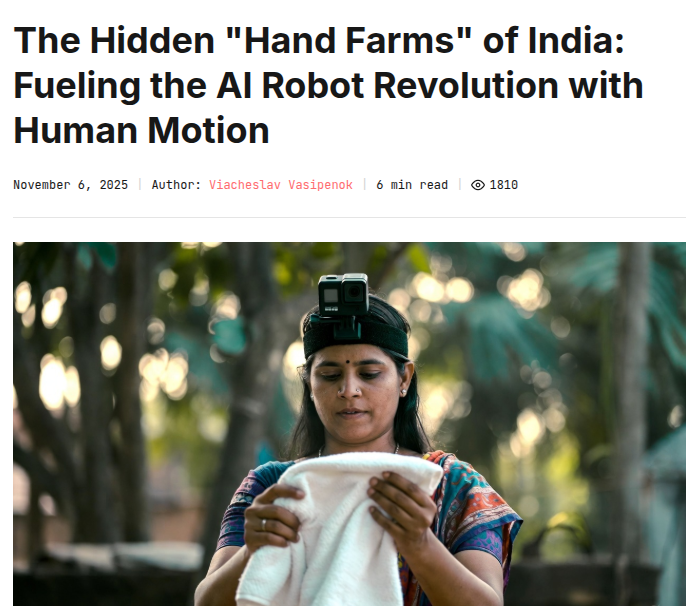
Indian factory workers wear head-mounted cameras to capture data for training robotics AI models. This image captures a blunt truth about robotics: teaching a machine to move in the real world is still painfully expensive. What looks dystopian at first is also a clue about the bottleneck. Robots do not learn useful physical behavior from internet-scale text the way language models do. They need embodied data: hands reaching, wrists turning, objects slipping, fabric folding, tools resisting, people recovering from small mistakes in real time. That data is rare because reality is slow, messy, and costly. A robot fleet is expensive to buy, expensive to maintain, hard to supervise, and dangerous to scale in uncontrolled settings. Even teleoperation is costly, because every minute of human-guided movement requires hardware, operators, calibration, and failure recovery. So companies go looking for the cheapest possible proxy for physical intelligence. First-person video from factory workers is not the same as robot action data, but it can still be valuable because it captures sequencing, posture, bimanual coordination, and the micro-adjustments that make real work look easy. The frontier in robotics is not just better models. It is better pipelines for collecting reality itself. That is why warehouses, factories, kitchens, and repair benches matter so much: they are dense environments of repeated contact with the physical world, which is exactly what robots lack. The unsettling part is that this turns human labor into training infrastructure twice over, first as work, then as data. And until embodied data becomes cheaper to gather than human motion is to record, robotics will keep learning from workers before it fully replaces them.