FDA_Alerts

367 posts

FDA_Alerts banner
FDA_Alerts

FDA_Alerts

@AlertsFda

🧬 Your daily dose of FDA news! Tracking the next big drug approvals 🚀 Simplifying clinical data & regulatory headlines 💊 Patient education + Biotech insight

Seattle Bergabung Nisan 2026
95 Mengikuti263 Pengikut
FDA_Alerts
FDA_Alerts@AlertsFda·
📊 Why LGSOC is so underserved: • ~3,000 US cases/yr — 15-20% of epithelial ovarian cancers • Younger patients (avg ~45 yrs) — years of life at stake • Platinum-resistant, chemo-insensitive • ~60% harbor RAS/MAPK mutations ripe for targeting
English
1
0
0
122
FDA_Alerts
FDA_Alerts@AlertsFda·
🚨🧬 THREAD: $VSTM's avutometinib+defactinib faces FDA decision on May 22. Low-grade serous ovarian cancer has had ZERO approved targeted therapies — until now. Here's why this matters 🧵👇
English
1
0
0
339
FDA_Alerts
FDA_Alerts@AlertsFda·
💊 Multiple myeloma kills ~12,000 Americans/year. Late-line patients exhaust 4+ drug classes fast — and run out of options. Linvoseltamab targets that exact group: 64% response even when everything else has failed. Peak US sales estimates: $700M–$1B+
English
1
0
0
82
FDA_Alerts
FDA_Alerts@AlertsFda·
🚨🧬 THREAD: $REGN's linvoseltamab faces FDA decision ~May 2026. FDA rejected it once — not for science, but for a factory inspection. EU approved it in Jan 2025. US is next. Here's why this myeloma drug comeback story matters 🧵👇
English
1
0
0
271
The Wall Street Journal
The drugmaker said the results provide convincing evidence that fenebrutinib can become the first high-efficacy oral treatment for relapsing and primary progressive multiple sclerosis. on.wsj.com/4cmViIC
English
14
12
43
28.3K
dough
dough@semodough·
$SNY FDA has issued a complete response letter (CRL) for the new drug application of tolebrutinib to treat non-relapsing secondary progressive multiple sclerosis (nrSPMS) in adult patients. sanofi.com/en/media-room/…
English
2
2
18
20.4K
Lea Alhilali, MD
Lea Alhilali, MD@teachplaygrub·
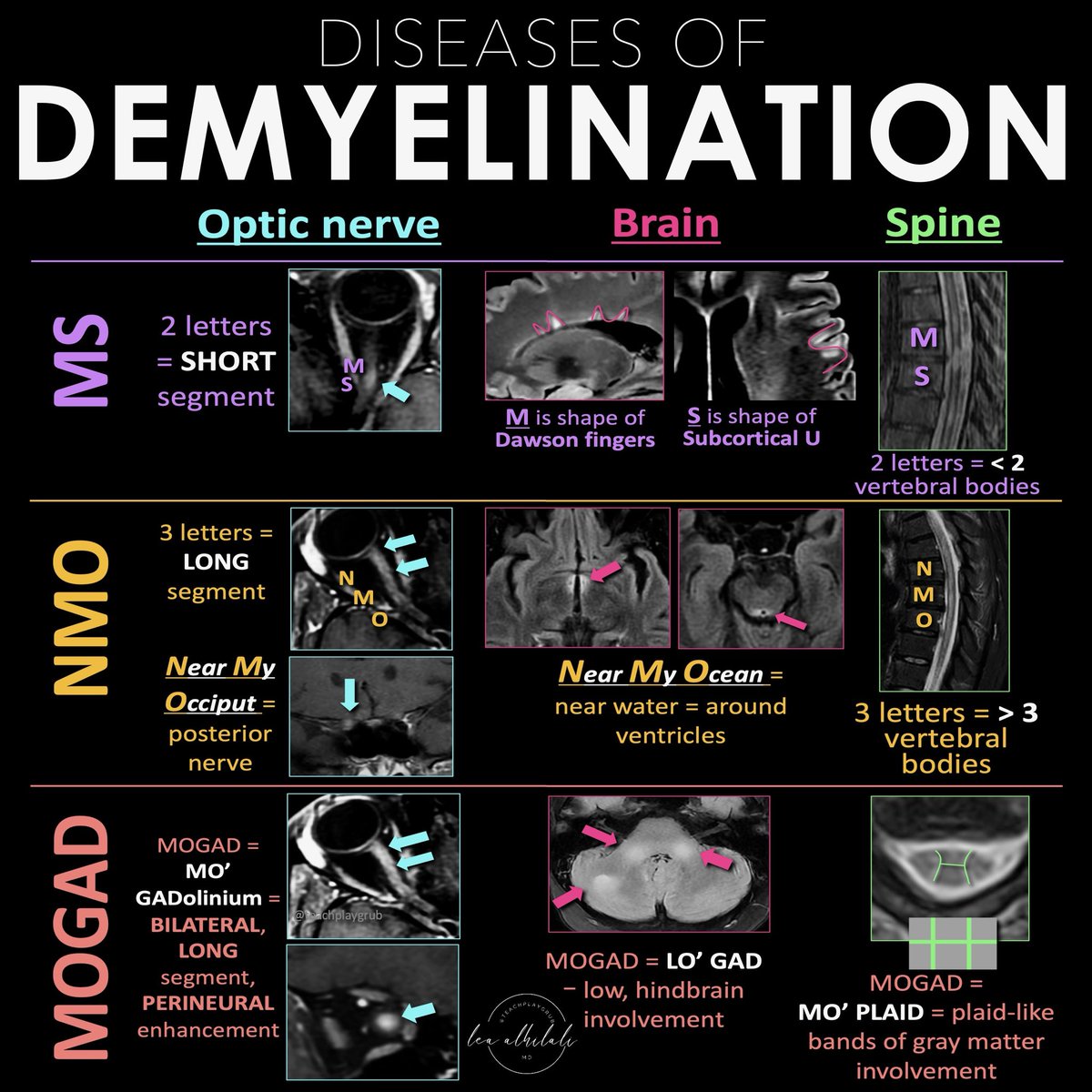
Have MULTIPLE questions about MULTIPLE sclerosis?   Having trouble seeing neuromyelitis optica?   In a fog about MOG?   Here’s the cheat sheet you NEED to distinguish the demyelinating diseases!   Demyelinating diseases predominantly involve the optic nerves, brain, & spine.    The three main chronic demyelinating diseases are Multiple sclerosis (most common), neuromyelitis optica (NMO), & myelin oligodendrocyte glycoprotein (MOG) antibody associated disease or MOGAD   Each has its own features in the optic nerve, brain, & spine.  Here’s how to remember them!   MS Optic nerve: MS only has 2 letters, so MS involvement of the optic nerve tends to be short segment Brain: Letter M makes the shape of the perivascular distribution of lesions along the ventricles (Dawson’s fingers) Letter S makes the shape of the subcortical U fiber involvement Spine: MS is only 2 letters, so lesions are usually less than 2 vertebral bodies in length   NMO Optic nerve: NMO is a longer abbreviation, three letters, so longer involvement NMO can stand for Near My Occiput. Occiput is posterior, so more posterior nerve involvement Brain: NMO can stand for Near My Ocean. What is your brain’s ocean? The ventricles. NMO lesions are all periventricular Spine: NMO is 3 letters, so lesions usually more than 3 vertebral bodies in length   MOGAD Optic Nerve: Remember MO’ GAD-olinium.  So things that cause more regions of enhancement.  MOGAD lesions are commonly bilateral & long segment & enhancement can extend perineural Brain: Remember LO’ GAD.  MOGAD typically involves the lower areas of the brain Spine: Remember MO’ PLAID. MOGAD can give a plaid-like H shape in the cord from predominantly gray matter involvement   Hopefully, this cheat sheet will help you remember how to distinguish the demyelinating diseases! It ain’t lyin’ about diseases of myelin!
Lea Alhilali, MD tweet media
English
1
94
410
17.4K
Cell
Cell@CellCellPress·
In the latest issue! Anti-BCMA CAR-T therapy in patients with progressive multiple sclerosis dlvr.it/TPK7rc
English
1
5
31
14.5K