
Aybüke Geylan, MD me-retweet

🚨 Can echocardiography really exclude HFpEF? New data say: not reliably.
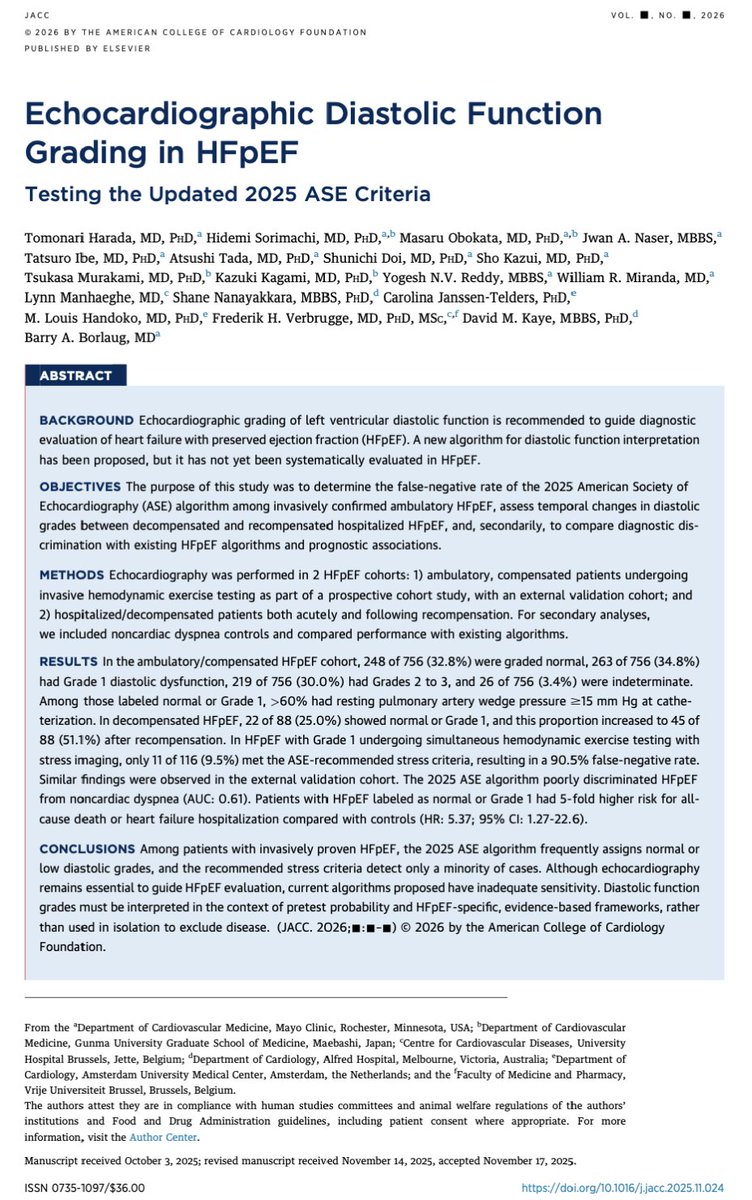
A large, invasive hemodynamics–validated study tested the updated 2025 ASE diastolic function grading algorithm in patients with confirmed HFpEF — and the results are eye-opening. 👀
🔍 Key finding:
Among ambulatory patients with invasively proven HFpEF, ~68% were classified as “normal” or Grade 1 diastolic dysfunction by the new ASE criteria. Yet >60% of these patients already had elevated filling pressures at rest, and many worsened dramatically with exercise.
🏃♂️ Stress echo underperformed:
In patients labeled Grade 1 (where exercise testing is recommended), the ASE 2025 stress criteria detected HFpEF in only ~10% — a false-negative rate >90%. Even under “best-case” assumptions, sensitivity remained poor.
🏥 Volume status matters:
Diastolic grades shifted substantially between decompensated and recompensated states. After diuresis, over 50% of hospitalized HFpEF patients reverted to normal or Grade 1, highlighting how load-dependent and unstable diastolic grading can be.
📉 Diagnostic performance:
Overall discrimination for HFpEF vs non-cardiac dyspnea was modest (AUC ~0.61) — inferior to probability-based tools like H₂FPEF, especially when combined with functional testing.
⚠️ Prognostic paradox:
Patients with HFpEF labeled “normal” or Grade 1 still had a ~5-fold higher risk of death or HF hospitalization compared with controls.
💡 Bottom line:
🛑 Normal diastolic function ≠ no HFpEF.
Echocardiography remains essential — but diastolic grades must be interpreted within pretest probability frameworks, not used in isolation to rule out disease.
English