Be Pham | Ambassador of InterLink Labs me-retweet

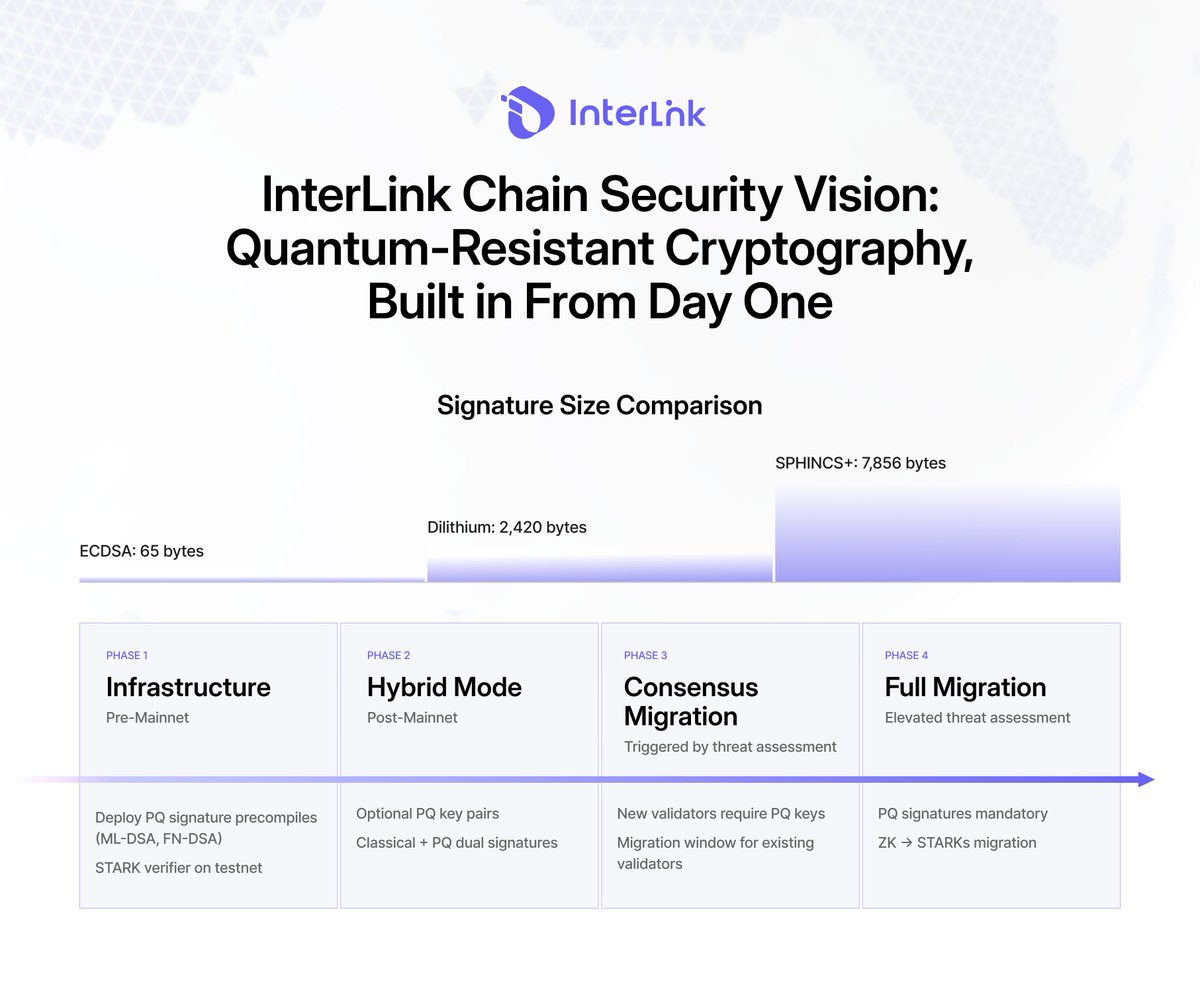
INTERLINK CHAIN SECURITY VISION: QUANTUM-RESISTANT CRYPTOGRAPHY, BUILT IN FROM DAY ONE 🔥
Every blockchain being built today faces a silent deadline. Cryptographically relevant quantum computers are not a question of if, but when. Most chains are not prepared. InterLink Chain is.
Our cryptographic architecture is designed under a single assumption: quantum computers capable of breaking classical cryptography will exist within the operational lifetime of this network. That is why a full modular post-quantum migration path is built into the protocol from day one, preserving the integrity of every on-chain asset, every verified identity, and every consensus guarantee across the transition.
The 4-Phase Post-Quantum Migration Strategy:
✅ Phase 1: Infrastructure (Pre-Mainnet)
Deploy post-quantum signature precompiles including ML-DSA and FN-DSA. Launch STARK verifier on testnet. This is the groundwork phase, where the chain is equipped with quantum-resistant primitives before mainnet ever goes live. No retrofit. No rushed upgrade later.
✅ Phase 2: Hybrid Mode (Post-Mainnet)
Optional post-quantum key pairs become available to all users. Classical and post-quantum dual signatures run side by side. This gives the ecosystem time to adopt quantum-resistant keys without disruption, while maintaining full backward compatibility.
✅ Phase 3: Consensus Migration (Triggered by threat assessment)
When threat intelligence signals that quantum capability is approaching critical mass, new validators are required to hold post-quantum keys. A structured migration window opens for existing validators. The consensus layer hardens before the threat arrives, not after.
✅ Phase 4: Full Migration (Elevated threat assessment)
Post-quantum signatures become mandatory across the network. The zero-knowledge proof system migrates from ZK-SNARKs to STARKs, which are natively quantum-resistant. At this point, InterLink Chain is fully sealed against quantum attack vectors.
Signature Size Reality Check:
ECDSA: 65 bytes
Dilithium: 2,420 bytes
SPHINCS+: 7,856 bytes
Post-quantum signatures are significantly larger than classical ones. That is the real engineering challenge. It is why preparing infrastructure, precompiles, and STARK verification in advance is the only path that does not break performance when the migration is triggered.
The Taj Mahal was built to last centuries. InterLink Chain is built with the same standard. Trust that does not expire. Infrastructure that does not need to be rebuilt.
The Human Network is not just faster. It is engineered to survive the next generation of computing.
#InterLink #ITLG #ITL
English