I really want to connect with more Hyperliquid bulls
Trying to go deeper into the Hyperliquid ecosystem and learn from people who’ve been around longer than me
Would love to follow more smart accounts
Reply below, let’s connect 👋
1400 Followers!🎉
Wow... we've hit 1.4K followers! I'm so grateful for each and every one of you who has joined me on this journey.
This is just the beginning more content, more vibes, and more fun ahead.
Your support means the world!💙
woke up to 49k frens today 🥳
kinda crazy to be close to 50k after 3.5 years of posting
appreciate you all, even if half are probably bots and ghost accounts
0 → 1,000 followers 🚀
When I started, I had no connections…
honestly, not even a clear idea what I was doing 😅
I just began sharing my coding journey 💻
Some posts got ignored.
Some did surprisingly well.
But I kept showing up.
And today… 1K 💙
Still learning.
Still figuring things out.
Still hungry to grow.
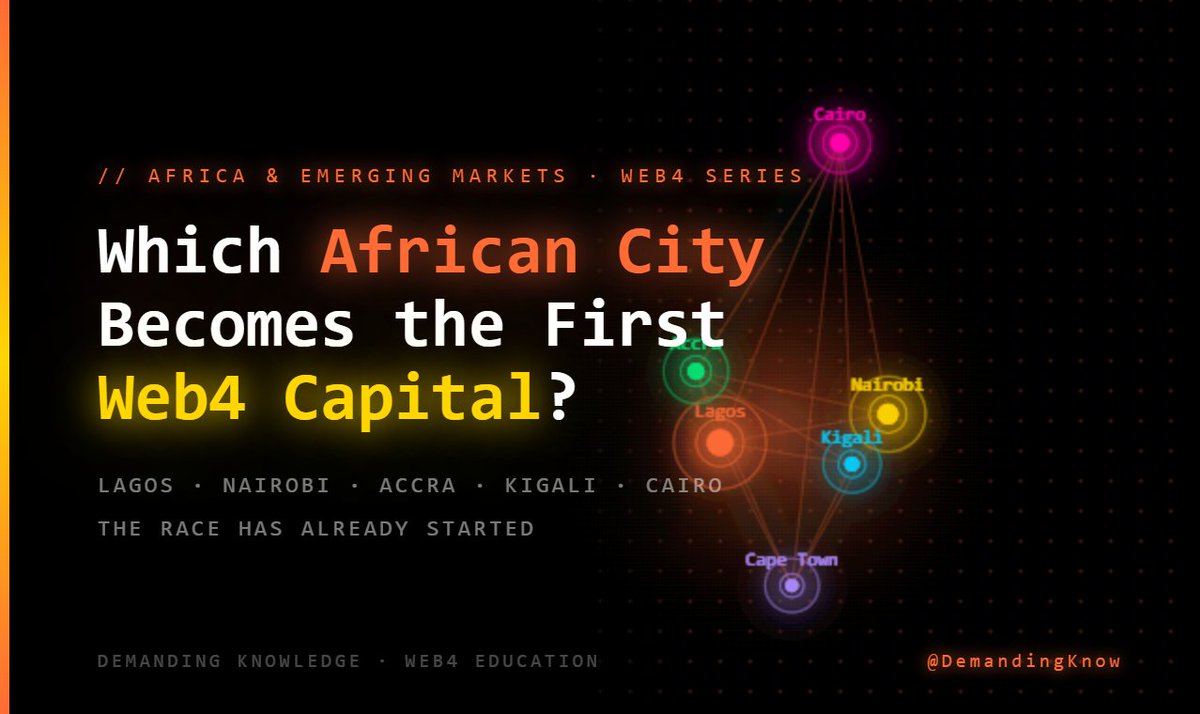
Which African City Becomes the First Web4 Capital?
Silicon Valley did not become the world's technology capital by accident. It became one because of a specific combination of talent, capital, infrastructure, culture, and timing that converged in one place at exactly the right moment. That convergence is happening in Africa right now — and the city where it crystallizes first will define the continent's digital future for a generation.
The race is real. The contenders are known. And the criteria that will determine the winner are already visible in the data. This article examines each city on its merits — not through the lens of national pride or promotional tourism, but through the hard questions that determine where Web4 truly takes root.
The five cities in serious contention are Lagos, Nairobi, Accra, Kigali, and Cairo.
What Makes a Web4 Capital?
Before evaluating the cities, it is worth being precise about what a Web4 capital actually means — because it is not simply the city with the most crypto users or the most blockchain startups.
A Web4 capital is a city where the full stack of Web4 infrastructure comes together: developer talent building protocols, not just applications; regulatory environment that enables rather than suppresses; capital — both local and foreign — flowing into Web4 ventures; physical and digital infrastructure reliable enough to support the demands of decentralized systems; a community culture that attracts and retains the kind of risk-taking, technically ambitious builders who create paradigm shifts rather than incremental improvements; and early adoption by ordinary citizens and businesses that creates the network effects needed for Web4 applications to achieve genuine scale.
This is a high bar. No African city fully meets it today. The question is which city closes the gap first.
Lagos: The Giant With Everything to Prove
Lagos is Africa's most populous city, its largest economy, and its most chaotic, creative, and relentlessly entrepreneurial urban environment. It is home to the Yabacon Valley — a concentration of tech startups, developer communities, investor networks, and digital infrastructure that has produced more funded African tech companies than any other city on the continent.
The case for Lagos is overwhelming in raw numbers. Nigeria's 700,000 developers. The country's position as the world's top crypto adopter three years running. $20 billion in annual remittances flowing through Nigerian corridors. Unicorn companies built and scaled in Lagos. A consumer market of 220 million people accessible from a single metropolitan hub.
Lagos has something no other African city has: scale and urgency operating simultaneously. The naira crisis created a population with direct, personal, economically painful experience of why decentralized financial infrastructure matters. Ordinary Lagosians — market traders, Uber drivers, university students, small business owners — have used crypto not as a speculative instrument but as functional financial infrastructure. That lived experience is the most powerful possible foundation for Web4 adoption.
The weakness of Lagos is equally visible. Infrastructure in the city is genuinely difficult — power supply is unreliable, internet connectivity is inconsistent outside affluent neighborhoods, traffic and logistics impose real costs on business operations, and governance instability creates regulatory uncertainty that can change overnight. The CBN's 2021 crypto ban and its eventual reversal illustrated both the risk and the resilience: Nigerian adoption survived regulatory hostility, but regulatory uncertainty imposes a tax on every serious business decision.
For Lagos to become Africa's Web4 capital, Nigeria needs to make a deliberate national choice to enable it — with regulatory clarity, infrastructure investment, and institutional support that matches the organic talent and adoption already present. The talent is there. The demand is there. The question is whether the environment becomes worthy of them.
Lagos verdict: Highest potential. Most uncertain path.
Nairobi: The City That Has Been Here Before
Nairobi has an advantage no other African city possesses: it has already done something like this. M-Pesa was built in Nairobi. The mobile money revolution that transformed financial inclusion across East Africa and became a global model for fintech innovation emerged from the specific combination of regulatory openness, telecommunications infrastructure, developer talent, and entrepreneurial culture that Nairobi provided in 2007.
That history is not merely symbolic. It created institutions — iHub, Strathmore University's @iLabAfrica, the Kenya ICT Authority, Safaricom's innovation division — that understood how to nurture and scale transformative digital technology. It created a regulatory culture at the Central Bank of Kenya and the Capital Markets Authority that, while cautious, has generally leaned toward enabling innovation rather than suppressing it. Kenya's regulatory sandbox approach — allowing experimental fintech products to operate under supervised conditions before full regulation — is the most sophisticated innovation-enabling regulatory framework in Africa.
Nairobi's developer community, while smaller than Lagos's in absolute numbers, is exceptional in quality. The Nairobi blockchain developer scene is one of the most technically sophisticated in Africa, with deep engagement in Ethereum development, DeFi protocol building, and decentralized application design. The city has produced a disproportionate number of African contributors to major global blockchain projects.
The weakness of Nairobi is scale. Kenya's population of 55 million, while significant, is less than a quarter of Nigeria's. The consumer market accessible from Nairobi is smaller, and the urgency driving adoption — while real — is less acute than in Lagos. The naira crisis had no Kenyan equivalent. M-Pesa's success actually reduced the urgency for crypto adoption among ordinary Kenyans who already had functional mobile financial services.
Nairobi is the city most likely to produce the Web4 protocol or infrastructure layer that powers the entire continent. It may not be the city with the most Web4 users. It may be the city that builds the rails everyone else runs on.
Nairobi verdict: Highest technical quality. Best regulatory environment. Limited by scale.
Accra: The Surprise Contender Nobody Is Taking Seriously Enough
Accra does not appear in most Web4 discussions. It should.
Ghana has built, quietly and deliberately, one of the most favorable environments for digital innovation in West Africa. The country has maintained democratic governance, relative macroeconomic stability, and a consistent regulatory philosophy that treats technology companies as partners rather than threats. Ghana's central bank has been among the first in Africa to pilot a central bank digital currency — the e-cedi — signaling institutional comfort with digital monetary infrastructure that most African central banks still lack.
Accra's tech ecosystem — Accra Tech Hub, MEST Africa, the vibrant fintech community around mobile money platforms MTN MoMo and AirtelTigo — has attracted significant foreign direct investment and produced companies that operate at regional scale. Ghana's English-language education system, high literacy rates, and strong professional culture create a talent pipeline that punches above its population weight.
The strategic advantage Accra offers is political stability combined with genuine regulatory openness. For serious Web4 infrastructure builders — the kind building protocols and platforms rather than consumer applications — political risk is a critical factor. Lagos's higher potential comes with higher political risk. Accra offers a lower-ceiling, lower-risk environment that may be more attractive to the patient, long-term infrastructure investment that Web4 requires.
Ghana is also uniquely positioned in the African diaspora economy. The "Year of Return" campaign and subsequent "Beyond the Return" initiative have made Accra a focal point for African diaspora reconnection — bringing technically skilled diaspora Africans back to the continent and creating a bridge between the capital and talent of the global African diaspora and the opportunities on the ground in Accra.
Accra verdict: Most stable environment. Strongest diaspora bridge. Underestimated by almost everyone.
Kigali: The Wild Card That Planned Its Way Into Contention
Kigali is the most deliberate city on this list. Rwanda's transformation from the site of one of the 20th century's greatest tragedies to one of Africa's most efficiently governed and technologically forward-looking nations is one of the most remarkable stories in modern development history. And it did not happen by accident.
President Paul Kagame's government made a conscious decision decades ago to position Rwanda as Africa's technology and innovation hub. That decision produced results that are genuinely extraordinary for a landlocked country of 14 million people with no oil wealth and no colonial-era industrial base.
Kigali is consistently ranked among Africa's cleanest, safest, and most efficiently run cities. Rwanda has fiber optic internet penetration that exceeds most of its African neighbors. The Kigali Innovation City — a $2 billion development adjacent to the University of Rwanda — is designed specifically to attract technology companies, research institutions, and innovation infrastructure. Carnegie Mellon University has an African campus in Kigali. The University of Rwanda's Center of Excellence in IoT is building the technical foundation for exactly the kind of sensor networks and connected device infrastructure that Web4's IoT layer requires.
Rwanda's regulatory environment for fintech and blockchain is among the most progressive on the continent. The National Bank of Rwanda has been proactive in developing regulatory frameworks for digital assets, and the government has made explicit public commitments to positioning Kigali as a blockchain and Web4 hub.
The limitation of Kigali is the same as its strength — it is a planned city with a government-driven tech strategy. Organic, bottom-up Web4 ecosystems tend to be more durable than top-down planned ones. The question for Kigali is whether its extraordinary infrastructure and regulatory advantages can attract enough organic builder culture to create genuine ecosystem momentum, rather than a well-funded but sterile innovation district.
Kigali verdict: Best infrastructure and governance. Needs organic ecosystem depth to match its institutional strength.
Cairo: The Sleeping Giant
Cairo is the largest city in Africa and the Arab world — a metropolitan area of 22 million people that is the intellectual, cultural, and economic center of North Africa and the broader Middle East. Its Web4 potential is almost entirely unrealized.
Egypt's tech sector has grown rapidly in recent years, producing notable companies like Swvl, Halan, and Instabug that have raised significant international capital. Cairo's universities produce large numbers of engineering and computer science graduates annually. The city's position as a bridge between Africa, the Middle East, and Mediterranean Europe gives it geographic and commercial relationships that no sub-Saharan African city can replicate.
The obstacles are significant. Egypt's regulatory environment for crypto has been among the most hostile in Africa — with religious authorities issuing fatwas against cryptocurrency and the government maintaining tight capital controls that make decentralized financial infrastructure directly threatening to institutional interests. Political governance in Egypt has moved in a direction that prioritizes stability over innovation freedom, creating a risk environment that serious Web4 builders find difficult.
But Cairo cannot be dismissed. Egypt's government has shown, in other sectors, an ability to rapidly shift policy direction when strategic interest aligns. If the right combination of political will and economic necessity creates a regulatory opening, Cairo's scale, talent, and geographic position could make it the most formidable Web4 hub on the continent almost overnight.
Cairo verdict: Highest ceiling if politics align. Highest regulatory risk if they don't.
The Verdict: Who Goes First?
The honest answer is that the race is not yet decided — and may not be decided by the choices any single city makes. The Web4 capital of Africa may emerge from a combination of cities operating as a distributed ecosystem rather than a single dominant hub, the way the US tech industry spans San Francisco, New York, Austin, and Seattle rather than residing in one place.
But if forced to choose the city most likely to claim the title of Africa's first Web4 capital in the next five years, the evidence points to a two-city race between Lagos and Nairobi — with Lagos winning on adoption scale and economic urgency, and Nairobi winning on technical quality and regulatory environment.
The determining factor will be Nigeria's regulatory direction. If Nigeria establishes clear, enabling regulation for Web4 infrastructure in the next two to three years, Lagos runs away with this. Its scale, its adoption momentum, and its builder community are simply too large for any other African city to match.
If Nigeria continues to oscillate between crypto hostility and cautious openness, Nairobi builds the infrastructure layer while Lagos supplies the users — and the Web4 capital conversation becomes about which city provides the foundation rather than which has the most activity.
Accra and Kigali are the long-term bets for investors and builders who prioritize stability over scale. They may not win the race to be first. They may be the most durable Web4 ecosystems a decade from now.
Cairo is watching. And when it moves, it will move fast.
The Most Important Insight
The question of which African city becomes the first Web4 capital is important. But it is less important than the question of whether African cities collectively build Web4 infrastructure for African needs — or whether they become the adoption markets for Web4 systems built elsewhere.
Silicon Valley became the global tech capital not because it was the only place with talented engineers. It became it because it built the platforms, the protocols, and the infrastructure that the rest of the world ran on. Africa's Web4 capital will be the city that does the same — not just adopts Web4, but builds the foundations that other cities, other countries, and eventually other continents run on top of.
That city exists. Its builders are alive right now. The question is whether the environment around them — the regulation, the capital, the infrastructure, the institutional support — becomes worthy of what they are capable of building.
#web3#web4#Africa#builders
Nigeria's Web4 Opportunity: The Numbers That Should Shock You
There is no country on Earth better positioned to become the dominant force in Web4 than Nigeria. Not the United States. Not China. Not Germany. Nigeria. And when you look at the data — really look at it — the conclusion becomes almost impossible to argue against.
This is not national pride talking. This is mathematics. Demographics. Market structure. Adoption behavior. Developer output. And a population of 220 million people that has already demonstrated, repeatedly and unmistakably, that it will adopt decentralized financial technology faster than any comparable population on the planet when given the opportunity to do so.
The opportunity is Web4. The numbers are below. Prepare to be shocked.
Number 1: 220 Million People — Africa's Most Populous Nation
Nigeria is not just Africa's most populous country. It is the sixth most populous country on Earth — ahead of Pakistan, Brazil, and Indonesia. By 2050, Nigeria's population is projected to reach 400 million, making it the third most populous nation in the world, behind only India and China.
Population alone means nothing without the right conditions. But population combined with the specific conditions Nigeria possesses creates a market opportunity of extraordinary scale. Every Web4 application built for Nigeria — every DeFi product, every identity solution, every creator economy tool, every smart contract platform — has access to a potential user base larger than the entire population of Brazil.
When Nigeria adopts something, it moves at continental scale. M-Pesa transformed Kenya. A Nigerian equivalent transforms Africa.
Number 2: Median Age of 18 — The Youngest Major Economy on Earth
The median age in Nigeria is 18.1 years. In the United States it is 38.5. In Germany it is 45.7. In Japan it is 48.6.
This number is not merely a demographic curiosity. It is an economic forecast.
The people who will be the primary builders, adopters, and economic actors of Web4's peak decade — 2025 to 2035 — are people who are teenagers and young adults right now. In Germany and Japan, those people are a shrinking minority of an aging population. In Nigeria, they are the majority.
Every Web4 product that achieves mainstream adoption in Nigeria in the next decade will be adopted by a population for whom digital-native, mobile-first, crypto-comfortable behavior is not a new skill but a default state. Nigerian Gen Z did not learn to use smartphones. They were born into them. They will not learn to use Web4. They will grow up inside it.
The compounding effect of the world's youngest major economy fully engaging with Web4 over the next 20 years is not calculable. It is enormous.
Number 3: #1 Crypto-Adopting Nation on Earth — Three Years Running
In 2021, 2022, and 2023, Nigeria ranked first in the world on Chainalysis's Global Crypto Adoption Index — a measure that accounts for on-chain value received, peer-to-peer exchange trade volume, and DeFi activity, all adjusted for purchasing power parity and population size.
Let that sink in. Not first in Africa. First in the world. Ahead of the United States, ahead of the entire European Union, ahead of every Asian market.
Nigerians did not adopt crypto because of speculation, though speculation played a role in early adoption as it did everywhere. Nigerians adopted crypto primarily because the naira was depreciating catastrophically and they needed a store of value that couldn't be inflated away. They adopted crypto because sending money to family abroad or receiving payment from international clients was cheaper, faster, and more reliable via blockchain than through the formal banking system. They adopted crypto because 60% of the population is either unbanked or underbanked and crypto offered financial services the formal system refused to provide.
In other words, Nigerians adopted crypto for the exact reasons Web4 was built. Not as a speculative asset. As functional financial infrastructure for a population the traditional system had failed.
This is the most important single data point in the entire Nigerian Web4 story. When a population of 220 million people has already demonstrated the highest per-capita crypto adoption rate on Earth — driven by genuine economic need rather than speculation — the infrastructure transition to Web4 is not a question of whether. It is a question of when and how fast.
Number 4: 700,000 Software Developers and Growing at 3.8% Annually
Nigeria produces more software developers per year than most European countries and is home to the largest developer community in Africa. Lagos alone has a tech ecosystem — locally called the Yabacon Valley — that has produced unicorn startups, attracted global venture capital, and built consumer products used across the continent.
Andela, Flutterwave, Paystack, Konga, Interswitch, PiggyVest — these are Nigerian-founded technology companies that have raised hundreds of millions in capital, built products used by tens of millions of people, and created templates for African tech entrepreneurship that are being studied and replicated across the continent.
In Web3 and early Web4 specifically, Nigeria's developer community has been disproportionately active. Nigerian developers are prominent contributors to major blockchain protocols, DeFi projects, and decentralized application platforms. The Web4 builders who will create the applications that define the next decade of the internet are, in significant numbers, already building in Lagos, Abuja, Port Harcourt, and beyond.
Number 5: $20 Billion in Annual Remittances — The Largest Single Financial Flow
Nigeria receives approximately $20 billion in annual remittances — the largest remittance flow on the African continent and the fifth largest in the world. The Nigerian diaspora, estimated at 1.7 million people in the United States alone and millions more across the UK, Canada, Europe, and the Gulf states, maintains one of the strongest financial connections to its home country of any diaspora population globally.
As established in the previous article, the average cost of these transfers is approximately 8.5%. Applied to $20 billion, that is $1.7 billion in fees extracted from Nigerian families every single year — nearly twice Nigeria's annual education budget.
Web4 payment rails, operating at near-zero transaction cost, return that $1.7 billion to Nigerian households annually. Not eventually. Immediately upon adoption at scale. The economic case for Nigerian diaspora adoption of Web4 remittance tools is not theoretical. It is the single most obvious financial decision available to 1.7 million people right now.
Number 6: 60% Unbanked — The Largest Unbanked Population in Africa
Despite being Africa's largest economy, Nigeria has a formal banking inclusion rate of approximately 40%. 60% of Nigerian adults — approximately 90 million people — are either entirely unbanked or severely underserved by formal financial institutions.
This is not primarily a poverty problem. It is an infrastructure and trust problem. Many Nigerians who could open bank accounts choose not to — or are functionally excluded by distance, documentation requirements, or minimum balance rules. The trust deficit with Nigerian banking institutions, earned through decades of instability, corruption, and customer-hostile practices, is real and rational.
Web4 financial infrastructure requires none of what formal banking demands. No minimum balance. No branch visit. No documentation beyond a smartphone and a wallet. No institution whose solvency you must trust with your savings. Self-custodied Web4 assets are held by their owner — not deposited in an institution that can fail, freeze accounts, or impose arbitrary restrictions.
The 90 million unbanked Nigerians are not a financial exclusion statistic. They are the largest single addressable market for Web4 financial services in the world.
Number 7: The CBN Ban That Backfired — And What It Proves
In February 2021, the Central Bank of Nigeria issued a directive prohibiting banks from facilitating cryptocurrency transactions. The explicit goal was to suppress crypto adoption. The actual result was the opposite.
Peer-to-peer crypto trading in Nigeria increased by 27% in the month following the ban. Nigeria maintained its position as the world's top crypto adopter through the entire period of the ban. Nigerians simply routed around the banking system entirely — using P2P platforms, mobile wallets, and decentralized exchanges to continue transacting in crypto without touching the banking system the CBN controlled.
By December 2023, the CBN reversed course entirely — issuing new guidelines that re-authorized banks to work with crypto companies under a regulatory framework. The reversal was an implicit admission that the demand was too large and too structurally embedded to suppress through regulatory action.
What this episode proves is not that Nigerian regulators are incompetent. It proves that Nigerian crypto adoption is not driven by convenience or fashion. It is driven by structural economic need that persists regardless of regulatory headwinds. When the regulatory environment improves — and it is improving — adoption will not merely recover. It will accelerate dramatically.
Number 8: $500 Billion GDP — Africa's Largest Economy
Nigeria's GDP of approximately $500 billion makes it the largest economy on the African continent, ahead of South Africa, Egypt, and Ethiopia. Despite recent naira depreciation challenges, Nigeria's economic scale means that Web4 products gaining significant adoption in Nigeria achieve economic throughput comparable to mid-sized European economies.
The Nigerian market is not a developing world experiment. It is a $500 billion economy whose financial infrastructure is being rebuilt from the ground up in real time. The companies that build the rails, the wallets, the identity systems, and the DeFi products for that rebuild will participate in one of the largest economic infrastructure construction projects of the decade.
Number 9: 30 Million Small Businesses — The Informal Economy Waiting for Web4
Nigeria has approximately 30 million small and medium enterprises, the vast majority operating entirely in the informal economy — outside the formal financial system, without access to credit, without the ability to build credit history, and without the legal and financial infrastructure that makes business growth possible.
Web4 changes this structurally. A small trader in Lagos can establish a decentralized identity that accumulates verifiable transaction history on-chain. That history becomes the basis for decentralized credit scoring — creditworthiness established through demonstrated behavior rather than institutional records. Smart contracts enable trade finance without banks. Tokenized invoices unlock working capital. DAOs enable cooperative business structures that pool resources and share risk.
The formalization of Nigeria's informal economy through Web4 infrastructure is not a social program. It is the largest untapped commercial opportunity in the country — and possibly on the continent.
Number 10: The Naira Crisis — The Accidental Accelerant
Between 2022 and 2024, the Nigerian naira lost approximately 70% of its value against the US dollar. The Central Bank of Nigeria's foreign exchange management, fuel subsidy removal, and monetary policy decisions combined to produce one of the most severe currency depreciations in the country's recent history.
For ordinary Nigerians, this was devastating — savings evaporated, import costs doubled, and the cost of living surged in ways that outpaced income growth for most households.
For Web4 adoption, it was rocket fuel.
The naira crisis created the most powerful possible motivation for ordinary Nigerians to seek alternatives to naira-denominated savings and transactions — and millions found them in dollar-pegged stablecoins, Bitcoin, and other crypto assets. The population that emerged from the naira crisis is the most financially motivated, crypto-literate, and decentralization-positive mass market on Earth.
The crisis did not create Nigeria's Web4 opportunity. But it accelerated the adoption curve by years — creating urgency, education, and adoption infrastructure that would otherwise have taken much longer to develop organically.
What Nigeria Must Protect and Build
The numbers paint an extraordinary picture. But numbers are not destiny — they are potential. Whether Nigeria captures its Web4 opportunity depends on choices being made right now.
Protect developer talent. Nigeria's greatest Web4 asset is its developer community. Policies, infrastructure investment, and institutional support that keep Nigerian developers building in Nigeria — rather than emigrating to build for foreign companies — are among the highest-return investments the country can make.
Build regulatory clarity that enables rather than suppresses. The CBN's reversal on crypto is a positive sign. Nigeria needs a comprehensive Web4 regulatory framework — covering DeFi, decentralized identity, smart contracts, tokenized assets, and autonomous AI agents — that gives builders certainty and gives users protection without strangling innovation.
Invest in digital literacy at scale. The 90 million unbanked Nigerians who represent Web4's largest addressable market will only be reached through sustained, community-based digital literacy investment. Understanding how to use a crypto wallet, what a smart contract is, and how to protect a private key must become as common as knowing how to use a mobile phone. This is achievable. It requires sustained commitment.
Build Nigerian infrastructure for Nigerian needs. The naira stablecoin. The Nigerian land registry on blockchain. The Nigerian agricultural smart contract platform. The Nigerian diaspora DAO. These are not products that will be built by Silicon Valley for Nigeria. They must be built by Nigerians, for Nigerians, with the specific needs of the Nigerian market from the architecture up.
The Bottom Line
220 million people. Median age 18. World's top crypto adopter. 700,000 developers. $20 billion in remittances. 90 million unbanked. $500 billion economy. 30 million informal businesses. A currency crisis that accelerated adoption by years.
There is no country on Earth with a more complete set of Web4 adoption conditions than Nigeria. The demand is enormous and demonstrated. The talent is real and growing. The structural need for decentralized financial infrastructure is more acute than anywhere else of comparable economic scale.
Nigeria is not waiting for Web4. Web4 is waiting for Nigeria to decide how large it wants to go.
🇳🇬 Are you building? #Web4#web3Nigeria#DemandingKnowledge
check also @peaq and fill some gap