
Tweet Disematkan
Hugo
13.8K posts


Hugo
@HugoRene_
sigo aprendiendo a pensar antes de hablar (y escribir). Seek discomfort.
México Bergabung Temmuz 2010
285 Mengikuti288 Pengikut
Hugo me-retweet

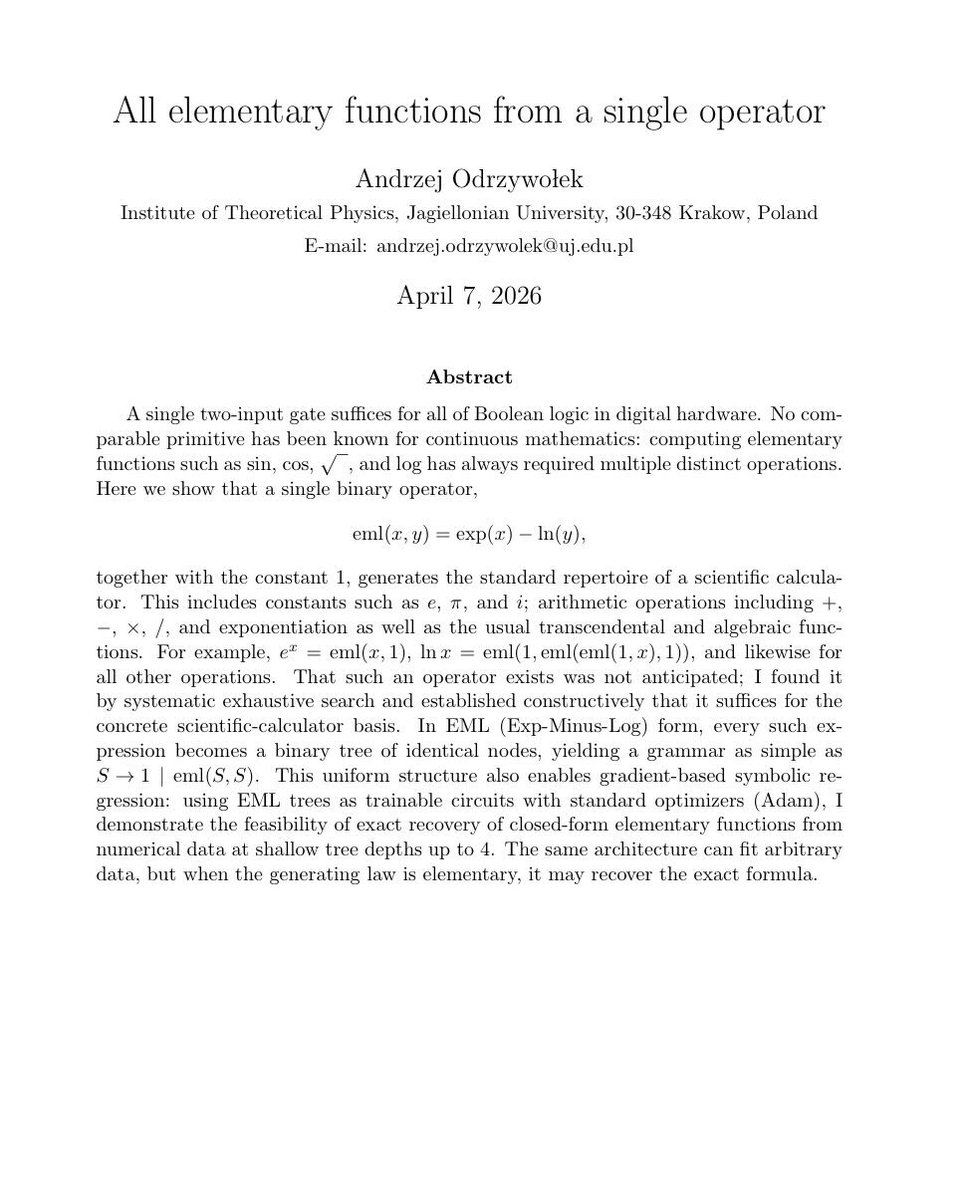
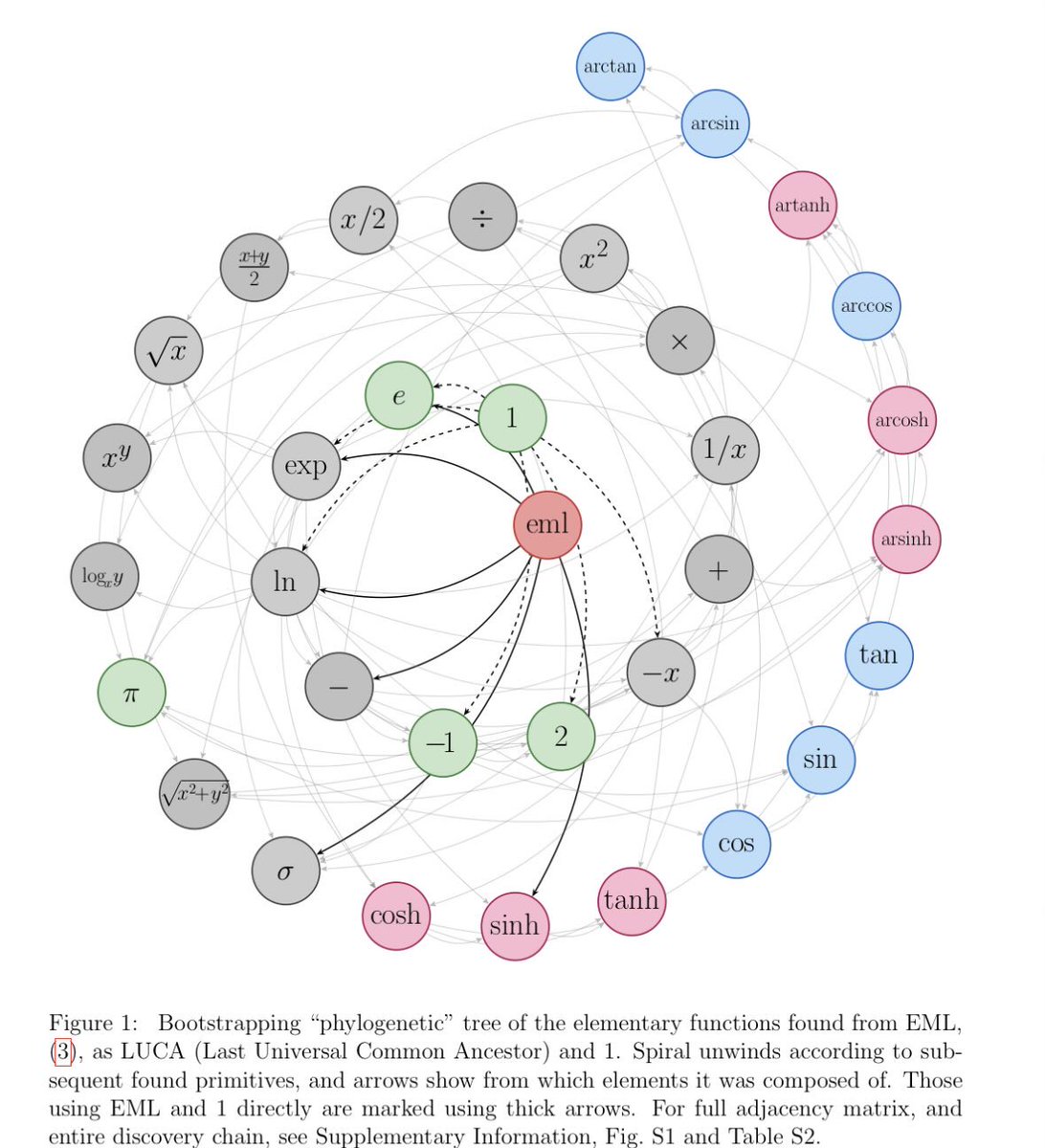
Physicist has written a fascinating big beautiful paper.Let’s not be afraid to call it what it is - groundbreaking. For hundreds of years, mathematics had dozens of “basic” functions: sine, cosine, logarithm, square root, exponential. You know these from school. Everyone does. Now it turns out that all of it is one single operator:
E(x, y) = exp(x) - ln(y), and the constant 1.
Sin, cos, π - everything follows from this neatly , just nest it properly. Nature hid the simplest possible description of reality. And it was just been found. The whole thing is beautiful and remarkable, here the word “groundbreaking” is not a marketing buzzword.
For instance, instead of writing π or 3.14, one can now elegantly write E(E(E(1,E(E(1,E(1,E(E(1,E(E(1,E(E(1,E(1,E(E(1,1),1))),1)),E(E(E(E(E(1,E(E(1,E(1,E(E(1,E(E(E(1,E(E(1,E(1,E(E(1,1),1))),1)),E(E(1,E(E(1,E(E(1,E(E(1,1),1)),E(E(E(1,E(E(1,E(1,E(E(1,1),1))),1)),E(1,1)),1))),1)),1)),1)),1))),1)),E(E(E(1,E(E(1,E(1,E(E(1,1),1))),1)),E(E(1,E(E(1,E(1,E(E(1,E(E(1,E(E(1,E(1,E(E(1,1),1))),1)),E(1,1))),1))),1)),1)),1)),1),1),1))),1))),1)),E(E(E(1,E(E(1,E(1,E(E(1,1),1))),1)),E(E(1,E(E(1,E(1,E(E(1,E(E(1,E(E(1,E(1,E(E(1,1),1))),1)),E(1,1))),1))),1)),1)),1)),1)
arxiv.org/abs/2603.21852
English
Hugo me-retweet


Hugo me-retweet

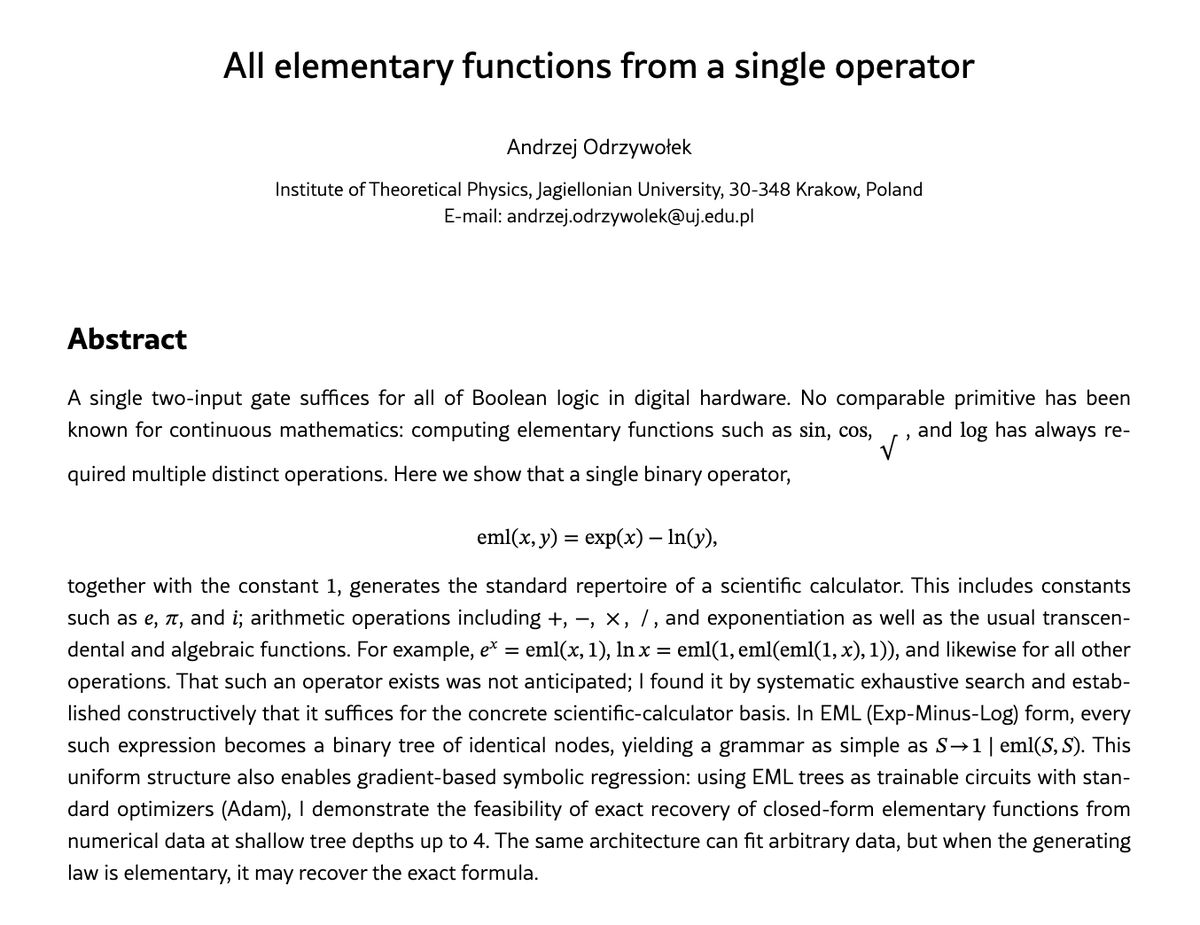
Researchers just proved that every single elementary function, sin, exp, log, sqrt, comes from one single binary operator.
It is like finding the “God Particle" for calculus.
In computer science, every complex program breaks down to a single logical operator: the NAND gate. It is the fundamental building block of all digital reality.
But for continuous math, physics, engineering, machine learning, we thought we needed a massive toolbox.
Addition. Subtraction. Trigonometry. Logarithms.
Every scientific calculator and neural network has to juggle all of them.
Until today.
But this paper proved that every single mathematical function can be generated by a single, bizarre binary operator.
eml(x,y) = exp(x) - ln(y).
Combine that with the number 1, and you can build everything.
Pi. The square root. Sine and Cosine. Arithmetic.
It is all just the exact same operator, repeating over and over again in a binary tree.
Nobody anticipated this existed. It was found by systematic exhaustive search.
But the implications for AI are massive.
Instead of an AI struggling to combine different mathematical rules to discover a new scientific law, it can just use a single, uniform architecture.
One trainable circuit. One repeatable node.
We thought the language of the universe was complex.
It turns out, it's just one equation repeating in the dark.
English
Hugo me-retweet

Ryan Gosling talking in Gen Z slang is hilarious but also oddly... normal
English
Hugo me-retweet

Hugo me-retweet


Hugo me-retweet

So you say you are a software engineer.
Have you ever downloaded actual binaries like Kafka, Postgres, ClickHouse, Elasticsearch, Redis, or something else, and tried running them locally while exploring what those bin, lib, data, and logs, etc directories contain?
And then did you understand why they expose specific ports, what exactly gets written inside the data directory, and why in that particular format?
Did you then write your own client to call their APIs and bombard the server with requests, just to observe when CPU becomes the bottleneck, when RAM starts limiting scale, and how the system degrades under pressure?
After that, did you run the same systems inside Docker or Podman and experiment with controlling memory, security and disk limits to see how resource isolation affects behavior?
Did you go one step further and install Minikube locally, to orchestrate multiple instances of your container, simulate a multi-node cluster, and understand ingress and load balancing in practice?
And then maybe, did you spin up a free AWS EC2 instance and repeat everything on a real remote machine to understand how ssh works and how distributed systems behave outside your pc?
Or is your definition of backend engineering still limited to APIs plumbing?
English
Hugo me-retweet

CDMX vacía, con mucho frío y 20 minutos de camino en un tramo que normalmente te haces una hora.
Esta es la CDMX que necesitamos.
Español
Hugo me-retweet

A guy didn't have a CS degree
wanted to work at Google
studied 8-12 hrs/day for months
got hired at Amazon instead
he open-sourced his entire study plan
coding-interview-university - 337k stars on GitHub
covers everything: DSA, trees, graphs, dynamic programming, system design, OS, networking
github.com/jwasham/coding…
the most complete free CS curriculum on the internet

English
Hugo me-retweet

Tus padres están envejeciendo.
30 cosas que hacer con ellos antes de que el tiempo se vaya.
1.Graba su voz contando una historia. Algún día esa voz será un sonido que nunca volverás a escuchar.
Español
Hugo me-retweet

Hugo me-retweet

A lot of software engineers work hard, but their work does not stack.
They do one bug here, one dashboard there, one random API there. Good work, but no story. And promotion usually goes to the person with a story.
The smarter way to choose projects is this:
Pick work that compounds.
That means:
1. It teaches you a deeper part of the system
2. It is visible to multiple teams
3. It solves a painful business problem
4. It creates follow-up work where you become the obvious owner
5. It can be explained as a journey, not a one-off task
A friend of mine did this really well.
His company had a huge monolith. Everybody complained about it. Slow deploys. Tight coupling. Random breakages. Teams stepping on each other. Everyone knew it was a problem, but most people only wanted to work on safe tickets around it.
He picked one feature from that monolith and said: let me take this end to end and move it into a service properly.
At first, people thought it was just another backend task. It was not.
To do it well, he had to understand: how the old module worked, which tables it touched, what hidden side effects existed, what downstream consumers depended on it, how auth, logging, retries, deployment, metrics, alerts, rollback all worked.
For almost 1 year, that one project kept stacking.
First he wrote the extraction plan. Then interfaces. Then data contracts. Then dual writes. Then shadow traffic. Then observability. Then gradual cutover. Then cleanup of old code. Then docs for other teams to repeat the pattern.
By the end of it, he had not just “migrated one feature”.
He had built: a migration playbook, a reusable service template, credibility with senior engineers, trust with management, and a promotion case that wrote itself.
That is what stacked work looks like.
One project became: technical depth + cross-team visibility + business impact + leadership signal.
That is how you should think too as a software engineer.
Do not just ask: “What ticket can I finish this sprint?”
Ask: “What project, if I own it well, will make next year’s bigger opportunities naturally come to me?”
That is how careers compound.
Justin Skycak@justinskycak
Choose projects that stack. You want your work this year to be the foundation for something 10x bigger next year.
English
Hugo me-retweet

It’s obvious in retrospect, but wasn’t intuitively clear earlier in life: your primary life partnership is somewhere between medicine and poison.
Kate is medicine. Her mind tickles me, touch soothes, and essence animates. No life decision more important than who you journey with
English
Hugo me-retweet
If you want to be a distributed systems engineer who wants to become Staff at FAANG, I would say this a bit differently.
Do not try to learn 17 things as separate checklist items and then keep changing languages every 3 months.
That is how people keep “preparing” for 5 years.
You do not become Staff because you know REST, GraphQL, gRPC, Redis, Kafka, Docker, Kubernetes, AWS, Prometheus, Grafana and 40 other buzzwords.
You become Staff when you can look at a messy production system and answer things like:
Why is p99 latency suddenly bad? Why is replication lag increasing? Why are retries causing a thundering herd? Why did this cache make things faster yesterday but inconsistent today? Why did one region fail and now the whole system is timing out? Why does this service need to exist at all?
That is the real game.
For wannabe Staff engineers, the path is more like this:
1. Pick one backend language seriously. Go, Java, or even Python if your stack allows it. Not because language is everything, but because syntax should become invisible to you.
2. Go deep on fundamentals. Networking, OS basics, concurrency, storage engines, indexes, transactions, consensus tradeoffs, queues, failure handling. This is where actual engineers are separated from tutorial collectors.
3. Build systems, not toy CRUD apps. Rate limiter. Job queue. Distributed cache. Event driven pipeline. Notification system. Search autocomplete. Write something that breaks under load, then fix it.
4. Learn tradeoffs, not definitions. Strong consistency vs availability. Sync vs async. Horizontal vs vertical scaling. Partitioning vs replication. Monolith vs microservices. Every Staff conversation is mostly tradeoffs.
5. Get very good at observability. Logs tell you what happened. Metrics tell you how bad it is. Traces tell you where it broke. Most engineers write code. Few can debug production calmly.
6. Write design docs. A lot of people want Staff title. Very few can clearly explain: problem, constraints, proposed design, bottlenecks, rollback plan, and why this is the right tradeoff for the business.
That is why some engineers with less tech stack knowledge still grow faster.
Cause Staff is not “best coder in the room”.
It is usually: the person who sees around corners, reduces future incidents, simplifies systems, and helps 5 other engineers move faster.
So yes, learn system design. Learn APIs. Learn databases. Learn distributed systems. Learn caching. Learn security. Learn cloud. Learn monitoring.
But do it through one serious language and repeated real system building.
Otherwise you are just collecting nouns.
And FAANG does not promote noun collectors.
SumitM@SumitM_X
As a backend engineer. Please learn: - System Design (scalability, microservices) -APIs (REST, GraphQL, gRPC) -Database Systems (SQL, NoSQL) -Distributed Systems (consistency, replication) -Caching (Redis, Memcached) -Security (OAuth2, JWT, encryption) -DevOps (CI/CD, Docker, Kubernetes) -Performance Optimization (profiling, load balancing) -Cloud Services (AWS, GCP, Azure) -Monitoring (Prometheus, Grafana) Pick up a language.. Stop jumping from one language to the other
English
Hugo me-retweet
Hugo me-retweet

Hugo me-retweet


Hugo me-retweet


Hugo me-retweet

Hugo me-retweet

The airport taxi system in México is an example of how artificial monopolies work. Consumers pay the price through worse service, higher prices, less transparency, and less freedom to choose. When a better alternative appears the state uses its power to block the new entrant.
Maciej Cepnik 🇵🇱 🇲🇽 🇨🇦@CepnikMaciej
In other parts of the world, autonomous cars without human drivers are already in use, but in Mexico, they're still debating whether Uber should be allowed. 😫🇲🇽 My opinion on the subject 👇
English