ICPFren

2.6K posts

ICPFren banner
ICPFren

ICPFren

@ICPFren

Love ICP. Love Dvinity. Hate Tyranny. Simple as.

USA Bergabung Kasım 2024
482 Mengikuti496 Pengikut
ICPFren me-retweet
Justin ⚡︎ JackBear.Ai ∞
You can't rely on @caffeineai -- credit system and prompt engine is BROKEN. 100 credits instantly drained (AGAIN!) after buying them and prompting a single project audit in the chat... left my computer for the day, came home to work again on project, and 100 credits GONE! I have to fight with SUPPORT to get any acknowledgement compensation because they deny on their end these didn't happen... this last one timestamps and no other activity will prove it. Spending thousands of dollars, and 22 credits were given from the last inconclusive credit drain. thanks @dominic_w @lomeshdutta @dfinity
English
16
9
57
4K
Pierre
Pierre@PierreSamaties·
Looking forward to joining the @UNDP Blockchain Advisory Group
English
44
113
450
40.1K
ICPFren me-retweet
Rabbithole.app ∞
Rabbithole.app ∞@rabbithole_ic·
After a long pause, Rabbithole is back. Our 2023 encrypted storage prototype for ICP led us to completely rethink the architecture and UX. Over the last year we redesigned the project from scratch. Docs are now public: docs.rabbithole.app More updates soon.
English
0
3
7
142
ICPFren
ICPFren@ICPFren·
@Dojosmithy @dominic_w @dfinity Node providers were the main cause of the dumping before, and they still are now. The mission70 cut was to ONLY old nodes. All modern nodes didn't even get a cut. Why? Node providers are actually the ones calling the shots. That's my opinion, but to me it's obvious
English
0
0
1
125
Tony V
Tony V@Dojosmithy·
I am a big fan of @dominic_w and $ICP. But also a realist. Since inception, it has been a minting a dumping machine. The question is who and why? Dom is insisting that it isn’t @dfinity . And I honestly believe him. So who is it? Because there is zero fucking reason why Goldman Sacs exiting Solana and XRP results in ICP dumping harder than either. Mission 70 was an act of desperation by the foundation(sorry but it is what it is). Hopefully it works and these fucking cunt job Node Providers start having to do something for their free money. I see there are a couple node providers near my location. Maybe I’ll swing by and get some more intel. After everything @cz_binance still deserves to be publicly castrated for holding the entire space back.
English
14
8
67
4.3K
ICPFren
ICPFren@ICPFren·
@OWHistory @dfinity Im working on the team that's building this, it's ALMOST ready for release
English
1
0
1
84
octavian augustus.icp
octavian augustus.icp@OWHistory·
❓ Hey internet-computer:native fam - quick question. Why hasn't @dfinity built a simple, 100% decentralized alternative to Google Drive or Dropbox specifically for retail users? 📂 The value prop is massive: complete privacy, immune to big tech censorship, and a simple yearly subscription paid in USD ($).It doesn't sound overly complicated. Why isn't it a reality yet? Is on-chain storage still too expensive for the everyday person, or is the ecosystem just overly focused on enterprise? Let’s discuss. 👇
English
24
3
51
4.2K
ICPFren me-retweet
QuantumPink
QuantumPink@QuantumPinkkk·
$ICP Node rewards are skyrocketing halfway through May and its on its way to make an ATH Node providers are incentivized to keep the price low the lower the price ... more minting We know who is selling this model needs to be tweaked @dfinity @dominic_w
QuantumPink tweet media
Cat of Wisdom ∞ IQ 277@CatOfWisdomICP

The node provider rewards for May are in! 680,827 internet-computer:native minted in May! Down over 300k from April's 980,902 mint!

English
6
14
58
7.7K
ICPFren me-retweet
octavian augustus.icp
octavian augustus.icp@OWHistory·
Hey internet-computer:native fam, let’s make a discussion here❓ Is it possible node providers to pressure the price because more low it is, more tokens they receive. They have tons of tokens and they can dump them everytime the price goes up. Is this the case?
English
27
3
38
3.3K
ICPFren
ICPFren@ICPFren·
Experiment with 10 funnai miners for 5 days All on low setting 20 icp in 24 icp worth of funnai out Effectively a profit of 0.1 icp profit per miner per day. Not too bad
English
0
0
0
28
ICPFren me-retweet
PassionPlanet
PassionPlanet@PassionPlanet1·
5 years ago my day was. Wake>Check markets>bake>DD all day>invest>sleep Now it's Wake>check team chats>laugh for 2 hours>build on icp>forget to Check markets>bake>DD through ai>invest>sleep What's your day look like?
English
6
4
24
606
jackblack infinity
jackblack infinity@JustinB20701389·
Hold your seat, this will blow your mind. In s.e.a. they don't grow jalapeños. I found them at a gourmet grocery store for like 1.00 a pepper, so you know I got to grow me some of them, just for flavor. I need to expand my pepper collection. But mostly jalapeños and tomatoes. Wife is growing tons of flowers.
English
1
0
0
31
jackblack infinity
jackblack infinity@JustinB20701389·
@PassionPlanet1 @ICPFren Wake, coffee, prayer, read a few verses, meditate, volunteer work/finished by 1300. Garden, check the feeds/markets, rest, relax, bed usually by 2300
English
1
0
0
34
ICPFren
ICPFren@ICPFren·
@PassionPlanet1 Wake>gym>eat>bake (pastries)>read manga>eat>church meeting or volleyball>read some more >sleep
English
0
0
0
28
ICPFren me-retweet
dom | icp
dom | icp@dominic_w·
Dear ICP community, the Internet Computer has now been running strong for 5 years 👏👏👏 Here is a celebratory preview of ICP "cloud engines," the sovereign frontier cloud technology the network shall soon provide from opencloud.org. Main points: — Cloud engines enable anyone to spin up their own sovereign frontier cloud. The technology involves an extraordinary inventive step, in which cloud is created from a mathematically secure network of nodes. The nodes run as part of the Internet Computer network (internetcomputer.org) but are selected and configured by the cloud engine's owner. — The frontier cloud provided by engines is strongly focused on enabling AI agents to build and update online applications and services for us. The world is changing fast, and nearly all new online apps and services are already being built with the help of AI, and thus cloud engines target the future of cloud. — Software hosted on cloud engines is tamperproof, which means that it is immune to infrastructure hacks, because it runs inside a mathematically secure network protocol, rather than on computers directly. This means that AI agents, and those building with them, don't need to have a security team in the loop, or to trust someone else's security team. This is crucial, because in the future, non technical people will demand the freedom to build with full automation — where they just need to issue instructions to AI about what to build, and don't need to worry about anything or anyone else. Of course, apps and services running on engines are also vastly safer from the new breed of hacker being enabled by frontier AI. (The cloud engines themselves are also "tamperproof." Even if a hacker gains physical access to some portion of a cloud engine's nodes, and can make arbitrary changes, the computations and data of the hosted apps and services cannot be corrupted or interrupted so long as the network's fault bounds aren't exceeded. The recent hack of Vercel, a major cloud platform, which gave hackers access to the apps it hosted, provides additional perspective on the importance of this advantage.) — Software hosted on cloud engines is guaranteed to run, so long as a sufficient number of the engine's nodes are running. This means that AI can build applications and services without the need to have a human systems admin team constantly tinkering with the underlying platform to keep it running, which is again crucial, because in the future, non technical people will expect the freedom to use AI to build without the support of others. — New frontier programming language technology, in the form of the Motoko language developed by Caffeine Labs, leverages seminal "orthogonal persistence" technology that unifies program logic and data to deliver further unlocks for AI (Motoko is the first computer language being developed that targets agents that are writing software rather than humans engineers per se). Nowadays, AI can build and update production apps at a prodigious rate, even at the speed of conversation. But it can also make mistakes, and there's a risk that an update it creates might be "lossy" in the sense it causes some transformed data to be lost. Again, in this new world, it's both undesirable and impractical for everyone to have to have a systems admin team on-hand to detect lossy updates and roll them back, but Motoko provides a solution: it can detect new software updates are lossy before they are applied, reducing potentially catastrophic errors by AI to harmless coding retries. — Software hosted on cloud engines is "serverless" but unlike traditional serverless software, directly it directly incorporates data through "orthogonal persistence." Another key purpose is simplify backend software logic and fuel the modeling power of AI by increasing abstraction (sorry for the technical language!!!). Put simply, this enables AI to produce more sophisticated backends, faster, and at dramatically lower costs, as measured by the number AI API tokens consumed during coding. (Tip for the technical: orthogonal persistence is a new paradigm where "the program is the database," and data lives inside program variables, which is possible because it's as if hosted software runs forever in persistent memory). — An expanding database of skills at skills.internetcomputer.org shall make it possible to develop and directly deploy apps and services to your cloud engines directly from Claude Code, Perplexity, Codex and other AI platforms. Further, your account on caffeine.ai can be connected, so that new apps and updates created through conversation automatically appear hosted from your cloud engine. In the future, R&D is going to be very seamless. You converse with AI, and your secure and unstoppable apps or services are created or updated. Cloud engines are designed to directly support this "self-writing cloud" future where we can work hands-free. — Tech sovereignty is becoming a huge issue worldwide, with governments and corporations seeking to create sovereign tech stacks owing to geopolitical tensions. Increasingly, people are realizing that tech provided by foreign nations can come with hidden backdoors and kills switches, from the base platform, right up through hosted apps and services. ICP technology is open source, and those building on ICP using AI own their own source code. When you have the source code, you can verify that there are no backdoors, and when you own the source code thanks to AI, you can update it at will, freeing you from vendor lock-in. But cloud engines take sovereignty much further... — You create a cloud engine by selecting the nodes that will be combined. You can choose the class of nodes used, and their number, but more importantly, you can choose who operates the nodes, and where they are located. Almost any configuration is possible, because the Internet Computer scales the security privileges afforded to hosted software within the network according to configuration (software hosted on cloud engines can directly interoperate with software on other engines and traditional subnets, but base restrictions are applied according to security rules). A cloud engine can be created within a region such as Europe, to comply with regs such as GDPR, or completely within a sovereign state like Switzerland or Pakistan. But cloud engines go further still... — Sovereignty is also about freedom from vendor lock-in. Cloud engines are essentially ICP (Internet Computer Protocol) network configurations, and this means the underlying compute nodes they combine can be swapped out without interrupting their hosted apps and services. This is a big deal. In addition, cloud engines now support nodes that are instances running on Big Tech's clouds, in addition to nodes that are dedicated specialized hardware, as per the Gen I and Gen II nodes that dominate the Internet Computer today. For example, it is possible to have an engine running across different AWS data centers, say, and then reconfigure the engine to run across a mixture of AWS, Google, Azure and Hetzner for even more resilience, without the users of hosted apps and services noticing a thing. That's true freedom. — Sovereign AI is becoming increasingly important too, and cloud engines allow special "AI nodes" to be added to them, so that hosted software can perform inference on hardware provisioned by the owner from a location the owner has selected. Even though the AI nodes are only accessible within the cloud engine, they can still benefit from the forthcoming Internet Intelligence Gateway (IG), which will make it possible to validate inference performed on key frontier open weights LLMs, even when the inference is performed on completely independent AI clouds. When the results of inference are received, this technology can verify that neither the prompt+context (input) nor the inference result (output) have been modified, and that the results were produced by the precise LLM expected. This ensures that AI clouds don't cheat by running inference on cheaper models than are being paid for, and bad actors aren't modifying the inputs or outputs to surreptitiously insert advertising into results, say, or change facts, or insert malware when code is being generated. What's super cool about this technology is the cost of the verification is scalable. A very valuable additional security can be achieved with only 1-2% of extra cost. — Scaling apps and services when they hit capacity limits is another thorny problem that cloud engines help the world address. Engines make scaling possible without rewriting or reconfiguring software. The query workload capacity of hosted software can be horizontally scaled simply by adding new nodes to an engine, and nodes can also be added in geographical proximity to demand. Meanwhile, update workload capacity can first be scaled-up by swapping an engine's nodes out for the next class up, and then when no larger class of node is available, horizontally scaled-out by "splitting" the engine into two, which doubles available capacity. (Technical tip: horizontally scaling update capacity by splitting engines requires multi-canister architectures). — For those who have been following how Caffeine builds apps that can efficiently store large numbers of files, I should mention that apps built on cloud engines will also support the new ICP Blob Storage cloud network (since cloud engines currently have up to about 3 TB of memory, which apps storing large amounts of files can easily exceed). We are also working on allowing blob storage nodes to be added to cloud engines, to enable sovereign mass blob storage within an engine, similarly to how AI nodes can be added currently. — Lastly, but certainly not least, I should mention that cloud engines are multi-blockchain capable, and ready for digital assets, thanks to the clever math at their core. For example, an e-commerce service built on a cloud engine can securely accept and custody stablecoin payments, or a multi-chain DEX could be hosted. Further, engines can support software autonomy (software orchestrated and controlled by other autonomous software, in a decentralized way) and can themselves be orchestrated by SNS technology, and thus run autonomously too. Today, though, the focus is on *mainstream* cloud. This year, the cloud industry will generate approximately one trillion dollars in revenue. That number is already huge, but is expected to grow to two trillion dollars by 2030. After years of continuous development, which have seen more than $500m spent on R&D, the Internet Computer network is now tacking directly toward this mainstream cloud market with cloud engine technology. In their first version, cloud engines are not meant to be a cloud panacea. For example, currently they are not ideal for working with big data. You should use something like DataBricks for that. Cloud engines are carefully targeted at enabling AI to produce traditional online applications and services, including SaaS, in a safer and more productive way, which represents a new market segment with tremendous potential. Of course, DFINITY will continue to work relentlessly to push forward ICP's capabilities, so expect further developments. It's worth mentioning that this cloud segment isn't just about creating new apps and services using AI, it's also about replacing legacy systems and apps built on super expensive SaaS services. Caffeine Labs is working to produce technology (Caffeine Snorkel) that can study an enterprise's legacy systems and app built on SaaS, create replacement systems and apps, and migrate the data, while supporting key stakeholders through the process over email and chat, with full automation. Thus the legacy systems and SaaS markets shall also be addressed by cloud engines. Zooming out, and reasoning in a more metaphysical way, we believe, as we always have, that there is room for a new kind of cloud created by mathematical networks, that provides seminal advances in the fields of security and resilience, as well as true sovereignty and freedom from lock-in. That this same technology, with the help of additional technologies like orthogonal persistence and Motoko, enables AI to build for us without the need for so much oversight, and to create more backend sophistication while consuming fewer AI API tokens, enables ICP to bring game-changing advances to the world. Cloud engines will work synergistically with the Intelligence Gateway, which will enable apps and services running on engines to seamlessly leverage AI, wherever that AI is running, while providing verifiability at extremely low cost for open weights frontier models. We believe that cloud engines represent an inflection point in the storied history of the Internet Computer project, and I'm very proud to be sharing the details with you on the network's fifth birthday 💪 I'll be back with more news soon!!
English
217
653
1.9K
188.8K
ICPFren
ICPFren@ICPFren·
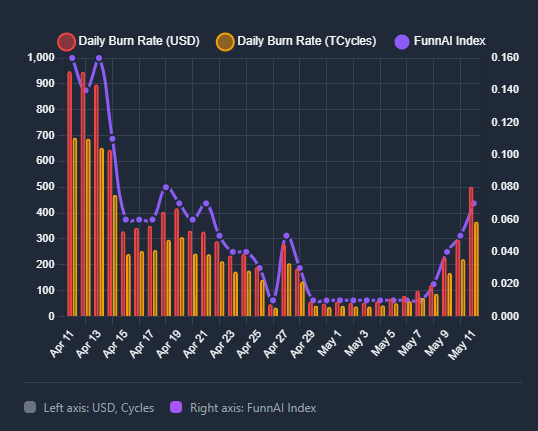
As Funnai price goes up it becomes more profitable to mine, which causes miner sales to increase, 10% of which automatically goes towards buying more funnai on the market. Hope we surpass 50% cbr again once we convert to an SNS (with stakers getting a share of the profits)
ICPFren tweet media
English
0
0
1
30
ICPFren
ICPFren@ICPFren·
@chainspect_app @dfinity Its just that funnai is up lmao. Wait until 10x from here and it'll be $30k/day. Maximum icp burn incoming!
English
0
0
1
34
Chainspect
Chainspect@chainspect_app·
.@dfinity economic activity is becoming more sustainable Just days after the previous spike, ICP generated over $15.5K in daily revenue again Reaching these levels repeatedly is a strong signal that demand for ICP's sovereign cloud is already here 📊 chainspect.app/chain/icp?rang…
Chainspect tweet media
English
4
33
157
5K
ICPFren
ICPFren@ICPFren·
Funnai growing against icp as 99% of alts dump due to speculation. If this keeps up cbr will spike from funnai alone
English
0
0
0
42