Jamie Dulaney

747 posts

Jamie Dulaney

Jamie Dulaney

@JamieSoftware

Long: $SGMO, $PTHRF

Oklahoma City, OK Bergabung Kasım 2009
179 Mengikuti206 Pengikut
Jamie Dulaney
Jamie Dulaney@JamieSoftware·
@Jota5571189851 @GothamGirl_1 Not sure she should assume that prospective board positions would be anything like what she has seen with existing Sangamo board. The board is suppose to be accountable to shareholders. I don't feel like Sangamo board necessarily has kept the management in check... JMO
English
0
0
4
227
Jota557
Jota557@Jota5571189851·
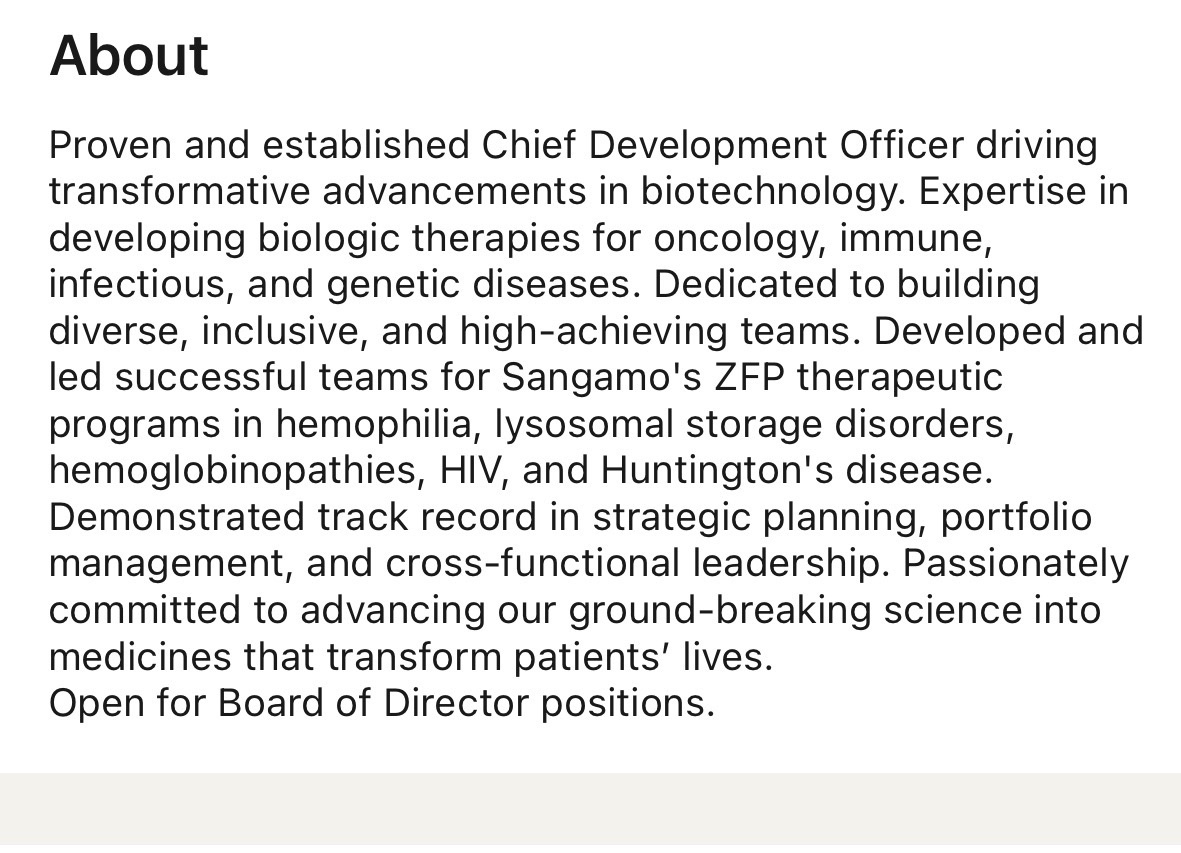
@GothamGirl_1 $sgmo 👀 Well she is open for board of director positions as per her linkedln She might be leaving soon
Jota557 tweet media
English
3
0
2
2.2K
GothamGirl
GothamGirl@GothamGirl_1·
$SGMO Seems she is on her way out the door. Read her bio on the Sangamo’s site. It says she is responsible for Hemo, lysosomal storage diseases and other failed programs. No mention of Fabry or neuro assets. She will take the fall for the failures.
Spa-Go@SP28947316

$sgmo Nobody talking about Nathalie??!!??

English
4
0
10
3.4K
Jamie Dulaney
Jamie Dulaney@JamieSoftware·
$SGMO
Franca_ole@Franca_ole

In clinical trials to date, $SGMO s ST-920 has demonstrated an overall markedly different and potentially superior efficacy profile compared to conventional enzyme replacement therapy (ERT). While ERT has been established as the standard of care for many years and primarily helps to slow the progression of Fabry disease, treatment remains necessary for life and usually leads only to stabilization or a moderate improvement in individual parameters. Renal function typically continues to decline slowly under ERT, albeit at a reduced rate, and effects on cardiac parameters and quality of life are often limited and variable. ST-920, on the other hand, takes a causal, gene-therapeutic approach with the goal of achieving long-term or potentially permanent endogenous production of α-galactosidase A after just a single administration. In the STAAR studies conducted to date, there are indications of a positive or at least stabilized eGFR slope, which could represent a departure from the typical progressive loss of renal function observed with ERT. Cardiac parameters also remained stable over the observation period, while significant and clinically relevant improvements were reported in several domains of quality of life, as measured by the SF-36. Added to this is the considerable practical advantage that regular infusions are no longer required. Overall, ST-920 thus points to a potential new therapeutic approach that not only slows disease progression but could also enable functional improvements in some patients. However, these results are currently based on early clinical studies without direct randomized comparative data against ERT, so a definitive assessment can only be made following further Phase 3 and head-to-head studies.

QCT
0
0
5
1.8K
Jamie Dulaney me-retweet
Franca_ole
Franca_ole@Franca_ole·
Compared to DNA-editing methods such as #CRISPR, $SGMO s repressor approach offers several key advantages. Instead of permanently altering the DNA, gene activity is merely downregulated, leaving the genetic information intact and making the effect potentially reversible. This reduces the risk of long-term damage. Additionally, there are fewer so-called off-target effects, since no cuts are made in the genetic material; instead, there is only a targeted binding to specific DNA sites. This makes the method safer overall and causes less structural damage to the DNA, which also lowers the risk of serious side effects. Another advantage is greater precision: the gene is not completely switched off, but only “dimmed,” allowing for more precise adjustment. Overall, the approach is therefore more controllable and gentler than directly cutting the DNA. $CRSP $EDIT $BEAM $NTLA
English
2
2
18
1.5K
Jamie Dulaney me-retweet
G-PA
G-PA@IndianaGPA·
Chuck Norris doing Chuck Norris Jokes! 😂😂
English
223
5.8K
38.4K
1.3M
Jamie Dulaney me-retweet
TONY™
TONY™@TONYxTWO·
Couldn’t be more accurate 😭
English
73
2.1K
5K
103.2K
Jamie Dulaney me-retweet
Franca_ole
Franca_ole@Franca_ole·
cGPT asking about the potential price for $SGMO ´s ST-920: "A realistic price for Isaralgagene civaparvovec should clearly be based on the established logic of modern gene therapies: a one-time treatment with long-term benefits and savings on lifelong treatment costs. Since the current standard treatment for Fabry disease often costs several million U.S. dollars over a patient’s lifetime, manufacturers have room to justify a high one-time price. Against this backdrop, a price in the range of approximately $2.5 to $3.5 million appears most likely. If the drug demonstrates particularly convincing and lasting efficacy, a price close to $4 million would also be conceivable, while uncertainties regarding the duration of the effect could push the price downward. Regardless of the exact amount, it is also very likely that the price will not be implemented as a simple one-time payment, but rather through tiered or performance-based reimbursement models."
English
2
1
11
1.4K
Jamie Dulaney me-retweet
Don Keith
Don Keith@RealDonKeith·
🤣This is a hilarious montage of Chuck Norris jokes. If you think about it, he really was the first 80’s action hero and pretty much started the genre of 80’s and 90’s action movies.
English
430
7.9K
30.1K
1.1M
Jamie Dulaney
Jamie Dulaney@JamieSoftware·
@wintament I think the neuro target is Huntingtons from $SGMO.. They (Takeda) have been sitting on it for years.. Ideally, Takeda would negotiate a Stac-bbb deal (to deliver Huntington the solution) as part of a Fabry deal. Do that, and both indications can take off...
English
1
0
6
874
Miko
Miko@wintament·
Takeda is a current partner of $SGMO (on an undisclosed neurology target). Given Takeda’s current "Priority Review" streak and their need to fill revenue gaps, quants are speculating that they could be a natural fit to take over the Fabry program
English
4
1
7
1K
Jamie Dulaney
Jamie Dulaney@JamieSoftware·
$SGMO
Franca_ole@Franca_ole

Is Sangamo Therapeutics ( $SGMO) the Ultimate Penny Stock Comeback? youtube.com/watch?v=grJKjC… The video, released a week ago, assesses the current status of Sangamo Therapeutics and its gene therapy ST-920 for the treatment of Fabry disease. It highlights that the company is nearing an important milestone, as accelerated approval by the FDA appears more realistic. One reason for this is that kidney function (eGFR) is accepted as a relevant endpoint, which simplifies the approval process. According to the video, the study data to date show that the therapy is effective: kidney function remains stable or improves, and nearly all patients were able to reduce or completely discontinue their previous ERT treatment. This suggests a potentially long-term or even one-time therapy. At the same time, risks are highlighted: the data set is still small, long-term results are lacking, and Sangamo is under financial pressure, which could lead to capital measures. Overall, the video sees great potential, but also significant uncertainties.

QCT
0
0
5
1K
Jamie Dulaney me-retweet
Steve 🇺🇸
Steve 🇺🇸@SteveLovesAmmo·
Sound advice.
English
140
3.8K
14.5K
791.7K
Jamie Dulaney
Jamie Dulaney@JamieSoftware·
$SGMO
Bernd H Zinselmeyer@ZinselmeyerB

@Franca_ole $SGMO #Fabry is commercially far less complex than many assume: Patients can travel for a single lifetime infusion, & drug is manufactured by #CMO : • 1 infusion per workday ~ $250M+ yearly revenue • 2 infusions per workday ~ ~$500M • Even a ~100 m² practice could handle that

QCT
0
0
2
836
Jamie Dulaney
Jamie Dulaney@JamieSoftware·
$SGMO
Franca_ole@Franca_ole

There are currently three particularly relevant gene therapy programs for #Fabry disease that aim to permanently replace the missing enzyme α-galactosidase A. They differ primarily in vector design, target tissue, and clinical progress. The most advanced therapy is ST-920 (#isaralgagene civaparvovec) from $SGMO. This is an AAV-based gene therapy that targets the liver. Following a single intravenous infusion, liver cells produce α-galactosidase A on a permanent basis, allowing many patients to discontinue their previous enzyme replacement therapy. In the STAAR study, ST-920 demonstrated stable or improved renal function and no serious safety issues to date, which is why this therapy is currently considered promising. A 2nd gene therapy is FLT190 from Freeline Therapeutics, also AAV-based and liver-targeted. It generates very high enzyme levels but has shown immune reactions in early studies that delayed clinical development. The third relevant therapy is 4D-310 from $FDMT 4D Molecular Therapeutics, which specifically targets heart muscle cells to treat Fabry cardiomyopathy. However, studies have shown that severe side effects such as myocarditis have occurred in some cases, leading to a temporary halt in development. In comparison, ST-920 is currently considered the most advanced because it provides stable enzyme activity over years, patients can often discontinue enzyme replacement therapy, no serious safety issues have arisen to date, and initial data show an improvement in renal parameters. An open question in research remains whether gene therapies can completely reverse cardiac involvement in Fabry disease or merely halt its progression, particularly with regard to fibrosis, left ventricular mass, and cardiac MRI findings.

QCT
0
0
5
978
Jamie Dulaney
Jamie Dulaney@JamieSoftware·
A glitch with videos not playing, and showing zero seconds for length. Tap frame a few times and it works #NewXAndroidFeedback
English
0
0
0
13
Jamie Dulaney
Jamie Dulaney@JamieSoftware·
@EricLDaugh great example of someone critiquing a person (Trump) and not a specific policy... Maybe he should try harder at articulating an debating policy nuances...
English
0
0
2
38
Eric Daugherty
Eric Daugherty@EricLDaugh·
🚨 WTF?! Dem strategist James Carville has JAW-DROPPING meltdown on President Trump "Look, you fat f*ck Trump! If you listen to this, you listen good! You hear me, you fat a**hole! [...] We want to hate the son of a b*tch so much we can't SEE STRAIGHT!" x.com/i/status/20303… "I got Trump Derangement Syndrome! I don't want to get better! I want to get WORSE! I want to hate him MORE!" "I pray to God in heaven: God, reign the righteous reign of Trump Derangement Syndrome on me. Pray for me, Lord. I'm your vessel on this earth. Pray for the people that listen to this. We want MORE [TDS]!" Mental institution.
English
10.8K
3.6K
13.4K
1.1M
Jamie Dulaney me-retweet
American AF 🇺🇸
American AF 🇺🇸@iAnonPatriot·
LMAOO.. Sen. Adam Schiff (D-CA) gets BAITED into hating on Obama when he thinks it’s President Trump 😭😭
English
234
3.6K
15.1K
224.5K
Jamie Dulaney me-retweet
Franca_ole
Franca_ole@Franca_ole·
$SGMO ´s Isaralgagene civaparvovec (ST-920) has received several regulatory designations and pathway agreements from the FDA to support its development for Fabry disease in the United States. The therapy has been granted Orphan Drug Designation, reflecting its development for a rare disease and providing associated incentives such as market exclusivity upon approval. In addition, the FDA has awarded Fast Track designation, which facilitates more frequent interactions with the agency and enables eligibility for rolling review and potential Priority Review. Furthermore, isaralgagene civaparvovec has received Regenerative Medicine Advanced Therapy (RMAT) designation, a program specifically designed to expedite the development and review of regenerative medicine products, including gene therapies. The FDA has also aligned with the sponsor on a potential Accelerated Approval pathway, under which surrogate or intermediate clinical endpoints—such as measures of renal function—may serve as the basis for earlier approval, subject to post-approval confirmatory requirements. In this context, the agency has permitted a rolling Biologics License Application (BLA) submission, allowing sections of the application to be submitted and reviewed incrementally rather than waiting for a complete dossier. As of now, Priority Review has not been formally granted, although the existing Fast Track designation makes the product eligible for such consideration upon BLA submission.
English
0
3
19
1.4K
Jamie Dulaney
Jamie Dulaney@JamieSoftware·
$SGMO
Franca_ole@Franca_ole

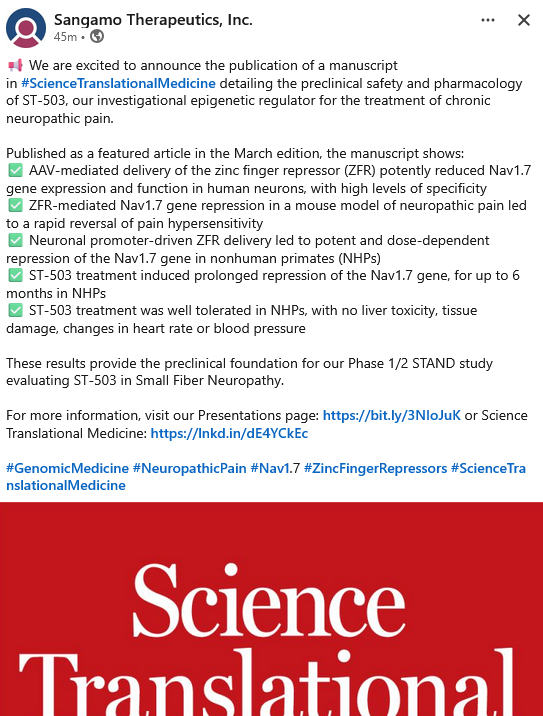
According to the entry for $SGMO ´s ph1/2 study NCT06980948 on ClinicalTrials.gov, the primary endpoint for ST-503 is clearly defined as safety and tolerability, measured by the incidence and severity of treatment-emergent adverse events (TEAEs) over a period of 12 weeks after dosing. All secondary endpoints—including pain reduction of at least 30% or 50% on the PI-NRS, changes in PGIC, C-SSRS, SF-MQ-2, DSIS, HADS, SFN-SIQ, SFN-RODS, SF-36, and other patient-reported outcomes—are also specified with a 12-week time window. However, this does not mean that the entire study lasts only twelve weeks. In early gene therapy studies, it is common to set a relatively early primary analysis time point in order to quickly evaluate safety and initial signs of efficacy, while patients are followed up for a significantly longer period of time. Particularly with an epigenetic approach against Nav1.7, as pursued here, 12 weeks in the pain domain is a regulatory established period for assessing clinically relevant pain reduction. Threshold values of ≥30% or ≥50% improvement on the numerical rating scale are considered standardized and clinically meaningful criteria. Strategically, a 12-week endpoint can even be advantageous because it allows for earlier evaluable data. Once the first patients have reached this milestone, safety data and initial indications of efficacy could be communicated without having to wait for a one-year follow-up. For investors, this increases the likelihood of an earlier data catalyst, especially if a consistent responder signal is evident. The safety profile of intrathecal administration, the robustness of pain reduction, a possible dose-response relationship, and indications of the durability of the effect beyond 12 weeks will be decisive factors.

QCT
0
0
5
697