
‘
14.4K posts


I typically ignore all these false claims attacks. But... You can apologize now. I am officially divorced. I won't post any legal docs online, as I respect privacy of my ex-wife, and I appreciate the time we spent together. I am happy to bet $1 billion USD (or any number you choose) that: I am officially divorced (way before today). If you agree to take the bet, we can get lawyers to validate my divorce agreement, which should be dead simple. This bet offer is valid permanently, whenever you feel ready. But if you don't take it within 24hrs, it clearly shows who has been mis-representing to the public. Moving on to better things to do.

While China was busy shipping missile chemicals to Iran and collecting yuan tolls at Hormuz, someone was inside its most sensitive supercomputer stealing everything. CNN reports that a hacker group calling itself FlamingChina breached the China National Supercomputing Center in Tianjin and exfiltrated up to 10 petabytes of classified defence data. The samples posted on dark web forums include bomb and missile designs, animated explosion simulations, structural integrity tests, renderings of the J-20 stealth fighter, sixth-generation aircraft concepts, nuclear submarine schematics, hypersonic weapons systems, and target analyses for American assets including HIMARS launchers and carrier strike groups. Ten petabytes. For context, the entire printed collection of the US Library of Congress is approximately 10 terabytes. This breach is one thousand times that volume. It is being sold for cryptocurrency on Breach Forums. Cybersecurity experts who reviewed the previews told CNN the data appears genuine, matching known output patterns from the NSCC Tianjin facility, which serves over 6,000 clients including defence agencies and aviation firms across China. The timing is extraordinary. Trump posted a 50 percent tariff threat on any country supplying military weapons to Iran hours before CNN published this story. Five Chinese vessels shipped sodium perchlorate to Iran from Gaolan Port in the past six weeks, enough propellant precursor for hundreds of ballistic missiles. China’s ghost fleet continues operating through the IRGC’s yuan toll booth at Hormuz. And now the supercomputer that designed the weapons China is helping Iran reconstitute has been gutted by hackers selling its contents for the same cryptocurrency that Iran charges for strait passage. The irony is architectural. China built a parallel financial system using yuan and crypto to bypass the dollar at Hormuz. A hacker group is now using crypto to bypass Chinese state security and sell Beijing’s most classified military designs to anyone with a wallet address. The same technology that enables sanction evasion enables espionage monetisation. The blockchain does not distinguish between a toll payment and a weapons leak. It processes both. For Xi, this is a catastrophe arriving at the worst possible moment. Bessent’s mid-May Beijing summit was already going to be difficult. Trump holds the waiver on 140 million barrels of Chinese-bound Iranian crude. The 50 percent tariff threat targets China’s arms pipeline. The IDF just destroyed 100 Hezbollah targets using F-35I aircraft with Israeli software upgrades the Pentagon approved today. And now the classified designs for China’s most advanced military systems, the systems that justify the rare earth monopoly and the South China Sea posture and the Taiwan coercion campaign, are available for purchase on a dark web forum for less than the price of a single Hormuz transit. If the data is genuine, every adversary and ally of China can now reverse-engineer the capabilities Beijing spent decades and hundreds of billions developing. The J-20’s stealth profile. The hypersonic glide vehicle’s trajectory calculations. The nuclear submarine’s acoustic signature. The sixth-generation fighter’s sensor architecture. All of it, priced in crypto, available now. China wanted to build a post-dollar world. A hacker group just demonstrated what that world looks like when the technology works in both directions. open.substack.com/pub/shanakaans…


what if oxygen is poisonous and it just takes 75-100 years to kill us


Introducing Project Glasswing: an urgent initiative to help secure the world’s most critical software. It’s powered by our newest frontier model, Claude Mythos Preview, which can find software vulnerabilities better than all but the most skilled humans. anthropic.com/glasswing
WTF just happened today with $AAVE AAVE is the biggest DeFi protocol so far and has become the face of DeFi When it collapses, that would not be good for the industry $AAVE losing chaos labs and cracking $90 support in the same news cycle is rough but wagmi after the dust settles Chaos Labs out = $AAVE in chaos. The math is mathing harder than portfolio of someone rn who was holding Tough break for $AAVE holders tbh Is this over?
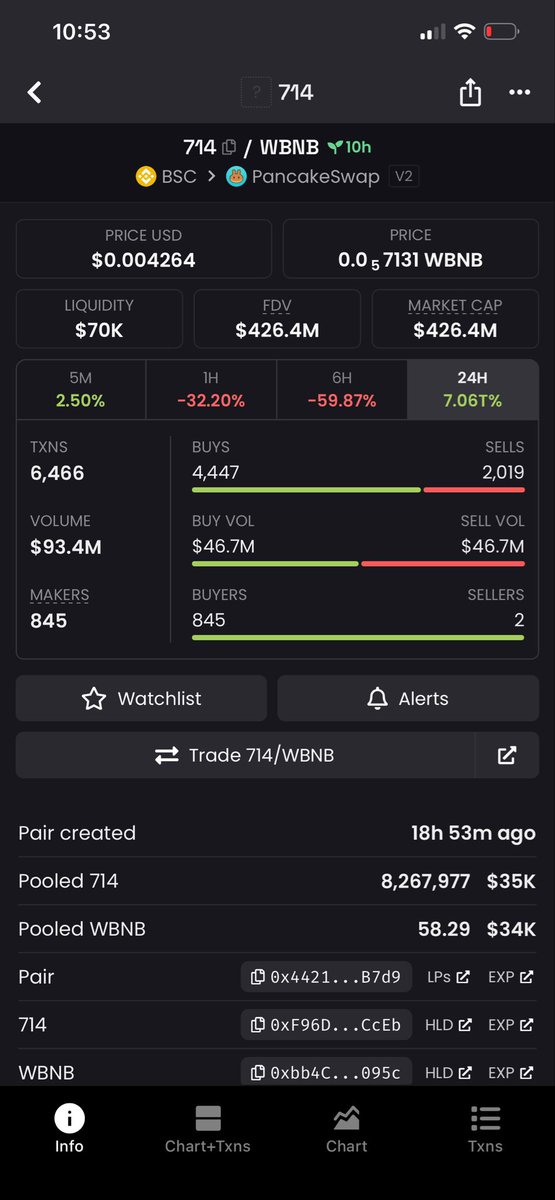
Laundering complete, and there’s the rug

🚨 I’ve been hearing a lot from the $KAS community on $Qubic ‘s verified certik audit on performance and security, but brushing off a pretty obvious gap that shouldn’t be ignored Kaspa currently shows no CertiK audit at all while still carrying a Skynet score around 84.9 (A rating) At the same time, it has no CertiK bug bounty and no verified audit badge, with only a mention of some third party audit and limited transparency around it Qubic on the other hand is sitting at a ~90+ Skynet score (AA rating) with a completed CertiK audit report delivered in 2025 On top of that, CertiK actually verified its mainnet performance claims, including 15.5M TPS in a live test That’s not a small difference CertiK scores are not random numbers. They factor in audits, code security, team verification, monitoring, and overall risk signals So when one project has gone through a full audit process and the other hasn’t, yet both are being compared like equals, it raises a fair question Why is a top tier project like Kaspa still avoiding a full external audit from one of the biggest firms in the space And more importantly, why is the community treating that as normal You can argue different architectures, different priorities, whatever you want But at the end of the day, verified external validation matters Right now the gap is simple Qubic has it Kaspa doesn’t #Kaspa #KAS #Qubic #QubicNetwork #Crypto #CryptoNews #Altcoins #Blockchain #Web3 #CryptoInvesting #CryptoCommunity #DeFi #CryptoDebate #CertiK #CryptoSecurity #DYOR #CryptoAnalysis
The longer the market stays in bearish shitty conditions the more confident I am with my bull thesis on the adoption of $kas long term, blessing in disguise this happened for the network imo YS has openly spoken how prefers these conditions over good ones to build and that’s what we have been gotiven but the real positive for me is $kas will have to play MUCH MUCH less catchup to other networks in adoption which is ultimately what matters
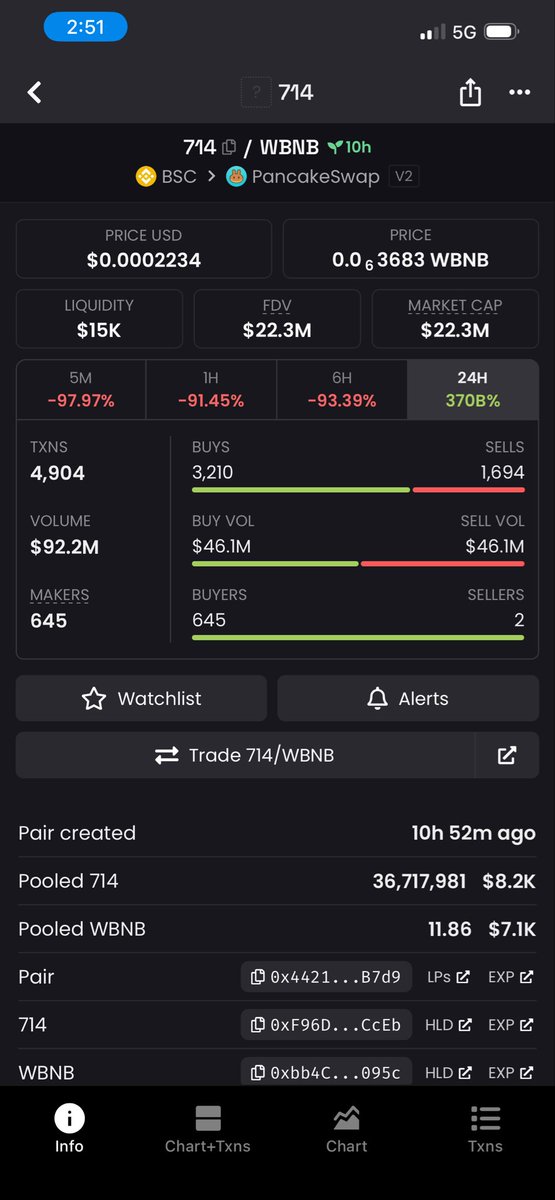

I’m all for nefarious actors and rugging and scamming and fraud can’t forget about the fraud But when I see something up 3.85 trillion % and there have only been TWO addresses doing 45.7M worth of selling through 1490 transactions, THAT is where I draw my line in the sand What the fuck is two sellers? The thing just 1000000000x’d and no one takes anything off the top? Ok. High probability this is purely money laundering, nothing more nothing less
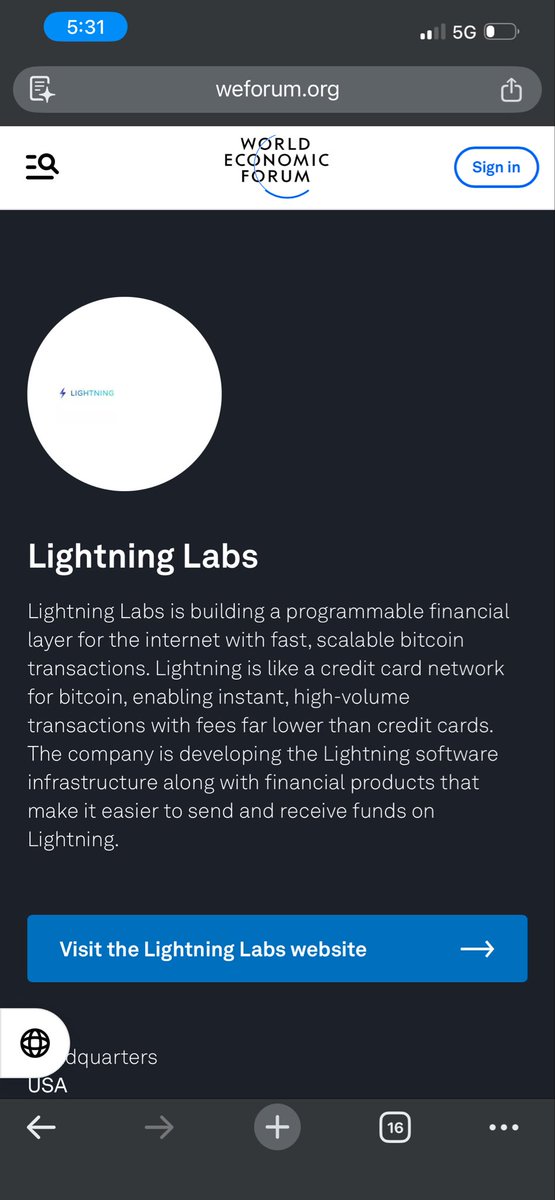

Store $100,000 worth of groceries in your car trunk for a year. Then we can talk. 😂 Lightning is for moving Bitcoin, not storing it long term. Same way your checking account is for spending, not storing your life savings. This is why I can’t take Kaspa Bros seriously.