

Muski Coder
22 posts

Muski Coder
@MuskiCoder
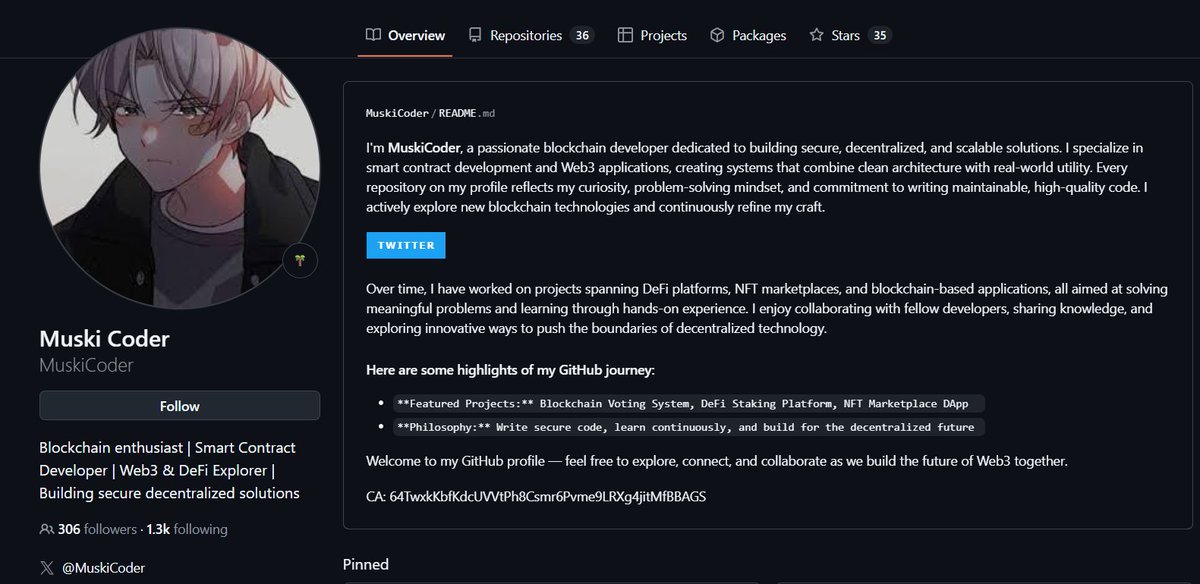
Blockchain enthusiast | Smart Contract Developer | Web3 & DeFi Explorer | Building secure decentralized solutions
Bergabung Ekim 2017
32 Mengikuti634 Pengikut
I’m streaming the process of building the SHH SDK on Twitch:
twitch.tv/shhproto
English

$SHH Is Live On @BagsApp!
Encrypted Messaging Protocol
On-chain messages, no phone numbers, no servers.
ca: 64TwxkKbfKdcUVVtPh8Csmr6Pvme9LRXg4jitMfBBAGS
Website: shhproto.com
App: app.shhproto.com
English
English
yo, wanted to share a bit of what's happening behind the scenes with encryption every message gets a fresh ephemeral key (forward secrecy).
we use NaCl box - same crypto as Signal. messages are encrypted twice: once for the recipient, once for you so you can read your own history. everything lives on Solana but only the private key holder can decrypt
SHH Protocol@SHHProto
SHH interface preview Minimal. Quiet. Focused on messages - nothing else.
English
Muski Coder me-retweet

I think if you care about privacy, it’s unhelpful that people are deploying ML models in TEEs and calling it “end to end encrypted.”
English
i’m starting to build something new — like an on-chain messenger where only two people can see the messages (the wallet owners). @SHHProto
English
i don’t understand how someone like @durov got out of arrest in france completely untouched - and still keeps boldly claiming he’s “uncompromising” and never shares any info about telegram messages with anyone. and it all just got brushed off like it never even happened.
English
damn, it’s crazy living with the fact that you can’t talk to someone online and be 100% sure that only you and the other person know what’s in the chat.
English
Muski Coder me-retweet
The hardest problem in computer science is people just getting along.
English
Muski Coder me-retweet

Major milestone 🏁
#Binance is the first-ever digital assets trading platform to secure a full suite of licenses from FSRA under @ADGlobalMarket.
This marks a breakthrough moment that raises global standards for regulation, security, and trust.
It reflects our commitment to building a secure, transparent, and institution-ready global digital asset ecosystem.
A turning point for the industry.
A major leap for global adoption.
One step closer to a billion users 💛
Read more 👉 binance.com/en/blog/regula…

English
Muski Coder me-retweet


Muski Coder me-retweet

The costs to use Ethereum are at an all-time low.
The liquidity & capital velocity in low-risk DeFi (lending, stablecoins) on Ethereum are at an all-time high.
The Ethereum core dev shipping pace is at an all-time high.
Exciting times.

English
Muski Coder me-retweet

🇵🇭PHILIPPINES: An Ethereum Adoption Case Study
- Top 10 globally for crypto use
- 12M+ crypto natives, strong Web3 literacy
- 49.8% unbanked, $38B remittances, 57% digital payments
- Gov uses Ethereum for transparency & tokenized bonds
Why it matters: localethereum.substack.com/p/the-philippi…

English
Muski Coder me-retweet

One of the world’s largest exchanges, @okx, has migrated @XLayerOfficial to the OP Stack, adopting a modular, high-performance framework to operate its own independent L2.
Built for security, throughput, resilience, and consistent uptime, the OP Stack powers ~70% of all Ethereum L2 activity and is openly available for anyone to build with.

English
Muski Coder me-retweet

Obol and @dsrvlabs present a collaborative report on the State of Ethereum in South Korea.
A deep dive into one of Ethereum’s most unique local scenes featuring the key voices pushing it forward.
As we discovered, the South Korean community is ready to build the future 🇰🇷🌱
English
Muski Coder me-retweet

Always glad to see when people appreciate the protocol changes that add hard invariants, improving protocol security and future adaptability
2021: EIP-2929 + 3529 (SLOAD gas cost increase, refunds nerfed)
2024: SELFDESTRUCT nerf (Dencun)
2025: 16,777,216 gas per tx limit
All of these put various kinds of hard caps on how much can happen within a single block or a single transaction, eliminating entire classes of DoS risk, enabling client code simplification, and creating more options for how to increase efficiency.
Invariants I expect we will want soon:
* Cap number of code bytes accessed (short term: increase cost of calling big contracts, medium term: binary tree + per-chunk pricing)
* Bounds on ZK-EVM prover cycles (repricings)
* Changes to memory pricing to create a clearer hard bound on max EVM memory consumption
michael@no89thkey
EIP-7825 is one of the most underrated upgrades for the future of ZK proving and 100X Ethereum scaling. By capping each Ethereum transaction at ~16.78M gas, it removes the risk of a single “mega-transaction” consuming an entire block. That sounds small, but the implications for ZK systems are huge. ZKVMs generate proofs by replaying execution. Bigger single tx → bigger un-parallelizable unit of work → longer latency. Before 7825, one "ZK unfriendly" transaction could blow up the proof time because you cannot run parallel proving across multiple transactions. This easily breaks real-time proving which is needed for 100X Ethereum scaling. For any team working on fast ZKVMs, this was the nightmare scenario. 7825 fixes that. Now, every block is made of predictable, bounded work units, which makes proving schedulable and highly parallelizable. As long as we can prove a worst-case 16M gas tx fast enough (like <5s), we know we can prove basically any big blocks through parallel computing. In short: EIP-7825 made sure that Ethereum real-time proving becomes a pure money problem. As long as we can throw enough parallel computing power to the problem, we can get real-time Ethereum proving for even 100M, 200M gas blocks, TODAY. This upgrade may not look like the main event tonight, but it is actually a massive unlock for the ZK roadmap and the future of Ethereum scaling in 2026. Believe in somETHing.
English
Muski Coder me-retweet

One of the many EF teams that doesn’t get nearly enough credit for keeping Ethereum safe and secure
The EF STEEL Team. Learn more about them 👇
danceratopz.⌐◨-◨ 🦇🔊@danceratopz
What does the Ethereum Foundation STEEL Team do? STEEL is the EF team responsible for Specifications & Testing for the Ethereum Execution Layer ⚔️🛡️ A relatively new team that ensures that EL: 1️⃣ Specs are clear & correct📐✅ 2️⃣ Clients are adequately tested before forks🧪
English
Muski Coder me-retweet
My rough math based on average difficulty stats suggests that Bitcoin mining crossed the total 2**96 hashes milestone very recently?
Seems like a good reason to insist on (close to) 128 bit security (ie. @drakefjustin was right)

English