DrFlo me-retweet
DrFlo
978 posts

DrFlo
@ProfFJWilliams
Assist Prof Chemistry. Interests: OChem, Chem Bio, Chem Ed, Med Chem, Brewing Beer, Equity/Equality, Also lots of other stuff! Views are my own. She/her
Bergabung Haziran 2019
397 Mengikuti525 Pengikut
DrFlo me-retweet

Dan Baldassarre is lying about organic chemistry professors, and I would like him to stop chemjobber.blogspot.com/2023/12/dan-ba…
English
DrFlo me-retweet

Finally out! Our paper on nitrene reduction is now available - open access - at Org Lett @JOC_OL pubs.acs.org/doi/10.1021/ac…
English

@VT_Chemist @sasha_sundstrom Sorry I meant overhead not startup. *Long week.
English

@VT_Chemist @sasha_sundstrom Yes, and for grad housing you can set up the rent to balance the maintenance (heat, water, etc) and it should still be competitive with the rental market. Also worth stating that building costs often do not come from startup. Donors love their names on buildings.
English

@LCademartiriLab The point is not to be profitable, it is to give stable housing options to grad students. It can be net neutral in cost balance, and benefits the university by supporting research and recruitment.
English

@LCademartiriLab I don't think anyone has to be forced, just having the option can be very helpful.
English

@emily_m_arndt @thanukaDD @PalliThordarson Cool! Happy to be corrected. I know industry is also increasing it's internship opportunities which is great.
English

@emily_m_arndt @thanukaDD @PalliThordarson True, though at a higher level of training in their career. But didn't mean to downplay the role of mentoring in these other places as well! Very big part too.
English

@pauldauenhauer @millanek1 @rbgetman Yep, large amounts too over time, adds up to tens of thousands. No other business I know would think this is normal.
English

@thanukaDD @PalliThordarson @emily_m_arndt While there are always exceptions, the vast majority of profs I know (myself included) care deeply about training students (grad and ugrad), and would likely be in pharma if we didn't. Lots of amazing research (and toys) there.
English

@PalliThordarson @emily_m_arndt The costs are real, I agree, but we need to be honest about the objectives. Academics get into academia to do research they are passionate about and not train graduates. Most economical way to do it is grad students. And unis and grants pay for these as investments vital for econ
English

@emily_m_arndt @Kris_Koskela Since we functionally end up doing our own accounting, 100% yes.
English

@lowrank_adrian @Andrew_Akbashev In a lot of instances this would mean funding security. A minimum amount of $$ to make sure your lab can at least function on a basic level makes sense to me. Otherwise, it remains a brutal system that supports problematic incentives.
English

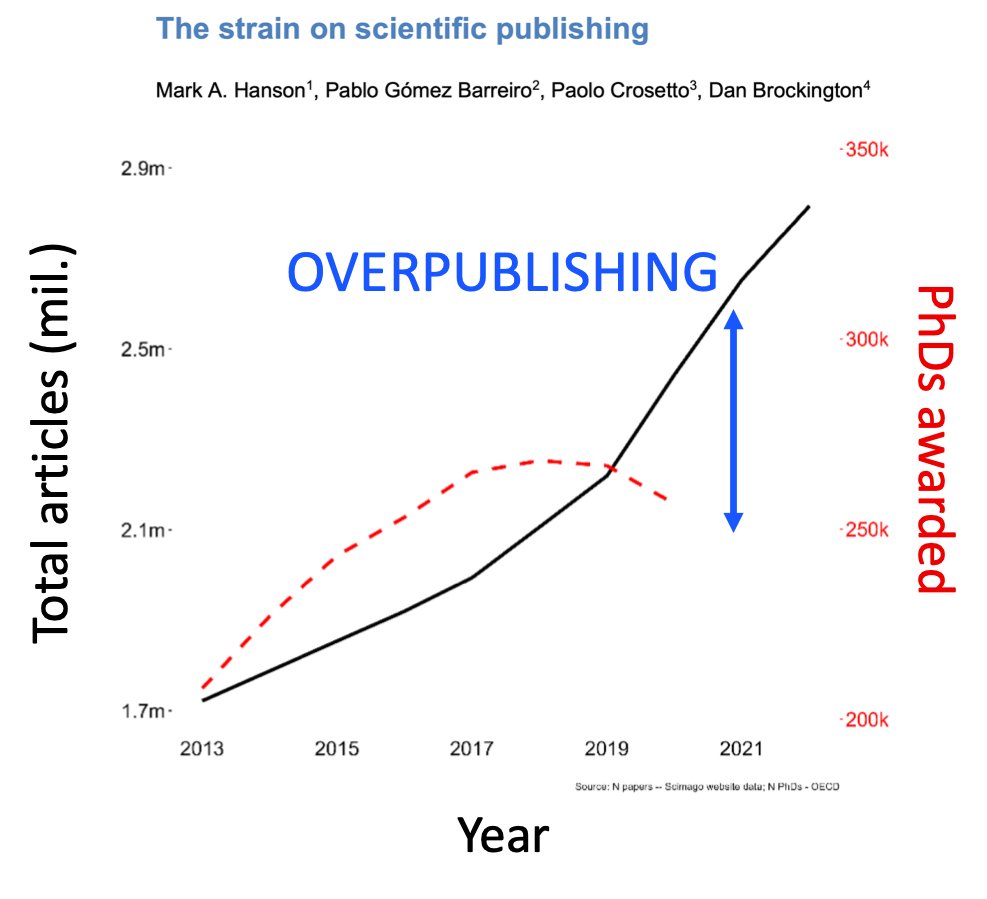
Overpublishing puts enormous stress on students and PIs.
And brings tons of money to publishers in STEM.
A new study shows that the number of papers is increasing FASTER than the number of #PhD graduates.
It’s an amazing work with very useful statistics. Huge kudos to the authors!
▫️
Main outcomes:
1️⃣ In 2022 the number of articles is 47% higher than in 2016. The amount of writing, reviewing and editing workload per scientist is increased enormously.
2️⃣ “Special issues” is a strategy for publishing lots of papers with reduced review time. This is possible due to the “publish or perish” pressure and clearly benefits the publishers.
3️⃣ The publishing time varies widely!
MDPI = 37 days. Frontiers = 72 days. Elsevier = 134 days. Springer = 157 days. Nature = 185 days.
4️⃣ The article rejection rates do not seem to correlate with publisher growth. However, rejection rates decline with increased use of special issue publishing.
5️⃣ Certain for-profit gold-open-access publishers create an increasing number of special issues, with uniquely reduced turnaround times, and in specific cases, high impact inflation and reduced rejection rates.
6️⃣ The authors suggest a new metric - Impact Inflation, which is reflected in self-citation within the same journal. For example, MDPI has a high impact inflation due to excessive self-citation compared to other publishers.
Conclusions and my opinion:
- Scientists have to spend a lot more time on reviewing and writing than before (on average).
- The more papers are published, the more the quality is compromised.
- Scientific progress has become partially bound to the business models of publishers and their revenue (a sad reality today).
- There is a huge lack of transparency. Much of these data had to be ‘web-scraped’ from numerous sources in order to get a full picture. We clearly need regulators to mandate open access to publisher’s statistics.
- Reduce the number of special issues! Those typically have low standards.
▫️
Science, publishing and funding make a trio that is very hard to disentangle.
However, research quality is controlled by the community.
This is why preprint + community review can make a big difference.
#AcademicTwitter #AcademicChatter

English
DrFlo me-retweet