Satya Protocol

16 posts

Satya Protocol banner
Satya Protocol

Satya Protocol

@SatyaProtocol

AI Model Marketplace secured with TEEs and decentralized storage on @WalrusProtocol.

Bergabung Kasım 2025
3 Mengikuti290 Pengikut
Tweet Disematkan
Satya Protocol
Satya Protocol@SatyaProtocol·
First step completed (proof of concept) - @WalrusProtocol hackathon submission. Over the next couple of months, we would be iterating this product, getting it prepped for mainnet! cc: @RJ_Simmonds, @WalrusProtocol, @theharrisonkim, @kostascrypto, @EmanAbio.
Sele@iv_dev3

Excited to share my latest hackathon project: Satya, a decentralized AI model marketplace built on the Sui stack. For a while now, I've been researching bridging AI and Web3, and I have noticed some gaps in today’s AI ecosystem. Centralized platforms still struggle with trust: creators face piracy and unfair payouts, while buyers gamble on fake, biased, or underperforming models. So I built Satya to flip that dynamic, a trustless, cryptographically verifiable marketplace where creators keep control and buyers know exactly what they’re getting. Satya brings verifiable trust and strong IP protection to AI models. Using TEEs via Nautilus, every model gets tamper-proof attestations for authenticity, performance, and bias, all visible on-chain. No more blind buys. For creators, Seal (secrets management on @WalrusProtocol) enables encryption so models stay encrypted even during evaluations, preventing theft or reverse-engineering. Sui smart contracts automate payouts, fees, and revenue splits with sub-second finality, and dynamic NFTs let model metadata evolve as new verifications come in. On the storage side, Walrus provides decentralized, redundant, blob-based hosting for encrypted models, giving creators reliability and buyers verifiable access without centralized points of failure. I built this as a prototype for the Walrus Foundation Haulout Hackathon, using Sui’s object-centric model and parallel execution to power high-throughput AI asset trading. Satya isn’t just another marketplace, it’s a verification-first ecosystem that treats AI models as secure, tradable digital assets. Huge thanks to @Mysten_Labs for the powerful tooling.

English
5
0
34
1.3K
Satya Protocol me-retweet
Sui
Sui@SuiNetwork·
Most AI was trained by scraping content without permission, attribution, or payment. The Sui Stack enables a licensing layer where creators get compensated and users get AI built on verified, rights-respecting data. A fairer system for everyone. Read on 👇 blog.sui.io/data-with-righ…
Sui tweet media
English
42
68
425
31.6K
Satya Protocol me-retweet
Sele
Sele@iv_dev3·
Genuinely having a lot of fun building on the Sui stack alongside @minting_ruru and @cyberX___. Easily integrated passkeys on @SatyaProtocol using the TS SDK, no headaches, more flexibility for wallets. *app’s still a bit buggy, but it’s fun to work on.
English
10
4
69
2K
Satya Protocol me-retweet
Ruru_arcade
Ruru_arcade@minting_ruru·
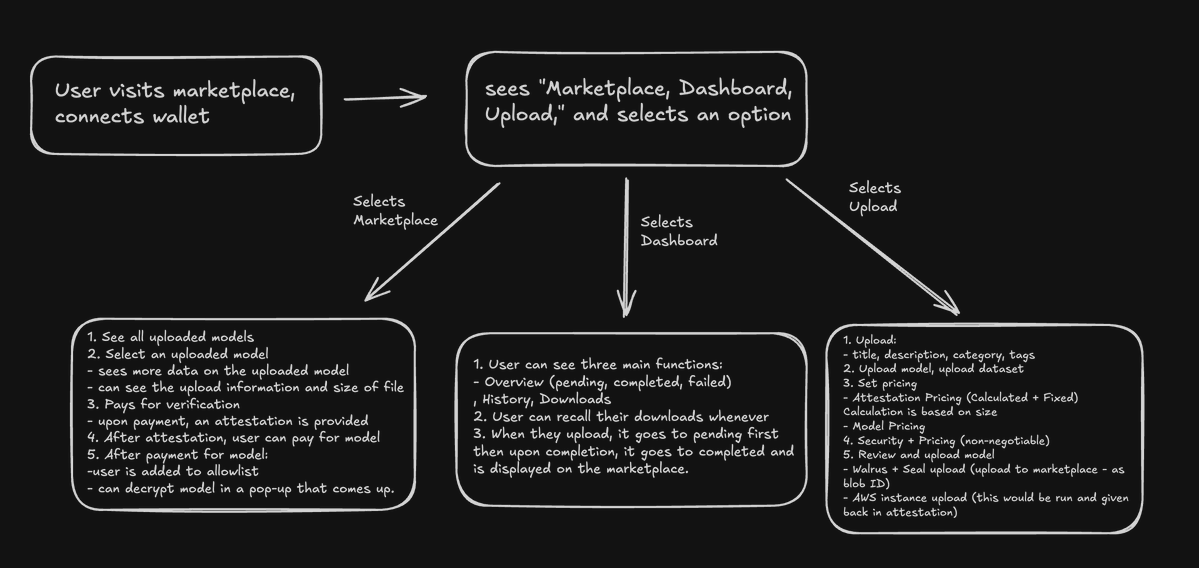
The model download process on @SatyaProtocol: TEE verification → Onchain Verification → Model Purchase → buyer requests decryption → Key manager releases session key → Walrus blob decrypted → Model downloaded by buyer When a creator uploads a model on Satya, it first goes into a "pending". At that point, the model is already encrypted with Seal and stored on @WalrusProtocol, but nothing is live on the marketplace yet. It just sits in the user dashboard while the platform queues it for verification. All we have at this stage is the encrypted blob, the on-chain metadata, and the listing skeleton. From there, the model gets pushed into a TEE for verification. The enclave runs the model, checks that it has not been modified, benchmarks it, and then returns a hardware attestation that proves the environment was real and secure. Once that attestation comes back and gets written to the listing on Sui, the model automatically moves from Pending to Verified. At that moment it becomes visible and can be purchased like any other item on the marketplace. When someone purchases the model, the purchase goes through a Sui smart contract that handles payment and access rights. After the purchase is confirmed, the buyer can request decryption, and the SEAL key manager checks their proof of ownership before issuing a temporary session key. That key is used to decrypt the file stored on Walrus, and the buyer receives a secure download link.
English
8
6
50
1.6K
Satya Protocol
Satya Protocol@SatyaProtocol·
Revolutionary product being built, fully on the @SuiNetwork stack.
Ruru_arcade@minting_ruru

The model download process on @SatyaProtocol: TEE verification → Onchain Verification → Model Purchase → buyer requests decryption → Key manager releases session key → Walrus blob decrypted → Model downloaded by buyer When a creator uploads a model on Satya, it first goes into a "pending". At that point, the model is already encrypted with Seal and stored on @WalrusProtocol, but nothing is live on the marketplace yet. It just sits in the user dashboard while the platform queues it for verification. All we have at this stage is the encrypted blob, the on-chain metadata, and the listing skeleton. From there, the model gets pushed into a TEE for verification. The enclave runs the model, checks that it has not been modified, benchmarks it, and then returns a hardware attestation that proves the environment was real and secure. Once that attestation comes back and gets written to the listing on Sui, the model automatically moves from Pending to Verified. At that moment it becomes visible and can be purchased like any other item on the marketplace. When someone purchases the model, the purchase goes through a Sui smart contract that handles payment and access rights. After the purchase is confirmed, the buyer can request decryption, and the SEAL key manager checks their proof of ownership before issuing a temporary session key. That key is used to decrypt the file stored on Walrus, and the buyer receives a secure download link.

English
0
0
3
199
Satya Protocol me-retweet
Sele
Sele@iv_dev3·
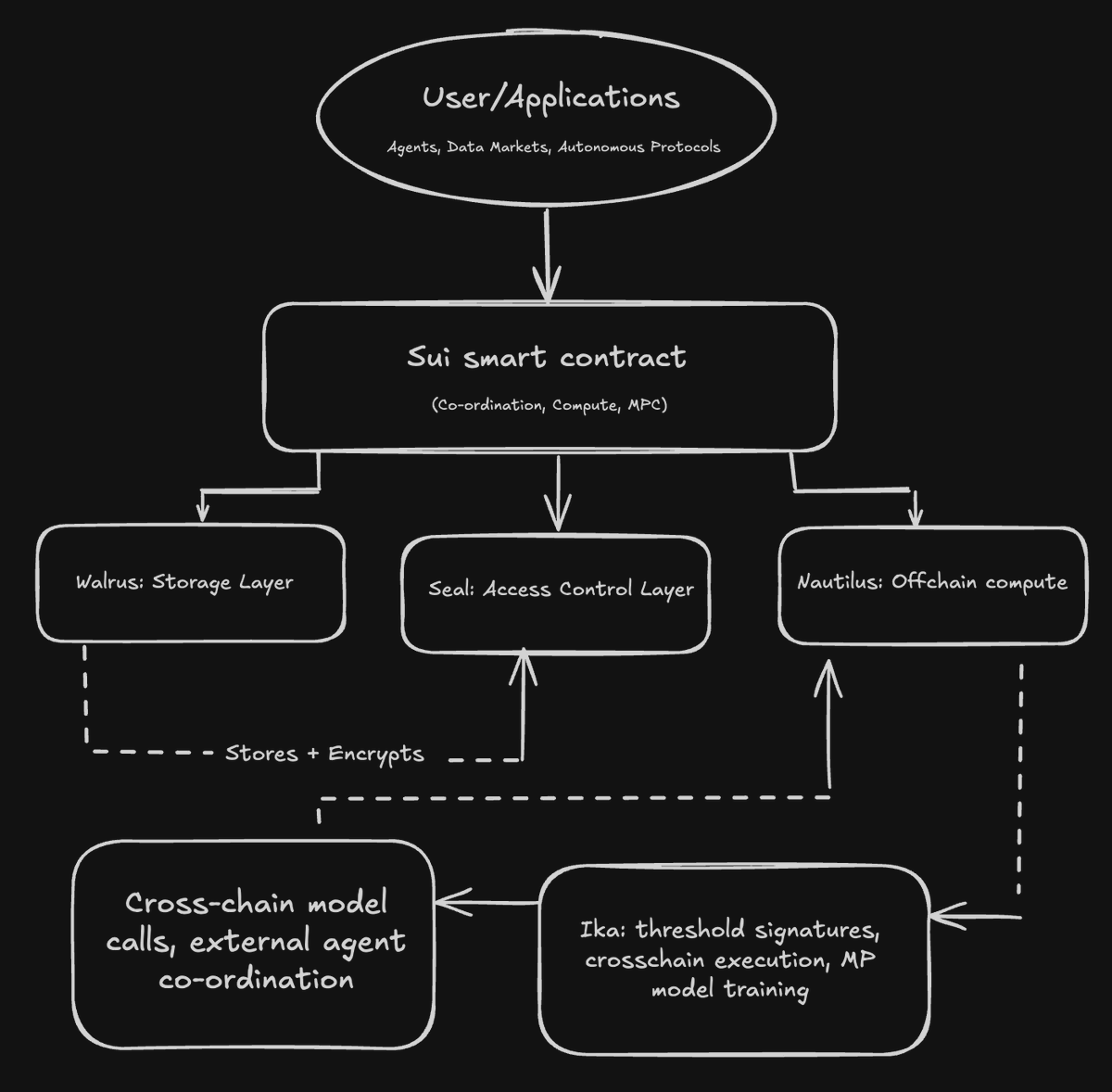
Been building @SatyaProtocol for a while now, and it has prompted me to research the DeAi (Decentralized AI) stack on @SuiNetwork. Currently, the stack has evolved into one of the most complete and high-performance infrastructures for DeAI. At the base of this stack is @WalrusProtocol, a storage layer built specifically for AI-scale data, with durability, retrieval speed, and verifiability that feel closer to a cloud platform than a blockchain. Its erasure coding and fountain-code architecture allow massive datasets to be stored, repaired, and retrieved with minimal redundancy and sub-second access times. Sitting on top of this foundation is Seal, the programmable privacy layer on Sui, which adds identity-based encryption, threshold decryption, and fine-grained access control for AI models, datasets, and digital assets. This combination: high-performance storage with first-class privacy, is what makes the data layer of Sui’s DeAI stack fundamentally different from anything else in Web3 today. The compute layer is powered by Nautilus, a verifiable off-chain execution framework built around TEEs like AWS Nitro Enclaves. Nautilus lets developers run sensitive AI workloads, like private inference, secure agent logic, or confidential on-chain automation, inside hardware-isolated environments while anchoring cryptographic proof of correct execution directly on Sui. This gives builders the performance of off-chain compute with the trust guarantees of on-chain verification and because Nautilus integrates directly with Walrus and Seal, you can do things like run AI inference on encrypted datasets without ever exposing the underlying data. This architecture also enables standardized verification pipelines for AI outputs, helping solve the authenticity problem that plagues most AI systems today. The final piece of the stack is @ikadotxyz , a high-speed MPC layer enabling sub-second threshold signatures, cross-chain execution, and multi-party control, all without exposing private keys or relying on a single coordinator. Ika effectively turns Sui into a control hub for assets and logic on other chains, enabling programmable Bitcoin, multi-chain AI agents, secure federated training, and cryptographically enforced cross-chain automation. Its 2PC-MPC design is built for scalability, supporting thousands of nodes and tens of thousands of signatures per second, performance never before seen in decentralized cryptography. Because Ika plugs seamlessly into Nautilus, Seal, and Walrus, it completes a system where data can be stored, encrypted, computed on, verified, and propagated across chains with full cryptographic guarantees. Taken together, Walrus, Seal, Nautilus, and Ika form a unified “verifiable AI control plane”, a stack that blends storage, privacy, compute, and interoperability into a single programmable environment. This makes Sui one of the only ecosystems where AI applications can run with enterprise-grade performance and decentralized trust assumptions. With billions in ecosystem value, thousands of active developers, and rapidly growing enterprise integrations, Sui’s DeAI stack is positioning itself as the open infrastructure powering the next wave of AI agents, data markets, privacy-preserving applications, and cross-chain automation.
Sele tweet media
English
8
15
77
3.9K
Sele
Sele@iv_dev3·
Over the past couple of weeks, I've been building an AI Model Marketplace powered by entire Sui stack, designed for a future where data, compute, and intelligence flow securely across open networks. My work focuses on solving one of the biggest problems in AI today, how to enable developers, companies, and creators to exchange models without giving up ownership or exposing sensitive information. By combining verifiable storage - @WalrusProtocol, with hardware-backed confidentiality, using the Nautilus framework on @SuiNetwork , the marketplace makes trust an engineering property, not a negotiation. At the core of this project is the belief that AI shouldn’t be gated behind closed platforms. TEEs allow models to run in sealed environments where inputs, outputs, and weights remain private, while @WalrusProtocol ensures data availability, verifiability, and censorship resistance, leveraging Seal. Together, they create a system where anyone can deploy a model, sell access, prove correct execution, and earn, without ever losing control of their intellectual property. This marketplace is built for the next generation of AI builders, researchers needing privacy guarantees, startups shipping intelligent agents, enterprises protecting proprietary knowledge, and on-chain apps requiring verifiable computation. The goal is simple, unlock a permissionless AI economy where value flows transparently, securely, and globally. cc: @theharrisonkim, @RJ_Simmonds.
Sele tweet media
English
8
9
94
3K
Satya Protocol
Satya Protocol@SatyaProtocol·
Building this, brick by brick!
Sele@iv_dev3

Over the past couple of weeks, I've been building an AI Model Marketplace powered by entire Sui stack, designed for a future where data, compute, and intelligence flow securely across open networks. My work focuses on solving one of the biggest problems in AI today, how to enable developers, companies, and creators to exchange models without giving up ownership or exposing sensitive information. By combining verifiable storage - @WalrusProtocol, with hardware-backed confidentiality, using the Nautilus framework on @SuiNetwork , the marketplace makes trust an engineering property, not a negotiation. At the core of this project is the belief that AI shouldn’t be gated behind closed platforms. TEEs allow models to run in sealed environments where inputs, outputs, and weights remain private, while @WalrusProtocol ensures data availability, verifiability, and censorship resistance, leveraging Seal. Together, they create a system where anyone can deploy a model, sell access, prove correct execution, and earn, without ever losing control of their intellectual property. This marketplace is built for the next generation of AI builders, researchers needing privacy guarantees, startups shipping intelligent agents, enterprises protecting proprietary knowledge, and on-chain apps requiring verifiable computation. The goal is simple, unlock a permissionless AI economy where value flows transparently, securely, and globally. cc: @theharrisonkim, @RJ_Simmonds.

English
2
0
13
298
Sele
Sele@iv_dev3·
the model upload process on @SatyaProtocol: data entry -> walrus upload + seal encryption -> pending in user dashboard
English
4
2
52
1.7K