
Skill Arbitrage me-retweet

A startup founder in Toronto sent Bella Roy from Burdwan a DM on LinkedIn in early April 2026 (a real case study that really inspired me).
It was not random. Bella had been commenting on her posts for weeks.
Bella is a philosophy graduate from Burdwan, West Bengal. Class of 2011. Seven years in administration and coordination roles, then she left work in 2021: pregnancy, postpartum depression, her husband's health collapsing, a career gap that stretched into years, a broken laptop she could not afford to replace for months.
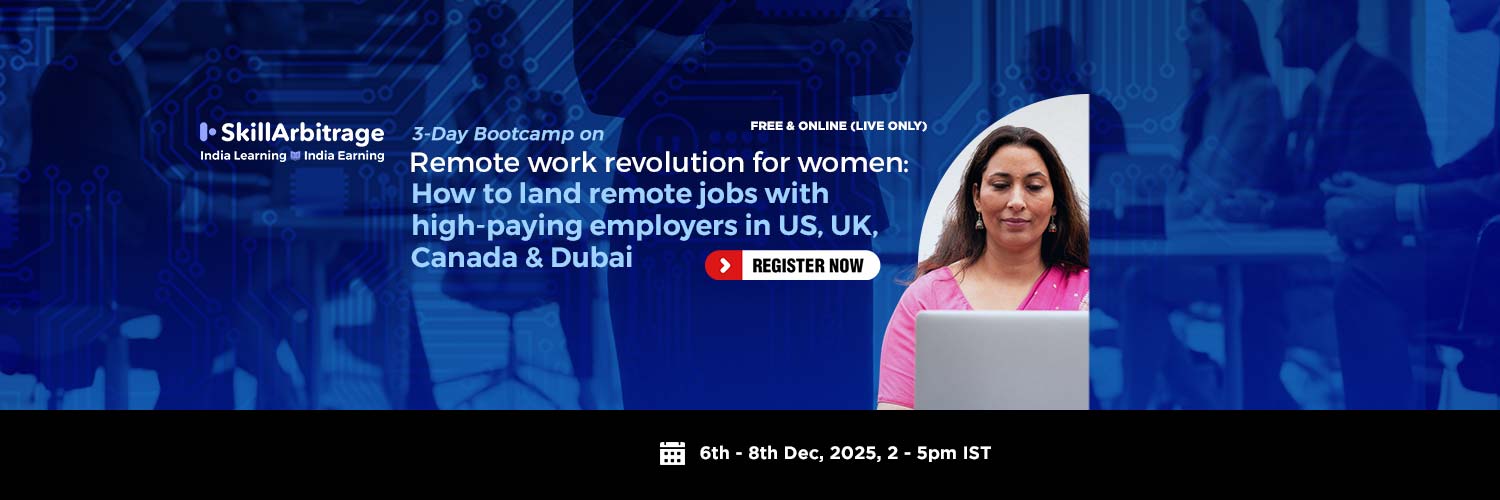
At a Skill Arbitrage bootcamp in 2025, she heard a woman speak.
This woman had started freelancing two years earlier at $3 an hour. She now earns $35 an hour, works 10 to 15 hours a day, and makes around $300,000 a year. She had not started with a degree in technology. She had not started with connections or a portfolio. She had started at $3 and gotten better every month until the market started paying her what the skill was worth.
Bella said later that something shifted in her when she heard that story. Not inspiration in the vague sense. Something more specific: the realisation that there was a sequence, a path, and that the path had a beginning she could actually stand at.
She got a new laptop on 15 March 2026. By 1 April she had her first global client. $250 a month. Two to three hours a day. From home, around her child.
Here is exactly what she did between those two dates.
Her course instructor @OmkarAmble1 gave her a framework with three rules, and she followed all three.
The first rule: never say you will grow someone's LinkedIn. Say you will increase their reach by 20 percent. Say you will help them book three new clients in the first week. Quantify the result you are promising. Every freelancer says they are good at LinkedIn. Almost none of them tell a potential client what that actually means in numbers. That specificity alone puts you ahead of 99 percent of people competing for the same work.
And when you finish a project, write the case study with the same discipline: actual numbers, actual outcomes, not "helped a founder build her presence."
The second rule: identify ten potential clients and comment on every post they publish. Not once. Every time. But not any ten clients, this is the part most people get wrong. Do not go after big influencers. They have thousands of comments.
They will never see yours. Find the people who are small but growing, who are clearly working hard to build their audience, who are posting consistently and getting modest engagement.
These people are paying close attention to who is showing up for them. They notice a name that keeps appearing with something thoughtful to say.
The third rule: do not pitch until a conversation has already started. Comment. Reply when they reply. Keep going until there is a thread, a relationship, something warm. Then, and only then, send the DM.
Not a pitch. A continuation of the conversation you are already having.
This is what Bella did for weeks before the founder in Toronto messaged her.
By the time the DM arrived, the founder already knew who Bella was. Had seen her name in the comments. Had read what she was saying. The DM was not a cold introduction. It was the next step in something that had already begun.
Most freelancers do the opposite. They find a potential client, look at their profile for thirty seconds, and send a pitch. The recipient has never heard of them, has no reason to trust them, and ignores it. This is why most pitches fail. Not because the service is bad. Because the relationship is zero.
Bella did not have a portfolio. She did not have testimonials. She had a LinkedIn profile that was itself a demonstration of what she was selling, optimised, positioned, showing clearly what value she could deliver and in what numbers and she had weeks of comments that had already made her name familiar.
The profile was the proof. The comments were the relationship. The DM was the close.
If she takes on four clients at her current rate she crosses ₹1 lakh a month. Before Upwork. Before Fiverr. Before she adds AI tools that let one person manage eight accounts with the time it currently takes to manage three. She can use AI to track drafting post variations, building content calendars, tracking which formats are driving engagement for each specific client's audience.
India has tens of millions of people sitting out of the global economy because they believe the gap is too wide. Wrong city. Wrong degree. Wrong career history. Wrong life stage.
But the internet does not know where Burdwan is. It knows whether your comments are good.
Do you find something worth learning from Bella's journey? Any insight you can implement? Tell me in comments.
English