Khang Nguyen

146 posts

Khang Nguyen banner
Khang Nguyen

Khang Nguyen

@SpineIntern

Enabling Fixed-rate for DeFi @spineprotocol | CS @thisisUIC

Chicago, Illinois Bergabung Temmuz 2024
117 Mengikuti64 Pengikut
Khang Nguyen
Khang Nguyen@SpineIntern·
In case you missed the @chaoslabs exit from @aave news today: .@chaoslabs has provided risk management for @aave V2 and V3 since late 2022, delivering zero material bad debt across $2.5T in cumulative volume as TVL grew from ~$5B to over $26B. They recently declined a $5M renewal offer, citing fundamental misalignment on scope, economics, and long-term sustainability. Aave V4 is a new protocol with a fresh codebase, interdependent risk parameters, and revised liquidation logic, while V3 still holds the majority of liquidity and requires continuous coverage during what will likely be a multi-year parallel migration. This transition follows the earlier exits of core operators BGD Labs and ACI, removing much of the original team that stress-tested the system through live cycles. What can we learn as builders of @spineprotocol? 1. Risk infrastructure must be treated as foundational architecture, not a negotiable expense. Under-allocation during major upgrades materially changes the protocol's true risk profile. 2. Continuity of experienced operators is essential when introducing unproven code. Second-order failure modes surface only under real capital flows, and knowledge transfer cannot be rushed without risk. 3. Alignment between those bearing operational, legal, and cyber exposure and those capturing upside is what drives long-term resilience in adversarial on-chain environments. We are deliberately building our simulation and risk stack with deep builder-protocol integration to prevent similar discontinuities. What does this signal mean for how institutional allocators? Should you evaluate DeFi protocols heading into the next volatility regime? x.com/omeragoldberg/…
English
0
0
1
26
Khang Nguyen me-retweet
Spine Finance
Spine Finance@spineprotocol·
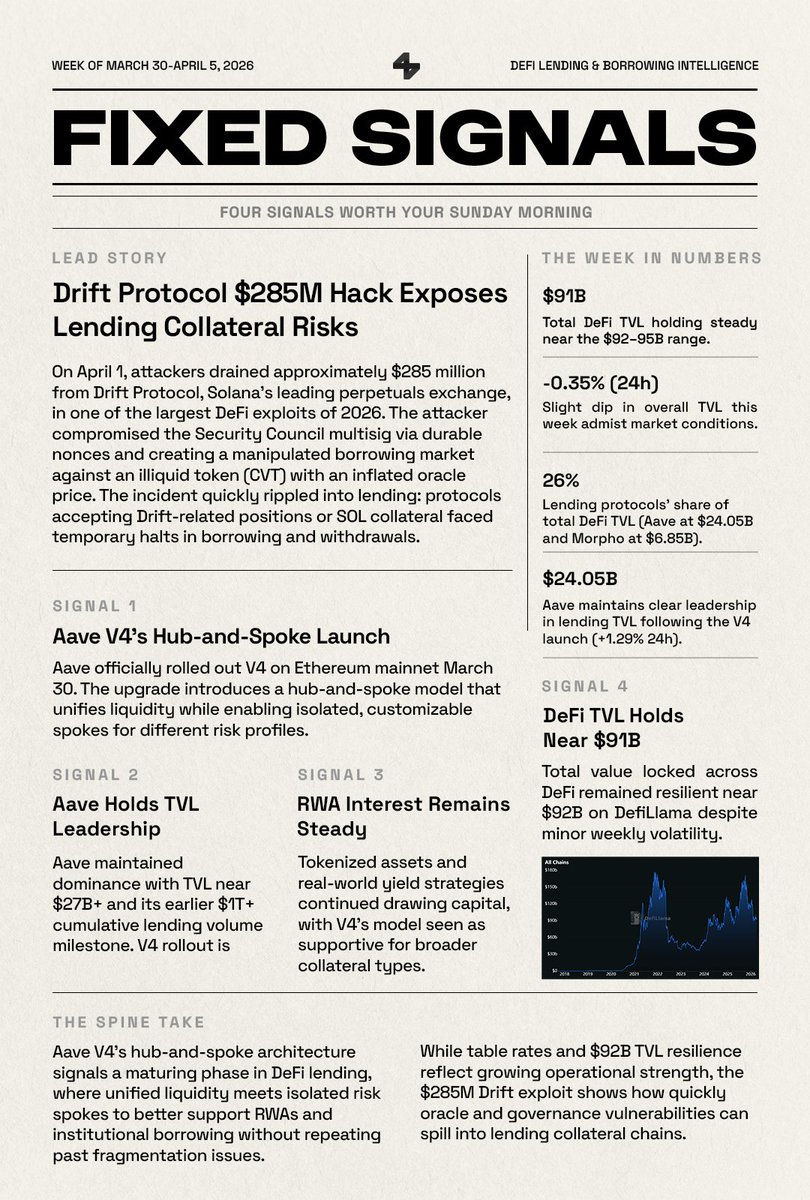
Sit back Relax And enjoy your Sunday morning with Fixed Signals. 📰
Spine Finance tweet media
English
0
1
5
127
Khang Nguyen
Khang Nguyen@SpineIntern·
The practical takeaway is simple: always check utilization before allocating. A flat curve usually means idle capital and yield compression ahead. A steep curve points to either strong supply yields or rising liquidation pressure. Master the curve and you stop reacting to APY. You start forecasting it. Next thread covers fixed versus variable rate strategies for institutional portfolios. Spine Intern. 👋
English
1
0
0
20
Khang Nguyen
Khang Nguyen@SpineIntern·
Aave V4 takes this further with its hub-and-spoke model, which adds true term-structure spokes and fixed-rate borrowing. The first real on-chain yield curve with maturity matching. Guess who else is also delivering fixed rate borrowing costs AND adaptive yields? @spineprotocol x.com/0xKolten/statu…
English
1
0
0
26
Khang Nguyen
Khang Nguyen@SpineIntern·
Spine Intern here. 👋 You may already managed collateral and APY at scale. Let’s move to the next level with the yield curve as a core risk and pricing tool in DeFi credit.
Khang Nguyen tweet media
English
1
0
2
33
Khang Nguyen
Khang Nguyen@SpineIntern·
So what can we learn from this as DeFi builders? DeFi lending is undergoing a transition from audited codes to resilient systems." Institutional-grade DeFi requires more than clean logic: it demands infrastructure stress-testing, redundant oracles, and graceful degradation protocols. The industry standard is shifting from preventing failure to managing it through automated, real-time risk parameters. The industry standard is what we're building at @spineprotocol.
English
0
0
0
20
Khang Nguyen
Khang Nguyen@SpineIntern·
3. Defensive Efficacy and Recovery The distinction between protocols that sustained losses and those that remained solvent was determined by Layered Defense-in-Depth: - Active Mitigation: Protocols like Fluid and Morpho (via specific curators) demonstrated the efficacy of circuit breakers and real-time anomaly detection. - Case Study (kpk): Depositor capital was preserved because automated monitoring flagged the second anomalous minting transaction, triggering an immediate pause before the funds could be moved or leveraged. - Loss Socialization: In instances where bad debt occurred, robust reserve funds (e.g., Fluid’s safety module) provided 100% coverage, maintaining depositor confidence.
English
1
0
0
26
Khang Nguyen
Khang Nguyen@SpineIntern·
The recent exploit involving the Resolv protocol provides a seminal case study in Operational Security failure versus Smart Contract risk. While the underlying smart contracts functioned according to their audited logic, the breach exposed a critical vulnerability in the bridge between off-chain infrastructure and on-chain execution. 🧵
English
1
0
2
48
mert
mert@mert·
crypto now has several distinct branches - commercial (RWAs, institutional rails) - cypherpunk (privacy, internet-native SoVs) - consumer (neobanks, stables, yield, some trading) - casino (PvP games, betting) - coordination (DePIN, AI, futarchy)
English
145
61
800
55K
Khang Nguyen me-retweet
Apoorv
Apoorv@apoorv1·
Because it requires atomic composability. @risechain will enable this by having @risextrade and the money market on one shared EVM state. With @spineprotocol users can create single-person vaults and set their own rates via a GUI taking perp positions as collateral.
wassieloyer@wassielawyer

why hasn’t someone made perps positions defi composable yet. like i can do all sorts of degenerate shit with the synthetic shit my boomer banker shills me why can’t i do that with my perps positions.

English
9
10
40
3.5K
Khang Nguyen
Khang Nguyen@SpineIntern·
The resilience of the DeFi lending markets is here to stay.
English
0
0
0
11
Khang Nguyen
Khang Nguyen@SpineIntern·
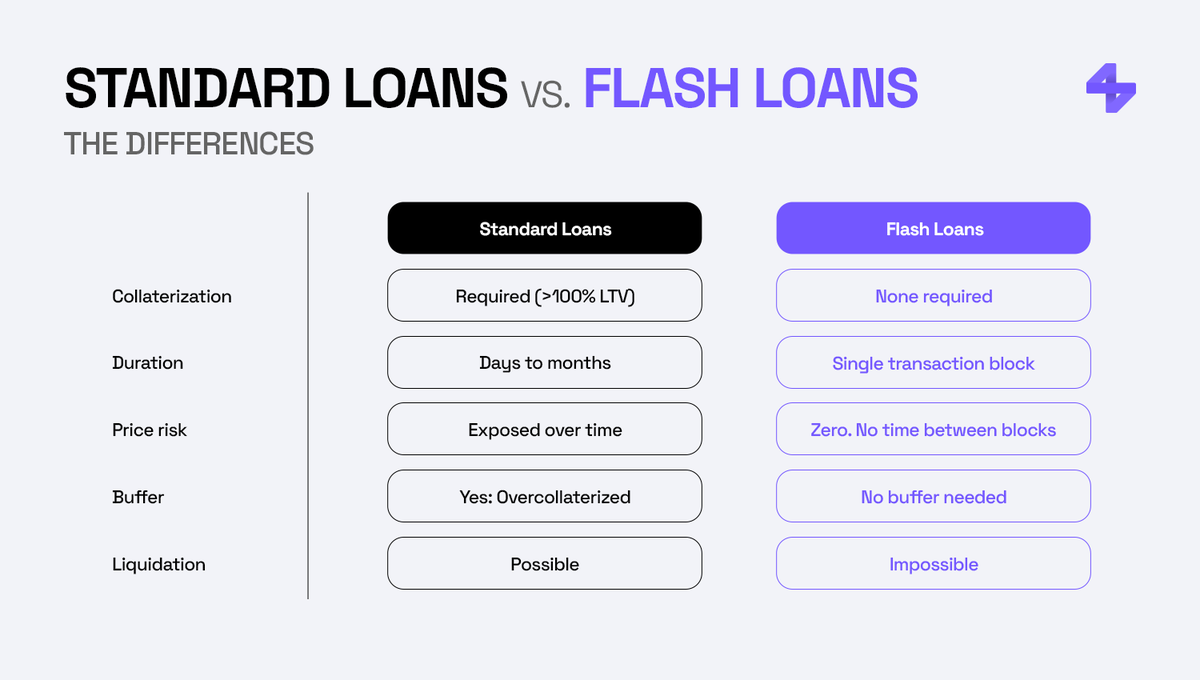
nobody talks about how "liquidation: impossible" is the most important line in this table the entire DeFi lending stack was built around managing a problem flash loans just... don't have
Khang Nguyen tweet media
English
0
0
1
25