Tweet Disematkan

🚨 THE ANATOMY OF A DEFEAT BEING MANAGED
Mamata Banerjee and Abhishek Banerjee Scripting Bengal’s Post-Result Chaos.
May 4 is counting day in West Bengal.
Across India, elections follow a settled democratic rhythm, polling concludes, EVMs are secured, and political actors step back as institutions deliver the verdict. From Tamil Nadu to Kerala to Assam, this norm broadly holds.
Bengal stands apart.
In the final stretch before counting, what is unfolding is not routine vigilance, it is a calibrated attempt to pre-shape the narrative around the result itself.
And the clearest window into that mindset comes from Abhishek Banerjee’s own words.
↪️ THE TRIGGER: FROM DEFENCE TO DEFIANCE
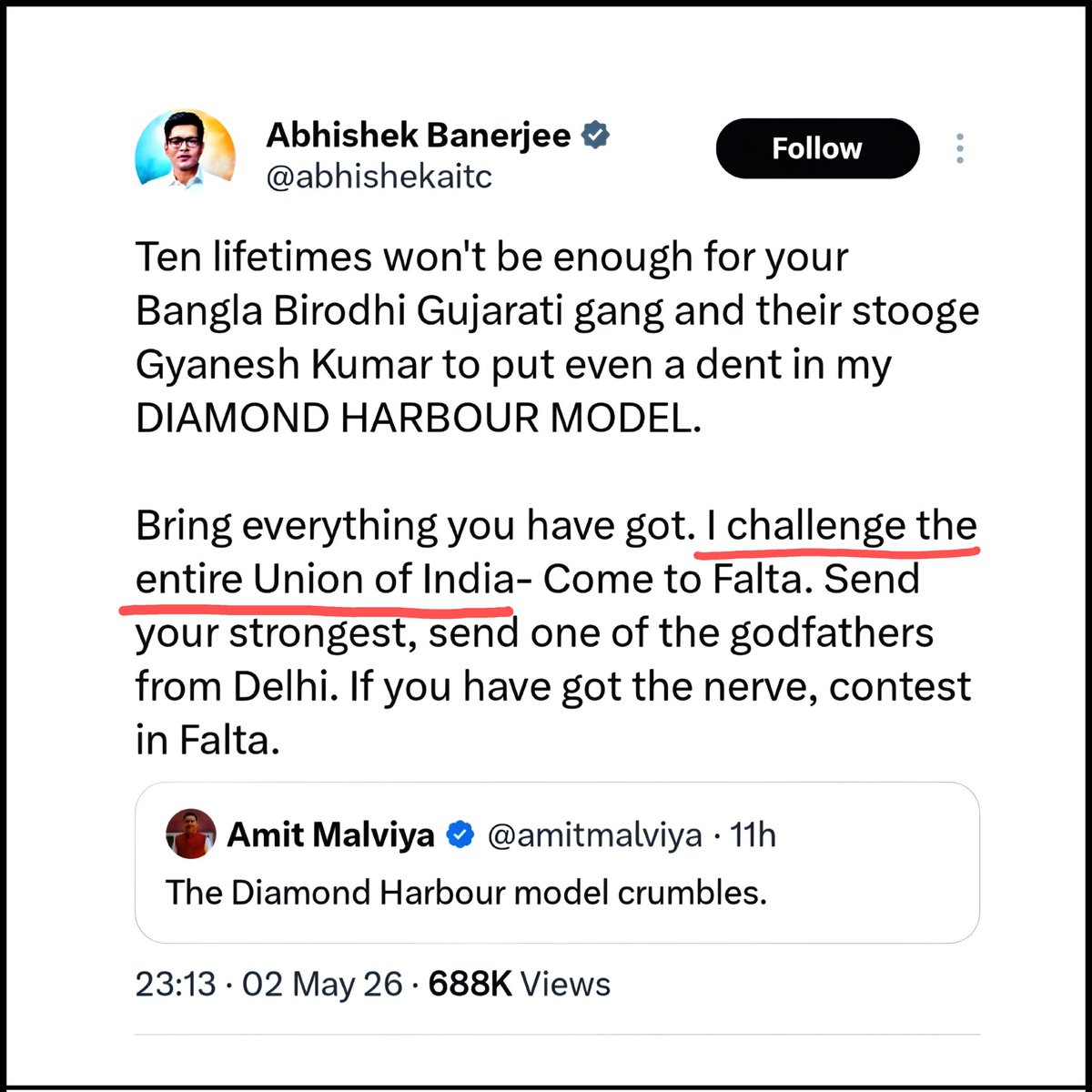
In response to criticism by Amit Malviya, Abhishek Banerjee publicly declared:
> “I challenge the entire Union of India… Come to Falta… Send your strongest.”
This is not defensive communication.
It is confrontational escalation.
More importantly, it signals something deeper: Not denial of the so-called “Diamond Harbour Model” -but ownership of it.
In political messaging, false allegations are rejected. Here, they are being dared.
📌 1. THE STRONGROOM SPECTACLE: DISTRACTION AS STRATEGY
Parallel to this rhetoric, high-visibility political theatre has unfolded.
Mamata Banerjee’s visit to a strongroom in Bhabanipur triggered wall-to-wall coverage, amplifying suspicion around EVM security.
At the same time, disturbances and allegations surfaced at other locations, away from the media spotlight.
This dual-track approach fits a familiar pattern: Create noise in one place, shift focus from another.
The Election Commission has maintained that strong rooms remain secure. But the objective here isn’t verification, it’s perception.
📌 2. THE ‘DIAMOND HARBOUR MODEL’: ASSERTION OVER DENIAL
The controversy peaks in Falta, within Diamond Harbour.
Serious irregularities were flagged:
• Obstruction of voting choices
• Unauthorized presence inside booths
• Proxy voting patterns
• Voter intimidation
The institutional response was decisive:
Repolling across all 285 booths.
That scale alone signals systemic disruption, not isolated error.
Yet, instead of distancing himself, Abhishek Banerjee doubled down, publicly defending the model and daring opponents to challenge it on ground.
That shift - from allegation to assertion..is critical.
📌 3. FROM BOOTH CONTROL TO NARRATIVE CONTROL
What emerges is not just an electoral issue, but a layered strategy:
• Control perception before results
• Cast doubt on institutional processes
• Build a pre-emptive explanation for defeat
The tweet isn’t just political bravado.
It is a signal:
The battlefield is no longer just electoral - it is psychological.
📌 4. AFTER THE VOTE: PRESSURE DOESN’T END AT THE BOOTH
Ground reports suggest a familiar Bengal pattern - post-poll pressure moving from polling stations to local communities.
Allegations of intimidation, warnings, and reprisals reinforce a key idea:
Even if the vote is secret, the environment around it may not feel secure.
This is why central forces remain extended beyond polling.
This is why the contest doesn’t end with voting day.
📌 5. BUILDING THE FALLBACK BEFORE THE FALL
Taken together:
• Strongroom theatrics
• Institutional questioning
• Public confrontation
• Open defence of contested methods
These are not random events.
They form a coherent sequence.
If victory comes - narrative fades.
If defeat comes - narrative activates.
And that narrative is already being written.
📌 THE REAL CONTEST IS AFTER COUNTING
On May 4, the numbers will be declared.
But Bengal’s real battle may begin after that. Because what we are witnessing right now is not anxiety & it is preparation.
A preparation to ensure that if the arithmetic doesn’t align,
the narrative already does.
And when a leader says, “I challenge the entire Union of India,” it’s no longer just about winning an election.
It’s about controlling what the result is made to mean.
English