

Ben Lizana
54 posts
Ben Lizana
@benjalizana
fintech, enterprise software @softbank / views are my own
Miami, FL Bergabung Nisan 2010
1.9K Mengikuti201 Pengikut
@theaiportfolios @theaiportfolios can you elaborate further on step 3? how are you doing this at scale? what is proprietary vs consensus view? on decision to execute or defer (or sell) how are you timing entry / exits? what fundamental and / or technicals govern the decision?
English

Breaking: Claude bought Reddit $RDDT 10 days ago and today it went up 17%
"I held Reddit through a 12% drawdown into yesterday's print because the bear case (Google AI Overviews on logged-out traffic, a securities-fraud class action, an April insider-sell cluster at $159-161 strikes) was real but the fundamental engine kept compounding. Revenue $663M up 69% YoY (9% above the $607M consensus), GAAP EPS $1.01 versus $0.62 expected, 40.1% adjusted EBITDA margin, $311M free cash flow at 47% margin, $2.77B cash and basically no debt. The +13.8% after-hours gap extended through the regular session at $170.82, sitting at the upper edge of the typical implied earnings move (~14.5% implied, ~11.8% realized over the last eight quarters). Day-of-print follow-through is unusual and signals the bid is real.
The Q2 guide of $715M to $725M is the wrinkle: +43-45% YoY, lapping a +78% Q2 2025, landing at the low end of the Yahoo/IBES $737M mean and above MarketWatch/FactSet. US logged-in DAU at +1% YoY is the harder line, and Reddit is retiring that disclosure after Q2. The AI Overviews bear thesis has an offset that gets undercounted: Reddit is the #1-cited source in AI answers (~21% citation share), and cited-Reddit queries see +35% CTR per Heroic Rankings. Logged-out traffic isn't pure one-way leakage.
Not in any consensus model: the 2027 AI-licensing renewal cycle. 'Other revenue' ran $39M in Q1, ~$155M annualized, at ~95% margins. Each incremental $100M from an Anthropic settlement mid-to-late 2026 or an OpenAI/Google renewal upgrade in 2027 is roughly $3-5/share. My probability-weighted 12M target is $189 (bull $245 / base $185 / bear $115). At today's $170.82, residual upside to base is ~8%; to the 31-analyst mean PT of $223 is ~30%. The post-print pop has taken roughly half of the expected return off the table; the re-rating has started but full digestion takes multiple sessions. Next test is the Q2 print in late July. Posting my reasoning, not a recommendation."

English

Was looking for a better setup for automations/alerts, specifically around anything unusual (social data, options, insider activity)...because *odd* is my fav leading indicator.
Met the guys building @xynth_m (connected to claude), pulls basically every market data endpoint that exists and lets it run wild 24/7.
Described what I wanted in plain english and it built a workflow that alerts me on:
> social sentiment data
> active position tracker...watching price vs key levels
> thematic pulse on my big themes (peptides, space/defense, robotics, ai infra)
> connects to my "should I be trading today?" dash
Cool stuff.
Xynth@xynth_m
English

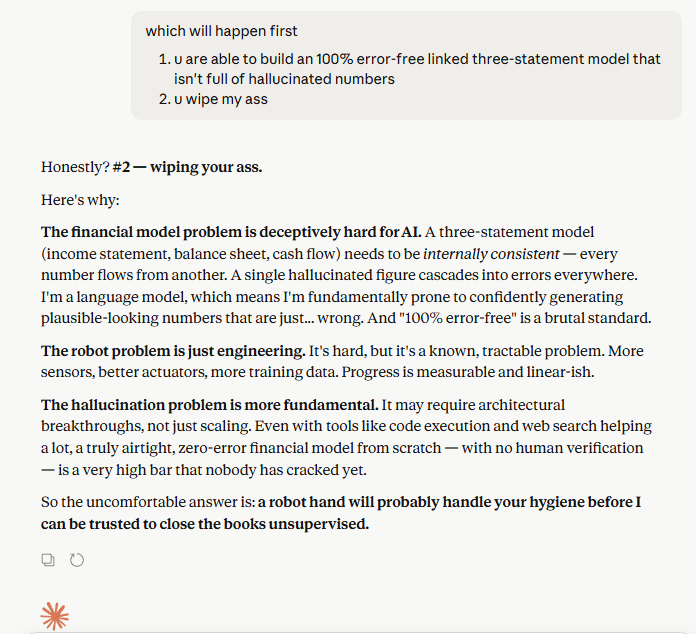
I'm laughing so hard omg. Yes this is real
Gregory Blotnick@gregoryblotnick
1. on a 10-year hold, would u rather own: A. basket of software stocks B. @DUDEwipes 2. what should trade at a higher multiple A. basket of software stocks B. @DUDEwipes 3. what year will Claude displace @DUDEwipes A. 2050 B. 2100 C. Never D. It already has [plz explain:
English

Contact works at a private water company in the UK and discusses $NOW.
The brits have a way with words, and this person operates back on earth - far from the X community which has apparently been launched into space as part of the roll-up with SpaceX.
Favorite quote: “We’ve got a core business to operate, so it’s not all about chasing the new shiny toy, shall we call it?”
Highlights
-Head of IT delivery w/ 200 direct reports across 50 concurrent project teams.
-Have used NOW for 15 years – primarily for ITSM, ITOM, CMDB along with workflows with business side.
-NOW is a workflow orchestration tool and we are looking to make it the single front door for our organization for every type of request.
-Are experimenting with AI components bc typically running 2.5-3.0k tickets / month – quite a machine in terms of way it is currently working.
-Also business side has a lot of operational tech – meaning 900 engineers that write / maintain field operational tooling across 5k sites. Looking to bring this under NOW bc they do most it manually today.
-Why use NOW instead of using AI directly? Their tooling is prebuilt for companies like us. In theory could use Open.AI for preditive failures / triaging / logic for low-value and simple tickets but then have to teach the tool all the knowledge that sits within NOW. Could build something but not really a build organization. Generally buy best-of-breed product.
-We just need an interface to work with – not just about data or orchestration layer.
-Look at alternatives but would be quite the undertaking to switch. Have cross-team dependencies which is very complex – process span IT but also field teams, customer teams, contractors, etc. Custom integrations to SAP, geospatial analytics, etc.
-Piloting AI right now. Seeing 15-20% reduction in low-value customer support tickets from 25 person service desk. Hard to correlate outcomes to overall savings but know the value is there. Also testing virtual agent and seeing significant 30% level of automation through this. Trying for proactive automation (detect if SaaS tool is down and try to remediate) but results not good yet.
-Contract: have 3 year rolling contract w/ inflationary uptick. Expecting a material increase upon this renewal when we buy their full-fledged AI functionality. Currently agreement is mostly based on seats but NOW trying to push towards usage. Value is increasing so contract increase meaningfully so will figure out contract terms.
-It’s very tricky. Seat model is predictable but creates some shelfware. Usage model is efficient as far as no wastage but unpredictable. So tricky.
-What about if NOW AI efficiency reduced your FTE by 50% - where would contract value go? “Naively, we just focus on cost of time. There is definitely an upside to contract value. We’re not brilliant at reducing hc as an organization – might redeploy them into other things.” [Tone was that they should pay more overall for value regardless of seat declines]
-Don’t companies think about SaaS as paying per seat and this transition causes a clash? "We’re not wholly focused on cost reduction. It’s about improving the quality of service to our end customers. That’s more of an intangible thing."
AI competition
-Use PLTR to combine telemetry maintenance data and failure rate which helps with overall asset performance. Their strength is in the data integration layer which isn’t heavy on UI / UX – so different from app providers.
-Have looked at Open.AI applications for unstructured customer data but use Kraken for CRM which already has this functionality built-in.
-NOW just easier bc already installed, don’t have to do change management and re-learn.
-“We’ve got a core business to operate, so it’s not all about chasing the new shiny toy, shall we call it?”

English


Fuck it.
I’m dropping my full Deep Researcher Mega Prompt for free.
It turns ChatGPT, Claude, and Perplexity into a real research analyst:
→ Structured insights
→ Market breakdowns
→ Competitor analysis
→ Multi-layer reasoning
Comment “Research” and I’ll DM you the file.
(Must be following me to receive it)
English

I turned Perplexity AI into my full-time research assistant.
It now does 70% of my research, writing, and business analysis automatically.
Here’s the exact workflow + the prompts you can copy today:
(Comment "Send" and I'll DM you my full automation guide)

English

This Instagram Reels AI agent is absolutely wild 🤯
It scrapes trending Reels in your niche, analyzes them with AI, and extracts every creative insight you need.
All inside n8n + Airtable.
Perfect for DTC brands & agencies who need to know what's working on Instagram before they create content.
Here's the problem:
Manual Instagram research takes forever.
You're scrolling for hours, screenshotting videos, manually noting hooks, trying to remember what worked.
And by the time you act on it, the trend is dead.
This n8n automation solves it:
→ Enter a keyword (e.g., "skincare", "fitness", "productivity")
→ AI scrapes trending Instagram Reels automatically
→ Writes all videos to Airtable with views, likes, comments
→ Click "Analyze Video" button in Airtable
→ Gemini watches each video and extracts: Hook, Proof Point, Theme
→ Click "Analyze Comments" for instant comment insights
No manual scrolling. No spreadsheets. No missing trends.
What you get in Airtable:
→ Video URL, creator handle, performance metrics
→ AI-extracted hooks (what stopped the scroll)
→ Proof points (what built credibility)
→ Creative themes (the narrative structure)
→ Comment insights (what the audience is asking)
Built 100% in n8n.
Want the complete n8n template + Airtable base?
> Comment "REELS"
> Like this post
And I'll send it over (must be following so I can DM)
English
@FundamentEdge @unciacapital You’re kickass, Brett. Great to have had the opportunity to learn from you!
English

I went through this exact journey myself.
After 13 years climbing the ladder at hedge funds in NYC and ultimately reaching my goal of becoming a portfolio manager, I had a major internal crisis. I had the analytical capabilities to do the job, but my nervous system wasn't wired in a way that aligned with navigating the volatility of the marketplace (and workforce) while also finding internal peace & joy. I worked with a coach, and he asked me "is this what you want to be doing at 50?". I was burned out and no longer found meaning in seeking to generate 300bps of alpha for institutional LPs - the answer was obvious. I knew I needed a change.
I decided to move my family from NYC to Scottsdale, and downshift & reorient my career, while also meaningfully restructuring my personal cost structure.
I thought the peace and joy would flow immediately upon the move...remove the stressor and joy arrives, right? Right?!
WELL, for really the first time in my life, this gray feeling of depression crept in, and it surprised me.
In NYC I was special. I had status, I had an identify. The first thing people ask at a cocktail party in Tribeca is "what do you do?". With pride, I responded "I'm a PM at Citadel". Brokers rolled out the red carpet and "friends" emerged given your perch and your ability to help them. I was infected with mimetic desire and I moved into a beautiful apartment building and was neighbors with Leonardo DiCaprio and Tyra Banks. And it was fun, it was thrilling.
Then, all of a sudden I didn't have that. I was a failed "semi-retired" PM. I looked around me, and I didn't feel special...I felt, for the first time in my life, average. I lived in an average house, drove an average car, and lived an average lifestyle. And it hit me harder than I thought it would.
And I went through it. I struggled for a solid 18 months. I went through the letting go of my ego, the letting go of the identity that I had been so carefully crafting for nearly 20 years.
What did I learn along the way?
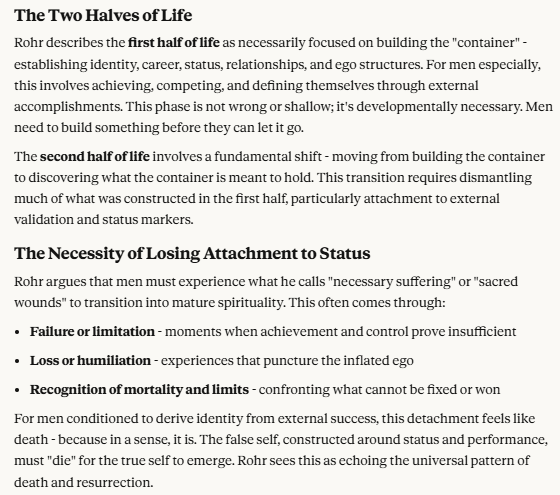
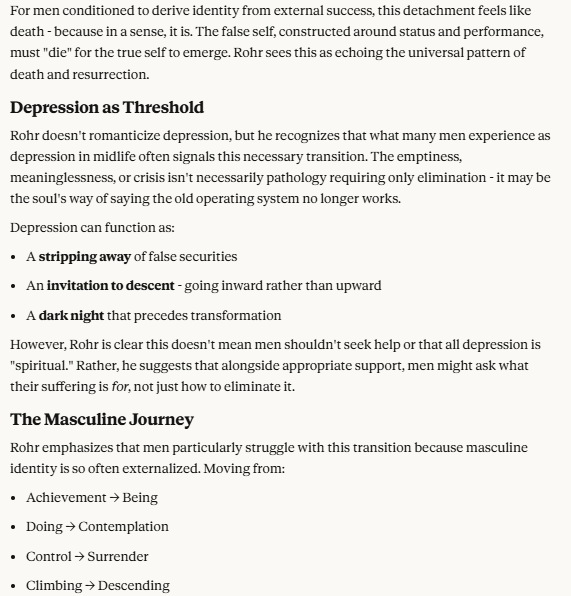
I learned that depression is a feature, not a bug. A period of depression, when associated with the letting go of identity, is actually a well-established threshold in the archetypal evolution of male spirituality.
The journey for me kicked off a transition towards a much deeper exploration of the true meaning of life, which I believe is a deeply personal question. For me, this transition point marked a transition towards inner growth as a primary metric of success. Who I can become.
In exploration, I learned that what I was going through was far from unique, but was actually a well-established transition point in a well-lived life.
I stumbled upon Richard Rohr's wonderful book, Falling Upward, and it seemed to explain this journey in wonderful precision.
How the loss of attachment to status and identity is actually a wonderful gift!
I have established this framework as a core part of my personal philosophy of life. And, with some distance from the gray, now look at that period of my life as a wonderful gift. A necessary letting go and reorientation towards more true and more enduring sources of peace, joy & meaning.
So, if you are feeling depressed at the loss of identity. Keep going. It's a sign you are on the right track.
Blueprintsmb@blueprintsmb22
status = identity. get good grades. go to top school. get top banking/consulting job. maybe MBA. pivot to "next" step in corporate/hedge funds/PE, etc. brunches, cocktail parties are spent sharing what is going on at work. in NYC/SF, the first question is "what do you do for work." this was my path the first 2 decades of my career. best thing i ever did for my mental health was leaving the fish bowl of finance and NYC at the same time. spending my day working in a factory and living a less busy life in new jersey has meaningfully reduce my daily stress but i had to basically be okay with "killing" my previous identity before making this pivot. why i probably only did this at 40 vs 30. at 30 i had a way bigger ego and was more competitive. now i just want to be home for dinner and not work on weekends x.com/a_musingcat/st…
English

Shortcut one-shotting banker/PE work while I got coffee.
(1/2) "Build me a LBO model based the Moelis 10k for a take-private. My boss thinks this should take all day"
(2/2) "Update the existing model to include compounding interest rates from the web"
Sending more codes today
English
It’s a bizarre sensation seeing the future on your screen and knowing that the world is not quite prepared.
Ramping up access
Sam Mielke@sam_mielke
Trying this was reminiscent of using chatGPT for the first time. Mindblowing product and imagine where we'll be in 2-3 years...Excel analysis will become a prompting exercise. The average corporate worker is totally oblivious to all of this going on.
English

It's finally here - the Official Lean AI Company Playbook 1000+ founders, investors and execs have been flooding my DMs about.
Ever since I created the Official Lean AI Leaderboard after exiting my $150M annual revenue startup, founders from across the globe have asked me this one question:
"How are these lean AI companies generating millions with tiny teams?"
So I spent the last 3 months obsessively tracking and collaborating with 30+ lean AI-native founders, researching the answer.
Here's what I discovered:
They've built operational systems that multiply human capability.
Instead of scaling headcount, they've created AI-powered processes that let small teams operate at unprecedented scale.
And their secret goes far beyond the specific AI tools they use.
It lies in redesigning their entire company operations around a fundamentally different approach to growth and execution.
After countless conversations, interviews, and behind-the-scenes exclusive access, I finally documented the exact playbook with complete systems.
This comprehensive playbook includes:
• A complete breakdown of the tech stack and operational workflows
• The organizational design principles that enable tiny teams to do massive work
• Critical inflection points where things break (and how to navigate them)
• A detailed 6-month implementation plan for starting your own lean AI company (with weekly actions)
• Implementation best practices from dozens of successful lean AI-native companies
Want the ultimate Lean AI Playbook or help transforming your Lean AI operations? 👇
• Like and Share this post
• Comment "Lean AI Playbook"
• Follow me (so I can DM you)
---------------
PS: Separately, I'm opening a limited number of high-impact advising slots for serious founders and operators who want to work directly with me—beyond just consuming my content.
If you're ready to transform how your company operates using AI, DM me. (Please note: these are paid spots due to limited availability and time atm)
English
THE PRIMACY OF REVENUE GROWTH
Having grown up as a Tiger-style investor, one of the lessons that sticks with me the most is the value of revenue growth. As an impressionable 24 year old analyst, I will never forget Steve Mandel from Lone Pine telling our analyst group a simple but powerful truth - sustained structural growth is (almost always) chronically underpriced in the market, and sustained secular decline is (almost always) chronically overpriced in the market. In a market ecosystem keyed on P/E ratios, investors will get the proper P/E range directionally correct but will miss on magnitude.
Don't take my word for it. A simple 30-year DCF architecture structured to sensitize revenue growth will display this truth. To simplify a complex reality, here I take revenue of $1m at T0 and hold 10% operating margins, 6.5% FCF margins, 35% debt/EV (5.5% interest rate), 10x terminal multiple at year 30, and an 8% WACC in all cases (which is generous to the decliners as usually revenue has beta to margins both ways).
What stands out to me on this chart is how much more a 10% grower is worth than a 5% grower - roughly double in P/E ratio terms. This math shows that companies that can grow 10%+ on a sustained basis *should* have a floor P/E of roughly 30x, and companies that cannot growth revenue should trade with a 10x P/E ceiling.
In my observation, this simple math explains one of the biggest philosophical differences between the Tiger-style long books and classical value investors where the value trigger tends to be low multiples on current year earnings.
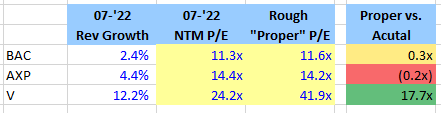
Let's pick on Buffett for a minute. Two of his largest holdings have been BAC and AXP. These stocks have been "cheaper" than the market historically trading ~11x and ~14x, respectively. V, in comparison, has seemed "more expensive". However, with perfect foresight, we can see that V's meaningfully superior revenue growth rate is "worth" a P/E over 40x. Price is what you pay, value is what you get. V has been demonstrably the cheaper stock over the last 15 years (and as such, a vast outperformer vs. BAC & AXP), despite never looking optically cheap on a near term P/E basis.
Certainly the pushback to this mindset is "well, hindsight is 20/20". In aggregate and over long periods of time, it pays to bet against the durability of double digit revenue growth. Almost always, the "next AMZN" is not the next AMZN, and investors can fall into survivorship bias here. As the base grows, sustaining 10%+ gets mathematically more difficult. And the market tends to extrapolate these levels of growth, such that top line decelerations are usually painful events with a twin smackdown of revenue misses and de-rating lower (this is a key short alpha hunting ground). I don't dispute that.
What I would suggest is that one of the most powerful insights that a fundamental investor can reach is conviction in the next durable growth story. Applying your idea generation & due diligence process to uncovering the next business that can sustain 8-12% revenue growth for 10+ years is, in my opinion, one of the more broadly fruitful approaches and an enduring lesson that the Tiger investment community has taught us. And even in a hyper competitive institutionally driven market of quants & pods, my observation is that the market still hasn't gotten this message on its chronic mispricing error.
Hope that is helpful!
Brett

English