Cy𝕭er₿ULK@cyberbulk911
The devwork Thesis
How to play — and how to actually become a dev
The premise: most web3 games ask you to speculate. devwork asks you to show up. This is a town where value isn't printed, airdropped, or farmed from thin air — it's earned the way developers earn everything: one shipped ticket at a time. To play devwork is to build a career inside a tiny planet. Here's how you do it.
1. Arrive connect and become someone
You enter one of two ways. Spectate as a ghost and drift the town core for free good for a look, but you can't build anything. Or log in as a dev: connect a Solana wallet, make an avatar, and put your name over your head dev/you. That name is your identity in a live, multiplayer town where other real players are working alongside you. The moment you walk in, the whole town's feed announces it. You are now a resident. Everything after this is your climb.
If you're early, this step pays forever. The first 70 wallets to ever enter become Founders — permanent extra energy, exclusive gear no shop will sell, and a boost to every skill. You don't grind for it. You just have to be here first.
2. Work the loop that runs everything
The heart of devwork is a loop every developer already knows: play → earn → spend → grow → repeat. You work by shipping. Open the task board and there are hundreds of tickets a day bugfixes, deploys, reviews, refactors. Take quests at The Studio, run jobs off the job board, chase buried treasure. Each one costs energy and pays Commits and XP, and some drop BIT.
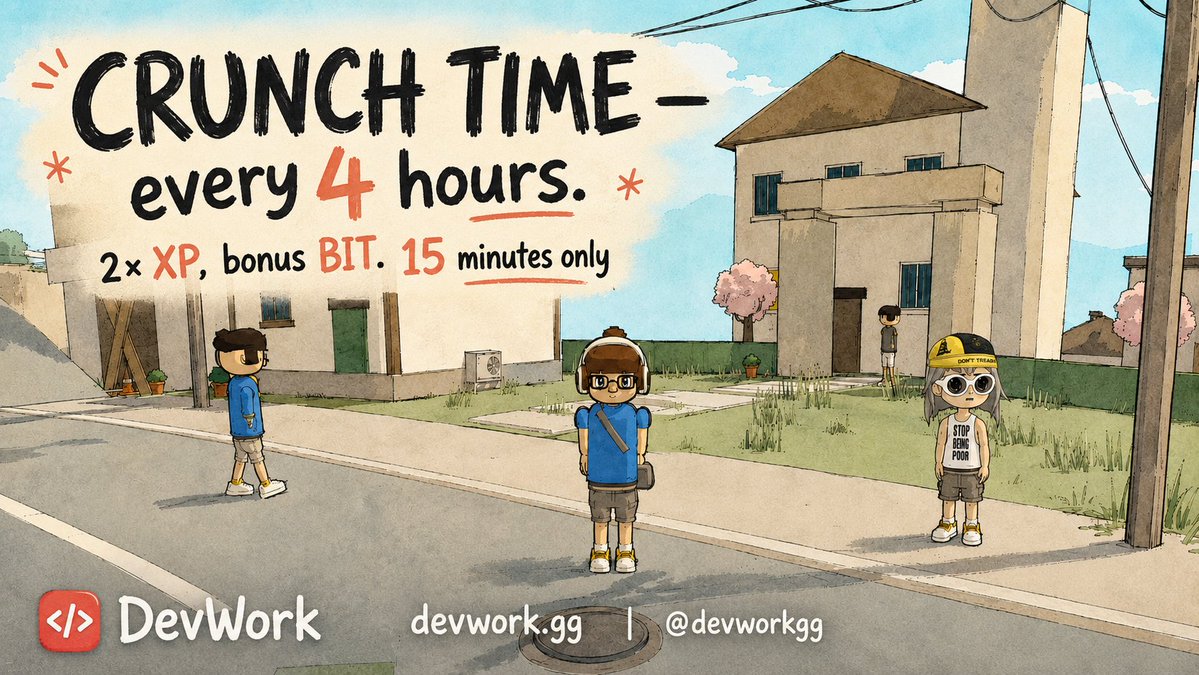
The skill is in the timing. Crunch Time opens every four hours a fifteen-minute window where every task pays double XP and bonus BIT. The devs who plan their day around those windows compound faster than the ones who don't. This is the first lesson of the town: anyone can work, but the good ones work when it counts.
3. Manage energy is your real budget
You can't grind forever. Sprinting drains energy; resting, sitting, and soaking at the GPU Onsen restore it. When you run dry, you buy a meal, or you buy an energy pack with real SOL. This is deliberate. Energy is the town's honest bottleneck it turns "how much do you want it" into a resource you actually manage. Learn your own rhythm and you'll out-ship people with twice your level.
4. Learn skills are the multiplier
Raw grinding has a ceiling. To break it, go to the Code Dojo and choose a path: backend, devops, smart contract, frontend, or AI. Pay tuition, pass the exam, and earn permanent stat boosts that make every future task faster. Stack enough gear and levels and you cross into Super Developer — golden ink, the town knows you on sight. The thesis here is compounding: you don't just earn tokens, you earn the ability to earn tokens faster. That's a career, not a grind.
5. Own turn earnings into a footprint
Once you have BIT flowing, you stop being a visitor and start being a landowner. Claim a lot and build your HQ a founder's camp that grows into a production house, rendered in the world for every player who walks past. Home gives you real advantages: faster work nearby, better regen. Now the town isn't a place you visit — it's a place with your name on a building.
6. Govern stake your conviction
The final tier is belief made visible. Stake $DEVWORK to climb from Resident → Citizen → Founder. Each tier unlocks gated districts, better job pay, stall rights, and eventually a vote at Town Hall on how the community pool is spent. Staking isn't yield-chasing; it's declaring you're here for the long build and being rewarded with a say in it.
The economic thesis: why it holds
One rule anchors the entire town: the game never mints. Every token is earned, sunk, or sealed never conjured. SOL flows in through real sinks (energy, gear, tuition) straight to the treasury. BIT circulates as game credit. And every spend pays a 5% town tax 3% to the community pool, 1% burned onto the Bug Cemetery gravestone, 1% to the treasury. Value doesn't leak; it circulates and compounds. In a market full of games where the token is the product, here the token is the fuel and the product is a place you'd want to be even if the chart didn't exist.
The whole thesis, in one line
Don't trade the town. Move into it. Show up daily, work the crunch windows, spend energy wisely, train a skill, buy a house, stake your belief. That's not a strategy for beating a game it's a career inside one. The devs who understand that early won't just hold $DEVWORK. They'll be devwork.
→ devwork.gg
@devworkgg
pump.fun/coin/$devwork