
Danny Sharples me-retweet
Danny Sharples
3K posts

Danny Sharples
@iamdsharp
🇬🇧 Scouser 📍London 🎤 Sings 🚀 Does other stuff || 1/2 of @goodfootfunk ||
Bergabung Temmuz 2012
997 Mengikuti506 Pengikut
Danny Sharples me-retweet

Exclusive: Two Google workers have resigned and another was fired amid protests over a $1.2 billion project providing AI and cloud services to the Israeli government and military ti.me/3xt16hg
English
Danny Sharples me-retweet

Today's editorial in Haaretz, Israel's New York Times, reiterates the demand of Israeli families whose loved ones were killed in Kibbutz Be'eri on October 7 to investigate the events of that day – and mounting evidence that the Israeli military fired a tank shell into the house where the Israelis were being held hostage.
Many of the hostages and Hamas fighters were incinerated by the explosion. The charred bodies at Be'eri – as well as many more at the Nova festival, where Israeli attack helicopters appear to have opened fire on cars with Israelis inside – were used by Israel in its propaganda war, justifying its subsequent genocidal attack on Gaza.
The suspicion is that Israel employed the so-called Hannibal directive, killing the hostages rather than allowing them to be used as bargaining chips for a release of Palestinians – men, women and children – held hostage in Israeli prisons.
Haaretz makes the point that the need for an investigation is urgent because of the surviving Israeli hostages held in Gaza. If Israel did prioritise the Hannibal directive on October 7, there is every reason to suspect it may be doing the same with regards to the hostages in Gaza.
In other words, rather than try to retrieve them safely, either militarily or diplomatically, Israel may have decided it is better to sacrifice them as casually as it did its own civilians on October 7 – rather than allow them to become an obstacle to pursuing genocide in Gaza.
Or as Haaretz states: 'The IDF must investigate and provide these answers now, while the war is in full swing, because those answers are relevant to the fates of the 136 hostages who are still, after 95 days, prisoners of Hamas in the Gaza Strip.'
Source: archive.ph/lWbP7
English
Danny Sharples me-retweet

The BBC's reporting on Gaza – or rather lack of it – is beyond parody.
Tonight's News at 10 featured reporter Wyre Davies finding yet another excuse for the BBC to return at length to the fall-out for Israelis from the three-month-old events of October 7, followed by him gravely intoning: 'The world's attention is still very much focused on the ongoing war, just over in Gaza.'
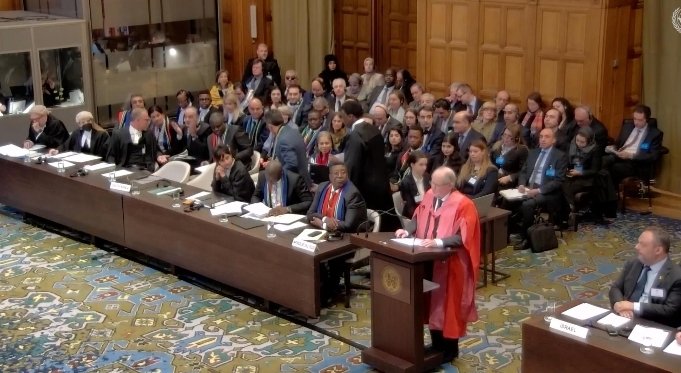
Well, the BBC's attention certainly hasn't been focused on the suffering of Palestinians in Gaza. Not a word tonight about Israel's continuing bombing of civilians, or the famine and disease it is inducing through its 'complete siege'. Or Israel's referral to the International Court of Justice, charged with carrying out a genocide.
Instead we segued from an interview with the families of the hostages and a report on the 'We will dance again' campaign by the Nova festival organisers to Lyse Doucet analysing Israel's options for running Gaza on the 'day after'.
Once again, the BBC made the Palestinians of Gaza – and the genocide they are enduring – invisible.
English
Danny Sharples me-retweet

This might be the best explanation I heard for "why Oct 7" and, surprisingly, it comes from Ami Ayalon, former head of the Shin Bet, Israel's secret service, and commander-in-chief of the Navy.
Here what he says (this is the first video, there are a couple more below which you'll really want to watch):
He says the "most important cause [of Oct 7]" was "the political paradigm", whereby Israel's policy was "divide and rule", meaning Israel "had to make sure Palestinians would not have a unified leadership" and could therefore always say "nobody to talk with, nothing to talk about". Concretely "in order to do it [Israel] had to make sure Hamas would go on controlling Gaza and the Palestinian authority the West bank", and incite them to "fight each other". This is why Israel "enhanced and assisted Hamas, transferred money, etc."
As a result of all this Hamas "got the Palestinians' support" because "they became the only administration who fought against the Israeli occupation and for the purpose of Palestinian freedom" while Fatah and the Palestinian authority became perceived as "Israeli collaborators". In his assessment "between 70 to 80% of the Palestinians are supporting Hamas, only because Hamas is perceived as the one who fight for [their] freedom."
He says Israel completely misunderstood the situation before Oct 7 because it measures "hardware" whilst Hamas measures "software", meaning that after every fight between Israel and the Palestinians, success for Israel is measured in "losses in human life, in military installations, in military infrastructure" whereas what Hamas measures is "the support of the people." As an illustration he says that in May 2021 - when there was fighting during 2 weeks and around 300 Palestinians were killed (to 17 on the Israeli side) - Israel thought that Hamas "suffered a huge loss and a huge military defeat" but from Hamas's standpoint it was "a huge victory" because this led to Hamas, for the first time, getting "more than 50% of the support from the Palestinian people."
English
Danny Sharples me-retweet