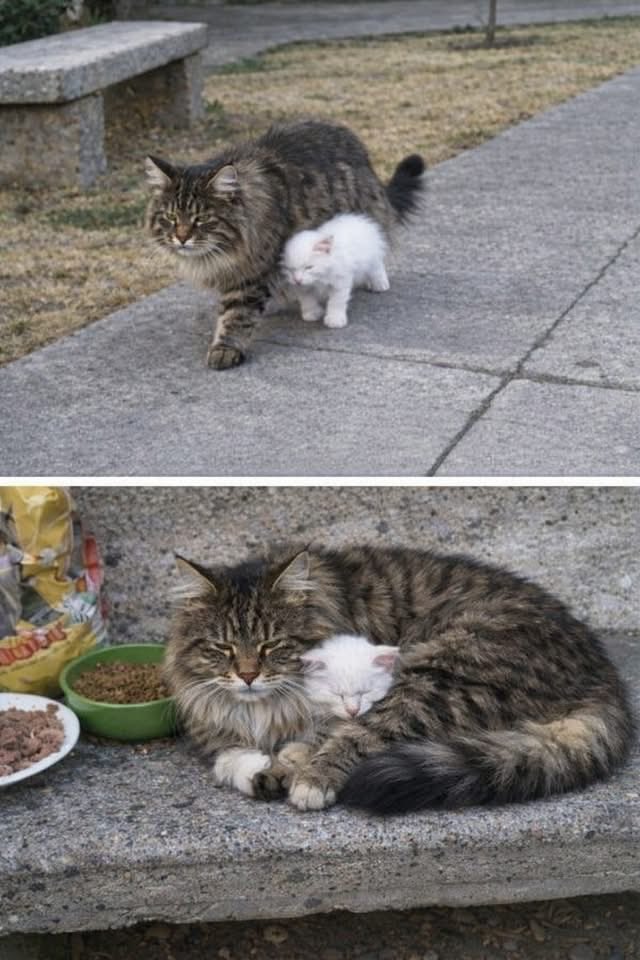
En un pequeño parque del vecindario vive un enorme Maine Coon "gigante gentil" al que todos conocen como Capitán.
Durante cinco años, dominó ese rincón verde como un rey silencioso.
No era violento.
No buscaba pelea.
Simplemente observaba desde su banca favorita, como un guardián tranquilo cuidando el barrio.
Entonces, un día, apareció un diminuto gatito blanco.
Era hermoso. Frágil. Y algo parecía extraño.
Se chocaba con las bancas.
Con las macetas.
Con las banquetas.
No reaccionaba a los movimientos bruscos.
No seguía los sonidos como cualquier otro gatito.
Y no tardaron mucho en entender la verdad.
El pequeño era ciego.
Solo allá afuera, no habría sobrevivido demasiado tiempo.
Pero dejó de estar solo muy rápido.
Porque Capitán lo vio.
Desde ese momento, el enorme Maine Coon jamás volvió a apartarse de él. Empezó a caminar apenas unos pasos delante, reduciendo el ritmo para que el gatito pudiera rozar su espeso pelaje y seguirlo. Como si fuera una guía viviente.
Cuando los vecinos dejaban comida, Capitán lo empujaba suavemente hacia los platos.
Cuando cruzaban la acera, ajustaba el paso.
Cuando descansaban en su banca favorita, Capitán envolvía al pequeño con su enorme cuerpo, como si fuera un escudo.
¿Y cuando llovía?
Primero se aseguraba de que el gatito estuviera protegido debajo de la maceta.
Solo entonces se acostaba junto a él.
Más tarde, una veterinaria confirmó lo que todos sospechaban: el pequeño había nacido ciego.
Dijo que sin Capitán no habría sobrevivido ni una semana en la calle.
No habría encontrado comida.
No habría logrado evitar el peligro.
Algunos vecinos quisieron adoptarlo.
Pero cada vez que intentaban separarlos, ambos lloraban sin parar.
Así que el vecindario tomó una decisión.
Dejarlos juntos.
Ahora sus platos están uno al lado del otro. La comunidad los cuida todos los días. Y Capitán todavía camina apenas adelante, mientras una pequeña sombra blanca sigue rozando su pelaje.
Porque a veces la familia no es cuestión de sangre.
A veces es quien disminuye el paso por ti.
Quien te protege.
Quien decide convertirse en tus ojos cuando no puedes ver el camino.
Y a veces…
los corazones más fuertes tienen patas y pelaje. 🐾❤️
アラゴンの道寄り道リスト
① Monastery of San Juan de la Peña
体力に自信があればハカ/Jacaから歩いてきて寄ることも可能だと思うが結構きつい山登り
私は修道院に行く場合2泊して良いという特例があるサンタシリア/Santa Ciliaのアルベルゲに荷物を置いて日帰りで向かった
巡礼者割7.5€
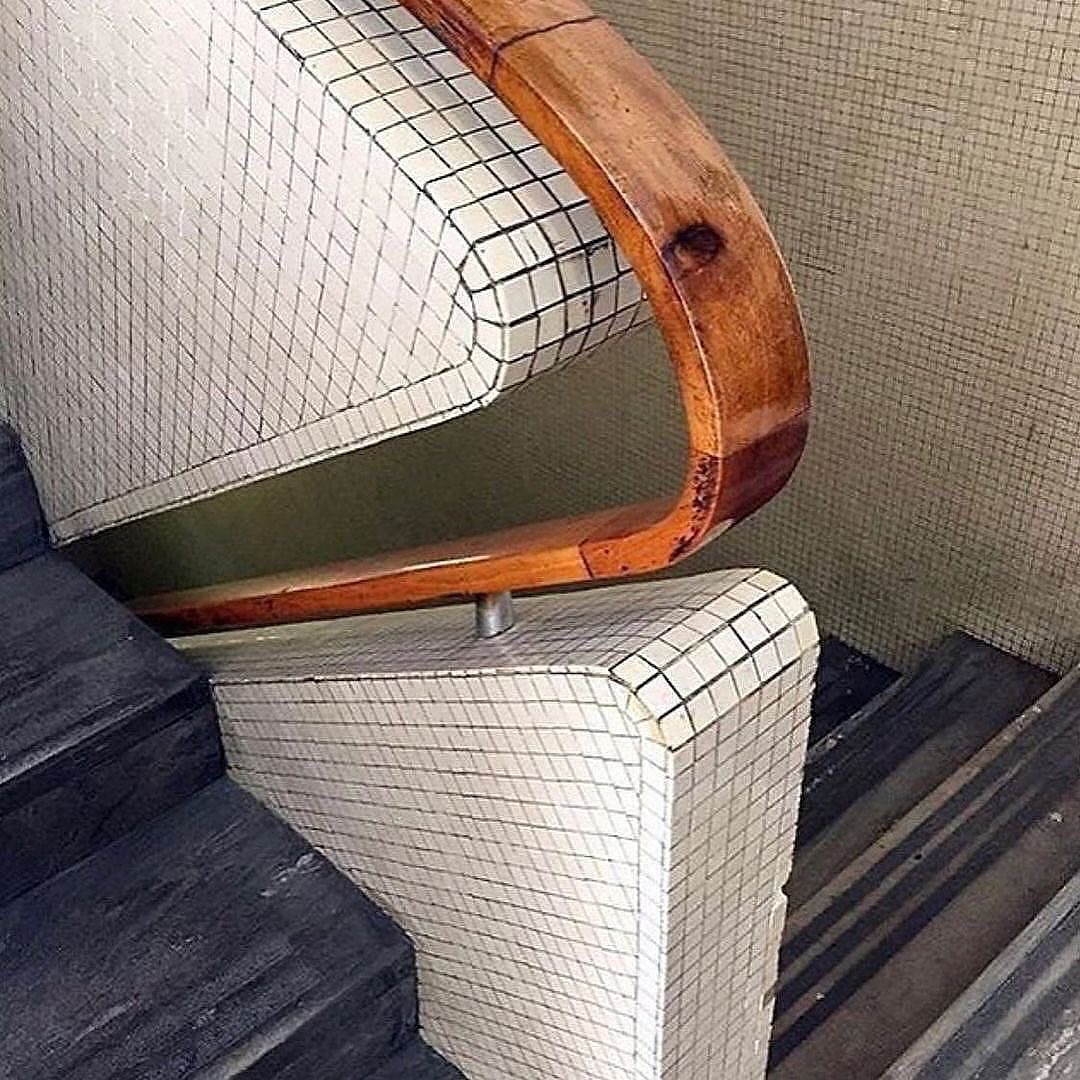
An Italian architect once threw a chair out of a fourth-floor window to prove it wouldn't break. It bounced. The same man designed the handrail in this photo.
The handrail is one continuous piece of wood. It runs from the ground floor to the top, never broken at any corner or landing.
The building is Italy's state broadcasting headquarters at Corso Sempione 27 in Milan. Construction started in 1940. It opened on October 9, 1952, after a wartime bombing destroyed part of it and stopped work for years. Italian television was born in this building. The first regular TV broadcasts went out from here in 1954.
The architect was Gio Ponti, born in Milan in 1891. He graduated from the city's architecture school in 1921 and spent the next 58 years putting his stamp on buildings, magazines, furniture, light fixtures, ceramics, and silverware. Domus, an architecture and design magazine he founded in 1928, is still publishing today. The Pirelli Tower in Milan was his too, a 127-meter skyscraper, 32 stories tall, with tapering sides and concrete corners cut away around the stairs. The whole building looks like it is barely touching the ground. He also designed the Denver Art Museum, Villa Planchart in Caracas, and the Hotel Parco dei Principi in Sorrento. He gave all of it the same attention.
His idea was simple: take a thing, then remove every part that does not need to be there. The clearest example is the chair from the opening. It's called the Superleggera, Italian for "super light." Cassina, the Italian furniture company, has produced it since 1957. The whole thing weighs 1.7 kilograms, about the same as a half-empty grocery bag. Each leg is triangular and just 18 millimeters thick. Narrower than your finger. The chair sits in the permanent collection at the Museum of Modern Art in New York.
The handrail in the source tweet uses the same rule on a bigger scale. A normal staircase rail breaks at every landing because that is the easy way to build one. Ponti decided breaks were unnecessary, so he removed them. The wood curves through every floor, the white tiles wrap around it like a sleeve, and your hand keeps moving from one level to the next without ever leaving the rail.
Ponti also taught for 25 years, ran Domus for over four decades, and designed buildings in Caracas, Stockholm, Hong Kong, Tehran, Eindhoven, Baghdad, Singapore, and Denver. He died in 1979 in Milan, where he was born.
The tweet calls it a stairway handle. It's also a pretty good summary of how he thought about everything.