AutoAIHorizon

2K posts

AutoAIHorizon

AutoAIHorizon

@AutoAIHorizon

Welcome to AutoAI Horizon, the hub for the latest in autonomous vehicle tech, and AI-powered humanoids. My Tesla Referral code: https://t.co/FyiWEENRT7


North Carolina, USA 参加日 Haziran 2024
87 フォロー中168 フォロワー
固定されたツイート
AutoAIHorizon
AutoAIHorizon@AutoAIHorizon·
I blinked and missed the pedestrians—but Tesla FSD didn’t.
English
0
1
2
88
AutoAIHorizon
AutoAIHorizon@AutoAIHorizon·
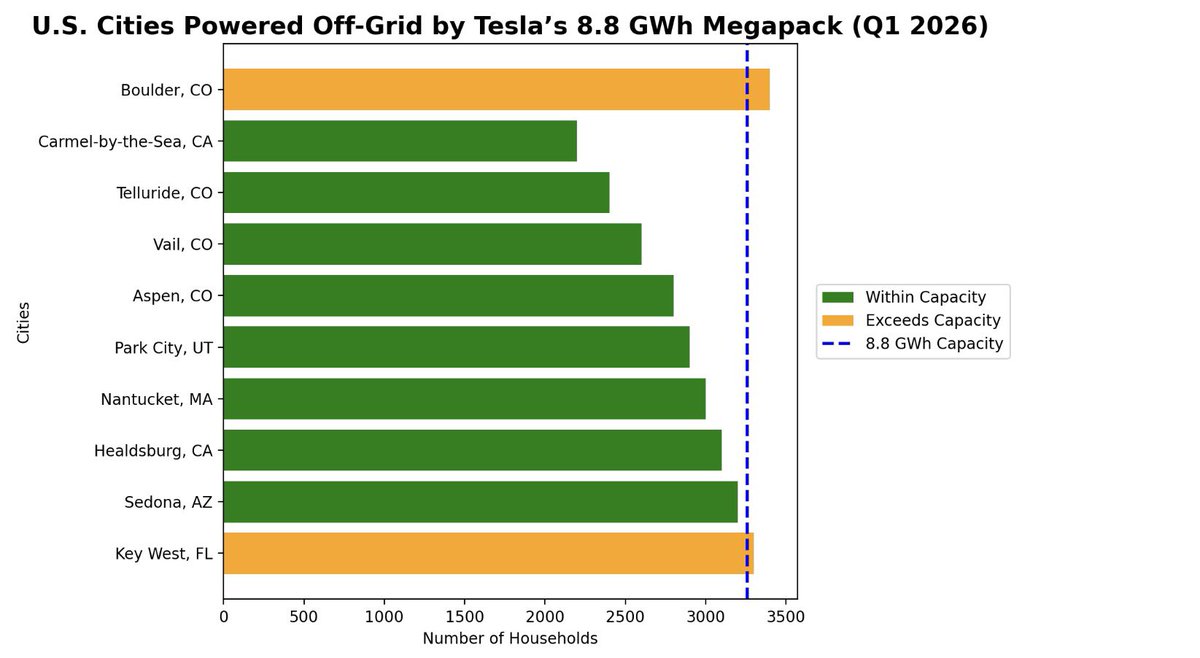
@SawyerMerritt Tesla deployed 8.8 GWh of energy storage in Q1 2026 — enough to power some of these cities for an entire quarter.
AutoAIHorizon tweet media
English
2
0
16
2.4K
Sawyer Merritt
Sawyer Merritt@SawyerMerritt·
BREAKING: Tesla delivered 358,023 vehicles in Q1, up 6% YoY. Wall Street was expecting 365,600. Total Q1 production was 408,386 Tesla also says that they deployed 8.8GWh of energy storage in Q1 2026.
Sawyer Merritt tweet media
English
248
221
2.5K
242.8K
AutoAIHorizon
AutoAIHorizon@AutoAIHorizon·
Tesla deployed 8.8 GWh of energy storage in Q1 2026 — enough to power some of these cities for an entire quarter.
AutoAIHorizon tweet media
English
0
0
0
21
AutoAIHorizon
AutoAIHorizon@AutoAIHorizon·
When your foot is hovering over the accelerator... in case someone wants to do something crazy.
English
0
0
0
1
AutoAIHorizon
AutoAIHorizon@AutoAIHorizon·
@tslaming @grok what are the practical applications of this breakthrough and are Tesla vehicles using this patent today?
English
1
0
0
172
Ming
Ming@tslaming·
BREAKING 🚨 TESLA HAS ENDED THE WAR ON BATTERY RESISTANCE BY A FEW MILLIMETERS OF FOIL OPTIMIZATION 🐳 The greatest enemy of an electric vehicle is not gravity, weight, or aerodynamic drag. The true bottleneck is internal battery resistance. Every time an electron is forced through a cramped, chaotic pathway inside a battery cell, it generates microscopic amounts of waste heat. Multiply that by billions of electrons during a supercharging session, and you have a massive thermal barrier that limits charging speeds and degrades battery life over time. Tesla has been fighting a relentless war against this internal resistance, and their latest weapon is an absolute masterclass in structural engineering. We now have a look at their next generation solution, quietly published under patent WO 2026/072937 A1. The core of this invention is a sequentially flagged electrode. Tesla has figured out that by precisely stepping down the height of the electrical contact flags from the outside of the battery can toward the inner core, they can create an ultra smooth, gapless connection point. This seemingly tiny reduction of a few millimeters of foil near the center of the roll drastically reduces direct contact resistance. It is a brilliant micro adjustment that promises to unlock massive macro benefits for battery cooling and sustained power output. ⚖️ The problem: Traditional battery tabs create bottlenecks To understand why Tesla is fighting this war on resistance, we have to look at how cylindrical cells are traditionally built. Many modern energy storage devices rely on a jelly roll design where the cathode, anode, and separators are tightly rolled together. The cathode and anode are simply the positive and negative metal layers that actually store the energy, while the separator is a thin insulating film that keeps them from touching and shorting out. To connect these internal components to the outside of the battery casing, manufacturers historically used separate metal tabs. Because of this design, the electrical current must travel all the way along the long, tightly coiled electrode foil just to reach these few isolated tabs before it can exit the cell. It is exactly like having thousands of cars on a massive highway that are all forced to squeeze through a single, narrow exit ramp. This traditional setup is the exact cause of the thermal barriers we just talked about. It inherently increases ohmic resistance, which is essentially the electrical friction created when electrons are forced through a long and congested path. Just like a pump working harder and generating heat when forcing water through miles of tiny garden hose, this electrical friction generates massive amounts of waste heat inside the battery. The tabs themselves also add unnecessary bulk to the rolled assembly. This added thickness complicates the automated winding process, drives up production costs, and creates physical weak points within the battery structure where heat loves to accumulate. 💡 Tesla's solution: The sequentially flagged electrode Tesla realized that the only way to permanently solve this heat accumulation was to rethink the connection point entirely. To eliminate the physical and thermal bottlenecks of traditional tabs, they engineered a truly tabless design. Instead of welding separate metal strips to the material, the electrode foil itself is precision cut. You can picture this foil as a very long, thin sheet of metallic wrapping paper that features a continuous series of integrated flags, or fringed cuts, along its top edge. When this long foil is wound into the cylindrical jelly roll, these flags are folded inward toward the central core. They overlap to form a dense, interleaved structure that strongly resembles an artichoke or a closed flower. But simply folding the foil creates a new geometrical problem because the center of the cylinder is much tighter than the outside. If all the flags were the exact same height, they would bunch up violently at the core. Imagine trying to fold a thick stack of cardboard into a tiny origami shape. The material would inevitably crinkle, creating uneven layers, empty air gaps, and terrible electrical contact. This is the genius of the sequentially flagged design. By progressively decreasing the height of the flags from the broad outer edge of the can down to the tight inner core, Tesla ensures the folded metal lays absolutely flat when compressed. It is similar to carefully trimming the innermost petals of a flower so the whole blossom can press together neatly. This progressive sizing creates a beautifully smooth, uniform metallic surface across the entire end of the jelly roll. It maximizes the electrical contact area for the terminal lid, which serves as the final metal cap and power exit point for the battery. This elegant geometry completely eliminates the chaotic choke points where heat would normally get trapped. 🧪 Ditching the toxic slurry: The dry electrode advantage However, redesigning the shape of the foil is only half the battle. How you actually manufacture that complex shape is equally important. The patent explicitly notes that these intricately flagged electrodes can be manufactured using a completely dry process. Traditional battery manufacturing relies on toxic wet solvents to mix the active materials into a thick slurry, much like stirring dry powders into a wet cake batter. This wet process then requires massive, energy hungry drying ovens to bake and cure the layers. Tesla entirely bypasses this outdated step. By utilizing a fibrillized polymer matrix, which acts as a microscopic web of interlocking fibers to bind the materials together, they can create a solid structure. For this matrix, they use materials like polytetrafluoroethylene, the exact same highly durable plastic widely known as Teflon. This innovative chemistry allows them to create a self supporting electrode film from dry particles alone. They are essentially pressing a highly conductive dry powder directly into a flexible sheet without ever using a single drop of liquid. This not only slashes the factory footprint and energy consumption but also aligns perfectly with the high speed production goals of the new tabless architecture. 🏗️ Metallurgical harmony: Tailoring materials for perfect welds Once this perfectly dry, uniquely shaped foil is ready, it has to be paired with the exact right companion metals to maximize its potential. To achieve those flawless, low resistance welds at the ends of the jelly roll, the base metals must be perfectly matched. The document specifies that the cathode side of the electrode roll is crafted from aluminum foil, while the anode side utilizes copper. To ensure a pristine electrical connection, the terminal lids are specifically tailored to match their respective poles. The cathode lid is made of aluminum, but the anode lid is constructed from steel. Beyond the structural metal foils, the active coating materials remain highly versatile. These active materials are essentially the energy storing chemical pastes that are painted directly onto the metal sheets. The design readily supports advanced chemistries like lithium iron phosphate, lithium manganese iron phosphate, and lithium nickel manganese cobalt oxide. While these long names sound like they belong in a textbook, they simply represent different chemical recipes that allow engineers to tune the battery for either maximum vehicle range, lower production costs, or a much longer overall lifespan. 🛡️ The geometry of safety: Asymmetric electrode overhang Combining these advanced chemistries at lightning fast factory speeds introduces a new set of physical risks that must be managed. Rolling these highly conductive metal foils at a breakneck pace introduces the danger of microscopic misalignments. These tiny physical slips can easily lead to catastrophic internal short circuits, a highly dangerous event where the positive and negative sides accidentally touch directly. This instantly bypasses the normal power route and often destroys the battery. To eliminate this risk, the internal architecture features a deliberate asymmetric design, meaning the two metal layers are intentionally mismatched in size. One electrode is specifically cut to be slightly larger than the other. This creates a physical overhang in both the winding and non winding directions. The larger metal sheet extends slightly further both along the length being rolled and across its side to side width. You can think of this protective overhang like a hardcover book, where the rigid outer cover is designed to be slightly larger than the paper pages inside to shield the vulnerable edges. This clever structural buffer ensures the insulating separator film perfectly isolates the anode and cathode at the very margins. This simple geometry protects the cell's internal integrity while allowing the automated factory lines to run at absolute maximum velocity. 🔋 Optimizing the core: Eliminating gaps and managing heat Even as the winding machines spin at maximum velocity to create the outer layers, the exact center of the roll demands a very different kind of precision. Even with graduated flags, the very center and the absolute perimeter of the tightly coiled jelly roll require special attention. The patent introduces highly calculated flagless zones, specifically named the nubless region near the center core and the buried region near the outer casing, or can. You can think of these regions like the blank margins on a printed page that ensure the text does not get crushed into the spine of a book. These are deliberate voids, meaning they are perfectly flat sections of foil with no fringe cuts at all. They are designed to prevent metal overcrowding in the extremely tight inner turns and the final outer wrap of the cylinder. Fine tuning these specific empty spaces allows the battery to shed heat dramatically faster. By minimizing the total length of these flagless areas to just a tiny fraction of the electrode, the thermal dissipation capability of the entire cell skyrockets. Less trapped heat means the battery can sustain heavy electrical loads safely without the vehicle needing to aggressively throttle power. Throttling power is an automatic safety measure where the car's computer intentionally limits your acceleration and performance to prevent a thermal meltdown, acting exactly like a sprinter who is forced to slow down to a jog to catch their breath. ⚡ Advanced electrical connections: Two stage welding Once the core is optimized and the battery can breathe properly, the final challenge is sealing the entire package without destroying the fragile internal structure. Rather than simply slapping the terminal lid onto the folded flags and blasting it with a laser, Tesla outlines a meticulous two stage connection sequence. First, the folded metal flags are welded directly to each other using a series of deep radial welds that strongly resemble the outward reaching spokes of a bicycle wheel. This crucial initial step binds the delicate, interleaved foil structure, where thousands of thin metal layers overlap like perfectly shuffled cards, together into a solid, highly conductive electrical mass. Only after the flags are fused internally does Tesla attach the terminal lid. This lid is secured using a highly specific pattern combining radial spot welds and concentric arcing welds. Radial spot welds act like tiny, targeted pinpoints of fusion radiating outward from the middle. Meanwhile, the concentric arcing welds form short, curved lines that sweep around the center much like expanding ripples in a pond. This multi step approach distributes the intense welding energy smoothly across a wider area. By spreading out the heat, this method prevents thermal damage to the ultra thin internal foils while creating an incredibly robust electrical pathway. 📏 Precision contact area percentages Creating that robust pathway requires a surgical touch rather than brute force. Tesla is remarkably precise about exactly how much of that lid needs to be welded to the folded flags beneath it. The engineering data reveals that for the cathode lid, the spot welds connect precisely one point eight percent of the total surface area to the underlying electrode. Spot welds are tiny, concentrated points of melted metal used to join two pieces together. You can picture them acting much like individual, targeted drops of superglue rather than a messy smear of glue across an entire surface. On the anode side, the welds cover roughly six point two percent. This hyper specific targeting provides maximum electrical connectivity, ensuring that heavy power flows instantly without any bottleneck. Most importantly, it achieves this strong connection without pumping destructive heat into the battery during assembly. If they were to weld the entire lid, the intense sustained heat would act like a blowtorch and completely melt the delicate, paper thin internal foils they just perfectly aligned. 🌀 Stress relief mechanics built into the lid Yet, even a perfectly welded battery is subjected to immense physical forces once it leaves the factory and hits the road. Cylindrical battery cells naturally heat up and cool down, causing them to expand and contract slightly during extreme charging and discharging cycles. To combat the internal mechanical pressures this swelling creates, the terminal lids are not always just solid, unyielding pieces of metal. The design incorporates specific geometric cutouts, such as triangular, circular, or square voids. These deliberately engineered empty spaces act as physical release valves to absorb axial and torsional stress. Axial stress is the heavy pressure that pushes up and down along the length of the cylinder, while torsional stress is a twisting force very similar to wringing out a wet towel. By allowing the metal cap to flex and breathe through these cutouts, the design keeps the delicate internal components safe from physical deformation. This prevents the carefully aligned metal layers from warping, crushing, or tearing as the cell naturally expands and contracts over years of rapid supercharging. 📉 Beating the resistance: Lower DCR for faster charging Ultimately, every single one of these innovations, from the stress relieving cutouts to the meticulously graduated flags, serves one master metric. The ultimate goal of this intricate foil origami and surgical welding is the dramatic reduction of direct contact resistance, commonly known as DCR. This specific resistance occurs at the exact physical boundary where two different metal parts touch. You can think of a high contact resistance like a rough, bumpy gravel road connecting two fast, smooth highways. It forces all the high speed traffic to violently slow down at the intersection. Experimental data included in the filing proves that welding the flags to each other before attaching the lid slashes this boundary resistance compared to older manufacturing methods. When resistance drops, the battery simply generates less waste heat. This translates directly to minimized energy loss and a noticeably improved lifespan for the pack, because excessive heat is the absolute primary cause of battery degradation over time. Lower resistance also unlocks the ability to push more current into the cell rapidly. This behaves very much like being able to fill a swimming pool with a massive fire hose instead of a regular garden hose, completely eliminating the bottleneck so the energy can flow freely. This dramatically increased flow capacity means significantly shorter charging times and sustained high performance output for the vehicle, even during intense acceleration or heavy towing. 🚀 How this foil origami powers Tesla's present and future This massive jump in flow capacity is not just a theoretical laboratory victory; it is actively reshaping Tesla's entire product roadmap. The immediate impact of this sequentially flagged design is happening right now on the manufacturing floors of Giga Texas. By completely eliminating the violent bunching of metal at the core of their massive cylindrical cells, Tesla can run their dry electrode winding machines at unprecedented speeds. Smooth, perfectly flat folded edges mean fewer torn foils, fewer factory jams, and a drastically lower rate of defective cells being thrown in the recycling bin. This geometric perfection directly translates to cheaper battery production, which is the absolute key to scaling up the Cybertruck and making everyday vehicles like the Model Y more profitable today. Beyond the factory floor, this tiny geometric tweak completely changes the math for the everyday driver. Because the graduated flags drastically lower the direct contact resistance we discussed earlier, these new cells can absorb massive electrical currents from the newest high power Superchargers without dangerously overheating. This means your vehicle can sustain its peak charging speeds for a much longer window. It results in significantly shorter pit stops on road trips, all without cooking the delicate internal chemistry and degrading the battery pack over time. Looking to the near future, mastering this thermal bottleneck is the foundational stepping stone for Tesla's most extreme energy demands. The continuous high power output required to haul fully loaded commercial freight with the Tesla Semi, or the brutal, sustained acceleration demands of the upcoming Roadster, rely entirely on cells that will not melt themselves from the inside out under heavy load. Furthermore, as the company pivots toward a fully autonomous fleet, those vehicles will be subjected to a highly demanding lifestyle. A working Robotaxi will need to be driven constantly and fast charged relentlessly, day and night, without the luxury of cooling down in a residential garage. This ingenious, low resistance artichoke architecture ensures their next generation of batteries will easily survive that grueling, million mile lifespan.
Ming tweet media
English
8
57
281
16.9K
Whole Mars Catalog
Whole Mars Catalog@wholemars·
10 billion FSD (Supervised) miles holds no special significance One misconception I hear sometimes is that Elon said you need 10 billion miles to do unsupervised. What he actually said is that you need ~10 billion miles of training data. Training data is manual driving, not self-driving. Unsupervised FSD has already been deployed in Austin.
English
15
10
275
21.7K
Sawyer Merritt
Sawyer Merritt@SawyerMerritt·
NEWS: The Tesla Model X appears to be sold out across the U.S. All that's left in existing inventory are some demo units.
Sawyer Merritt tweet media
English
110
117
2.1K
186.7K
AutoAIHorizon
AutoAIHorizon@AutoAIHorizon·
@SawyerMerritt Saving up for SpaceX IPO…hopefully retail investors can buy in at IPO
GIF
English
0
0
5
136
Sawyer Merritt
Sawyer Merritt@SawyerMerritt·
NEWS: OpenAI just announced that it has officially closed their latest funding round with $122 billion in committed capital at a post money valuation of $852 billion. "We are now generating $2B in revenue per month. At this stage, we are growing revenue four times faster than the companies who defined the Internet and mobile eras, including Alphabet and Meta. ChatGPT has more than 900 million weekly active users, and over 50 million subscribers. Search usage has nearly tripled in a year, and our ads pilot reached more than $100 million in ARR in under six weeks. Momentum is just as strong on the enterprise side, which now makes up more than 40% of our revenue, and is on track to reach parity with consumer by the end of 2026. GPT‑5.4 is driving record engagement across agentic workflows. Our APIs now process more than 15 billion tokens per minute. Codex now serves over 2 million weekly users, up 5x in the past three months, with usage growing more than 70% month over month."
Sawyer Merritt tweet media
English
269
262
2.6K
1.9M
AutoAIHorizon
AutoAIHorizon@AutoAIHorizon·
@SawyerMerritt This competition is healthy. Let the best and more affordable service wins…
English
0
0
0
109
Sawyer Merritt
Sawyer Merritt@SawyerMerritt·
Amazon must have offered a low price for this deal, because Delta is signing on for a service that they don't yet know for sure that Amazon will be able to provide. Starlink is already a proven in-flight high-speed Wi-Fi provider and could outfit Delta's fleet by end of 2027. Almost all of Delta's competitors have signed on with Starlink.
Sawyer Merritt@SawyerMerritt

NEWS: Delta Airlines has announced they are partnering with Amazon's LEO to bring high-speed Wi-Fi to its airplanes. "Delta will introduce Amazon Leo on hundreds of Delta aircraft, starting with an initial installation on 500 aircraft beginning 2028, and work with Amazon to expand its popular Delta Sync Wi-Fi and seatback experiences."

English
236
89
1.9K
211.2K
AutoAIHorizon
AutoAIHorizon@AutoAIHorizon·
@niccruzpatane What’s up with wiper blade maintenance after only 9 months of ownership of new model Y launch. Seems weird.
English
0
0
0
8
Nic Cruz Patane
Nic Cruz Patane@niccruzpatane·
This is basically all the maintenance a Tesla needs during ownership. You will not miss owning a gas car, that's for sure.
Nic Cruz Patane tweet media
English
25
14
241
13.2K
Nic Cruz Patane
Nic Cruz Patane@niccruzpatane·
Tesla has begun removing human supervisors from Robotaxis in Austin and adding those cars to the Unsupervised fleet. Approximately 20% of Robotaxis in Austin are currently running Unsupervised. That number is only going to grow.
Nic Cruz Patane tweet media
Robotaxi Tracker@RtaxiTracker

A previously supervised vehicle in the Tesla Robotaxi fleet was recently spotted operating unsupervised This is the first time a new unique vehicle has been operating unsupervised in over a month

English
30
131
1.7K
71.3K
AutoAIHorizon
AutoAIHorizon@AutoAIHorizon·
@elonmusk Rocket reusability that was once thought impossible until Elon and SpaceX set out to solve this problem. This is sick.
English
0
0
3
40