BehaviourWorks Australia

1.7K posts

BehaviourWorks Australia banner
BehaviourWorks Australia

BehaviourWorks Australia

@BehaviourWorksA

Solving problems with behavioural science research. #InspiringChange

Melbourne, Victoria 参加日 Kasım 2015
217 フォロー中1.5K フォロワー
固定されたツイート
BehaviourWorks Australia
BehaviourWorks Australia@BehaviourWorksA·
In a challenging job market, smart upskilling sets you apart. Our course, Applying Behavioural Science to Create Change, gives you in-demand skills that help you: ✅ Drive impact ✅ Stand out in competitive job markets ✅ Position yourself for higher-value roles Behavioural insights are being applied across government, health, education, sustainability and beyond. This is your opportunity to lead with evidence—and be rewarded for it. Find out more: behaviourworksaustralia.org/courses/applyi… #BehaviouralScience #CareerGrowth #Upskilling #BehaviourChange #ProfessionalDevelopment Our 25+ PhD-level researchers find behavioural solutions to pressing social, environmental and organisational problems. BehaviourWorks Australia, part of Monash University.
BehaviourWorks Australia tweet media
English
0
1
1
340
BehaviourWorks Australia
BehaviourWorks Australia@BehaviourWorksA·
Hear from our Director, Professor Liam Smith, in this free online webinar hosted by Impact Labs at Monash Business School. Liam will join James Trezise, director of the Biodiversity Council, to share insights from a national survey on community attitudes toward nature conservation. You will learn how the Biodiversity Council has used this research to inform both public engagement and policy advocacy. Following the May 2025 federal election, environmental law reform remains on the political agenda, but momentum has slowed. Liam and James will explore how these survey findings can help reignite a nature-positive reform agenda in the new federal term. Moderated by Associate Professor Anita Foerster, Director of Green Lab, Monash Business School. Register now via Humanitix: lnkd.in/gjKahJ8x ___ Make change happen: contact us about partnering on your project or explore our courses. Our 25+ PhD-level researchers find behavioural solutions to pressing social, environmental and organisational problems. BehaviourWorks Australia, part of Monash University. #BehaviouralScience #BehavioralScience #Biodiversity #Sustainability #Conservation
BehaviourWorks Australia tweet media
English
0
0
0
207
BehaviourWorks Australia
BehaviourWorks Australia@BehaviourWorksA·
Reducing Australia’s material footprint is a complex and multifaceted challenge. How can policy-makers, industry leaders, entrepreneurs and advocates reshape our systems of production and consumption for a more sustainable future? In our webinar 'Novel Approaches to Systems Change' this Thursday (link below), Jennifer Macklin will delve into her work on the CE Roadmap project, designed as a behavioural roadmap to circular consumption. Jennifer's research ultimately revealed that starting with consumers is not the best way to drive circular economy outcomes. The shift instead needs to come from industry practices, which will in turn create circular opportunities for consumers. Further, government intervention in the form of policy and other supports is necessary to help reduce barriers faced by industry. Diagnosing system challenges was at the heart of this project, says Jennifer. "Sometimes one defaults to ‘individual’ behaviour change as the most visible part of the problem, but individuals often face significant system barriers, and this is true for consumers in a circular economy. "Behavioural system mapping helps identify points of intervention in the system to lead to the change we want to see," she adds. "As well as individual change, behavioural science can identify structural and policy recommendations and industry change. "Behavioural science is about so much more than individual behaviour." Register now to view 'Novel Approaches to Systems Change' this Thursday 26 June, 2-3PM (GMT +10): monash.zoom.us/webinar/regist… ___ Make change happen: contact us about partnering on your project or explore our courses. behaviourworksaustralia.org Our 25+ PhD-level researchers find behavioural solutions to pressing social, environmental and organisational problems. BehaviourWorks Australia, part of Monash University. #BehaviouralScience #BehavioralScience #ScienceWebinar #CircularEconomy #ZeroWaste
BehaviourWorks Australia tweet media
English
0
0
1
149
BehaviourWorks Australia
BehaviourWorks Australia@BehaviourWorksA·
How can behavioural science help reshape the systems that shape us? In our second FREE webinar, 'Novel Approaches to Systems Change', we dive into how behavioural science is evolving to tackle deeply rooted, complex issues. From sustainable housing to hospital waste reduction and circular economy systems, our experts are applying behavioural thinking in impactful, system-level ways: 🔹 Liam Smith is spearheading a national blueprint to upgrade one million homes with sustainability and behaviour at its core. 🔹 Jennifer Macklin is using behavioural systems mapping to untangle circular economy challenges. 🔹 Lena Jungbluth is driving environmental responsibility in healthcare through smarter waste practices. If you're working on problems with no easy answers, this could well be the perspective shift you need. Sign up now for a thought-provoking session on using behavioural insights to influence systemic transformation, part two of our 'Challenge Accepted' webinar series. 'Novel Approaches to Systems Change' 26 June 2025, 2-3pm (GMT+10) Register here: lnkd.in/eQmTZq8e Read more about the series here: lnkd.in/dYyT2rfW ___ Make change happen, contact us about partnering on your project or explore our courses: lnkd.in/g3QpFJgP Our 25+ PhD-level researchers find behavioural solutions to pressing social, environmental and organisational problems. BehaviourWorks Australia, part of Monash University. #BehaviouralScience #BeSci #SBC #BehavioralScience #ScienceWebinar #CircularEconomy #Sustainability #Healthcare
BehaviourWorks Australia tweet media
English
0
0
1
106
BehaviourWorks Australia
BehaviourWorks Australia@BehaviourWorksA·
How can we ensure that sharing wildlife content online supports, rather than harms, conservation efforts? This question was at the heart of the forum "Designing Social Media Guidelines for Conservation", run by our very own Meghan Shaw at the International Congress for Conservation Biology this week. Meghan’s forum united conservation and social scientists to kick-start the creation of best-practice guidelines for sharing wildlife and conservation content online. The guidelines will be further refined by a panel of experts and released later this year for use by organisations and individuals sharing digital content on nature conservation. "The conversations sparked were rich and ongoing—but a few key takeaways stood out for me," Meghan says. "Consider the unintended consequences of your content. For example, could a photo of you holding an animal unintentionally encourage others to seek the same experience? "If an image requires a caption to explain or justify it… is it the right image to post?" Stay tuned for more discussions on ethical, effective conservation communication as the week continues at #ICCB2025. ___ Make change happen: contact us about partnering on your project or explore our courses. lnkd.in/g3QpFJgP Our 25+ PhD-level researchers find behavioural solutions to pressing social, environmental and organisational problems. BehaviourWorks Australia, part of Monash University. #BehaviouralScience #BeSci #SBC #BehavioralScience #MarketingCommunications #WildlifePhotography #Conservation
BehaviourWorks Australia tweet media
English
0
0
0
95
BehaviourWorks Australia
BehaviourWorks Australia@BehaviourWorksA·
Is email always the best way to get your message across, or is there still a place in our lives (and work) for the humble, handheld letter? Which is more effective when it comes to changing behaviour? Here at BehaviourWorks Australia we're asked this question often, especially by those whose professional role it is to impart information and 'persuade' in some way. So we're revisiting our best-read blog post of all time (link below), in which we compare and contrast emails and letters. Regardless of which way you ultimately choose to convey your message, the way you say it is crucial. To this end, we also explore some techniques designed to elevate your written communications and drive your message home. Happy reading: behaviourworksaustralia.org/.../emails-ver…... ___ Make change happen: contact us about partnering on your project or explore our courses: behaviourworksaustralia.org Our 25+ PhD-level researchers find behavioural solutions to pressing social, environmental and organisational problems. BehaviourWorks Australia, part of Monash University #BehaviouralScience #BeSci #SBC #BehaviourChange #BehavioralScience #MarketingCommunications #Storytelling #ContentMarketing
BehaviourWorks Australia tweet media
English
0
0
1
78
BehaviourWorks Australia
BehaviourWorks Australia@BehaviourWorksA·
People living with dementia can find the hospital environment stressful. There's the noise factor; confusion in the face of extreme busyness; and unfamiliar carers with high turnover, introducing constant change to the mix. These patients can also receive suboptimal care, partly due to a limited ability to express their needs in the face of overwhelm. This newly published paper, led by BehaviourWorks Australia researcher Alyse Lennox, found several factors contribute to the lack of quality care for dementia patients in a hospital setting. They included: • Uncertainty around responsibility for communicating with families to understand the needs of the person living with dementia; • Unsuitable tools; • Lack of opportunities for families to communicate with staff; • Resource and environmental constraints. Study participants discussed the various ways the level of care could be improved, and emphasised the need for an intervention that would foresee potential issues rather than simply react to them. The paper highlights their support for the idea of a "hospital admission kit" containing information about both people living with dementia and their familiar items. The ongoing project is a collaborative initiative between @MonashUni and @PeninsulaHealth, and spearheaded by A/Professor Chris Moran. The team has been collaborating to create and implement a digital tool that incorporates the needs and preferences of people living with dementia before their hospital admission, ensuring more personalised care. Read the journal article: bmcgeriatr.biomedcentral.com/.../s12877-025… Make change happen, contact us about partnering on your project or explore our courses. Our 25+ PhD-level researchers find behavioural solutions to pressing social, environmental and organisational problems. BehaviourWorks Australia, part of Monash University.
BehaviourWorks Australia tweet media
English
0
0
0
63
BehaviourWorks Australia
BehaviourWorks Australia@BehaviourWorksA·
A big congratulations to Dr Kathie Pawluk De-Toledo, who graduated this week upon completion of her PhD. Kathie, middle, was part of the Behaviour Change GRIP (Graduate Research Industry Partnership) group, made up of 17 PhD students led by Liam Smith at Monash Sustainable Development Institute. Kathie's organisation partner was Vicroads and her topic was travel behaviour changes during and post the COVID-19 pandemic. Her main supervisor was Sjaan Koppel at Monash University Accident Research Centre (MUARC), pictured on the left. Congratulations also to graduate Jane Wardani from MSDI; her main supervisor was Annette Bos. Pictured also is Michaela Lang, a former Behaviour Change GRIP student. Learn more about GRIP here: monash.edu/.../graduate-r…... Make change happen: contact us about partnering on your project or explore our courses. Our 25+ PhD-level researchers find behavioural solutions to pressing social, environmental and organisational problems. BehaviourWorks Australia, part of Monash University. #BehaviouralScience #BeSci #BehaviourChange #BehavioralScience
BehaviourWorks Australia tweet media
English
0
0
1
94
BehaviourWorks Australia
BehaviourWorks Australia@BehaviourWorksA·
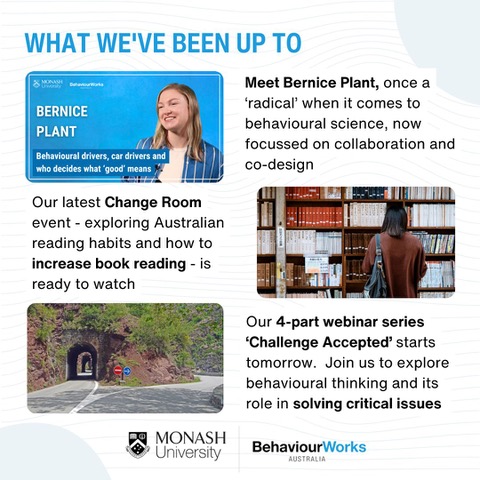
What have we been up to this month? - Meet Bernice Plant (one-time "radical behaviouralist") - Our latest 'Change Room' is ready to watch - Our 'Challenge Accepted' Webinars are here - Can you spot misinformation? Keep up with BehaviourWorks Australia’s news and updates — read our latest newsletter: linkedin.com/.../reading-ra…... #MakeChangeHappen, contact us about partnering on your project or explore our courses: behaviourworksaustralia.org #BehaviouralScience #BeSci #SBC #BehaviourChange #BehavioralScience
BehaviourWorks Australia tweet media
English
0
0
0
46
BehaviourWorks Australia
BehaviourWorks Australia@BehaviourWorksA·
Our webinar series starts tomorrow! Register now to catch the live broadcast of "Behavioural Science: A Critical Piece of the Puzzle", the first in a four-part series where we'll explore the incredible power of behavioural science in helping to solve critical and nuanced issues. Behaviour change approaches are invaluable for driving positive social and environmental shifts, yet surprisingly, they are rarely used in intervention design. In this one-hour session, you'll discover the essential steps of a behavioural science approach. We'll demonstrate how these steps can be applied using real-world case studies. Learn how we’ve used behavioural science to: •Enhance patient experience and safety •Reduce food waste •Support individuals with serious injuries in living their best lives Featuring three of our esteemed behavioural scientists: •Breanna Wright: Breanna’s work with the Victorian Managed Insurance Authority exemplifies the application of behavioural insights to patient safety strategies, enhancing outcomes in healthcare settings. •Mark Boulet: Mark will demonstrate the versatility of behavioural science in tackling critical environmental issues like food waste and loss, working with organisations like OzHarvest and NSW Environment Protection Authority (EPA) to reduce household food waste; a complex problem deeply rooted in human habits. •Alyse Lennox: Alyse employed behavioural principles to address engagement challenges among young men living with spinal cord injuries, collaborating with Austin Health, AQA Community and the Transport Accident Commission (TAC) to empower this cohort to lead fulfilling lives. Register now at the link below and be inspired by the creative thinking behavioural science can unlock. Whether you’re looking for fresh approaches to problem-solving or simply curious about how behavioural science works in practice, this webinar has something for you. Click here to register: monash.zoom.us/.../WN_Fdqbrwv…... #MakeChangeHappen, contact us about partnering on your project or explore our courses. Our 25+ PhD-level researchers find behavioural solutions to pressing social, environmental and organisational problems. BehaviourWorks Australia, part of Monash University
BehaviourWorks Australia tweet media
English
0
0
0
71
BehaviourWorks Australia
BehaviourWorks Australia@BehaviourWorksA·
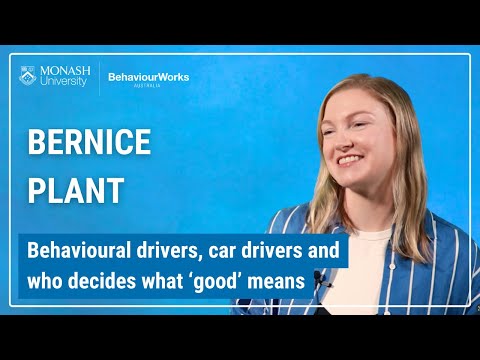
Our latest episode of 'Meet the Researcher' features Bernice Plant, a one-time "radical behaviourist" who talks us through her journey from forensic to behavioural science. A unit in community psychology and societal issues planted the seeds for Bernice's career, which now sees her working to affect positive change through behavioural insights — for example, among young drivers (fact: for young people, social threats can be as concerning as physical threats). Bernice suggests behavioural science needs to work more collaboratively, so that change isn't imposed by researchers, but rather agreed to via a participatory approach. View the episode here: youtube.com/watch?v=YrwR9t… #MakeChangeHappen, contact us about partnering on your project or explore our courses. behaviourworksaustralia.org Our 25+ PhD-level researchers find behavioural solutions to pressing social, environmental and organisational problems. BehaviourWorks Australia, part of Monash University.
YouTube video
YouTube
BehaviourWorks Australia tweet media
English
0
0
0
54
BehaviourWorks Australia
BehaviourWorks Australia@BehaviourWorksA·
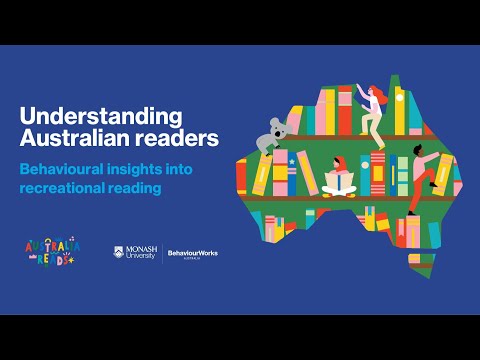
What kind of recreational reader are you — Avid? Ambivalent? Lapsed? These are a few of the types identified by our specialist researchers, who did a deep dive into Australia's declining recreational reading rate. In this live Change Room event (video link below), which brought together BehaviourWorks Australia and Australia Reads, we explain what Australians' reading habits look like, and ask how we can encourage more recreational reading. Join Breanna Wright, Anna Burkey and Geoff Paine as they bring the six different reader types to life, and gain insights from the audience on how to engage with them. #MakeChangeHappen, contact us about partnering on your project or explore our courses. Our 25+ PhD-level researchers find behavioural solutions to pressing social, environmental and organisational problems. BehaviourWorks Australia, part of Monash University. #BehaviouralScience #BeSci #SBC #BehaviourChange #BehavioralScience youtube.com/watch?v=2VFK-f…
YouTube video
YouTube
English
0
0
0
40
BehaviourWorks Australia
BehaviourWorks Australia@BehaviourWorksA·
Research in Australia consistently shows a link between unstable housing and re-offending rates. To address this, stable housing support is commonly proposed as key to reducing recidivism. But which types of programmes have proven to be effective? To answer this question, a rapid systematic review — a rigorous method for reviewing existing studies — was carried out by a team led by Dr Paul Kellner, who joined BehaviourWorks Australia in 2021. Their key findings were that: • Housing provision, whether it's temporary or permanent, is likely a “necessary, but not sufficient” programming component when it comes to reducing re-offending/recidivism in adults. Most of the effective interventions supported participants with additional services on top of housing, like mental health support and "wraparound" services like targeted caseworker support. • Reinforcing the above, authors from several studies speculate that housing-alone interventions are unlikely to be as effective as housing programs alongside other supports. • Permanent or long-term housing with wraparound supports may reduce rates of rearrest, increase the time to the first (post-release) arrest, and reduce rates of reconviction, reincarceration and/or reoffending. This systematic review was part of a larger suite of reviews supported by the Paul Ramsay Foundation, all of which looked to provide targeted insights for breaking cycles of disadvantage. With a focus on rapid evidence and practice reviews and a DPhil in International Development from the University of Oxford (among other, equally impressive qualifications), Paul is committed to making high-quality academic evidence useful to groups outside of academia. Throughout his career, he has partnered with governments, philanthropic organisations, NGOs, corporations and UN partners. "The work of my team, the evidence review service, can provide a sound foundation for exploring program and policy options on a wide range of issues related to social disadvantage," Paul says. "Understanding the current state of evidence on any issue is a critical first step in exploring phenomena, as well as designing, implementing, and evaluating an intervention." A detailed overview of this research can be found here: monash.edu/.../the-effect…... Read more about Paul here: behaviourworksaustralia.org/team/dr-paul-k… Make change happen, contact us about partnering on your project or explore our courses. behaviourworksaustralia.org Our 25+ PhD-level researchers find behavioural solutions to pressing social, environmental and organisational problems. BehaviourWorks Australia, part of Monash University. #BehaviouralScience #BeSci #SBC #BehaviourChange #BehavioralScience #SDG11 #SDG16
BehaviourWorks Australia tweet media
English
0
0
0
38
BehaviourWorks Australia
BehaviourWorks Australia@BehaviourWorksA·
Introducing our very first webinar — Behavioural Science: A Critical Piece of the Puzzle. The first in a four-part series, this session will explore the incredible power of behavioural science, explaining why it deserves a seat at the table in solving critical and nuanced issues. Behaviour change approaches can be invaluable in realising positive social and environmental shifts, but it's remarkable how rarely behavioural methods are used to design interventions. In this webinar, you'll discover the essential steps of a behavioural science approach and see how these steps were applied in real-world case studies. Learn how we’ve used behavioural science to: •Enhance patient experience and safety •Reduce food waste •Support individuals with serious injuries in living their best lives You'll hear from three of our esteemed behavioural scientists: •Dr Breanna Wright: Breanna’s work with the Victorian Managed Insurance Authority exemplifies the application of behavioural insights to patient safety strategies, enhancing outcomes in healthcare settings. •Dr Mark Boulet: Mark will demonstrate the versatility of behavioural science in tackling critical environmental issues like food waste and loss, working with organisations like OzHarvest, NSW Environment Protection Authority, and Fight Food Waste to reduce household food waste; a complex problem deeply rooted in human habits. •Alyse Lennox: Alyse employed behavioural principles to address engagement challenges among young men living with spinal cord injuries, collaborating with Austin Health, AQA and the Victorian Transport Accident Commission to empower this cohort to lead fulfilling lives. Whether you’re looking for fresh approaches to problem-solving or simply curious about how behavioural science works in practice, this webinar has something for you. Join us and be inspired by the creative thinking it unlocks. Click here to register: monash.zoom.us/.../WN_Fdqbrwv…... #MakeChangeHappen, contact us about partnering on your project or explore our courses. #BehaviouralScience #BeSci #SBC #BehaviourChange #BehavioralScience Our 25+ PhD-level researchers find behavioural solutions to pressing social, environmental and organisational problems. BehaviourWorks Australia, part of Monash University.
BehaviourWorks Australia tweet media
English
0
0
0
78
BehaviourWorks Australia
BehaviourWorks Australia@BehaviourWorksA·
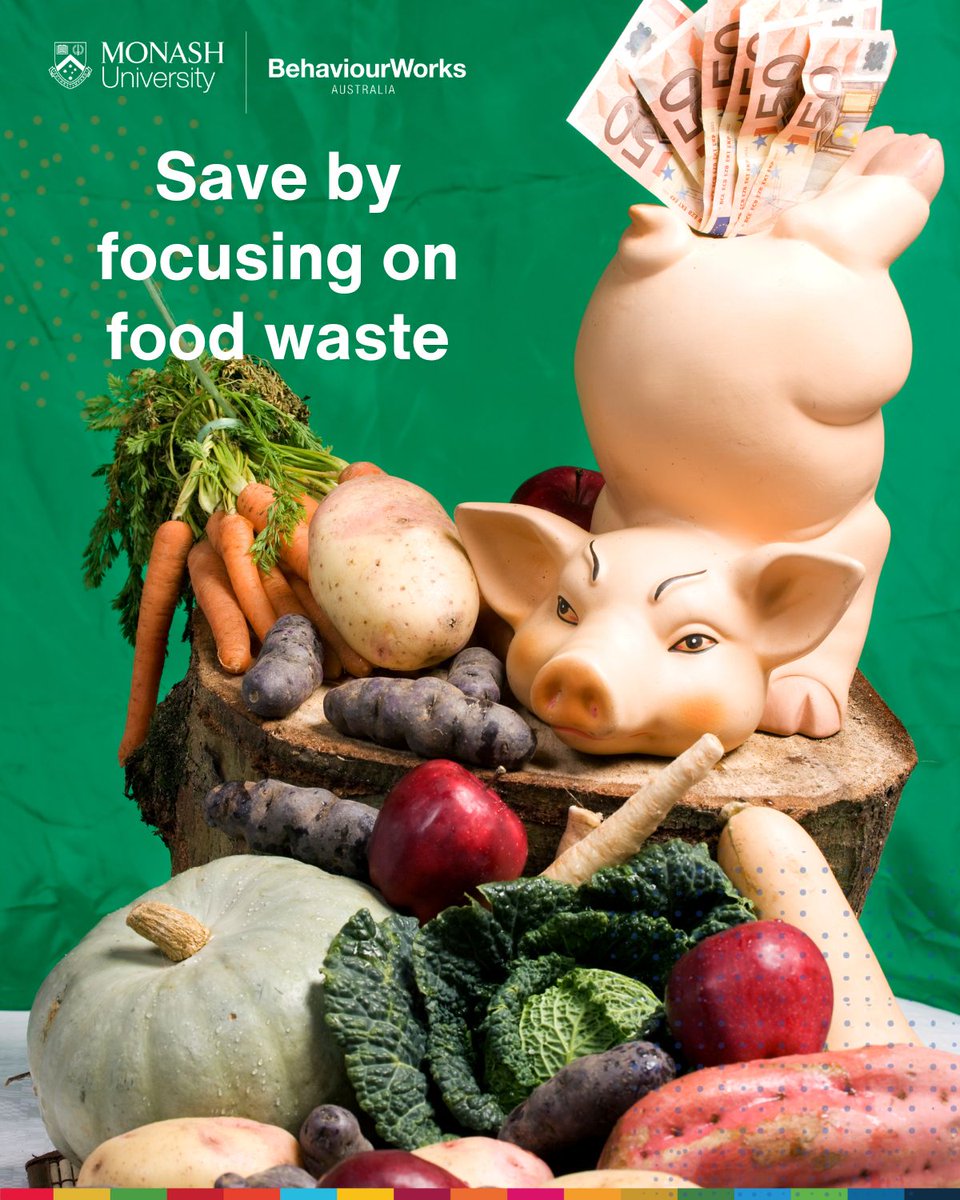
The cost of living has risen — anyone who's been inside a supermarket lately can tell you that. But fewer of us make the connection between the sting of expensive groceries and our level of food waste at home. This recent Herald Sun article (link below) delves into the potential to save money by focusing on food waste, among other things, and features our very own expert on all things food-waste, Dr Mark Boulet. As Mark says, “There’s a disconnect that’s happening at the moment where the food that we throw out, we still don’t associate [that] with an actual loss. And that cost of living crisis hasn’t yet translated to people actually avoiding wasting food at home.” Mark offers some of his own tips, including checking what's in the house before doing a shop to avoid doubling up on products: "I’m a father of a family so we always try to cook what we are going to eat. So that means we measure out spaghetti and rice and all those things ... so we don’t cook more than we’re going to eat." Read the full article here: heraldsun.com.au/lifestyle/food… #MakeChangeHappen, contact us about partnering on your project or explore our courses. Our 25+ PhD-level researchers find behavioural solutions to pressing social, environmental and organisational problems. BehaviourWorks Australia, part of Monash University. #BehaviouralScience #BeSci #SBC #BehaviourChange #BehavioralScience
BehaviourWorks Australia tweet media
English
0
0
0
63
BehaviourWorks Australia
BehaviourWorks Australia@BehaviourWorksA·
The spread of misinformation, disinformation, and resistance to knowledge has become a major concern, especially since Donald Trump's election, which affected the US research system. Understanding how false information is designed to shape public attitudes and beliefs is key to taking meaningful action. As scientists worldwide work to highlight the real harm caused by misinformation — particularly in the early days of Trump's presidency — this newly published editorial outlines three practical steps researchers can take, with examples from behavioural and implementation science: (1) Continue producing reliable knowledge (2) Make research openly accessible, and (3) Use effective, evidence-based communication strategies A particularly relevant read for researchers, universities and other knowledge institutions as they grapple with critical questions such as “How can credible knowledge be discovered, understood, and put to work amongst a deluge of other information?” and “Does knowledge even matter anymore?” Bragge, Peter. “Science Is Permanent, Politics Is Temporary: In an Era of Knowledge Resistance, Misinformation, and Disinformation, Researchers Must Continue to Stand and Deliver.” *JBI Evidence Implementation* 23, no. 2 (April 2025): 138. doi.org/10.1097/XEB.00…. #MakeChangeHappen, contact us about partnering on your project or explore our courses. Our 25+ PhD-level researchers find behavioural solutions to pressing social, environmental and organisational problems. BehaviourWorks Australia, part of Monash University. #BehaviouralScience #BeSci #SBC #BehaviourChange #BehavioralScience
BehaviourWorks Australia tweet media
English
0
0
1
35
BehaviourWorks Australia
BehaviourWorks Australia@BehaviourWorksA·
What are the similarities between the work of a behavioural scientist and a performance auditor? Why and how are behaviour change approaches beneficial? How do you apply a behaviour change approach? Professor @LiamSmith_BWA, Director of @BehaviourWorksA, recently served as a keynote speaker on these topics at the fourth International Meeting of Performance Audit Critical Thinkers (#IMPACT). Established in 2016 as an initiative of the Australasian Council of Auditors-General, IMPACT is the only Australian-led international conference dedicated to public sector performance audit. As Liam pointed out, behaviour change approaches are beneficial because they can make a difference (potentially immediately), are often an economical approach, compliment technology, and lead to attitude change. Three important steps to applying a behaviour change approach include: ➡️ Choosing behaviours specifically and wisely ➡️ Understanding the relevant drivers and barriers ➡️ Matching interventions to identified drivers Over two days in April, IMPACT looked to share ideas and innovations between auditing offices, discuss emerging topics, and devise solutions to addressing performance auditing issues in a time of increasing complexity and rapid change. Per Caroline Spencer, Auditor General for Western Australia, where IMPACT was held: "This period has increased the parliamentary and public appetite for truth and transparency from institutions they can trust. "This has elevated the responsibility of performance auditors to ensure their considered opinion is heard over the proliferation of information coming from less reputable sources." #MakeChangeHappen, contact us about partnering on your project or explore our courses. Our 25+ PhD-level researchers find behavioural solutions to pressing social, environmental and organisational problems. BehaviourWorks Australia, part of Monash University. #BehaviouralScience #BeSci #SBC #BehaviourChange #BehavioralScience
BehaviourWorks Australia tweet mediaBehaviourWorks Australia tweet mediaBehaviourWorks Australia tweet mediaBehaviourWorks Australia tweet media
English
0
0
0
33
BehaviourWorks Australia
BehaviourWorks Australia@BehaviourWorksA·
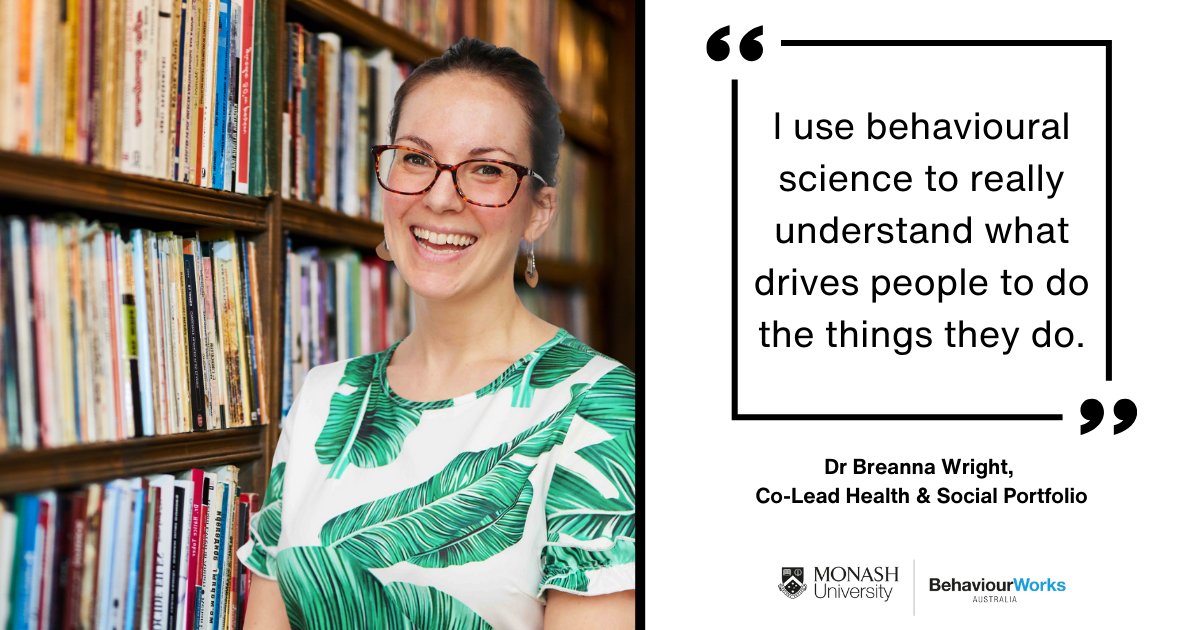
@DrBreannaWright's background in psychology and public health has proven invaluable when it comes to understanding human behaviour and designing effective interventions. Her work aims to understand what drives or inhibits behaviour in different situations, and among different groups of people. Her research projects have addressed; 📑 the decline in recreational reading rates in Australia, 📑 patient safety in hospitals, 📑 the decline of foster carers in Victoria, 📑 interventions for encouraging healthy eating habits, and 📑 understanding potential drivers of disadvantage. “I use behavioural science to really understand what drives people to do the things they do,” Dr Wright says, “and what might be stopping them from doing what they want, so we can promote more individual and community benefits.” Dr Wright recently published the findings of a research project with foster care organisation OzChild. The foster care sector in Victoria is up against a serious challenge: the decreasing number of foster carers versus the increasing demand for placements. The findings were that customised recruitment strategies could help attract foster carers, and that there were some traits of adults in Victoria who might be more likely to apply to foster. These traits include: ➡️ people who work in a caring profession like teaching or healthcare, ➡️ have a suitable home with a spare room, ➡️ are parents with dependents or live alone, ➡️ participate in prosocial behaviours like animal adoption, and ➡️ are motivated to help children. Better support is also needed to encourage fostering, retain carers, and help them to feel capable of looking after children who may have complex needs — along with financial support that doesn’t penalise foster carers. Dr Breanna Wright oversees a team of researchers who apply behavioural science to issues like patient safety, workplace safety, women’s health, social inclusion, foster care, family violence and community resilience. She has led a large variety of health and social projects for government and community sector organisations, including the Department of Health, @WorkSafe_Vic and Respect Victoria. Read more about our BehaviourWorks Australia/OzChild project: tandfonline.com/doi/full/10.10… Learn more about Dr Wright’s work: behaviourworksaustralia.org/team/dr-breann… #MakeChangeHappen, contact us about partnering on your project or explore our courses. #BehaviouralScience #BeSci #SBC #BehaviourChange #BehavioralScience #FosterCare #ChildWelfare #SDG1 #SDG2 #SDG3 #SDG10 Our 25+ PhD-level researchers find behavioural solutions to pressing social, environmental and organisational problems. BehaviourWorks Australia, part of Monash University.
BehaviourWorks Australia tweet media
English
0
0
0
18
BehaviourWorks Australia
BehaviourWorks Australia@BehaviourWorksA·
How did a simple strip of tape become a surprisingly effective tool in the fight against food waste at home? Over one-third of Australia’s food waste, about 7.6 million tonnes, comes directly from our homes. Driven by the national goal of halving food waste by 2030, @OzHarvest engaged @BehaviourWorksA to understand how they could use behavioural science to reduce food waste at home. The six-year collaborative mission explored exactly how food waste was generated in homes. The many research insights inspired (among other things) the creation of an innovative product to support long-term behavioural change: OzHarvest’s Use-It-Up™ Tape. The Tape is used to mark items/containers in your fridge as a reminder to use them up — and it works. OzHarvest have distributed tens of thousands of rolls, with households that participated in our trial of the Tape reporting up to 40 percent reductions in their weekly food waste. The OzHarvest collaboration was led by Dr Mark Boulet, BehaviourWorks Australia’s expert on all things food waste. Mark has conducted behavioural research for a broad range of government, commercial and not-for-profit organisations, including the federal Department of Climate Change, Energy, Environment and Water; @EndFoodWasteAus and the @Biodivcouncil. Past projects have seen him: 🍽 Develop the behaviour change strategy underpinning The Great UnWaste, the current national household food waste reduction campaign in Australia. 🍽 Conduct research into building public support for the control of invasive animals in Victoria. 🍽 Investigate different behavioural approaches to reduce boat collisions with marine megafauna (whales, manta rays, dolphins, etc.) in the Ningaloo Reef. 🍽 Explore the drivers and barriers for Australian homeowners to install energy efficiency upgrades (insulation, double-glazing, etc.) in their homes. Mark looks after a team of researchers who apply behavioural science principles to a range of issues such as circular economy and responsible consumption, biodiversity conservation, climate change adaptation and natural disaster response. “If we want to meaningfully tackle the huge social and environmental challenges of our time, we need to engage people to play their part,” he says. “But often we’re not clear about what people actually need to do, nor do we take the time to understand what might help — or hinder — people from playing their part. I love the power and clarity that behavioural science can bring to these issues, helping to create positive change.” Read the story behind the Use-It-Up Tape: behaviourworksaustralia.org/major-projects… Read more about Mark: behaviourworksaustralia.org/team/mark-boul… #MakeChangeHappen, contact us about partnering on your project or explore our courses. Our 25+ PhD-level researchers find behavioural solutions to pressing social, environmental and organisational problems. BehaviourWorks Australia, part of Monash University. #BehaviouralScience #BeSci #SBC #BehaviourChange #BehavioralScience
BehaviourWorks Australia tweet media
English
0
0
0
45