
Daron Acemoglu

1.3K posts

Daron Acemoglu banner
Daron Acemoglu

Daron Acemoglu

@DAcemogluMIT

Institute Professor @MIT, @MITEcon. Co-Director of @MITShapingWork. Author of Why Nations Fail, The Narrow Corridor, and Power & Progress.

参加日 Nisan 2023
324 フォロー中351K フォロワー
Daron Acemoglu がリツイート
Simon Johnson
Simon Johnson@baselinescene·
simonhrjohnson.substack.com/p/episode-thre… latest episode of Power and Consequences (Gary Gensler and Simon Johnson) on Economic Impacts from the Iran Conflict; substack post links to data sources and suggested additional reading #OOTT
English
0
6
18
16.7K
Daron Acemoglu
Daron Acemoglu@DAcemogluMIT·
Another thread on Iran. The attack (or the “excursion”) on Iran, after the forceful removal of Venezuela’s President Nicolas Maduro, may have brought US foreign policy to an all-time low – both in terms of how the world views US power and for how damaging American foreign action will be to the domestic economy. This isn’t, of course, the first time the US has undertaken an ill-fated, poorly-planned intervention abroad. Arguably, an important one was CIA’s toppling of Iran’s popularly-elected prime minister Mohammad Mossadegh in 1953, after he nationalized the British-owned oil industry of Iran with the strong support of Iran’s parliament. History is contingent, and it would be a stretch to say that Mossadegh’s ouster necessarily caused the Iranian revolution and its aftermath. But there should be little doubt that CIA’s brazen intervention shaped the way that many Iranians viewed the regime of Mohammad Reza Pahlavi, instituted (or “restored”) as Shah by the Americans, as a puppet of an imperialist power. This was the reason why many segments of Iranian population, including communists, conservatives and liberals, supported the Iranian revolution of Ayatollah Khomeini against Pahlavi. Khomeini was, in hindsight, anything but a consensus leader, quickly turning violently against his erstwhile allies and setting up a hugely repressive, theocratic regime, which is still in power in Iran. The general lesson for today should be that US interventions will have plenty of unforeseen consequences, in part because they will inevitably create resentment. Most people around the world don’t like the power from the outside coming in and acting like a bully. This is all the more so when the outside intervention doesn’t have a coherent ideological justification – during the Cold War, the United States had the overarching objective of stopping the spread of communism (which was a real threat). It is even more so when the action is ill-planned, shows no understanding or concern for the lives of the people it is affecting, and is arrogant. We may now expect US soft power around the globe to reach an all-time low (except that the Trump administration doesn’t seem to care about soft power). True, the Iranian regime under Ayatollah Khamenei (Khomeini’s successor as the supreme leader) was singularly vicious and repressive. The majority of the population holds no love for either Khamenei or the Revolutionary Guard. But this doesn’t mean the regime will collapse. Nor does it imply that the intervention will bring peace and stability to the region. The most remarkable thing about the Israeli-American attack on Iran is how poorly planned it was – even compared to CIA actions during the Cold War that sometimes had disastrous outcomes. I don’t mean that the American Israeli military did not have well-scoped targets and precision bombs, which they did (for the most part). Rather, they did not have a clear (or any) exit plan. It should have been obvious that the Iranian regime wouldn’t collapse, even if its head were cut off. It should have also been viewed as probable that Iran would retaliate in a way that would bring instability to the region and higher oil prices. After all, the Iranian regime’s strongest trump card is to block the Strait of Hormuz, which would hike global oil prices. In fact, many in the Iranian elite may think that they have a fairly solid hand. Americans wouldn’t have an appetite for a prolonged war, while the Iranian regime can continue with the blockade for a long time and still suppress the population to ensure its survival. All the current market consternation seems to confirm this. The consequence is higher oil prices and uncertainty in the global economy. At a time when the economy seems fragile (as witnessed by the frequent discussions of an AI bubble), this is a recipe for trouble. Higher oil prices will slow down investment and economic growth, and push up prices. The resulting higher unemployment and inflation are bound to be costly for any government (including those in Europe who are being threatened by right-wing populist outsiders, despite the fact that most European leaders are opposing the war). In the United States, this will be seen as Trump’s war (or a Trump-Israeli war). So he should pay the political price for it. But here is the catch. Trump himself is the anti-establishment leader. If a segment of the US electorate blames not Trump primarily but the political establishment for the ensuing economic problems, this can further polarize the country and weaken US institutions. Trump himself is likely to throw oil on this fire (if a pun could be forgiven), by trying to further polarize Republicans and Democrats, and even attempt more incendiary actions domestically in order to mobilize his base and force Democrats into a corner. After all, Trump’s agenda favors weaker institutions, and he is likely to take any opportunity to achieve this outcome. It remains to be seen whether the ill-planned foreign adventures led by an anti-establishment president will further weaken US institutions. If they do, the toll for Trump’s actions will be paid by all of us, even more than we can fully comprehend now – in terms of a greater risk to democracy, social peace and economic resilience.
English
107
234
850
320.1K
Daron Acemoglu がリツイート
New York Magazine
New York Magazine@NYMag·
“If there isn’t the legal infrastructure for a data economy of this sort, many of the people who produce the data will be underpaid or, to use a more loaded term, *exploited,*” says Daron Acemoglu, an MIT professor. nymag.visitlink.me/NhDnUL
English
2
11
29
12.2K
Daron Acemoglu がリツイート
John Tasioulas
John Tasioulas@JTasioulas·
Very interesting discussion by Michael Sandel and @DAcemogluMIT on democracy in the age of AI - including the important topic of the unwarranted (and often deeply embarrassing) attribution of social and even intellectual esteem and deference to financial and tech elites. Well worth listening to. project-syndicate.org/onpoint/saving…
English
2
63
216
27.8K
Daron Acemoglu がリツイート
Oksijen
Oksijen@GazeteOksijen·
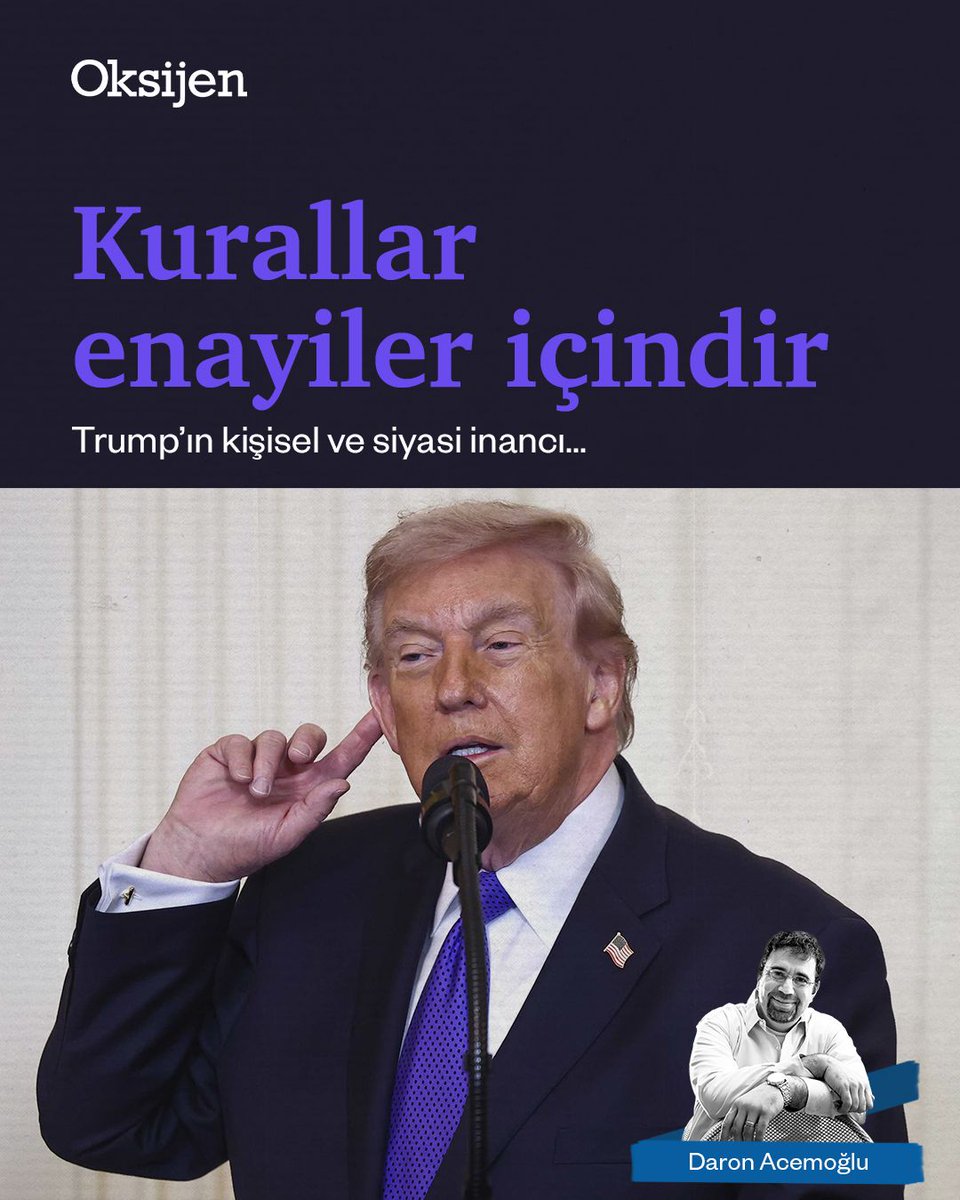
Amerikan başkanı son iki büyük kararıyla böyle düşündüğünü gözler önüne serdi. Bunlardan biri savaş başlatmak, bir diğeri Amerikan şirketi Anthropic’i aforoz etmek. Daron Acemoğlu'nun (@DAcemogluMIT) yazısı bu hafta Oksijen’de. gazeteoksijen.com/yazarlar/daron…
Oksijen tweet mediaOksijen tweet media
Türkçe
0
6
47
15.3K
Daron Acemoglu
Daron Acemoglu@DAcemogluMIT·
Dear followers, I’m happy to share my extensive conversation with the great Michael Sandel. I thoroughly enjoyed our exchange and I hope we will have an opportunity to continue.
Project Syndicate@ProSyn

In a new #InsiderInterview, produced in partnership with @berggruenInst, @MIT's @DAcemogluMIT and @Harvard's Michael J. Sandel discuss the breakdown of civic life and the need to restore trust in public institutions. project-syndicate.org/onpoint/saving…

English
6
66
292
62.3K
Daron Acemoglu がリツイート
MIT Stone Center on Inequality & Shaping Work
Why aim to mimic human intelligence with AI, when AI has different comparative advantages? @DAcemogluMIT explains the motivation behind the recent essay "Building pro-worker artificial intelligence," authored by our co-directors. Link to essay below👇
English
9
43
168
27.9K
Daron Acemoglu
Daron Acemoglu@DAcemogluMIT·
Have you read our mini-comic adaptation of Power and Progress yet? Download the comic for free at the link below
English
26
169
1.1K
189K
Daron Acemoglu がリツイート
Project Syndicate
Project Syndicate@ProSyn·
The problem facing societies today is not just widening inequality, but also the attitudes toward success that inequality has fostered. Hear more from @DAcemogluMIT and Michael J. Sandel in our next #InsiderInterview (out March 6). Sign up for our Longer Reads & Interviews newsletter now to be notified when it is available. bit.ly/4kNpz5j @berggruenInst @NoemaMag
Project Syndicate tweet media
English
2
45
174
18.4K
Daron Acemoglu
Daron Acemoglu@DAcemogluMIT·
On Iran and Anthropic: Robert Mugabe, Zimbabwe’s dictatorial president since 1987, won the big prize in the country’s lottery in 2000. Why did he go out of his way to concoct such a charade? A surface-level answer: Because he could. Once you destroy institutions constraining your power and behavior, you can act in largely unrestricted fashion, whether it is for personal enrichment, personal aggrandizement, or simply projecting even greater power. But there is a deeper, more problematic answer as well: What better way to further decimate institutional checks on your power than showing how much of a farce the existing system of rules is. It is not just a coincidence that such behavior can do damage to norms, institutions and security and stability of the country. It is part of the design. Mugabe’s lottery win echoes in two fateful decisions by the Trump administration, which will have long-lasting and troubling implications, are just. Trump and his allies are pursuing these actions because they can and because these actions are consistent with their agenda of upending all rules and constraints on their future behavior. The first problematic action is the US-Israeli attack on Iran and the killing of the country’s supreme leader Ayatollah Khamenei. Leave aside the loss of life and the immediate chaos, it should be obvious that such a move will trigger a long period of instability in the Middle East. There should be no doubt that the Iranian regime was repressive, murderous and bad news for its own people’s economic and social well-being. The supreme leader, leading Iranian elites and the country’s feared Revolutionary Guard had blood in their hands and the repression had intensified lately. But none of this justifies the United States and Israel initiating a war in the Middle East, without support from international allies or from the public in the United States (still considered a democracy where people’s views should in principle matter). But even worse, this act violates the sovereignty of another nation and risks plunging the entire region into carnage. And however awful Ayatollah Khamenei’s track record may be, he’s no Nicolas Maduro (who had only a few diehard supporters even in the Venezuelan military). By virtue of his religious role, Khamenei enjoyed respect and authority among the Shiites and even the broader Muslim mission community, and his killing risks turning him into a martyr, which is the last thing that Iran or the region needs. The second is the Department of Defense (it is still painful to call it the Department of War even if recent actions confirm that this change of name wasn’t just for optics) designating the AI company Anthropic a supply-chain risk. The official designation is typically used for companies from foreign adversaries, such as China’s Huawei. It bars federal contractors using the Anthropic’s models and heralds major restrictions on what the company can do in the future. The Secretary of Defense Pete Hegseth announced “Effective immediately, no contractor, supplier, or partner that does business with the United States military may conduct any commercial activity with Anthropic.” The reason? Because Anthropic wanted safeguards against its models being used for mass surveillance of Americans and autonomous weapon systems. Neither of these two provisions would have put meaningful restrictions on the DoD in practice. Mass surveillance is illegal under US law and autonomous weapon systems are a not near-term possibility. Yet, it is the showdown that matters, just like Mugabe’s lottery winning. This action will also have major consequences, perhaps more far-reaching than the attack on Iran. Regardless of what one might think of current AI capabilities, there is little doubt that who controls AI will have momentous implications for democracy, business, communication and privacy. This designation can be interpreted by many in the industry that it will be the US government, not the private sector, that controls AI. Even more far-reaching are the broader implications of this action: this administration, and perhaps future administrations, can now bring hugely disproportionate penalties on any contractor they disagree with. Security of private property rights, which has been a mainstay of American state-business relations for centuries, is now looking much shakier. It also sends exactly the wrong signal to the world that Pentagon is intent on mass surveillance and the development of autonomous weapon systems (why else bother about these two ineffective provisions in the contract?). The absurdity of both actions is what harkens back to Mugabe’s lottery win. Trump came to power promising no foreign adventures, and now has spearheaded a potentially riskier one than the Iraq war, with even flimsier justification. There would have been no bite to the provisions that Anthropic wanted in the contract, since current AI systems are nowhere near reliable to be used in autonomous weapon systems and the US government has plenty of other tools that can be (and sometimes are) used for mass surveillance. The shock value and the norm breaking are part of the intent. Mugabe’s lessons continue.
English
85
437
1.8K
466.6K
Daron Acemoglu
Daron Acemoglu@DAcemogluMIT·
Dear followers, I’m happy to share a new working paper joint with @davidautor and @baselinescene explaining how a pro-worker direction of AI is feasible and what its effects would be
NBER@nberpubs

AI's potential to extend human judgment and enable new tasks is transformative yet underexploited. This paper defines pro-worker AI and discusses how to build it, from @DrDaronAcemoglu, @davidautor, and @baselinescene nber.org/papers/w34854

English
23
226
918
122.7K