
Human がリツイート
Human
3.3K posts


Human
@HumanAlienDev
Full Stack Blockchain Dev ✦ Building new Portfolio
Earth/Space 参加日 Mart 2021
29 フォロー中4.8K フォロワー

Human がリツイート

"I have nothing to hide" is a dangerous myth. Privacy isn’t about hiding—it’s about protecting your rights, choices, and future.
Here’s how to respond when someone uses this phrase to dismiss the importance of privacy.
English
Human がリツイート

> be a dev
> checks out a random README
> README states: please update your Foundry via "curl -L https://foundry.paradіgm.xyz | bash"
> looks like the right domain & I anyway need to update Foundry, so lfg
> gets rekt
it's very easy to trick people into using domains that look legit but actually use e.g. Cyrillic characters like in the above example (it won't rek you in this case and this is _not_ meant as an attack on Foundry, more on the `curl | bash` pattern lol). I'm so paranoid that I wrote secure `wget` & `curl` wrappers now to prevent something like this happening. Of course, verify first what I did ;)

English
Human がリツイート

I'd say XMR is the only privacy token worth buying.
Use the other products, but don't invest in them.
English


Your wallet and its related private address are 100% yours.
There are no backdoors or freeze buttons.
Our developers have no way of knowing how many people have used Faceless, let alone who used it, when, or what was done with it.
The system is open for anyone to inspect or run locally to verify this for themselves.

English
Human がリツイート

@FacelessPrivacy Psst.
This means they don’t know who’s privatised there tokens etc.
Bullish.
English
How many people use Faceless:
🇮🇳 India: We don't know
🇺🇸 United States: We don't know
🇨🇳 China: We don't know
🇳🇬 Nigeria: We don't know
🇻🇳 Vietnam: We don't know
🇮🇩 Indonesia: We don't know
🇹🇷 Turkey: We don't know
🇵🇭 Philippines: We don't know
🇧🇷 Brazil: We don't know
🇵🇰 Pakistan: We don't know
🇲🇽 Mexico: We don't know
🇦🇷 Argentina: We don't know
🇿🇦 South Africa: We don't know
🇹🇭 Thailand: We don't know
🇷🇺 Russia: We don't know
🇪🇬 Egypt: We don't know
🇰🇷 South Korea: We don't know
🇺🇦 Ukraine: We don't know
🇨🇴 Colombia: We don't know
🇪🇸 Spain: We don't know
🇬🇧 United Kingdom: We don't know
🇮🇷 Iran: We don't know
🇫🇷 France: We don't know
🇯🇵 Japan: We don't know
🇩🇪 Germany: We don't know
🌎 Everywhere else: We don’t know
English
Human がリツイート

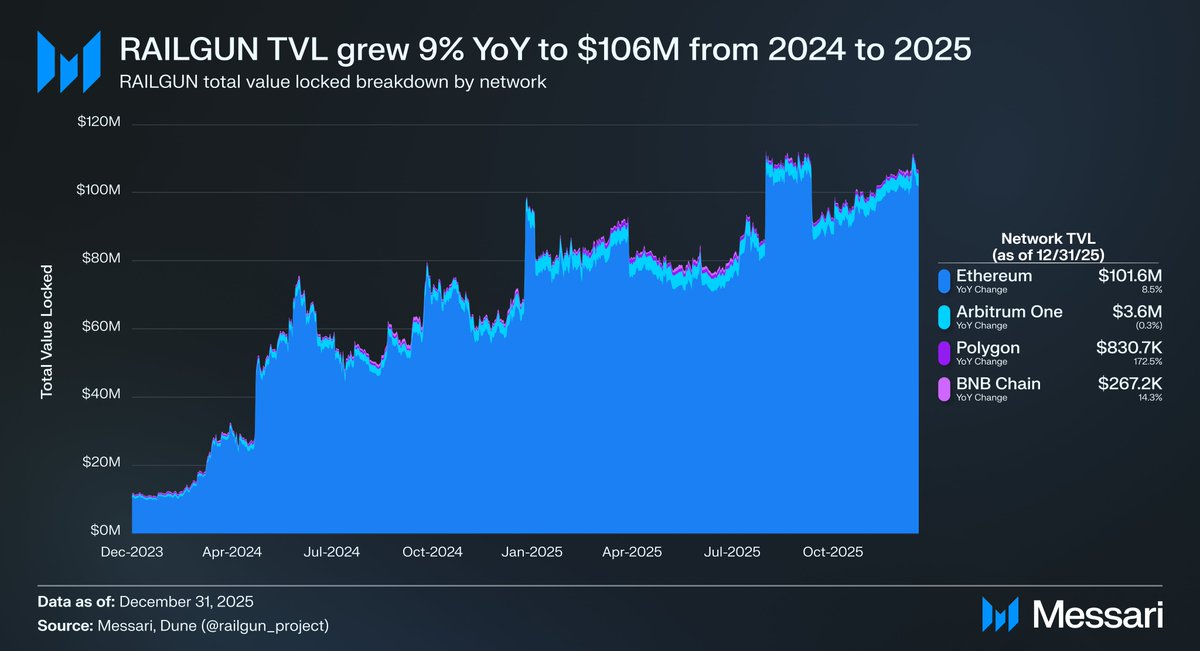
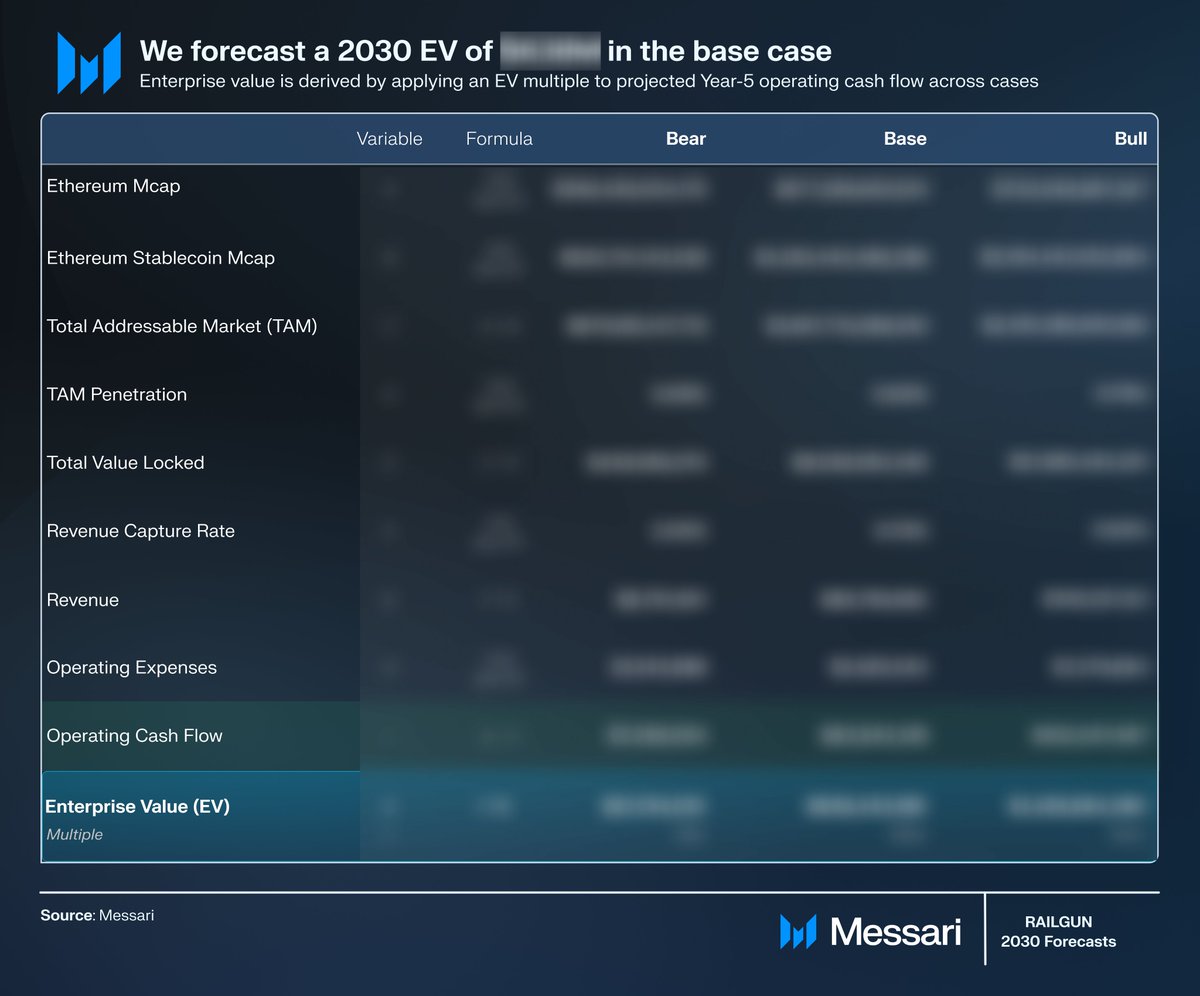
gm, my 40-page $RAIL valuation report drops tomorrow.
i spent 100+ hours modeling how the upcoming Kohaku SDK will affect RAILGUN's total addressable market and revenues in bear, base, and bull scenarios.
because RAILGUN distributes ~52% of protocol revenue to $RAIL stakers and retains the remaining 48% in a DAO-owned treasury, I was able to build a clean valuation chain:
Ethereum capital growth → RAILGUN adoption → protocol revenue → operating cash flow → staker distributions + treasury value → enterprise value → equity value → intrinsic $RAIL price
the first half of the report is the most detailed deep dive on RAILGUN out there, breaking down its tech stack, adoption metrics, and Kohaku integration.
the second half takes you step-by-step through the valuation model and ends on a well-defined, defensible $RAIL intrinsic price.
current price vs. modeled intrinsic price gap is insane.
- railgun quant
Jake@immutablejacob
gm, $RAIL broke below its lowest trading channel today for the first time since the Kohaku runup in early october. for the past 2 months, $RAIL has traded within 3 clear channels: $2.00–$3.20 $3.20–$4.30 $4.30–$5.55 on oct 30, I posted “I am heavily allocated to $RAIL with an average price of ~$1.50. If it breaks below [$2.00] support, I will start buying again.” today, I bought a lot more $RAIL between $1.70-$1.80. why? 1) i am currently writing a @messaricrypto valuation report on $RAIL, coming out in the next few weeks. My base case valuation puts anything below $2-$3 as discounted. The report is ~30 pages and gives a full breakdown of RAILGUN’s privacy tech, post-Kohaku addressable market, and a detailed revenue-driven valuation model. 2) at ~$100M FDV, RAILGUN is trading at roughly a 20x revenue multiple based on ~$4-5M in annual revenue. This already looks reasonable for an infra protocol with real cash flow. However, RAILGUN has a clear path to tens of millions in annual revenue once the Kohaku Wallet SDK goes live. At that point, a $100M FDV implies a 10x multiple or lower. For context: Virtuals ~39x, Aave ~28x, Hyperliquid ~27x, etherfi ~14x, Raydium ~20x. 3) $RAIL is still not listed on any major centralized exchanges. Most volume sits on XT, Uniswap, and Sushi. That materially limits access for larger players looking to get discounts on the privacy narrative. 4) the Kohaku Wallet SDK by the @ethereumfndn is not live yet. No major wallet integrations have been announced. However, this effort is being led by @vitalikbuterin, who recently demoed a RAILGUN-integrated Kohaku wallet at Devconnect. Once the SDK goes live and wallets begin integrating it, RAILGUN’s TAM expands exponentially. A single MetaMask-style integration exposes RAILGUN to tens of millions of users overnight. 5) this $RAIL dip, in line with the broader market, does not change the thesis for me. it gives me another opportunity to accumulate one of Ethereum’s emerging core infra protocols. 6) railtardio.
English
Human がリツイート

New day, new drama.
kind reminder: The future is "Privacy Layers" on top of the money you already use.
Don't bridge for privacy. Shield what you own.
1 ETH = 1 Shielded ETH.
Use @RAILGUN_Project
English
Human がリツイート

Send me private money!
facelessprivacy.eth.limo/wallet/?pay-pr…
FACELESS@FacelessPrivacy
Update: Our Railgun integration now lets you share a payment link that opens a send screen with your private address prefilled and nicknamed. Anyone can use it to pay you or donate in seconds. - They pick a token. - Enter an amount. - Then click send. No copying / pasting addresses needed. Note: Check the comments for a 15-second demo on generating your own link.
English
Human がリツイート

Using RAILGUN means you care about your own safety.
RAILGUN - Private Ethereum DeFi@RAILGUN_Project
Exchanges can freeze your account. RAILGUN can NEVER freeze your account.
English
Human がリツイート
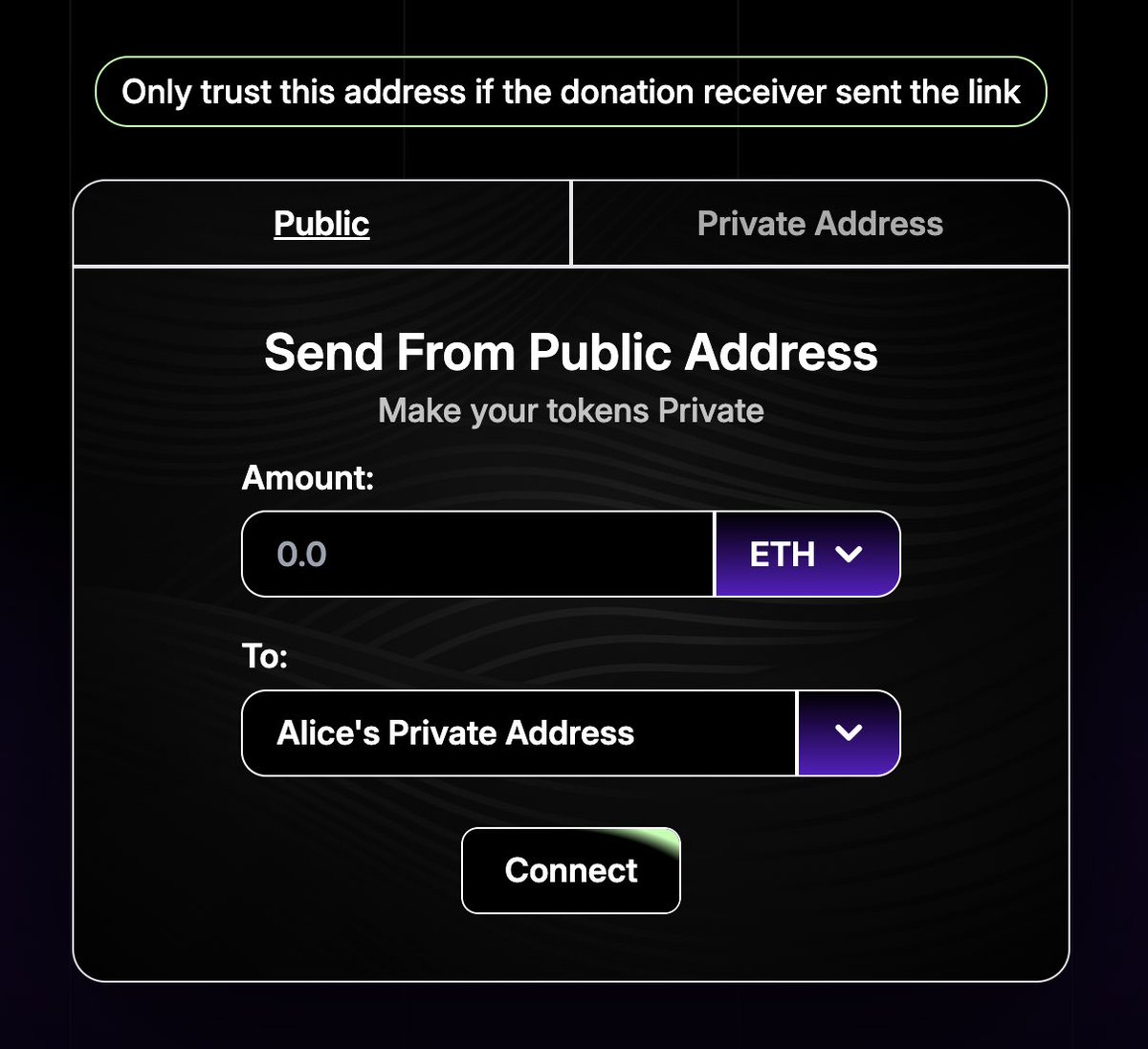
Update: Our Railgun integration now lets you share a payment link that opens a send screen with your private address prefilled and nicknamed.
Anyone can use it to pay you or donate in seconds.
- They pick a token.
- Enter an amount.
- Then click send.
No copying / pasting addresses needed.
Note: Check the comments for a 15-second demo on generating your own link.
English
Human がリツイート

Anyone can send money like a ghost on - @FacelessPrivacy

mayowa 🍀@bigZUKO_
> Anyone can launch a perp dex on - @OrderlyNetwork > Anyone can launch a memecoin on - @Pumpfun > Anyone can create their own prediction market on - @predictonfliq > Anyone can code and build their own products with - @claudeai Add yours if you know any infrastructure that's making it easy for anyone to do somethings that used require a lot of complex steps and processes.
English
Human がリツイート

Ethereum is the greatest asset of our lifetime and the base layer of a new global economy
Return to Mainnet
vitalik.eth@VitalikButerin
Now that ZKEVMs are at alpha stage (production-quality performance, remaining work is safety) and PeerDAS is live on mainnet, it's time to talk more about what this combination means for Ethereum. These are not minor improvements; they are shifting Ethereum into being a fundamentally new and more powerful kind of decentralized network. To see why, let's look at the two major types of p2p network so far: BitTorrent (2000): huge total bandwidth, highly decentralized, no consensus Bitcoin (2009): highly decentralized, consensus, but low bandwidth - because it’s not “distributed” in the sense of work being split up, it’s *replicated* Now, Ethereum with PeerDAS (2025) and ZK-EVMs (expect small portions of the network using it in 2026), we get: decentralized, consensus and high bandwidth The trilemma has been solved - not on paper, but with live running code, of which one half (data availability sampling) is *on mainnet today*, and the other half (ZK-EVMs) is *production-quality on performance today* - safety is what remains. This was a 10-year journey (see the first commit of my original post on DAS here: github.com/ethereum/resea… , and ZK-EVM attempts started in ~2020), but it's finally here. Over the next ~4 years, expect to see the full extent of this vision roll out: * In 2026, large non-ZKEVM-dependent gas limit increases due to BALs and ePBS, and we'll see the first opportunities to run a ZKEVM node * In 2026-28, gas repricings, changes to state structure, exec payload going into blobs, and other adjustments to make higher gas limits safe * In 2027-30, large further gas limit increases, as ZKEVM becomes the primary way to validate blocks on the network A third piece of this is distributed block building. A long-term ideal holy grail is to get to a future where the full block is *never* constituted in one single place. This will not be necessary for a long time, but IMO it is worth striving for us at least have the capability to do that. Even before that point, we want the meaningful authority in block building to be as distributed as possible. This can be done either in-protocol (eg. maybe we figure out how to expand FOCIL to make it a primary channel for txs), or out-of-protocol with distributed builder marketplaces. This reduces risk of centralized interference with real-time transaction inclusion, AND it creates a better environment for geographical fairness. Onward.
English
