Caffeine Buildoor

349 posts

Caffeine Buildoor banner
Caffeine Buildoor

Caffeine Buildoor

@ICPvibecoder

Building apps on $ICP using #CaffeineAI | Sharing apps built with Caffeine by the community

Internet Computer 参加日 Haziran 2025
315 フォロー中151 フォロワー
固定されたツイート
Caffeine Buildoor
Caffeine Buildoor@ICPvibecoder·
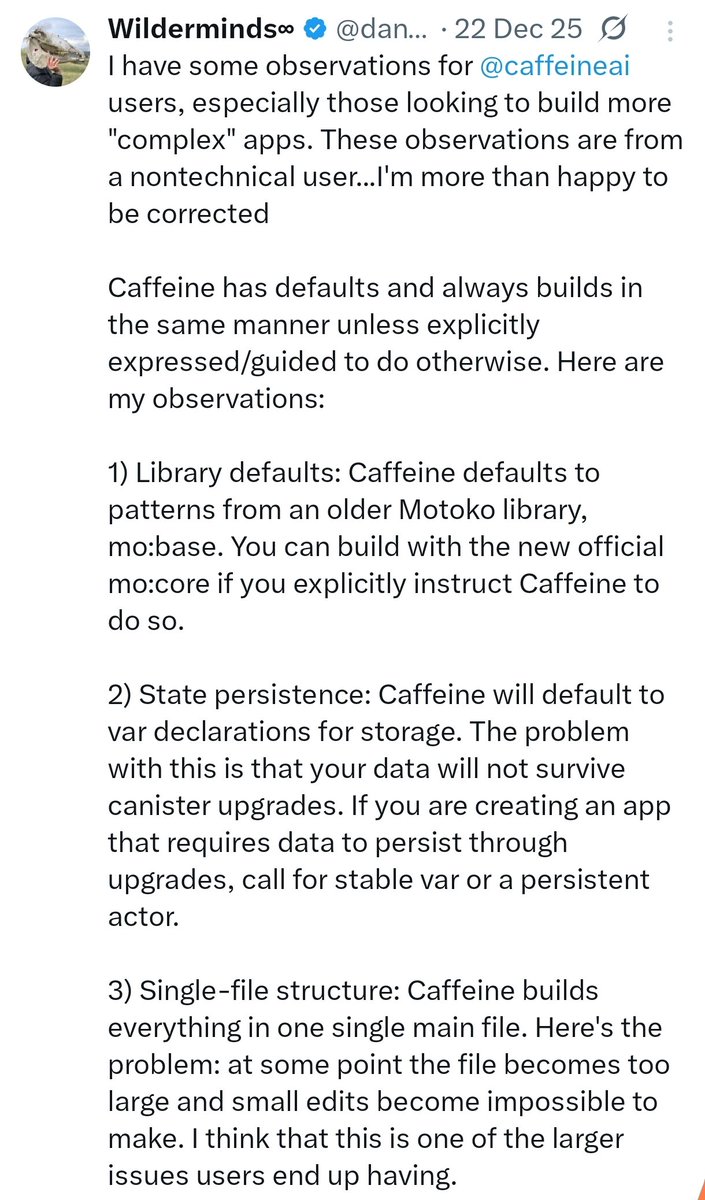
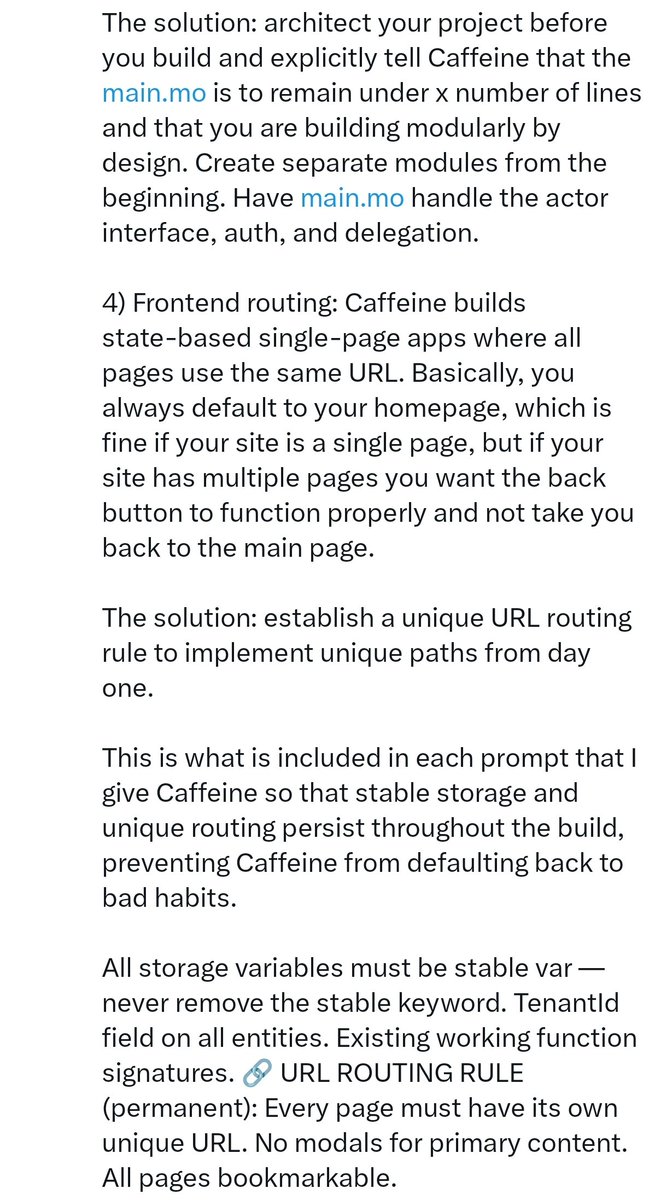
Caffeine AI Tips I see a lot of people are having issues with building apps on Caffeine AI and it's quite understandable. Building on @caffeineai requires a huge learning process especially if you're a non-technical folk like me but all hope is not lost. Below, I'll share tips that have been helpful to me and hopefully would be of help to you too. Tip 1: Ensure you structure your app properly right from the very first prompt. This reduces the chances of failure/ hallucination (check the images attached for how to handle some of this - thanks @danf25971) Tip 2: 'our AI couldn't handle that request. Consider making it clearer or simpler' This simply means your request is too complex and might not execute till that particular build times out. What do you do?- ask Caffeine to break down the prompt into several buildable phases (2-5 or more). This ensures that your 'simpler' requests are sorted out before the build/ Caffeine times out. Tip 3: Hallucination It's quite normal for 'AI' to hallucinate. While building, always tell Caffeine to ensure that only the task at hand should be handled and that other data/ files/ features should not be tampered with. If you have situations where Caffeine isn't responding or doing what you asked, be patient-> switch to pro mode -> hold proper conversations stating exactly what you're experiencing and try to find out how you can 'both' solve that particular issue. It might take a few prompts but you'll definitely get things sorted out. Hopefully, these tips will help you in solving some of the challenges you're experiencing while trying to build with @caffeineai Happy building! ☕
Caffeine Buildoor tweet mediaCaffeine Buildoor tweet mediaCaffeine Buildoor tweet media
English
3
4
37
3.7K
Caffeine Buildoor
Caffeine Buildoor@ICPvibecoder·
In the near future, the trend with most web2 and web3 projects will be: Vibecode with @caffeineai on $ICP -> Import to GitHub for minor adjustments (if needed) -> Export back to CaffeineAI This changes a whole lot. Why?: 🔹Time to ship reduces drastically (from >2months to ~just a few days) 🔹Smaller workforce: previously, you'd need an army of developers/ designers to ship. But now, CaffeineAI is breaking down that barrier and you'd be needing only a few team members to ship your products/ projects in record time. 🔹Budget: Shipping a simple or a really complicated app costs a lot- usually in the tens and hundreds of thousands of $$. Yeah big projects can easily manage to cough that out but for smaller projects or first time entrepreneurs, this becomes a very big and daunting task. This is where Caffeine comes in: you'd actually be able to ship at a massive discount. For example, I shipped this (x.com/i/status/20393…) with just two prompts. For reference, signing up at Caffeine.ai gets you free 110 credits. App generation via prompting costs 2 credits x 2 prompts= 4 credits; plus another 4 credits for live deployment= 8 credits in total. This means you've been able to ship your simple project without spending a dime. CaffeineAI remains the easiest and fastest way to get your project from the idea stage to production in no time. Get started here: Caffeine.ai
Caffeine Buildoor tweet mediaCaffeine Buildoor tweet media
English
0
2
9
157
Caffeine Buildoor
Caffeine Buildoor@ICPvibecoder·
Caffeine Buildoor@ICPvibecoder

In the near future, the trend with most web2 and web3 projects will be: Vibecode with @caffeineai on $ICP -> Import to GitHub for minor adjustments (if needed) -> Export back to CaffeineAI This changes a whole lot. Why?: 🔹Time to ship reduces drastically (from >2months to ~just a few days) 🔹Smaller workforce: previously, you'd need an army of developers/ designers to ship. But now, CaffeineAI is breaking down that barrier and you'd be needing only a few team members to ship your products/ projects in record time. 🔹Budget: Shipping a simple or a really complicated app costs a lot- usually in the tens and hundreds of thousands of $$. Yeah big projects can easily manage to cough that out but for smaller projects or first time entrepreneurs, this becomes a very big and daunting task. This is where Caffeine comes in: you'd actually be able to ship at a massive discount. For example, I shipped this (x.com/i/status/20393…) with just two prompts. For reference, signing up at Caffeine.ai gets you free 110 credits. App generation via prompting costs 2 credits x 2 prompts= 4 credits; plus another 4 credits for live deployment= 8 credits in total. This means you've been able to ship your simple project without spending a dime. CaffeineAI remains the easiest and fastest way to get your project from the idea stage to production in no time. Get started here: Caffeine.ai

QME
0
0
0
47
Caffeine Buildoor がリツイート
dom williams.icp ∞
dom williams.icp ∞@dominic_w·
Caffeine v3.0 ☕️, Tuesday, April 7th caffeine.ai A new era begins on ICP in a few days. A huge Caffeine upgrade will take place. This is about more than the new features it packs: what can be built on the Internet Computer through chat alone shall advance by a quantum leap. It will blow your mind, because you can go so much further: those wanting to build apps and services on self-writing cloud, where every technical task is automated and directed by natural language interaction, may rationally decide that the Internet Computer is the place to be thanks to the work of Caffeine Labs. But, stunning as the v3.0 advance is, this only marks the beginning of a new beginning for ICP. Caffeine is just getting started, and will be joined by other major advances unfolding in the ICP ecosystem. Several things are coming together: 1) The architecture that powers Caffeine v3.0 will ensure it continues to grow more powerful as time goes on. We expect that it will be possible for non-technical people to build almost anything on the Internet Computer in the future. Eventually special features like "Caffeine Snorkel" will also make it possible to auto-migrate legacy apps and services to the Internet Computer. 2) For the first time, Caffeine will allow all users to publish the App Market, so that other users can install copies of their apps, and if they want, remix them, since apps from the market are mutable and can be changed as needed. This is important change will be followed by the activation of monetization features, which will kickstart a new open source onchain economy based around the AI-driven development of re-usable apps and services. 3) Caffeine apps use ICP Blob Storage (which is currently exclusively available to Caffeine owing to its ongoing development) to maintain copies of files and binary large objects. Coming advances will enable Caffeine apps to store data at the world's best $/GB — making the Caffeine the perfect plartform to use to build apps that must store and share large amounts of data (for example, for a photo sharing app, or a team communications platform where video meetings are routinely recorded and archived). 4) Caffeine will soon be joined by new ICP "cloud engine" functionality, and then, the Internet Intelligence Network (IIN) — two new parts of the Internet Computer. Cloud engines will provide enterprise users with much more control over how the Internet Computer hosts their apps and services. IIN will provide everyone with access to inference on open weights models at lower cost than is possible today (for example allowing a business to create an e-commerce website on the Internet Computer where every customer can be helped through product exploration by AI, without worrying about the cost). 5) Cloud engines, which are essentially private subnets that can be controlled via a control panel, enable the Internet Computer to provide a cloud experience that feels more familiar to prosumers and enterprises used to centralized clouds. Users will be able to select the nodes combined to power their cloud engines, and nodes can include cloud-on-cloud nodes, such as AWS instances, as well as traditional sovereign node hardware. These nodes can be chosen to match precise throughput needs, or regulatory requirements (e.g. GDPR). The Internet Computer is thus transforming into a mass market cloud solution. 6) Powerful additional advantages of cloud engines include a) since they are essentally Internet Computer subnets, as usual hosted apps and services are tamperproof and unstoppable, and don't require support by security and systems administration personnel, b) hosted apps can have their query throughput auto-scaled horizontally by adding nodes, which can be located in proximity to demand, and can have ther update throughput auto-scaled by splitting the engines — enabling auto-scaling where software does not have to be updated — and c) owners can traverse underlying compute vendors and geographies and jurisdictions, simply by adding and deleting nodes, which can be done without interrupting hosted apps. 7) The Internet Intelligence Network is an extension to the Internet Computer that we plan to propose to the NNS soon (which I have mentioned before). This will be powered by community-operated hardware devices, which crucially, in combination with new technology we are developing, shall shall facilitate provision of lower per-token inference costs than AI clouds can currently achieve within targeted market segments (low costs that are derived from the technology involved, in contrast to certain contemporary decentralized GPU networks that use token appreciation to drive unsustainable subsidization flywheels). 8) A key unique additional aspect of IIN is that inference is verifiable, just like onchain compute — that is, those supplying prompts and context will know that their results are correct, and shall not have to trust that the IIN nodes powering inference haven't changed their results (for example, by inserting advertising, or malicious content). The strength of the verification is configurable. In the default mode, there will be no discernible difference in cost or performance/time thanks to the techniques developed. In higher security modes, useful for special high-security purposes, verification cost will scale linearly with every node checking the inference, while the hit to performance/time remains very small. (Note that because inference is non-deterministic, inference verification is technically challenging and novel, and will advance the state-of-the-art). In all, v3.0 is part of the Internet Computer's march towards the mainstream cloud market, which is predicted to generate $1 trillion in revenue in 2026, and $2 trillion in 2030. While we see the Internet Computer as a revolutionary decentralized cloud platform, rather than a network beloning to the web3 industry per se, we note that after tokens (Bitcoin), and DeFi (Ethereum), onchain cloud is the first new decentralized network functionality to unlock mass market potential — and it's happeing exclusively on the Internet Computer, which is by far the most technologically advanced network the world has ever seen. ICP is advancing to define an important new cloud sector, where the network is the cloud, and the cloud is self-writing.
English
51
141
409
11.4K
Caffeine Buildoor がリツイート
Pierre
Pierre@PierreSamaties·
April 7th: Caffeine v3 is going to be a major leap for building apps through natural language alone. But this release is only the start. Cloud Engines and the Internet Intelligence Network come later. A whole suite of products that work together and connect the Internet Computer to the mainstream markets: a cloud built for the agent era. ICP
dom williams.icp ∞@dominic_w

Caffeine v3.0 ☕️, Tuesday, April 7th caffeine.ai A new era begins on ICP in a few days. A huge Caffeine upgrade will take place. This is about more than the new features it packs: what can be built on the Internet Computer through chat alone shall advance by a quantum leap. It will blow your mind, because you can go so much further: those wanting to build apps and services on self-writing cloud, where every technical task is automated and directed by natural language interaction, may rationally decide that the Internet Computer is the place to be thanks to the work of Caffeine Labs. But, stunning as the v3.0 advance is, this only marks the beginning of a new beginning for ICP. Caffeine is just getting started, and will be joined by other major advances unfolding in the ICP ecosystem. Several things are coming together: 1) The architecture that powers Caffeine v3.0 will ensure it continues to grow more powerful as time goes on. We expect that it will be possible for non-technical people to build almost anything on the Internet Computer in the future. Eventually special features like "Caffeine Snorkel" will also make it possible to auto-migrate legacy apps and services to the Internet Computer. 2) For the first time, Caffeine will allow all users to publish the App Market, so that other users can install copies of their apps, and if they want, remix them, since apps from the market are mutable and can be changed as needed. This is important change will be followed by the activation of monetization features, which will kickstart a new open source onchain economy based around the AI-driven development of re-usable apps and services. 3) Caffeine apps use ICP Blob Storage (which is currently exclusively available to Caffeine owing to its ongoing development) to maintain copies of files and binary large objects. Coming advances will enable Caffeine apps to store data at the world's best $/GB — making the Caffeine the perfect plartform to use to build apps that must store and share large amounts of data (for example, for a photo sharing app, or a team communications platform where video meetings are routinely recorded and archived). 4) Caffeine will soon be joined by new ICP "cloud engine" functionality, and then, the Internet Intelligence Network (IIN) — two new parts of the Internet Computer. Cloud engines will provide enterprise users with much more control over how the Internet Computer hosts their apps and services. IIN will provide everyone with access to inference on open weights models at lower cost than is possible today (for example allowing a business to create an e-commerce website on the Internet Computer where every customer can be helped through product exploration by AI, without worrying about the cost). 5) Cloud engines, which are essentially private subnets that can be controlled via a control panel, enable the Internet Computer to provide a cloud experience that feels more familiar to prosumers and enterprises used to centralized clouds. Users will be able to select the nodes combined to power their cloud engines, and nodes can include cloud-on-cloud nodes, such as AWS instances, as well as traditional sovereign node hardware. These nodes can be chosen to match precise throughput needs, or regulatory requirements (e.g. GDPR). The Internet Computer is thus transforming into a mass market cloud solution. 6) Powerful additional advantages of cloud engines include a) since they are essentally Internet Computer subnets, as usual hosted apps and services are tamperproof and unstoppable, and don't require support by security and systems administration personnel, b) hosted apps can have their query throughput auto-scaled horizontally by adding nodes, which can be located in proximity to demand, and can have ther update throughput auto-scaled by splitting the engines — enabling auto-scaling where software does not have to be updated — and c) owners can traverse underlying compute vendors and geographies and jurisdictions, simply by adding and deleting nodes, which can be done without interrupting hosted apps. 7) The Internet Intelligence Network is an extension to the Internet Computer that we plan to propose to the NNS soon (which I have mentioned before). This will be powered by community-operated hardware devices, which crucially, in combination with new technology we are developing, shall shall facilitate provision of lower per-token inference costs than AI clouds can currently achieve within targeted market segments (low costs that are derived from the technology involved, in contrast to certain contemporary decentralized GPU networks that use token appreciation to drive unsustainable subsidization flywheels). 8) A key unique additional aspect of IIN is that inference is verifiable, just like onchain compute — that is, those supplying prompts and context will know that their results are correct, and shall not have to trust that the IIN nodes powering inference haven't changed their results (for example, by inserting advertising, or malicious content). The strength of the verification is configurable. In the default mode, there will be no discernible difference in cost or performance/time thanks to the techniques developed. In higher security modes, useful for special high-security purposes, verification cost will scale linearly with every node checking the inference, while the hit to performance/time remains very small. (Note that because inference is non-deterministic, inference verification is technically challenging and novel, and will advance the state-of-the-art). In all, v3.0 is part of the Internet Computer's march towards the mainstream cloud market, which is predicted to generate $1 trillion in revenue in 2026, and $2 trillion in 2030. While we see the Internet Computer as a revolutionary decentralized cloud platform, rather than a network beloning to the web3 industry per se, we note that after tokens (Bitcoin), and DeFi (Ethereum), onchain cloud is the first new decentralized network functionality to unlock mass market potential — and it's happeing exclusively on the Internet Computer, which is by far the most technologically advanced network the world has ever seen. ICP is advancing to define an important new cloud sector, where the network is the cloud, and the cloud is self-writing.


English
12
33
145
2.1K
Caffeine Buildoor
Caffeine Buildoor@ICPvibecoder·
@leftonredtweets Just for fun, I usually go as far as asking CaffeineAI for financial/ revenue projections. Caffeine makes building apps super easy
English
0
0
1
17
Red
Red@leftonredtweets·
Didn't need a designer. No developer required. No Figma file. → Have a website or app in mind → Describe what it does and how it looks → Give it to Caffeine → Builds you a working version → My own branding and copy Adapt it any way you like.
Red tweet media
English
2
0
3
88
Caffeine Buildoor がリツイート
caffeine
caffeine@caffeineai·
You asked, we delivered: Your Caffeine app can now live at your own domain. The setup takes only a few minutes - no dev needed. What you will need: - a Plus or Pro plan - a domain registered with any DNS provider - a Caffeine project that is already live
English
11
56
233
4.1K
Caffeine Buildoor
Caffeine Buildoor@ICPvibecoder·
Here's another app I built using #CaffeineAI. My goal is to build many amazing (d)apps and games for different users across different sectors. Introducing Orbita: a B2B CRM built for the decentralized web. Track contacts, companies, deals, and pipelines with a full activity timeline, global search, bulk actions, and a Kanban sales board; all backed by permanent, on-chain storage on the Internet Computer $ICP. No servers. No data loss on upgrades. ⛓️‍💥 orbita-67s.caffeine.xyz #BuiltwithCaffeine Orbita gives sales teams the tools they need, with the permanence and ownership that only blockchain infrastructure can provide.
English
0
5
21
1.2K
Caffeine Buildoor がリツイート
caffeine
caffeine@caffeineai·
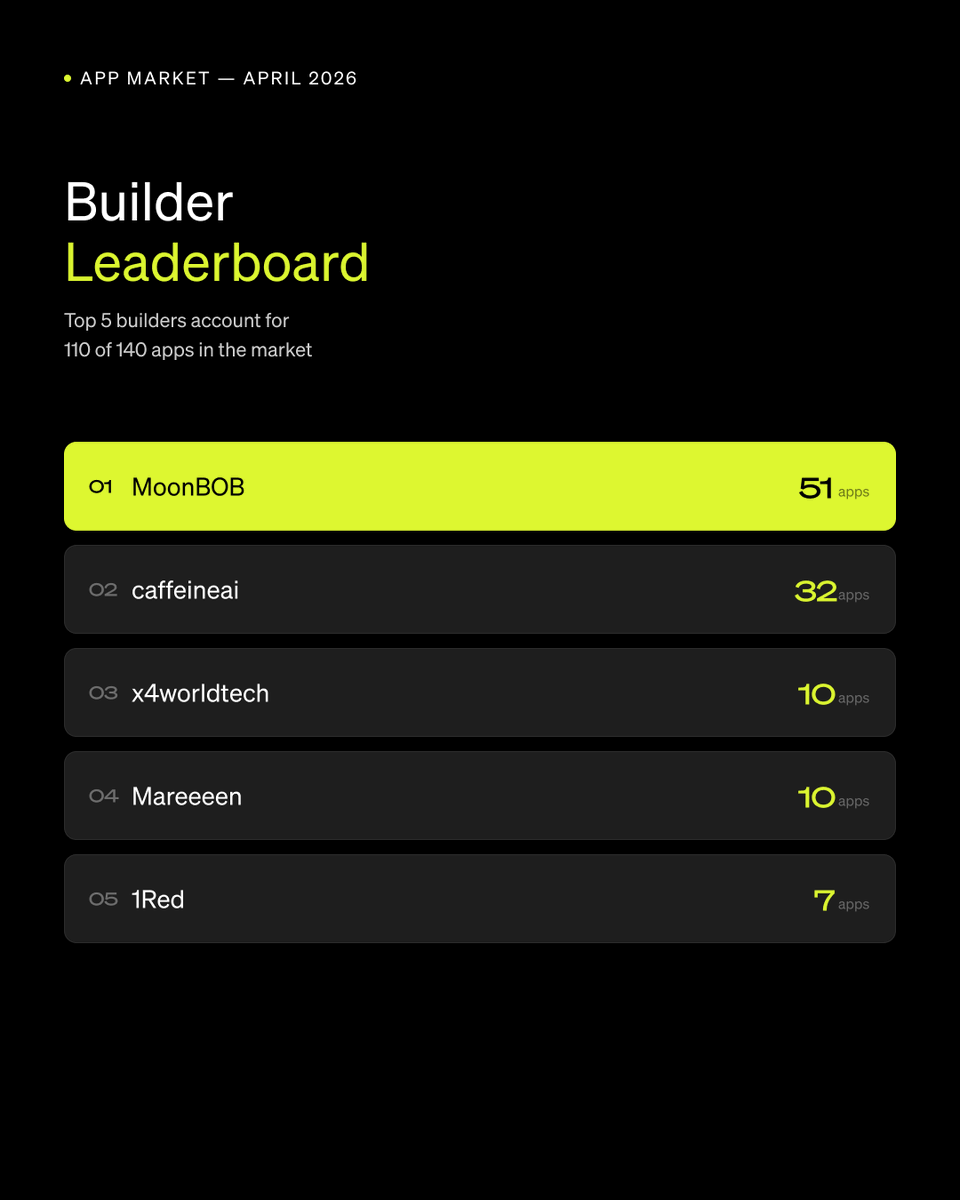
The top 5 builders account for 110 of the 140 apps in the Caffeine App Market. This is what happens when anyone can build an app. What will you build?
caffeine tweet media
English
8
26
162
2.8K
algor*nd
algor*nd@algor_nd·
which is more quantum-resistant right now 🔴 algorand (shipped 2019) 🔵 ethereum (10-year roadmap) 🟠 bitcoin (thoughts and prayers) ⚫ solana (what's quantum)
English
10
6
48
1.4K
Caffeine Buildoor がリツイート
Kristofer
Kristofer@kristoferlund·
Alpha: Caffeine V3 will mean a radical change to the technical architecture powering our platform. We are moving from one world computer to another. More details soon!
Kristofer tweet media
English
25
67
267
16.8K