
Center for Collective Learning

781 posts

Center for Collective Learning banner
Center for Collective Learning

Center for Collective Learning

@LearningCCL

Collective intelligence requires learning. The Center for Collective Learning works to make teams, cities, and nations smarter.

Toulouse, FR & Budapest, HU 参加日 Mart 2014
162 フォロー中6K フォロワー
Center for Collective Learning
Center for Collective Learning@LearningCCL·
Inclusion isn't just about sharing a classroom - it's about the connections formed within it. Using a novel experimental game to map peer networks, a new study co-authored by CCL's @mel2kill reveals how autism shapes social reciprocity. Read the paper: nature.com/articles/s4159…
English
0
0
3
210
Center for Collective Learning
The Conference on Economic Complexity (CEC) is back - this year in Istanbul. Submit your abstract at complexity.world and join us in July to explore the latest developments in economic complexity.
English
0
0
2
147
Center for Collective Learning
Center for Collective Learning@LearningCCL·
Meet our new Director! We are proud to welcome @johannes_wachs to lead the Center for Collective Learning in Budapest. His data & network science research explores the digital economy, AI's impact on knowledge work, and software. We are incredibly excited for this next chapter!
Center for Collective Learning tweet media
English
0
1
3
172
Center for Collective Learning がリツイート
Johannes Wachs
Johannes Wachs@johannes_wachs·
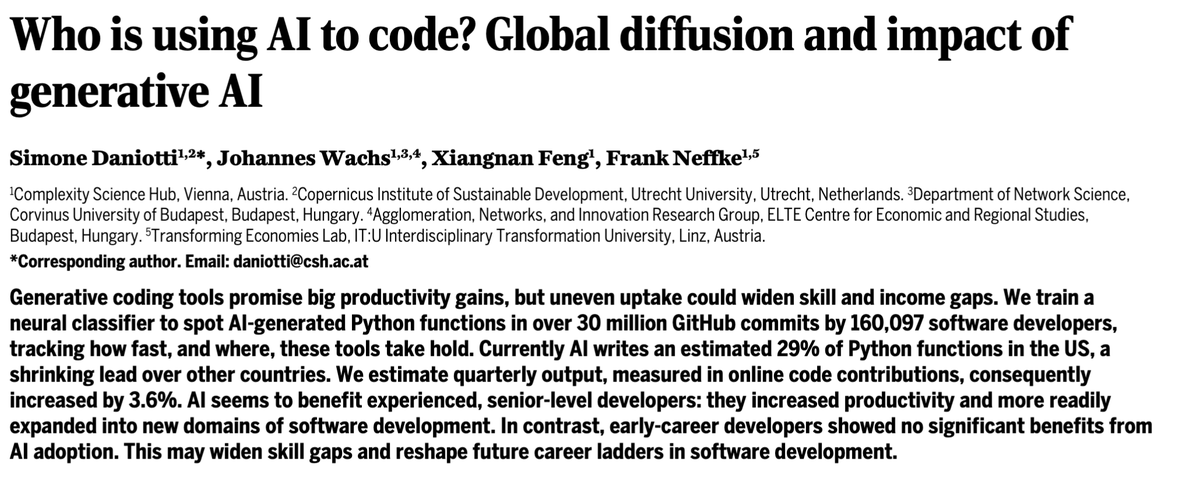
Our new paper in @ScienceMagazine shows that the adoption of AI in software development is explosive. By end 2024, 30% of Python functions on GitHub by US-based devs are written by AI. But we also see that it is rather experienced developers who benefit from using AI.
Johannes Wachs tweet mediaJohannes Wachs tweet mediaJohannes Wachs tweet media
English
8
64
263
48.3K
Center for Collective Learning がリツイート
Endre Mark Borza
Endre Mark Borza@endremborza·
Today's economics Nobel went for explaining economic growth with "creative destruction" (Aghion & Howitt) and "technological progress" (Mokyr). As much as both those things mean innovation, it's interesting how different the academic paths of the laureates are:
Endre Mark Borza tweet media
English
2
10
25
3K
Center for Collective Learning
Congratulations to Mary Brunkow, Fred Ramsdell & Shimon Sakaguchi, this year's Nobel laureates in Physiology or Medicine! On Rankless, you can learn more about their works, their co-author networks, and also their global impact. Check out their profile! Brunkow: rankless.org/authors/mary-e… Sakaguchi: rankless.org/authors/shimon… Ramsdell: rankless.org/authors/fred-r… *On Rankless, we use publication and citation data from OpenAlex, an open and comprehensive bibliographic database. While OpenAlex provides broad and valuable coverage of the global research landscape, it—like all bibliographic datasets—has inherent limitations. These include incomplete records, variations in author disambiguation, differences in journal indexing, and delays in data updates. As a result, some metrics and network relationships displayed in Rankless may not fully capture the entirety of a scholar’s output or impact.
Center for Collective Learning tweet mediaCenter for Collective Learning tweet mediaCenter for Collective Learning tweet media
English
0
0
3
221
Center for Collective Learning
Center for Collective Learning@LearningCCL·
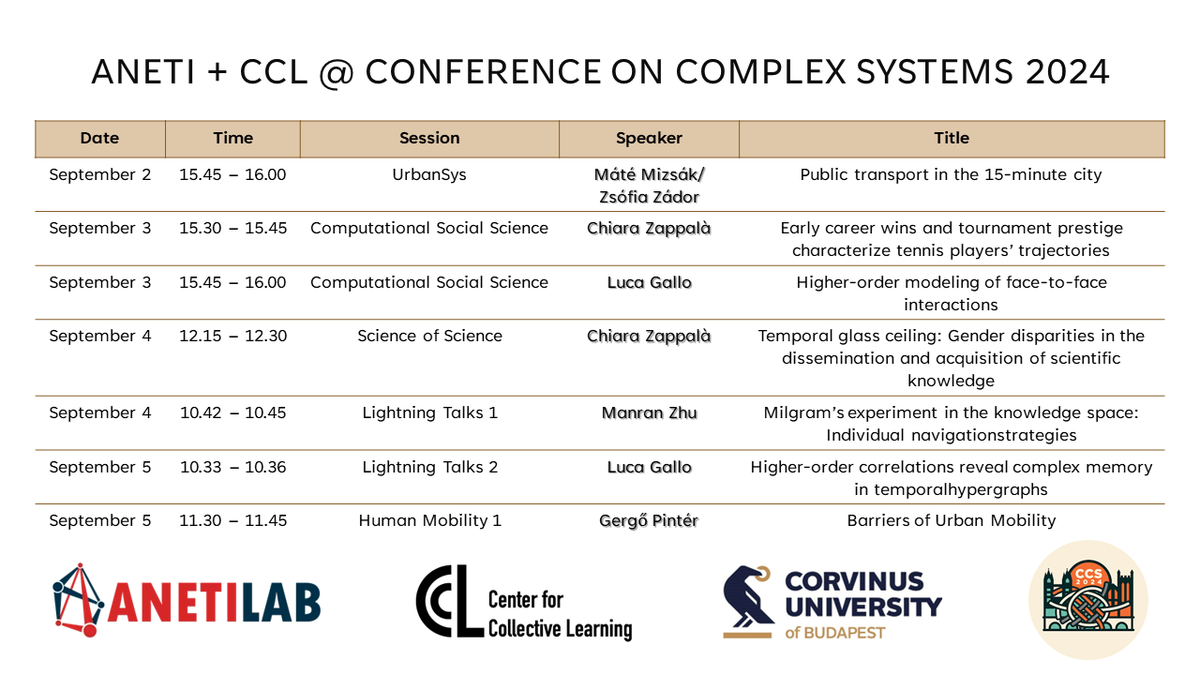
At @ConfCompSys, @mel2kill presented her poster on how friendship can help counterbalance inequalities, while @zappala_chiara shared her work on gender disparities in science. She also co-organized the Computational Social Science satellite, where @cesifoti gave a keynote on the theory of economic complexity. It was a wonderful event to connect and exchange ideas — and to see the beautiful city of Siena!
Center for Collective Learning tweet mediaCenter for Collective Learning tweet mediaCenter for Collective Learning tweet media
English
0
2
3
349
Center for Collective Learning
Center for Collective Learning@LearningCCL·
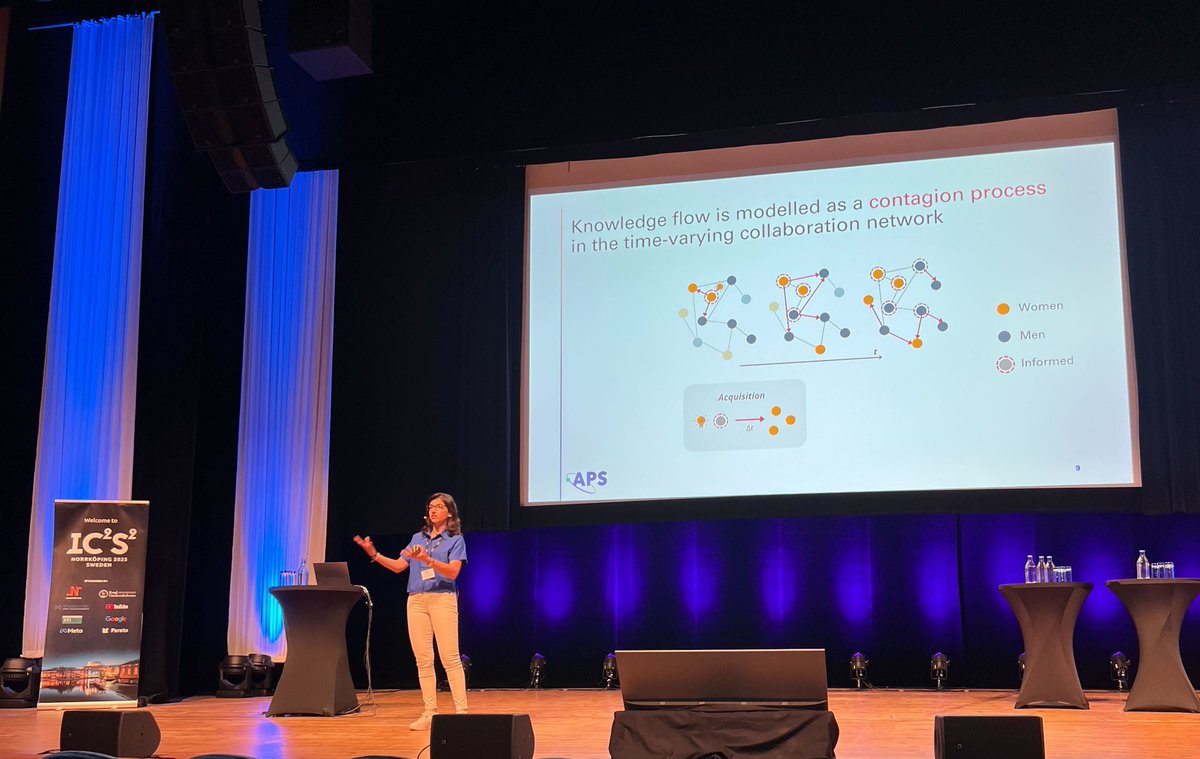
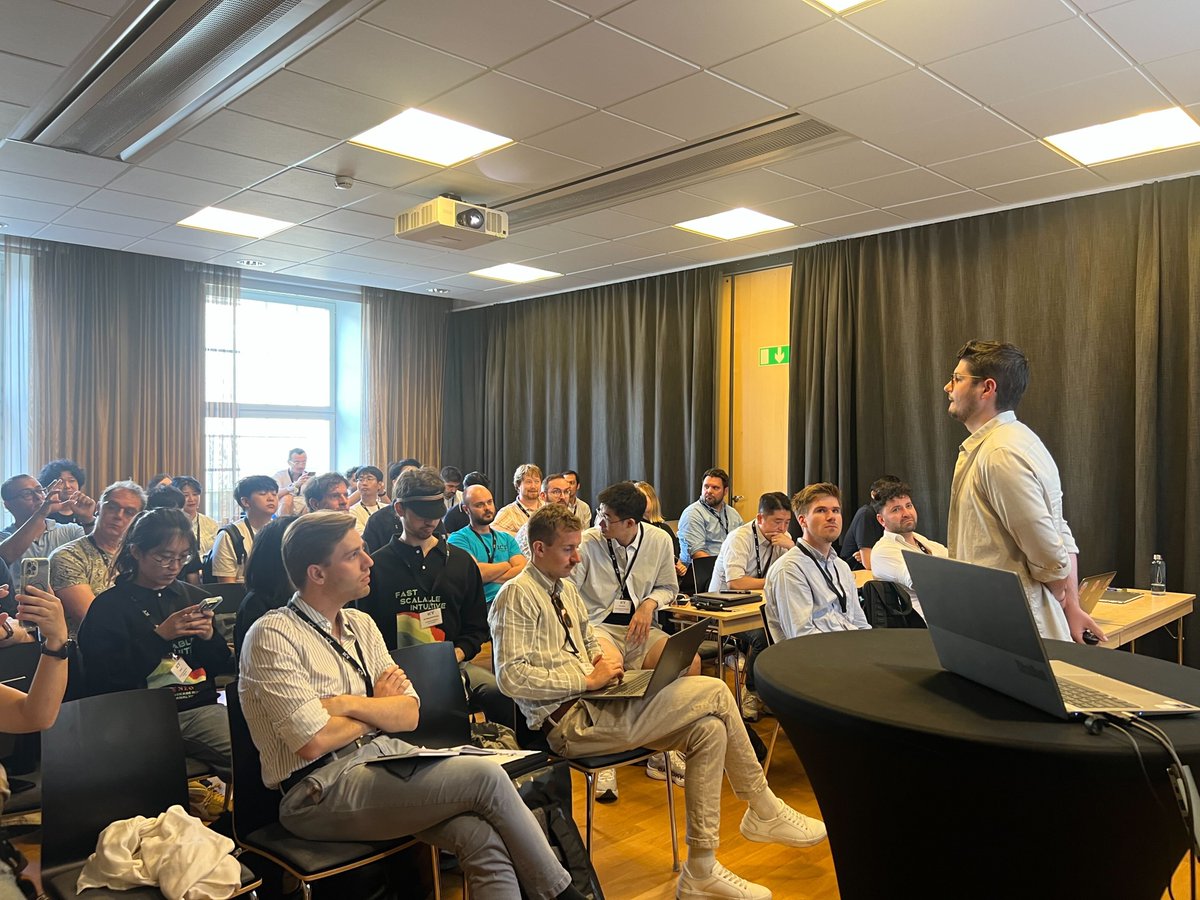
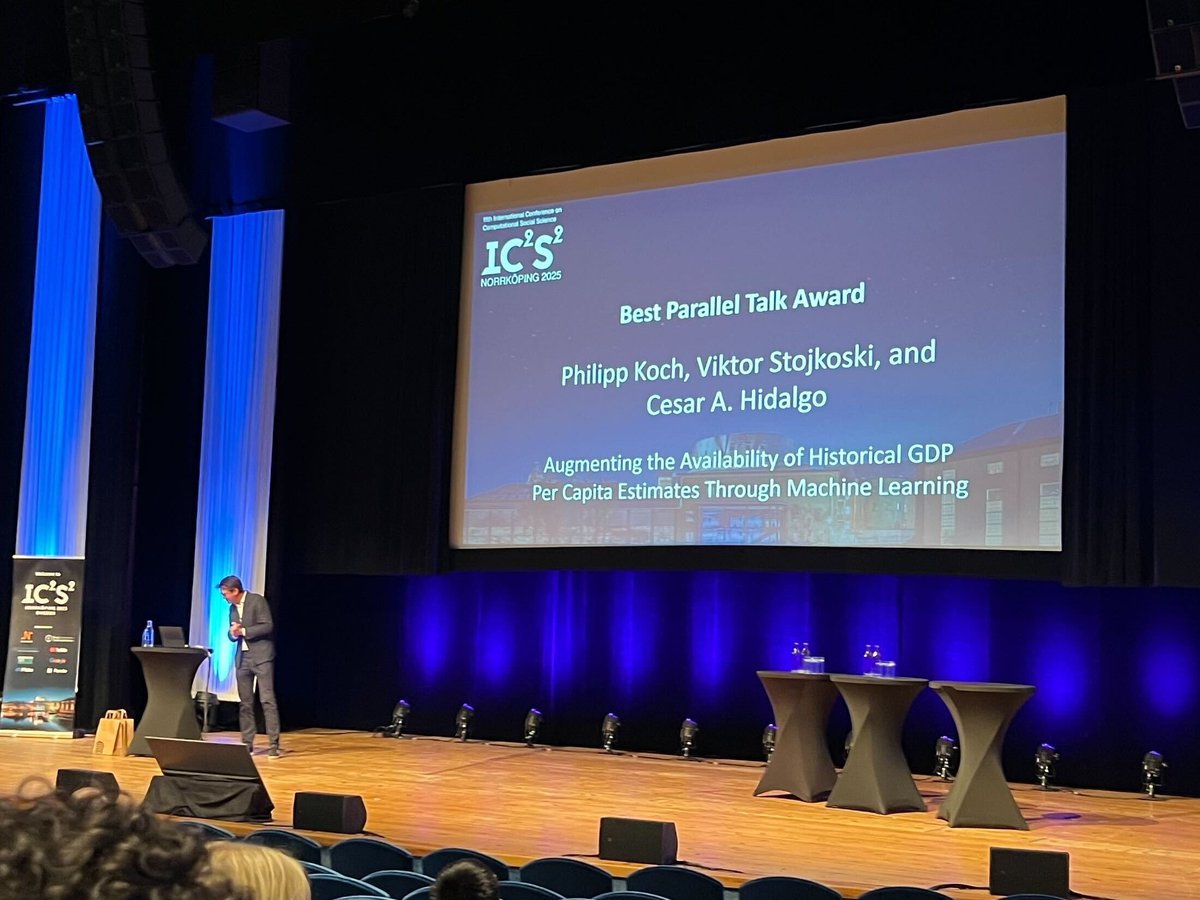
What do fame, historical GDP, and gender equality in science have in common? They were all explored by our colleagues at @IC2S2 2025! 👏Congratulations to @philippmkoch for winning the Best Parallel Talk award this year, and huge thanks to @zappala_chiara & @mel2kill for their amazing presentations!
Center for Collective Learning tweet mediaCenter for Collective Learning tweet mediaCenter for Collective Learning tweet mediaCenter for Collective Learning tweet media
English
0
4
9
1.3K
Center for Collective Learning がリツイート
César A. Hidalgo
César A. Hidalgo@cesifoti·
Do you have what it takes to forecast International trade? Today, we are launching AI4trade, a global challenge where teams compete for cash prizes by submitting their best trade forecasts. But it comes with a couple of twists: 1. This is a future out-of-sample challenge, so teams will need to forecast data that will not exist at the time of submission (impossible to train to the test 👹). 2. Forecasts must be better than simply using the latest trade data available at the time of submission (e.g. using July data as a prediction for October numbers ⏰). This should be a fun global competition. People from all parts of the world are welcome to participate and all methods are allowed. We hope the challenge stimulates more work at the intersection of AI and economics. Link in the first comment: 👇
English
5
24
67
22.9K
Center for Collective Learning がリツイート
César A. Hidalgo
César A. Hidalgo@cesifoti·
Interested in the latest developments on economic complexity? This year's CEC will be held in the beautiful city of Toulouse. We have two amazing Keynotes Corinne Autant-Bernard & Ernest Miguelez, and a half-week packed with activities, starting with a one day Summer School followed by two days of conference. Wanna join? Please register and submit. Link in comment.
César A. Hidalgo tweet media
English
1
16
32
6.2K
Center for Collective Learning がリツイート
César A. Hidalgo
César A. Hidalgo@cesifoti·
Today, the Nobel prize recognized the work of Acemoglu, Johnson, and Robinson. In a recent paper, we reproduce their classic Atlantic trade result when validating our machine learning derived historical estimates of GDP per capita.
English
2
22
95
11.4K
Center for Collective Learning がリツイート
César A. Hidalgo
César A. Hidalgo@cesifoti·
New PNAS paper. Historical GDP per capita data is scarce, but data on the places of birth, death, and occupations of famous individuals is abundant. In this paper we estimate the historical GDP per capita of hundreds of regions in Europe and North America using a machine learning model that leveraged data on about 500k famous biographies. Our estimates more-or-less quadruple the availability of historical GDP per capita estimates for the last 700 years. So why use biographies to augment historical GDP per capita data? Biographical data contains information about people who might have contributed directly to economic growth, like James Watt, or that were attracted to wealthy places looking for patrons, like Michelangelo. So we--mainly Philipp (@philippmkoch)--used this data to construct hundreds of features describing each European region. Then, we trained a machine learning model to find the features that explained most of the variance in a cross-validation test, where we split regions multiple times into a training set and a test set. On average, the model explained about 90% of the variance in GDP per capita of the regions it had not seen during training. But we wanted to go further, and Philipp really went to town by looking at different ways to validate our estimates. We found our estimates correlate positively with historical measures of wellbeing, church building activity, urbanization, and body height. We also used these measures to reproduce the basic Atlantic trade result of Acemoglu, Johnson, and Robison and to explore the economic consequences of the famous Lisbon earthquake of 1755. But what I personally loved most about this project, other than working with @philippmkoch and @ViktorStojkoski, is that it shows that we can use machine learning methods not only to explore the future, but the past. There is a bright and growing future in the use of machine learning for economic history. Hope you enjoy the paper and the data. You can find links to the paper and a data exploration tool in the first comment.
English
19
109
473
54.3K
Center for Collective Learning がリツイート
Philipp Koch
Philipp Koch@philippmkoch·
📢New paper in PNAS! How rich was Vienna at the time of Mozart or Tuscany at the time of Michelangelo? Historical GDPs per capita are scarce, leaving this unanswered. Here, we provide new estimates using machine learning to augment historical GDPs per capita. /1 🧵
Philipp Koch tweet media
English
19
223
838
167.8K
Center for Collective Learning がリツイート
César A. Hidalgo
César A. Hidalgo@cesifoti·
**New DataViz Project** Curious about academic impact? Tired of rankings? Today we are introducing Rankless (rankless.org) a new data exploration platform that can help you explore the academic impact of thousands of universities. All universities produce impact that is specific to certain topics and geographies, but rankings flatten that information. Rankless wants to change that. Consider a comparison between the University of Utah and the University of Vienna, two universities ranked similarly in the Shanghai ranking. These universities differ in their geographical and topical footprint. The University of Utah specializes in Neuroscience and Medicine whereas the University of Vienna specializes in Physics, Astronomy, and Environmental Sciences. Their geographic impact is also quite different. Utah receives a large fraction of citations from medical centers in the U.S., Canada, and Israel, whereas Vienna receives many citations from technical institutes in Austria, Germany, and Hungary. These differences are easy to explore in Rankless but hard to see in rankings. Rankless was developed by a talented team at the Center for Collective Learning at Corvinus University (@uni_corvinus). It was brought to life by Endre Mark Borza (@endremborza), a Hungarian economist and data engineer at CCL with the help of Máté Barkóczi, a Hungarian designer form MOME, and Veronika Hamar executive director at CCL. By moving beyond rankings, Rankless offers a fresh perspective on how universities influence each geography and topic, emphasizing diverse forms of impact and providing a richer understanding of academic influence. To learn more visit Rankless.org
English
20
211
696
124.6K
Center for Collective Learning がリツイート
Corvinus University of Budapest
Corvinus University of Budapest@uni_corvinus·
The Center for Collective Learning (CCL) is proud to announce the First Conference on Economic Complexity that will take place at #Corvinus between 10-12 July 2024. ⏰ Extended abstract submission deadline: 19 April, 2024 👉 uni-corvinus.hu/post/event/con…
English
0
9
19
1.4K