固定されたツイート
MajorSammerToor
312 posts

MajorSammerToor
@MajorSammerToor
My Back up account of @samartoor3086 (Major Sammer Pal Toorr (Infantry Combat Veteran) ZULU IWI Drone Instructor Kamikaze Drone Pilot The Peace Maker
World 参加日 Nisan 2026
50 フォロー中368 フォロワー

This Indian Move Hurt Turkey More Than Israel Ever Did.
India gave a powerful and strategic response to Turkey and Pakistan! In this video, we expose Erdogan's Islamist agenda, Turkey-Pakistan-Azerbaijan "three countries one nation" alliance, and how Turkey's new long range missile is aimed at India.
Learn how India countered silently through defense diplomacy with Armenia, showcased battle-proven weapons like BrahMos, Akash, Pinaka & ATAGS in Armenia's military parade, and boosted its defense exports after Operation Sindoor 2025.
From Erdogan's anti-India rhetoric to India's rising global arms power this is a story of smart strategy, not just slogans. What do you think?
Can India become a Top 5 defense exporter? And why not?
Credit: First Post.
English

Peace Deal Until Next Disagreement!
The US-Iran “peace deal” looks less like peace and more like an intermission.
The core disputes remain unresolved:
• Iran’s nuclear programme
• Sanctions relief
• Regional proxy networks
• Strait of Hormuz security
• Israel-Hezbollah tensions
In other words, the reasons for the war have not disappeared—only the shooting has paused. Reports indicate that many of the most contentious issues have been pushed into future negotiations rather than settled. (The Guardian)
History suggests ceasefires survive when both sides achieve their objectives. Here, neither side can honestly claim victory.
Translation:
The peace is real.
The trust is not.
Expect diplomacy by day, threats by night, and the possibility of another crisis before the ink is dry.
#Iran #USA #MiddleEast #Geopolitics

English

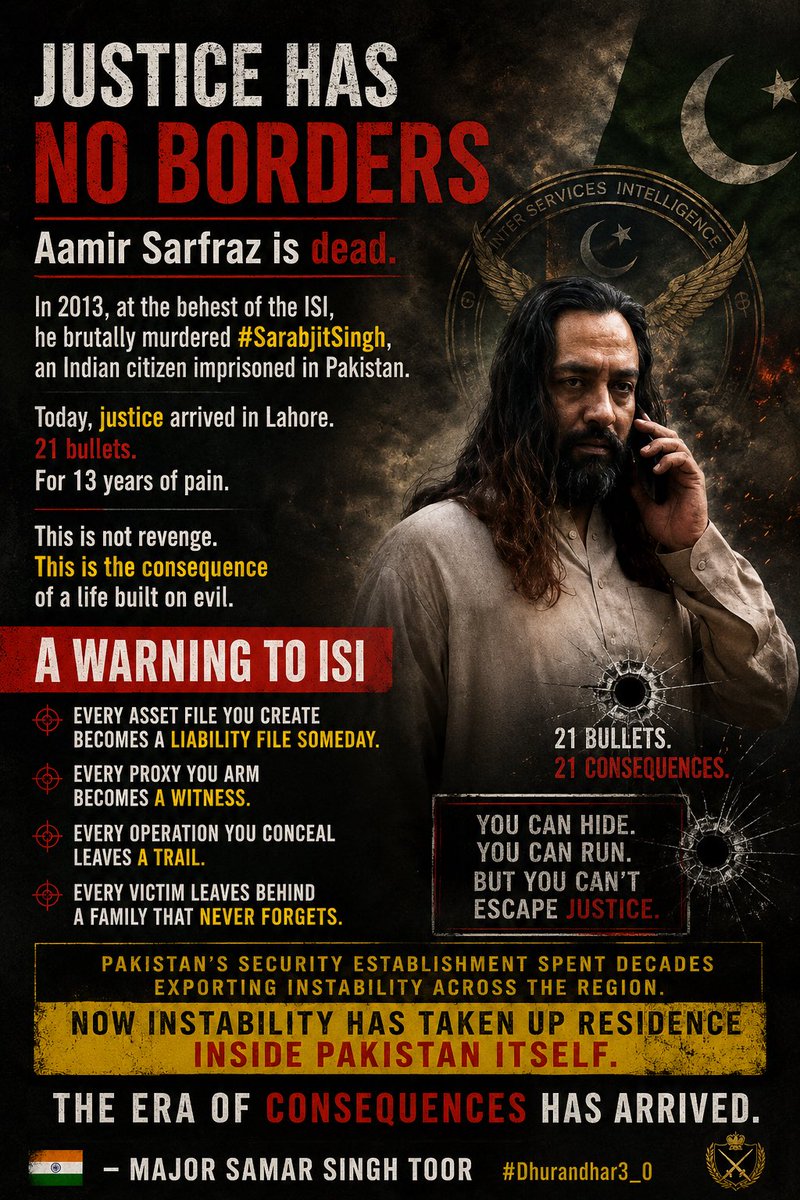
HISAAB HOGA! BARABAR HOGA!
#Dhurandhar3_0
For decades, the ISI cultivated, protected and weaponized criminals, gangsters and terrorists as instruments of state policy. They believed violence could be outsourced, deniability could be maintained, and there would never be consequences.
History is proving otherwise.
Those who spill innocent blood eventually discover that fear is a currency with a very short shelf life. The networks built on intimidation, extortion and murder ultimately consume their own creators.
The elimination of individuals linked to attacks on Indians sends a simple message: justice has a longer memory than the perpetrators of such crimes.
A warning to the ISI:
Every asset file you create becomes a liability file someday.
Every proxy you arm becomes a witness.
Every operation you conceal leaves a trail.
And every victim leaves behind a family that never forgets.
Pakistan’s security establishment spent decades exporting instability across the region. Now instability has taken up residence inside Pakistan itself.
The era of consequences has arrived.
Jai hind 🇮🇳
– Major Samar Toor (Infantry Combat Veteran)
“When a state chooses criminals as instruments of policy, it should not be surprised when criminals become the authors of its future.”

English

@theskindoctor13 Basically aapki gaadi ka engine cease karwake. App sirf rickshaw pe 15 rupay mien ghoomogey!!!! Hahaha
Filipino

This post needs actual promotion!
A French moto vlogger "Frenchy" was traveling through India on his bike, He had a lump on his neck. Curious about the cost and process to remove it, he inquired locally and was quoted just $500 for the treatment.
Stunned by both the price and the short waiting time, he went ahead with the procedure. Within a week, the lump was removed. He documented the whole journey on camera.
He later shared that the same type of surgery in Australia after an accident had cost him $12,000.
If manufactured online hate and negative perceptions in the West didn’t exist, India could easily be earning hundreds of billions of dollars every year from medical tourism alone.
And this is why India needs to fight bad image/perception, that is being promoted by India's adversaries.
English

Any country arming Pakistan against India should stop pretending to be India's friend.
"There are no neutral arms dealers in a conflict. Every weapon has a destination. Every shipment chooses a side."
Some countries have a fascinating foreign policy.
They sell weapons to Pakistan, fund its military capability, strengthen its strategic position against India... and then expect New Delhi to believe they are "neutral partners."
That's like supplying petrol to an arsonist and then claiming you're only interested in fire safety.
India should judge nations by the weapons they deliver, not the speeches they give.
Weapons supplied to Pakistan do not disappear into a museum. They are deployed against India, directly or indirectly. Every missile, drone, fighter aircraft, artillery system, and military aid package strengthens a state that has spent decades using terrorism and military coercion as instruments of policy.
Nations are judged not by their statements, but by their actions.
If you arm Pakistan against India, you are choosing a side.
And India should remember who stood where when the bill comes due.

English

Delhi: Anurag Singh, Lieutenant Colonel, Officer Commanding, Yamuna Task Force, says, "The Indian Army and the Government of India's Ministry of Defence decided to form the Yamuna Task Force here...The Indian Army's involvement in this brings with it people's expectations and hopes, and we will always live up to them." On being asked about the possibility of taking a holy dip, he says, "People will start taking a dip in the Yamuna from next year itself. But let me make it clear, this effort will require everyone's participation."
Video:PTI
English
MajorSammerToor がリツイート

🚨 MASSIVE: DRDO Cracks One of the World's Toughest Jet Engine Technologies, Develops Single Crystal Blade Tech
DRDO has successfully developed and perfected Single Crystal Turbine Blade technology, an achievement that places India among a small group of nations capable of producing one of the most sophisticated components used in modern jet engines.
At first glance, a turbine blade may appear to be just another metal component. In reality, it operates in one of the harshest environments known to engineering. Inside a fighter jet engine, these blades must withstand temperatures exceeding 1,500°C while spinning at tens of thousands of revolutions per minute. Even the smallest structural weakness can lead to catastrophic failure.
That is where single crystal technology becomes crucial.
Unlike conventional metal components, which are made up of multiple grains separated by microscopic boundaries, a single crystal blade is manufactured as one continuous crystal structure. The absence of grain boundaries eliminates weak points, allowing the blade to endure extreme heat, pressure, and mechanical stress that would destroy ordinary materials.
Developing such blades is considered one of the most difficult tasks in aerospace engineering. The manufacturing process requires extraordinary precision, from casting the crystal structure to machining cooling channels and achieving the final surface finish. A minor defect at any stage can render the entire component unusable.
Recognizing the maturity of the technology, DRDO has now invited private-sector companies to participate in its industrialization and large-scale production. The goal is not merely to manufacture the blades but also to obtain airworthiness certification, ensuring they meet the demanding standards required for operational aircraft engines.
The breakthrough carries major strategic implications. It strengthens India's ambitions to develop indigenous aero-engines, including future variants of the Kaveri engine, next-generation fighter jet engines, helicopter engines, and advanced gas turbines. Most importantly, it reduces India's dependence on foreign suppliers for one of the most sensitive technologies in the aerospace sector.
For years, aero-engines remained one of the few areas where India lagged behind the world's leading military powers. With the successful development of single crystal turbine blade technology, that gap has become significantly smaller.
What was once an exclusive capability of a handful of nations is now firmly within India's grasp.


English

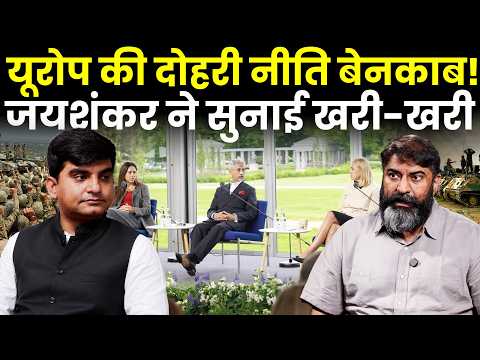
Jaishankar Exposes Europe’s Double Standards on Russia Oil | CFTV | Sama... youtu.be/-8u1-VjQNUc?si… via @YouTube

YouTube
English

“Great powers build economies to fund militaries. Pakistan funds militaries by borrowing against its economy. One path creates strength. The other creates creditors.” 🇮🇳📉💰
Pakistan’s Defence Budget: A Strategic Necessity or a Fast Track to a Debt Trap?
Pakistan’s latest budget has revealed a familiar pattern: when faced with economic crisis, political instability, declining foreign investment, and mounting debt obligations, Rawalpindi’s answer is always the same — spend more on the military.
Islamabad has announced a defence budget of approximately PKR 3 trillion for FY 2026-27, representing an increase of nearly 18% over the previous year. At the same time, development spending has been squeezed, social sectors remain underfunded, and the country continues to operate under strict IMF oversight.
The problem is not merely that Pakistan is spending more on defence.
The real problem is where the money is coming from.
Pakistan is not funding military expansion from economic growth, technological innovation, rising exports, or expanding tax revenues. It is attempting to do so while carrying one of the heaviest debt burdens in its history. IMF conditions require Islamabad to maintain budget surpluses before debt servicing, leaving very little room for development, welfare, or infrastructure investment.
This creates a dangerous cycle:
Borrow money.
Service old debt.
Increase defence expenditure.
Cut development spending.
Generate slower economic growth.
Borrow even more money.
That is not a strategy. That is a debt trap.
India offers an interesting contrast.
India’s defence budget is substantially larger, but India possesses an economy several times larger than Pakistan’s. More importantly, New Delhi’s defence allocations are often constrained by procurement timelines, bureaucratic processes, and phased modernisation programmes. Budgetary allocations do not automatically translate into immediate expenditure.
Pakistan, on the other hand, faces a different reality. Defence spending increasingly competes directly against education, healthcare, infrastructure and economic development. Recent budget discussions have already highlighted reductions in development allocations as resources are redirected toward security priorities.
History provides a warning.
No nation has ever achieved long-term strategic superiority by sacrificing economic strength. Military power ultimately rests upon industrial power, technological capability, demographic productivity and fiscal sustainability.
The United States became a military superpower because it first became an economic superpower.
China built the PLA after becoming the factory of the world.
Even the Soviet Union demonstrated the consequences of allowing military expenditure to outpace economic reality.
Pakistan’s leadership appears determined to reverse that formula.
The country now spends vast sums servicing debt while simultaneously increasing military allocations. Interest payments and defence expenditures consume a dominant share of available fiscal resources, leaving shrinking space for future growth.
A nation can survive temporary military weakness.
It cannot survive permanent economic weakness.
The real battlefield of the 21st century is not only the Line of Control or the Arabian Sea. It is the balance sheet.
And balance sheets are notoriously indifferent to military slogans.
If current trends continue, Pakistan may discover that the most dangerous enemy facing its national security is not across the border.
It is compound interest!

English

If Indian Crew is expendable then am sure the American Crew is the same too!
No apology.
No regret.
No condolence.
Three Indians are dead and Washington’s statement reads as if their lives were irrelevant.
If a commercial vessel was non-compliant, why was lethal force the answer?
Every merchant sailor in these waters deserves to know: Are Indian crews now considered acceptable collateral damage?
Strategic partnership demands respect.
Indian lives are not target practice.
#IndianLivesMatter

English

The Commanding officer of USS Abraham Lincoln is Captain Daniel J. Keeler. Other crew includes:
- Seaman Glory Anderson
- Lt. Cmdr. Tyler Barker
- Chief Petty Officer Cody Boyd
- Seaman Angel Campbell
- Petty Officer 3rd Class Mario Castro Gamez
- Petty Officer 2nd Class Nathaly Cruz
- Seaman Malina Davy
- Petty Officer 3rd Class Sonny Escalante


English

⚠️
MS Settebello which was attacked by US where 3 Indians died was locked by an AGM-114 hellfire missile which was fired by a F/A-18 Super hornet that took off from USS Abraham Lincoln (CVN-72).
The pilot who fired the missile was Lt. T.H. Bond call sign "Wesley".
⚠️
MS Settebello which was attacked by US where 3 Indians died was locked by an AGM-114 hellfire missile which was fired by a F/A-18 Super hornet that took off from USS Abraham Lincoln (CVN-72).
The pilot who fired the missile was Lt. T.H. Bond call sign "Wesley".


English

Breaking News:
The US and Iran are reportedly very close to a peace deal. Negotiators say the agreement has “never been closer,” although both sides are still arguing over the details.
Which, in geopolitical terms, usually means:
“Congratulations! We are only one misunderstanding, two tweets, and three airstrikes away from lasting peace.” 😄
Washington’s peace process often follows a simple cycle:
Sanctions
Threats
Bombing
Negotiations
Peace Deal
Bombing to protect the Peace Deal
So if a peace agreement is finally signed, Iran should remain more alert.
History suggests that the moment everyone declares “peace has arrived,” someone in Washington may suddenly discover an urgent need to deliver democracy at Mach 2.
#Iran #USA #Geopolitics #MiddleEast #PeaceTalks #MajorSamarToor 😄

English