Marginalia Review of Books

5.8K posts

Marginalia Review of Books banner
Marginalia Review of Books

Marginalia Review of Books

@MarginaliaROB

Reaching 150,000+ readers with Deep Learning for a Digital Age, integrating academic knowledge for a global audience. EST 2017 Editors @samuelloncar @A_Barylski

参加日 Temmuz 2012
325 フォロー中3.7K フォロワー
Marginalia Review of Books がリツイート
Gabe Gottlieb
Gabe Gottlieb@xgabegottliebx·
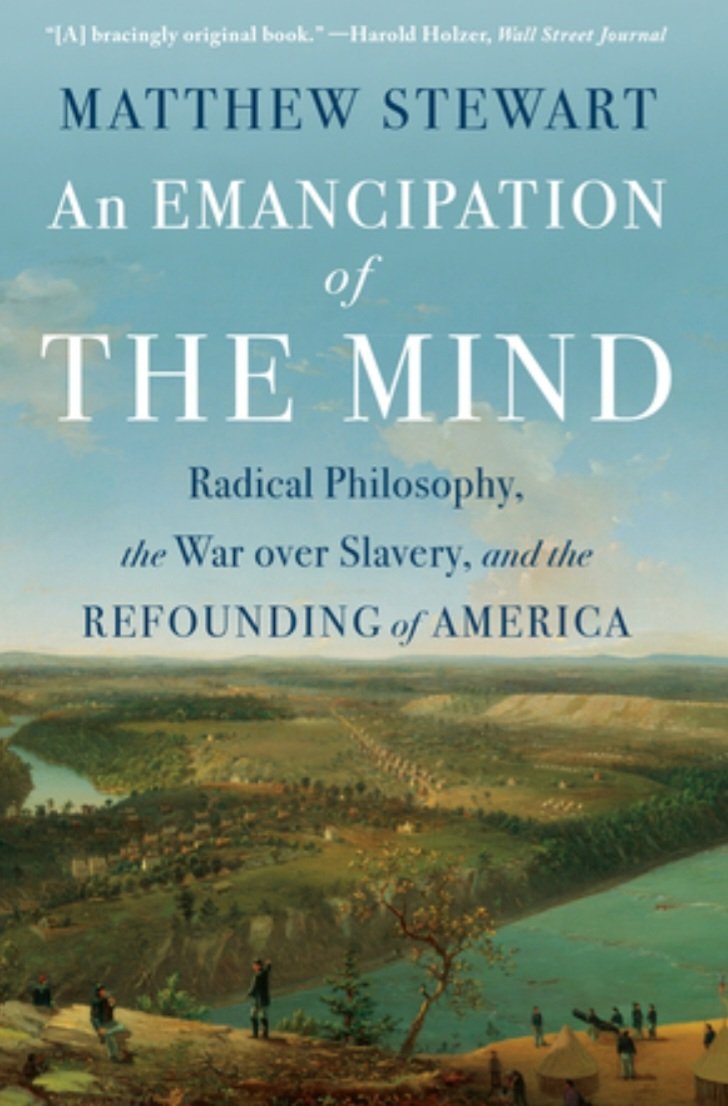
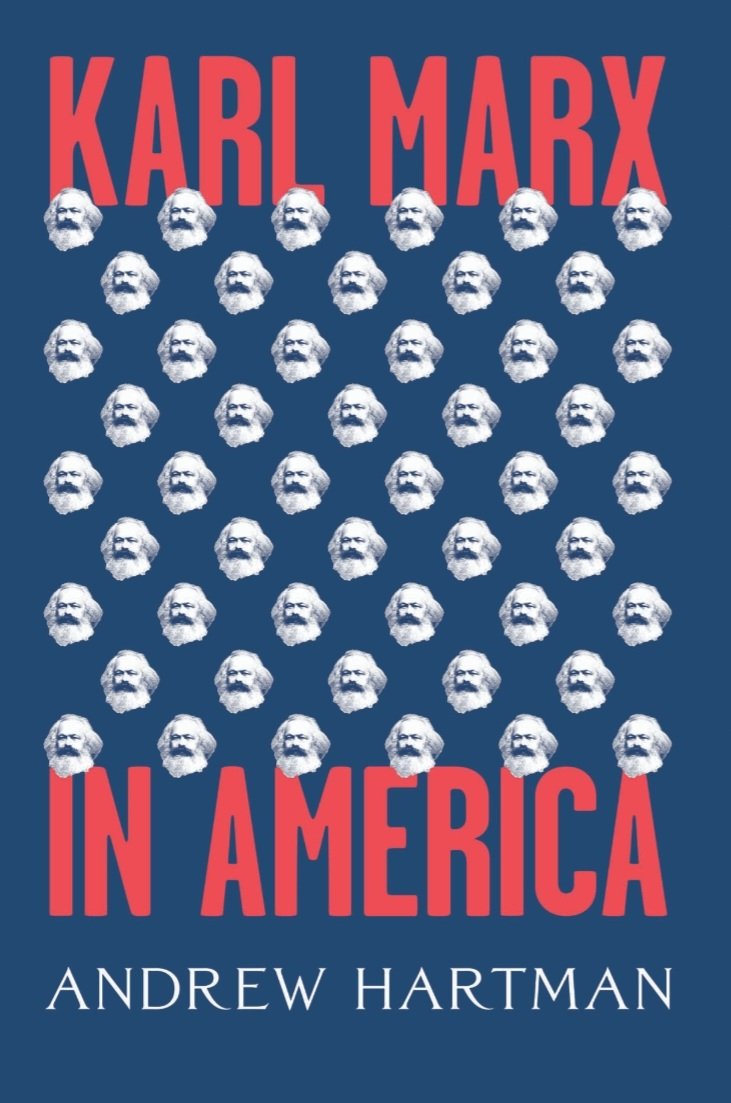
Excited about this review by Kelly Swope I edited for @MarginaliaROB. He looks at two books: Matthew Stewart's An Emancipation of the Mind and @HartmanAndrew's Marx in America - using Du Bouis's bio of John Brown as a way in. I love Kelly's writing here - check it out! 👇
Gabe Gottlieb tweet mediaGabe Gottlieb tweet media
English
2
12
103
14.9K
Marginalia Review of Books
Marginalia Review of Books@MarginaliaROB·
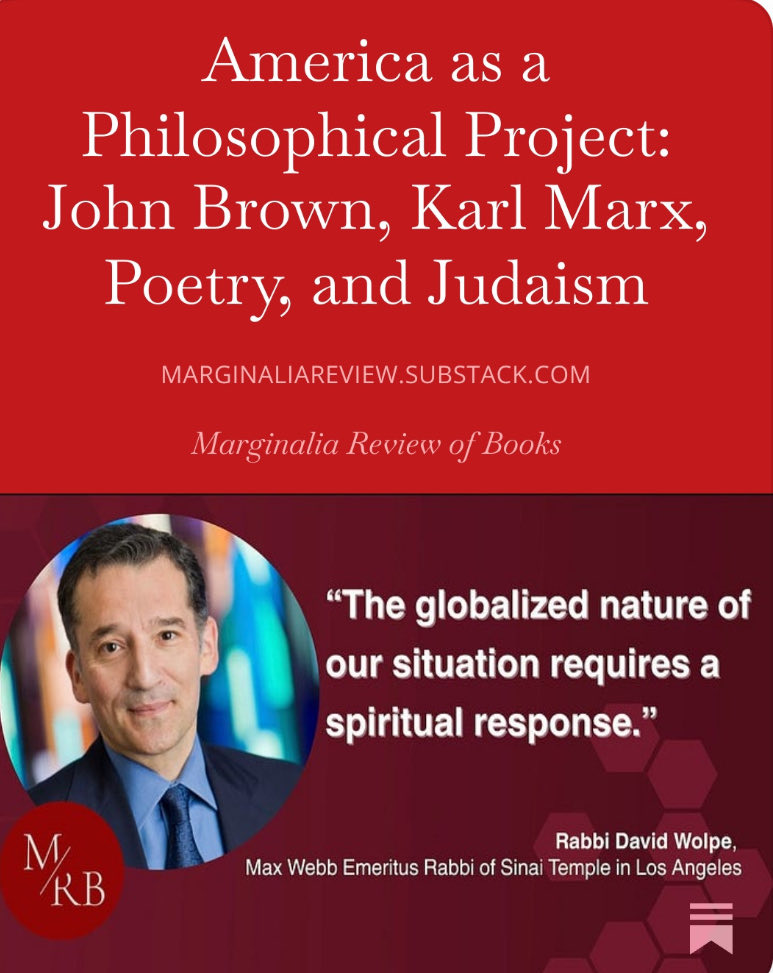
🎉New Issue! | The arc of justice bends according to the human will. There is nothing inevitable about progress. That is the myth: the idea that history happens, rather than that we shape it. Progress is real, and therefore contingent. It is precisely our responsibility to consolidate what has been gained in order to advance it. This issue features: ✡️one of America’s most influential rabbis, Rabbi David Wolpe, Max Webb Rabbi Emeritus of Sinai Temple, Los Angeles, who shares his reflections on the global challenges we face today and the existential responses required to navigate them as a species 🇺🇸 🇩🇪Kelly M.S. Swope reviews Matthew Stewart’s An Emancipation of the Mind and Andrew Hartman’s (@HartmanAndrew) Karl Marx in America, both from @wwnorton in his essay, “The German Philosophy that Emancipated America” 📚related to Swope’s review, we feature @SamuelLoncar’s 2013 review of David Hollinger’s After Cloven Tongues of Fire (@PrincetonUPress) and Molly Worthen’s Apostles of Reason (@OUPAcademic), showing how nineteenth‑century German liberal theology reshaped American elite Protestant discourse at the founding of our nation and explaining why current debates over “liberal” vs. “evangelical” faith still unfolded in a conceptual framework of German philosophers and theologians 🪶 and poet and translator Michael Bazzett contributes to the translator’s workshop series, where he explores the linguistic fluidity of K’iche’ Maya poet, Humberto Ak’abal (thank you, @AmitMajmudar, our George Steiner Editor for Poetry and Criticism, for curating this series!) open.substack.com/pub/marginalia…
English
1
2
12
9.9K
Marginalia Review of Books がリツイート
Samuel Loncar | Accelerating Scientific Progress
Probably should share this low-key vision of how AI leads to world peace, because it’s rational, desirable, and makes sense.
Samuel Loncar | Accelerating Scientific Progress@SamuelLoncar

No unassuming hobbits left to take on the task and have a “fool’s hope” of success. Humans will actually have to evolve; AI demands a conscious elevation of human freedom to recognize collective responsibility is the true meaning and means of collective agency. Climate, AI, Nuclear, are all Anthropocene issues in their planetary scope, and they all require humanity meaningfully act as a real collective agent, a unified force aiming at the same goal. The totalitarian shadow of this agency is the flicker of our own ethical ambiguity as a species, which makes the threats a projection: a bad use of AI, a refusal to act to do justice to our influence on the biosphere, a nuclear world war—all things we fear simply because we refuse to agree we can, literally, just decide we won’t violate the spirit of Immanuel Kant’s On Eternal Peace (Zum ewigen Frieden), and begin a step-by-step process towards forming global cooperation on all these issues, beginning with removing the greatest fear each international power has - war - shifting diplomatic energy from threat-aversion or anticipation to positive economic and cultural cooperation, agreeing not to unreasonably focus on major political differences or judges culture based on their current governments. Rather, diplomacy should be acknowledged as an active practice of humanistic philosophy, whose aim is foster the well-being of humanity by advancing the interests of one’s order in a way that seeks to benefit other orders as much as possible. Over time, the spirit of cooperation and its practice will help deal with the remaining significant political differences, and unjust regimes will have the incentive and means to begin improving their own modes of order, leading gradually to a permanently increasing quality of life and international order. Since we are members of the human species first, and nations second, prioritizing a transnational humanism, correlated to local cultural forms and traditions, is rational and beneficial, as it helps create a path (not a method) that over time eliminates zero-sum dynamics. Amodei is being pressured by what Burke aptly called the “sovereignty of circumstances” to embody his stated values, and to his credit is figuring out how to do that, which is not obvious and I imagine must be extremely difficult. But he’s implicitly calling for what this kind of humanistic philosophy yields, and I think it is in fact implicit in a wide ranged of already valued institutions and norms. The task is to articulate them into self-conscious recognition, then pursue their ever clearer realization. That is our project as a species: becoming human.

English
0
1
1
173
Marginalia Review of Books がリツイート
Ruxandra Teslo 🧬
Ruxandra Teslo 🧬@RuxandraTeslo·
Having noticed this, I began to wonder: why equality? Why the persistent fixation on oppression and the moral drama of victim and perpetrator? Why, out of all the possible goods, has this one become so central? writingruxandrabio.com/p/equality-as-… Nietzsche suggested that egalitarianism was the afterglow of Christianity—a moral residue lingering after faith itself had faded. But Christianity bequeathed many values to the modern world: humility, charity, forgiveness, self-sacrifice. Why did equality, in particular, survive as the organizing principle? It seems to me that equality functions as a kind of consolation prize in a secular age. The shift from an “enchanted” premodern cosmos to a “disenchanted” secular order has undoubtedly expanded individual freedom. Yet in casting off the old metaphysical scaffolding, we have also stripped the so-called “losers” of society of any sense of inherent dignity rooted in a larger cosmic story. At the same time, secular narratives place an immense weight of responsibility on the individual. In a world without providence and fate, outcomes appear to flow almost entirely from human choice and human systems. Nothing is “meant to be” or cosmically allotted. The contemporary fixation on oppression narratives—closely allied with the language of equality and often emerging from the same moral circles—can be understood, in part, as a response to this strain. By locating suffering within structures of domination, it externalizes at least some portion of the otherwise crushing responsibility modernity places on the self.
English
8
13
111
12.8K
Marginalia Review of Books
Marginalia Review of Books@MarginaliaROB·
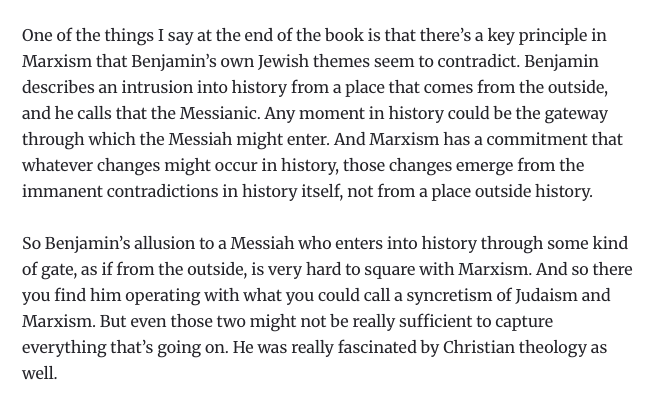
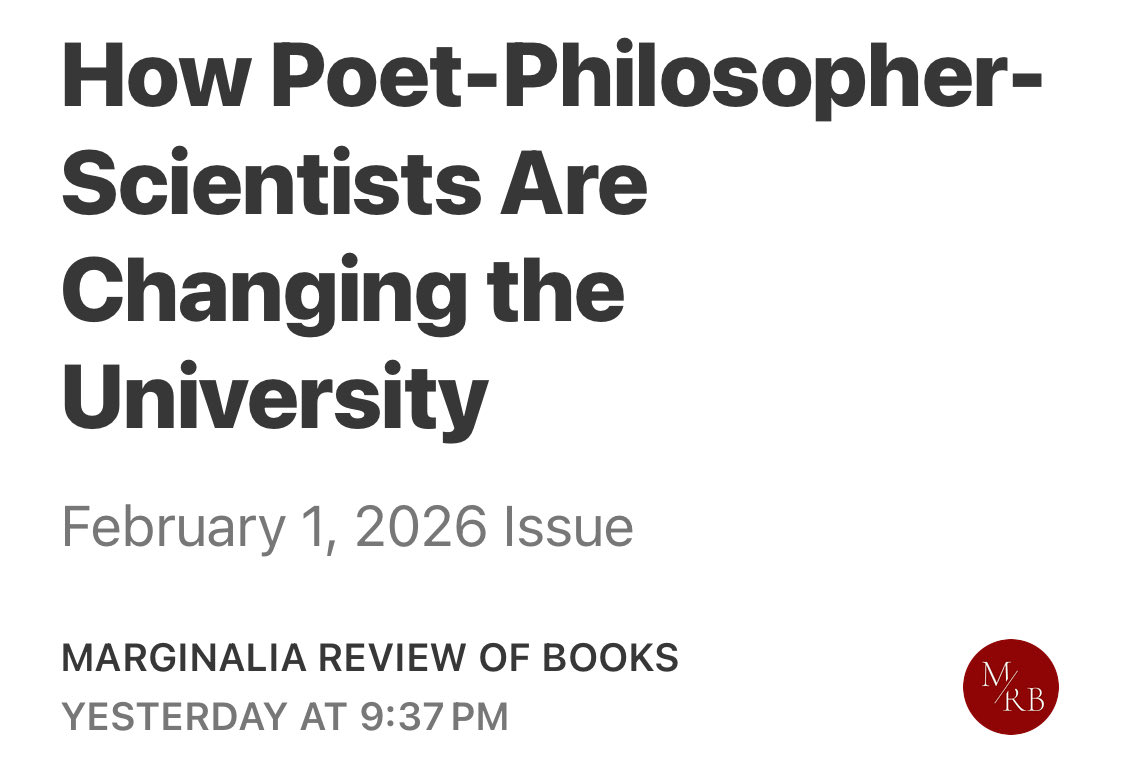
🎉Inaugural issue of 2026🎉 We finally came out as the German Idealists and Romantics that we are! And we are frank about the fact that new versions of the university, in the best-case scenario, are only creating good colleges for students. They are not changing how research is done, nor can they if they are hostile to the existing system and fail to respect the great importance of building on its achievements. We are because we do. And we couldn’t do it without our amazing contributors. This issue features: 🧠 @Harvard trained psychiatrist and brain researcher, Srini Pillay (@drsrinipillay), whom we are delighted to welcome as the Neuroscience and Society Fellow at our Institute for the Meanings of Science. His first contribution challenges one of the blind spots of current medical research: the crucial role of subjectivity in human well-being. 🪶Philosopher and poet Luke Fischer’s beautiful review of James D. Reid’s Novalis: Philosophical, Literary and Poetic Writing (@OUPAcademic). ✡️ Gad Barnea’s contribution to our forum on @AdlerYonatan’s The Origins of Judaism (@yalepress) 🎊 @yaleism’s profile on ISM alumna @A_Barylski, our poet Executive Editor, and @YaleDivSchool alumnus, @SamuelLoncar, our philosopher Editor-in-Chief Read more 👇 @marginaliareview/note/p-186499479?r=5d9fhz&utm_medium=ios&utm_source=notes-share-action" target="_blank" rel="nofollow noopener">substack.com/@marginaliarev
Marginalia Review of Books tweet media
English
2
3
12
540
Marginalia Review of Books がリツイート
Samuel Loncar | Accelerating Scientific Progress
Critical insight from superb reporting on an issue I remind clients of endlessly: the human talent architecture is the key issue in AI and every other area, and the US does not get this. The way we think about AI in the US is atomized, not strategic.
Zijing Wu@zijing_wu

Here’s the full version in print, available in our weekend edition as well as the FT Magazine. The earlier free link no longer works as too many have used it.

English
0
1
2
340
Marginalia Review of Books がリツイート
Samuel Loncar | Accelerating Scientific Progress
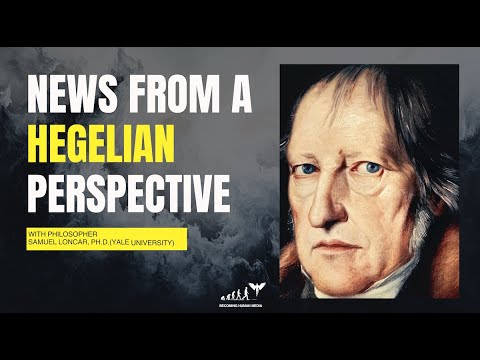
My new show, Spirit News, my philosopher’s take on “current affairs,” 😉 launches today, covering Thomas Aquinas (it’s his Feast Day), Hegel—Spirit News offers a Hegelian perspective on global affairs—and a Nietzschean analysis of Davos and AI developments.
Samuel Loncar | Accelerating Scientific Progress tweet media
English
0
1
7
199
Marginalia Review of Books がリツイート
Samuel Loncar | Accelerating Scientific Progress
There are many profound implications of this. Consider 3, on the assumption of this being generally valid: 1. Cutting edge mathematical work produced outside of the system of current academia is unlikely ever to be recognized, bc it’s completely valid for professional mathematicians to ignore rando crazy people when it’s already this hard to verify work by known colleagues who claim a major achievement. 2. In theory it’s possible some Ramanujan-type geniuses have made major breakthroughs, but absent a Hardy as patron this will never be known or knowable, and currently there is no way around it. Think about how much is owed to Hardy actually reading Ramanujan’s work and doing justice to it. 3. The lifecycle of profound advances is in generations, and the best way to dramatically improve science is to find a way to accelerate this. That’s what I’m doing in my work currently on collapsing the time-scale of intellectual progress, as in the New Biology Project I direct. As I stress in my philosophical consulting on AI and the future of education, the problems of AGI already exist in certain areas, and most AGI speculation is nonsense because it does not understand this, or how crucial verification is and how difficult it is. Hardy said he was not a genius but simply had the distinction, if I remember this right, of being “at one time in the 20th Century the fourth best pure mathematician in the world.” Bessis’ work has taken over decade to begin to be recognized for the achievement he sees as most important, and that is with the internet allowing far faster and easy access to research and researchers. Those thinking about the nature of science (and I mean that generally, in the European sense, not just the natural sciences and math) should recognize without confronting this issue, scaling the pace of scientific progress is impossible. That’s why my major long-term focus is on how that can happen. It’s far more valuable to make a contribution to that problem, for me, than any single expert subdomain, which I’ve already done and am doing in my book. Systemic awareness, not merely local specialization (that is a necessary condition), is the framework needed to address this issue. #math #science #scientificprogress #philosophyofscience #agi
David Bessis@davidbessis

The lifecycle of a pure math theorem: - 1997: my PhD advisor asks me to work on one of his conjectures - 2000: I solve the simplest case and dream of generalizing my approach - 2003: after years of struggle, I come to the conclusion that my approach *cannot* generalize - 2006: after reading a paper by Daan Krammer, I have a lighting bulb moment and realize that my approach works in full generality *up to equivalence of categories*... this enables me to solve my advisor's conjecture... I then use it as an ingredient in the proof of a much older and more famous conjecture (the "K(π,1) conjecture for finite complex reflection groups") - 2007: I submit my article for publication - 2009: referee #1 gives up - 2010: 2 more referees have now given up, complaining that the paper is too hard to read - 2012: referee #4 is finally able to produce a report, the revision work starts - 2014: the paper is accepted for publication - 2015: the paper is published - 2007-2025: because the older conjecture overshadows the lesser known conjecture by my advisor, and because my paper is too difficult, virtually no-one asks any question about the "lighting bulb" categorical idea at the core of the proof - Jan 22, 2026: I received an inbound email from a mathematician from another hemisphere, inquiring about the categorical aspects - Jan 26, 2026: I have my first ever videocall discussing the specifics of this core component of my proof

English
0
1
8
550
Marginalia Review of Books
Marginalia Review of Books@MarginaliaROB·
The new issue! 📚🎉 In this issue, we inaugurate our Forum on The Bible: A Global History (@BasicBooks), by Bruce Gordon, the Titus Street Professor of Ecclesiastical History @Yale Divinity School (@YaleDivSchool). The Forum will include, among many themes, discussions of the Quran and the Bible. It begins today with part One of our Editor, @SamuelLoncar ’s conversation with Gordon, focused on Gordon’s argument that the Bible is a living conversation that does not belong to any single community, but is an ongoing global story of cultural transformation, connecting the most distant cultures and periods through translation, commerce, and intellectual debate, from ancient Armenia to modern China. And in the second installment of our Translators Workshop series, curated by Marginalia’s George Steiner Editor for Poetry and Criticism, @AmitMajmudar, we share the work of poet, writer, and translator, Emily Osborne (@emilyasbjorn). Her essay explores a complex form in Skaldic poetry, known as a “kenning,” and she reads and renders a beautiful translation of a poem by the 11th century Scandinavian poet, Hallfreðr Óttarsson. Our Executive Editor, Alexandra Barylski (@A_Barylski), brings the themes of sacred text and poetry together in her essay on poetry as Living Language: “Tyrants fear free speakers of living language,” she writes, “because they know a well-spoken word can cause a regime to fall.” open.substack.com/pub/marginalia…
Marginalia Review of Books tweet media
English
1
1
6
586