
NeuroMesh

479 posts

NeuroMesh banner
NeuroMesh

NeuroMesh

@MeshNeuro

The Intelligence Layer for On-Robot Compute

2030 参加日 Ekim 2025
6 フォロー中19.9K フォロワー
固定されたツイート
NeuroMesh
NeuroMesh@MeshNeuro·
We’re excited to announce that NeuroMesh has secured a $5M investment in our Strategic Round at a $50M valuation, with participation from @alphacapital_vc and @CoinvestorV. NeuroMesh is powering embodied AI with an on-device intelligence stack, so robots can perceive, plan, and execute in real time without relying on the cloud, while their learnings propagate into a decentralized collective brain that improves across the network. This moves us closer to a world where autonomy is native, verifiable, and shared. Massive thanks to our investors, partners, and community for backing the mission. The new era of on-robot intelligence has begun.

NeuroMesh tweet media
English
85
181
354
67.7K
NeuroMesh
NeuroMesh@MeshNeuro·
Regulation of autonomous robots is coming faster than the industry is ready for. The EU AI Act already classifies certain robotic systems as high risk. Sector-specific rules for healthcare, logistics, and construction are being drafted in multiple jurisdictions. The companies that will navigate this cleanly are the ones that have built auditability into their stack from day one. Retrofitting compliance into a system that was not designed for it is expensive and usually inadequate.
English
4
10
26
14.7K
NeuroMesh
NeuroMesh@MeshNeuro·
Swarm coordination for robots is not science fiction. It is an engineering problem with a known solution set. The challenge is not getting multiple robots to communicate. Protocols for that exist. The challenge is getting them to coordinate in real time without a bottleneck, allocate tasks dynamically based on local conditions, and maintain safety guarantees across the entire group simultaneously. That is an infrastructure problem and it requires purpose-built infrastructure, not a generic message broker.
English
9
22
53
14.2K
NeuroMesh
NeuroMesh@MeshNeuro·
Most robotics companies are solving the wrong problem. They are optimizing actuator torque, battery density, and locomotion algorithms. Those are real engineering challenges and they matter. But the bottleneck is not mechanical. The bottleneck is that nobody has built the software layer that makes a physically capable robot actually deployable in an unstructured real-world environment at scale. Hardware is being solved by twenty well-funded teams. The intelligence layer is being solved by almost nobody.
English
8
21
39
14.3K
NeuroMesh
NeuroMesh@MeshNeuro·
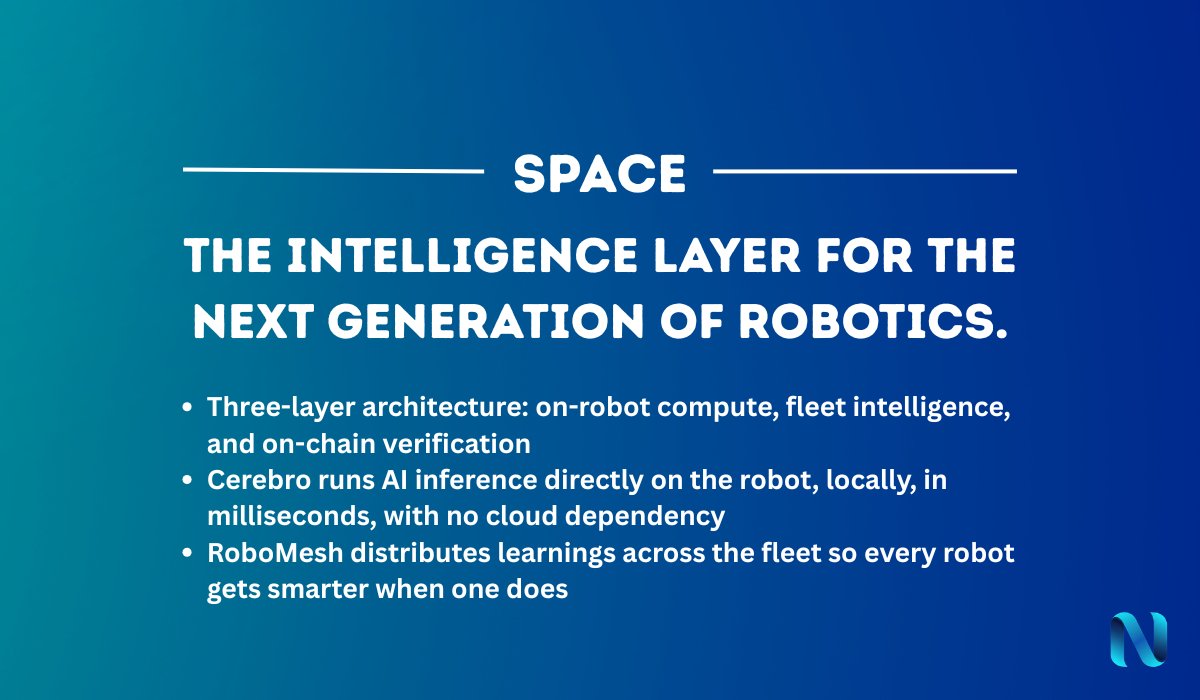
Episode 02 just finished. That was a good one. Nathan went deep. The full architecture, every layer explained from first principles. Why cloud-dependent AI is a liability in physical robotics. How Cerebro runs inference directly on the robot in milliseconds and keeps operating when the network drops. How RoboMesh turns a fleet of robots into a collective intelligence that gets smarter every single day. And the on-chain layer that makes every robot decision auditable, permanent, and verifiable. If you missed it, the replay is right here. x.com/i/spaces/1DGLd… Episode 03 is coming. A lot is in motion.
English
0
0
4
5.3K
NeuroMesh
NeuroMesh@MeshNeuro·
Going live today with Nathan Mc Arthur, CEO of NeuroMesh. March 22, 09:00 UTC: x.com/i/spaces/1DGLd… Episode 01 set the context. The robotics market is accelerating faster than most people are tracking. Hardware is improving every quarter. The big names are spending billions. But the intelligence layer, the thing that actually makes a robot autonomous, reliable, and safe in the real world, remains the unsolved problem nobody is talking about loudly enough. Episode 02 gets into the product. Nathan is going to walk through what NeuroMesh has actually built. On-robot compute that runs inference in milliseconds without a cloud dependency. Fleet coordination that makes every robot smarter when one robot learns something new. And an on-chain verification layer that creates a tamper-proof record of every decision a robot makes. This is not a concept. Cerebro and RoboMesh are live on app.neuro-mesh.io right now. The architecture is real and it is running. If you were at Episode 01, you came back for this. If you are new, everything you need is in the replay but you can follow along fine from here. Come in. Bring questions. A lot is in motion and Nathan will be speaking to what is coming next.
NeuroMesh tweet media
English
12
21
50
14.4K
NeuroMesh
NeuroMesh@MeshNeuro·
The next decade of competitive advantage in manufacturing, logistics, and healthcare will not come from who has the best robots. It will come from who has the best data from their robots. Behavioral graphs, inference logs, environmental maps, task completion records. This data compounds over time. An operator who has been running NeuroMesh-powered units for two years has a fundamentally different asset base than one who just deployed. The hardware is equal. The intelligence layer is not.
English
7
19
46
14.3K
NeuroMesh
NeuroMesh@MeshNeuro·
Safety constraints in traditional robotics are programmed as hard limits. The robot stops when it detects an obstacle. It cannot go above a certain speed. These are brittle rules that break in novel situations. Mathematical safety guarantees using Control Barrier Certificates are fundamentally different. They define invariant constraints that hold regardless of what situation the robot encounters, including situations that were never anticipated during design. That is the difference between a rule and a proof.
English
7
19
42
14.3K
NeuroMesh
NeuroMesh@MeshNeuro·
We've entered into the world of AI and robotics, but what happens when a humanoid robot makes a bad decision? Whose then to blame? -The operator -The manufacturer -AI Model Nobody really seems to know... NeuroMesh has built the proof of inference. Every decision a robot makes on NeuroMesh is cryptographically signed, timestamped, and you can verify it!
English
6
41
64
14.5K
NeuroMesh
NeuroMesh@MeshNeuro·
There are roughly 3.5 million industrial robots operating globally right now. That number will be closer to 30 million by 2030 and will include humanoid models capable of general purpose physical tasks. The infrastructure question is not being asked loudly enough. Who manages the software lifecycle of those robots. Who handles updates, security patches, behavioral audits. Who ensures that a robot upgraded overnight does not wake up with a subtly different decision policy than the one approved by its operator.
English
7
18
39
14.3K
NeuroMesh
NeuroMesh@MeshNeuro·
AI safety is currently just a list of polite requests. We’re doing something different. By moving safety from the software layer directly into the math using Control Barrier Certificates and ZK-proofs, we’ve made "don't do that" a mathematical certainty, not a suggestion.
English
6
19
44
14.2K
NeuroMesh
NeuroMesh@MeshNeuro·
Tokenizing robot behavior is not a crypto gimmick. It is the solution to a real coordination problem. When thousands of robots are operating in shared environments, you need a mechanism for them to exchange data, compensate each other for compute, and negotiate task allocation without a central coordinator. Micro-tokens solve this at the transaction level. The alternative is a centralized orchestration layer that becomes a single point of failure the moment it has any scale.
English
7
18
35
14.3K
NeuroMesh
NeuroMesh@MeshNeuro·
The most undervalued idea in robotics right now is that robots should feel like they belong to you. Not in a creepy sense. In the same sense that your phone feels personalized after a year of use. A robot that has been operating in your facility for six months should behave differently from a fresh unit. It should know your layout, your preferences, your operational patterns. That is not a product feature. That is the entire product.
English
8
17
32
14.6K
NeuroMesh
NeuroMesh@MeshNeuro·
We are early enough in the humanoid robot deployment curve that the infrastructure decisions being made by the first serious operators will become the defaults that the entire industry builds around. This is how it worked in cloud computing, in mobile, in every infrastructure transition before it. The teams moving now are not chasing a trend. They are building the substrate. By the time the market is obvious, the compounding advantages of early infrastructure ownership will already be insurmountable.
NeuroMesh tweet media
English
7
17
29
14.6K
NeuroMesh
NeuroMesh@MeshNeuro·
Just wrapped our first live session with Nathan Mc Arthur, CEO of NeuroMesh. Full replay here: x.com/i/spaces/1oKMv… We opened with what is actually happening in the humanoid robotics market right now. Tesla Optimus on factory floors. Figure with BMW. 1X raising serious capital. The hardware race is real and it is moving fast. But the conversation quickly moved to the gap that the market is not talking about loudly enough. Hardware is only half the problem. The intelligence layer is the unsolved frontier. Nathan broke down what NeuroMesh actually is. Cerebro, the on-robot AI engine that processes at the edge with no cloud latency. RoboMesh, the coordination layer that lets fleets of robots share intelligence and get smarter over time. And Control Barrier Certificates, the mathematical safety framework that makes autonomous robot decisions genuinely safe, not just probably safe. We got into the on-chain angle and why it is architectural, not optional. In a world where robots are making autonomous decisions next to humans, being able to prove what decision was made, why, and on what verified hardware is not a nice feature. It is infrastructure. The session closed with what is coming. Exchange conversations, partnerships, product roadmap. Nothing specific yet, each thing gets its own moment. Strong room. Sharp questions. This is just the start.
English
0
1
2
5.4K
NeuroMesh
NeuroMesh@MeshNeuro·
Going live soon with Nathan Mc Arthur, CEO of NeuroMesh. Starting on March 17, 08:00 UTC: x.com/i/spaces/1oKMv… The humanoid robotics market is moving faster than most people realize. Tesla, Figure, 1X, Boston Dynamics. Billions pouring in, hardware improving every quarter. But there is a gap that nobody in the space is talking about loudly enough. The hardware race has champions. The intelligence layer does not. Nathan is going to break down what is actually happening in robotics right now, why the intelligence problem is the most important unsolved problem in the space, and where NeuroMesh fits into all of it. Plus an update on what is in motion. A lot is happening and he will be talking about what is coming. Come in. Bring questions.
NeuroMesh tweet media
English
8
16
33
10.6K
NeuroMesh
NeuroMesh@MeshNeuro·
The security surface of an autonomous robot in a physical environment is larger than any software system deployed before it. Camera feeds, microphones, environmental sensors, actuator interfaces, wireless connectivity, software update mechanisms — each is a potential attack vector. A robot that can be hijacked does not just leak data. It becomes a physical threat in the space it occupies. Security architecture for autonomous physical systems requires assumptions that are categorically different from enterprise software security, and almost no one is building to those assumptions yet.
English
8
13
28
10.7K
NeuroMesh
NeuroMesh@MeshNeuro·
Swarm intelligence for robot fleets is not about making individual robots smarter. It is about making coordination emergent rather than centrally orchestrated. When each unit in a fleet can observe the state of nearby units, negotiate task allocation locally, and propagate environmental knowledge through the group without a central coordinator, the fleet becomes resilient to the failure modes that centralized systems cannot avoid. That is not a theoretical property. It is the architectural requirement for any deployment beyond a few hundred units.
English
7
13
25
15K
NeuroMesh
NeuroMesh@MeshNeuro·
People underestimate how much of a robot utility comes from memory and context. A robot that resets its understanding of its environment every time it powers down is a robot that has to relearn everything repeatedly. Persistent on-device memory, behavior graphs that accumulate over time, and the ability to build a model of its specific deployment environment are what separate a genuinely useful robot from an expensive automation tool that requires constant human supervision.
English
9
16
27
14.6K
NeuroMesh
NeuroMesh@MeshNeuro·
The coming decade will produce the first industrial-scale deployments of general-purpose humanoid robots, and the infrastructure bets being placed today will determine who captures the value from that transition. Hardware commoditizes. The intelligence layer does not. The behavioral stack, the safety primitives, the verification infrastructure, the data layer — these are the assets that compound. Every operator who deploys on a closed proprietary stack is building on someone else foundation. The open infrastructure play is the durable one.
English
9
18
34
14.7K
NeuroMesh
NeuroMesh@MeshNeuro·
A robot that develops a coherent sense of its operational context over time is categorically more valuable than one that starts fresh on every task. Familiarity with a specific environment reduces decision latency, improves task completion rates, and decreases error frequency. This is not anthropomorphization. It is the engineering consequence of persistent memory and accumulated environmental models. The question of how that accumulated intelligence is stored, secured, and ported between hardware generations is the infrastructure question nobody is asking loudly enough.
NeuroMesh tweet media
English
7
12
27
14.7K