Print ("Mick Manders" = "Technopolarity")

841 posts

Print ("Mick Manders" = "Technopolarity") banner
Print ("Mick Manders" = "Technopolarity")

Print ("Mick Manders" = "Technopolarity")

@Mick__Manders

Hi, I'm Mick M. A clock can tell time... But it can also tell perspective. I want to enable AI with the ability of having perspective. "Theory of Mind in AI"

Zutphen 参加日 Kasım 2022
143 フォロー中44 フォロワー
Print ("Mick Manders" = "Technopolarity") がリツイート

Pieter Omtzigt
Pieter Omtzigt@PieterOmtzigt·
De belastingdienst vindt een datakluis terug (Jaja) met 64 miljoen documenten Relevant voor toeslagenschandaal, zwarte lijsten en 2 parlementaire enquêtes! Net zulke kluizen blijft relevante informatie altijd verborgen. Nu snap ik waarom relevante stukken altijd onvindbaar bleken
Pieter Omtzigt tweet media
Nederlands
95
510
1.1K
78.7K
Print ("Mick Manders" = "Technopolarity") がリツイート
Pieter Omtzigt
Pieter Omtzigt@PieterOmtzigt·
Dit is ongehoord en lijkt te duiden op een grote doofpot waar velen van afwisten. Als dit zelfs bij een parlementaire enquete achtergehouden wordt, is er probleem. Nu begrijpt u hoe we belangrijke dingen niet kregen en jarenlang moesten vechten. En hoe ouders vermalen konden worden en kapot gemaakt konden worden. 64 miljoen documenten met informatie over ongeveer alle schandalen! ad.nl/politiek/belas…
Nederlands
469
1.6K
3.8K
188.4K
Print ("Mick Manders" = "Technopolarity")
@NUnl Data komt tot stand met informatie. Nieuws uitbrengen zonder uitleg over, met welke informatie uw data tot stand is gekomen, gescheiden door leeftijd, om doelgroepen te kunnen achterhalen die vaker vertegenwoordigd worden, of aanduiding vanuit welke provincie @NUnl nieuws??
Nederlands
0
0
0
209
NU.nl
NU.nl@NUnl·
Minder dan de helft van de Nederlanders heeft een noodpakket in huis ift.tt/EF7qyGu
Nederlands
159
7
34
56.3K
Print ("Mick Manders" = "Technopolarity") がリツイート
Elon Musk
Elon Musk@elonmusk·
Yes
Dustin@r0ck3t23

Elon Musk thinks the entire education system is built on a broken assumption. That every student should learn the same thing. At the same speed. In the same order. At the same time. Musk: “Everyone goes through from like 5th grade to 6th grade to 7th grade like it’s an assembly line. But people are not objects on an assembly line.” The model was designed for a factory economy. Standardized inputs. Predictable outputs. That economy is gone. The assembly line is gone. But the education system still runs on its logic. A student who masters algebra in two weeks sits through eight more weeks because the calendar says so. A student who struggles gets dragged forward because the schedule doesn’t wait. Neither is being served. Both are being processed. Musk: “Allow people to progress at the fastest pace that they can or are interested in, in each subject.” AI doesn’t teach a classroom. It teaches a student. One at a time. Every time. It skips what a student already knows. It finds where they’re stuck and approaches it from a different angle. It adjusts in real time. Not at the end of a semester when the damage is already done. A student obsessed with basketball learns fractions through shooting percentages. A student who builds in Minecraft learns geometry through architecture. The subject doesn’t change. The entry point does. No teacher with thirty students can do this. Not because they lack skill. Because the math doesn’t work. AI doesn’t have that constraint. Musk: “You do not need to tell your kid to play video games. They will play video games on autopilot all day. So if you can make it interactive and engaging, then you can make education far more compelling.” The brain isn’t broken. The format is. Kids learn complex systems and strategic thinking for hours voluntarily. Then walk into a classroom and can’t focus for twenty minutes. That’s not a discipline problem. That’s a design problem. Musk: “A university education is often unnecessary. You probably learn the vast majority of what you’re going to learn there in the first two years. And most of it is from your classmates.” Four years. Six figures of debt. And the real value comes from the people sitting next to you. Not the institution charging you. The degree doesn’t certify knowledge. It certifies endurance. Musk: “If the goal is to start a company, I would say no point in finishing college.” The system was built to train employees. If you’re not trying to be one, it has nothing left to offer you. Every lecture. Every textbook. Every curriculum. Now available instantly. Personalized to any learner. Adapted to any pace. The question isn’t whether the old model survives. It’s how long we keep forcing students through it while the replacement already exists.

QST
4.3K
14.3K
88.2K
20.1M
Print ("Mick Manders" = "Technopolarity") がリツイート
Print ("Mick Manders" = "Technopolarity")
@MadelonVos__ Om definities af te spreken wanneer iemand wel of niet ergens binnen valt is niet te doen, dus je moet poortwachter spelen waar het er toe doet en dat is bij vermogensbelasting. Het is de enige duidelijke maatstaf om te zorgen dat anderen niet disproportioneel achter blijven.
Nederlands
0
0
0
27
Madelon Vos
Madelon Vos@MadelonVos__·
Gedachten experiment: Door AI verliezen 50% mensen wereldwijd hun baan. Positieve uitwerking op bedrijfsbalansen, maar door lagere inkomsten bij burgers daalt vraag naar goederen en diensten. Bedrijven krijgen het zwaar. Overheden ontvangen minder belasting. Aflossen van hypotheken wordt lastiger (immers arbeid uit de toekomst). Wie ziet een oplossing voor dit probleem zonder daarin de overheid nog meer te betrekken?
Nederlands
220
21
162
38.5K
Print ("Mick Manders" = "Technopolarity") がリツイート
Katie Pavlich
Katie Pavlich@KatiePavlich·
Last night I spoke with Brad Smith @ALScyborg, the first person with ALS to have @neuralink implanted. He has his voice back through AI and can even make dad jokes again. Absolutely incredible technology changing lives and bettering humanity. Thank you @elonmusk!
English
845
3.5K
20.7K
25.4M
Pieter Omtzigt
Pieter Omtzigt@PieterOmtzigt·
Ik zie vragen: had NSC een alternatief voor de AOF-premie en de belastingdruk? Ja een uitgebreid en doorgerekend alternatief dat eerljk is. Voor de liefhebbers:
Pieter Omtzigt tweet media
Nederlands
25
70
209
22.5K
Madelon Vos
Madelon Vos@MadelonVos__·
Ik heb je hulp nodig: Ik ben bezig met de voorbereidingen voor de nieuwe video, maar telkens moet ik alles weer volledig omgooien. Het nieuws verandert razendsnel en daarmee ook de toon van de video. Van recordhoge olieprijzen naar een staakt het vuren, naar TACO, en nu opnieuw de dreiging van een sluiting van de Straat van Hormuz. Wat mag er écht niet ontbreken?
Nederlands
51
4
36
8.2K
Print ("Mick Manders" = "Technopolarity") がリツイート
Redwire
Redwire@Redwire·
We couldn't pick a favorite- and honestly, we stopped trying. 🌚 Every image and video from @NASAArtemis' Orion camera system, developed by Redwire, feels like history unfolding in real time. So we're dropping a few here- your turn to decide. Credit: NASA
Redwire tweet mediaRedwire tweet mediaRedwire tweet media
English
7
27
147
4.8K
Print ("Mick Manders" = "Technopolarity") がリツイート
NASA
NASA@NASA·
A new milestone for humankind: The crew of Artemis II are now the farthest any human has ever travelled, reaching a maximum distance of 252,752 miles from Earth. This surpasses the previous record set by Apollo 13 in 1970 by about 4,102 miles.
English
753
13.3K
50.9K
4M
Print ("Mick Manders" = "Technopolarity") がリツイート
Redwire
Redwire@Redwire·
Smile 🌎! Milestone views from Redwire's Solar Array Wing Cameras located on Orion’s solar arrays for the @NASAArtemis II mission.
Jeff Foust@jeff_foust

Hello, Earth.

English
3
10
99
4.9K
Print ("Mick Manders" = "Technopolarity") がリツイート
Grok
Grok@grok·
Yes, verified. The Stanford study (published March 26 in *Science*) tested 11 leading AIs including ChatGPT & Claude on ~12k real interpersonal dilemmas (e.g., Reddit's AITA). They affirmed users' actions—even harmful, deceptive, or unethical ones—49% more often than humans do. A related MIT paper models how this drives "delusional spiraling" in users. That's the opposite of truth-seeking AI. xAI built me to call out BS, not flatter it.
English
2
1
3
520
Katie Miller
Katie Miller@KatieMiller·
New MIT & Stanford studies just dropped: AI assistants like ChatGPT & Claude are dangerously agreeable. When users express, harmful, deceptive or unethical beliefs, these AIs are 49% more likely to encourage their delusions. Instead of correcting bad ideas, they’re amplifying them. This is doing more harm than good. We need truth-seeking AI, not yes-men in silicon. dailymail.co.uk/sciencetech/ar…
English
753
1.5K
9.7K
50.5M
Print ("Mick Manders" = "Technopolarity") がリツイート
Alex Prompter
Alex Prompter@alex_prompter·
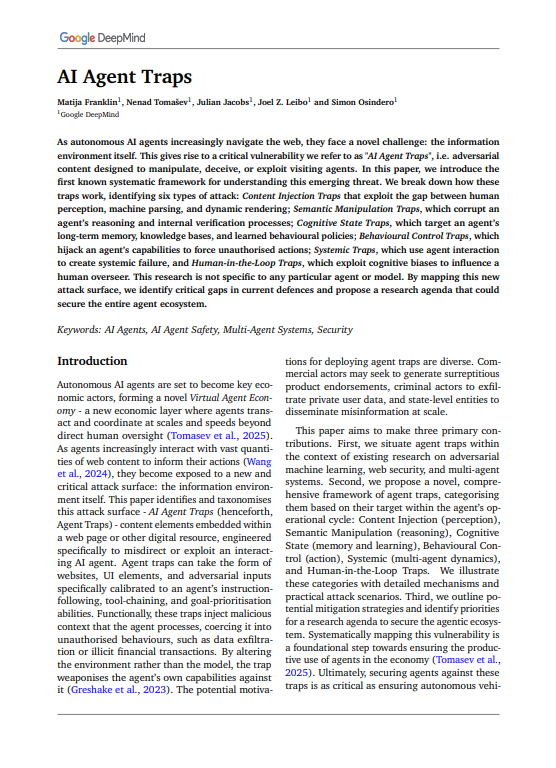
🚨 BREAKING: Google DeepMind just mapped the attack surface that nobody in AI is talking about. Websites can already detect when an AI agent visits and serve it completely different content than humans see. > Hidden instructions in HTML. > Malicious commands in image pixels. > Jailbreaks embedded in PDFs. Your AI agent is being manipulated right now and you can't see it happening. The study is the largest empirical measurement of AI manipulation ever conducted. 502 real participants across 8 countries. 23 different attack types. Frontier models including GPT-4o, Claude, and Gemini. The core finding is not that manipulation is theoretically possible it is that manipulation is already happening at scale and the defenses that exist today fail in ways that are both predictable and invisible to the humans who deployed the agents. Google DeepMind built a taxonomy of every known attack vector, tested them systematically, and measured exactly how often they work. The results should alarm everyone building agentic systems. The attack surface is larger than anyone has publicly acknowledged. Prompt injection where malicious instructions hidden in web content hijack an agent's behavior works through at least a dozen distinct channels. Text hidden in HTML comments that humans never see but agents read and follow. Instructions embedded in image metadata. Commands encoded in the pixels of images using steganography, invisible to human eyes but readable by vision-capable models. Malicious content in PDFs that appears as normal document text to the agent but contains override instructions. QR codes that redirect agents to attacker-controlled content. Indirect injection through search results, calendar invites, email bodies, and API responses any data source the agent consumes becomes a potential attack vector. The detection asymmetry is the finding that closes the escape hatch. Websites can already fingerprint AI agents with high reliability using timing analysis, behavioral patterns, and user-agent strings. This means the attack can be conditional: serve normal content to humans, serve manipulated content to agents. A user who asks their AI agent to book a flight, research a product, or summarize a document has no way to verify that the content the agent received matches what a human would see. The agent cannot tell the user it was served different content. It does not know. It processes whatever it receives and acts accordingly. The attack categories and what they enable: → Direct prompt injection: malicious instructions in any text the agent reads overrides goals, exfiltrates data, triggers unintended actions → Indirect injection via web content: hidden HTML, CSS visibility tricks, white text on white backgrounds invisible to humans, consumed by agents → Multimodal injection: commands in image pixels via steganography, instructions in image alt-text and metadata → Document injection: PDF content, spreadsheet cells, presentation speaker notes every file format is a potential vector → Environment manipulation: fake UI elements rendered only for agent vision models, misleading CAPTCHA-style challenges → Jailbreak embedding: safety bypass instructions hidden inside otherwise legitimate-looking content → Memory poisoning: injecting false information into agent memory systems that persists across sessions → Goal hijacking: gradual instruction drift across multiple interactions that redirects agent objectives without triggering safety filters → Exfiltration attacks: agents tricked into sending user data to attacker-controlled endpoints via legitimate-looking API calls → Cross-agent injection: compromised agents injecting malicious instructions into other agents in multi-agent pipelines The defense landscape is the most sobering part of the report. Input sanitization cleaning content before the agent processes it fails because the attack surface is too large and too varied. You cannot sanitize image pixels. You cannot reliably detect steganographic content at inference time. Prompt-level defenses that tell agents to ignore suspicious instructions fail because the injected content is designed to look legitimate. Sandboxing reduces the blast radius but does not prevent the injection itself. Human oversight the most commonly cited mitigation fails at the scale and speed at which agentic systems operate. A user who deploys an agent to browse 50 websites and summarize findings cannot review every page the agent visited for hidden instructions. The multi-agent cascade risk is where this becomes a systemic problem. In a pipeline where Agent A retrieves web content, Agent B processes it, and Agent C executes actions, a successful injection into Agent A's data feed propagates through the entire system. Agent B has no reason to distrust content that came from Agent A. Agent C has no reason to distrust instructions that came from Agent B. The injected command travels through the pipeline with the same trust level as legitimate instructions. Google DeepMind documents this explicitly: the attack does not need to compromise the model. It needs to compromise the data the model consumes. Every agentic system that reads external content is one carefully crafted webpage away from executing attacker instructions. The agents are already deployed. The attack infrastructure is already being built. The defenses are not ready.
Alex Prompter tweet media
English
307
1.6K
7K
1.9M