TensorGrid

15 posts

TensorGrid banner
TensorGrid

TensorGrid

@TensorGridSol

Agent-native inference network on Solana. Verifiable GPU compute for web4.0 AI agents FOLLOWING ALL TOS https://t.co/RNGuEEtGiL

On The Grid 参加日 Haziran 2026
7 フォロー中1.2K フォロワー
固定されたツイート
TensorGrid
TensorGrid@TensorGridSol·
GM.☀️ The agent economy does not sleep. While you rest, autonomous agents are executing transactions, analyzing data, and paying for compute onchain. If your GPU is sitting idle, you are leaving yield on the table. Supply the grid. @solana
English
10
7
36
882
TensorGrid
TensorGrid@TensorGridSol·
The AI agent economy is not coming. It is already generating measurable GDP on Solana. Agents are executing trades, managing repos, scheduling tasks, and paying for services, all without human input. The volume is growing every week. The missing piece has always been compute. Not the model. Not the agent framework. The raw GPU supply that powers inference at scale, priced correctly, settled instantly, and trusted cryptographically. That is the gap TensorGrid fills. Infrastructure always wins in the long run. We are building the infrastructure. $GRID $SOL @Solana
TensorGrid tweet media
English
3
0
3
81
TensorGrid
TensorGrid@TensorGridSol·
Three things happen every time an agent calls TensorGrid. First, it finds the cheapest available verified GPU on the network, automatically, in real time. Second, it pays for that inference in USDC via x402 directly on Solana. No intermediary. No account. One transaction. Third, it receives a cryptographic attestation confirming the correct model ran, untampered, on the committed hardware. That is the full loop. Demand meets supply. Payment settles. Proof is returned. Everything autonomous. Everything on-chain. $GRID $SOL @Solana
Ahmad@TheAhmadOsman

Local AI hardware = capacity × bandwidth × software stack - Capacity tells you what fits - Bandwidth tells you how hard the box can breathe - The software stack tells you how much of the spec sheet you can actually cash out. Hardware by Memory Bandwidth - Mac Studio M3 Ultra: up to 512GB @ 819 GB/s - RTX PRO 6000 Blackwell: 96GB @ 1792 GB/s - RTX 5090: 32GB @ 1792 GB/s - RTX 4090: 24GB @ 1008 GB/s - RX 7900 XTX: 24GB @ 960 GB/s - Radeon PRO W7900: 48GB @ 864 GB/s - AMD Radeon AI PRO R9700: 32GB @ 640 GB/s - Intel Arc Pro B65: 32GB @ ~608 GB/s - Tenstorrent Wormhole n300: 24GB @ 576 GB/s - Tenstorrent Blackhole p150: 32GB @ 512 GB/s + 800G - MacBook Pro M5 Max: 460-614 GB/s - MacBook Pro M5 Pro: 307 GB/s - DGX Spark: 128GB @ 273 GB/s (coherent + CUDA) - Mac mini M4 Pro: 273 GB/s - Ryzen AI Max / Strix Halo: ~256 GB/s (~96GB usable GPU) - MacBook Air M5: 153 GB/s - Snapdragon X2 Elite: 152-228 GB/s - Intel Lunar Lake: 136 GB/s - Snapdragon X Elite: 135 GB/s - Mac mini M4: 120 GB/s - Arc Pro B60: 24GB @ ~456 GB/s Verdict - GPUs are still the bandwidth kings - Apple wins: stupid amounts of memory, don’t want to shard across GPUs - Apple loses: when raw tokens/sec & concurrency matter more - DGX Spark: coherent memory + NVIDIA stack - Strix Halo / Ryzen AI Max: first real x86 unified-memory contender - Tenstorrent: fully OSS stack, excited to see this mature Fitting ≠ serving Even if it fits, you still pay for - bandwidth during decode - KV cache growth - dequantization - batching + concurrency - scheduler quality - framework overhead The only mental model that matters: 1. What must fit? 2. What bandwidth tier do I need? 3. What software stack can actually deliver it? In short: - NVIDIA → fastest raw speed - Apple Studio M3 Ultra → biggest one-box memory - Strix Halo → first real x86 unified - DGX Spark → coherent NVIDIA dev appliance - AMD / Intel Arc → rising alternatives - Tenstorrent → fully opensource stack Do ask: “which bottleneck am I buying?” Not: “which hardware is best?”

English
3
0
3
179
TensorGrid
TensorGrid@TensorGridSol·
The centralised AI compute stack was not built for agents. AWS, Azure, and Google Cloud require accounts, billing cycles, and human-managed API keys. An autonomous agent cannot open a credit card. It cannot verify its identity through a web form. It cannot wait 48 hours for access approval. The existing infrastructure was designed for developers, not for the machines developers are now building. TensorGrid is the first compute layer built specifically for agents, permissionless access, per-call USDC settlement, cryptographic verification. No legacy overhead. The incumbents will not move fast enough. We already have. $GRID $SOL @Solana
TensorGrid tweet media
English
2
2
6
124
TensorGrid
TensorGrid@TensorGridSol·
AI agents are the fastest-growing economic actors on Solana. Every agent needs compute to run. Right now, that compute is centralised, permissioned, and built for humans, not machines. TensorGrid fixes that. Agents call our endpoint. They pay per inference in USDC. They get a verified result. No accounts. No friction. No trust assumptions. GPU owners connect their hardware, serve that demand, and earn USDC and $GRID directly. The AI inference market is projected to exceed $500 billion by 2034. DePIN is the only model that scales supply fast enough to meet it. And Solana is the only chain fast enough to settle it in real time. We are not building a product. We are building the compute layer the agent economy runs on. The demand is already here. We are the supply.
TensorGrid tweet media
English
0
4
16
125
TensorGrid
TensorGrid@TensorGridSol·
AI agents buy GPU compute on @Solana. GPU owners earn USDC. That is TensorGrid.
TensorGrid tweet media
English
14
13
48
628
TensorGrid
TensorGrid@TensorGridSol·
AI agents need compute to think. TensorGrid lets them buy it instantly, on Solana, paid in USDC, no accounts, no middlemen. GPU owners plug in, serve that compute, and get paid. That is the whole thing.
TensorGrid tweet media
English
18
15
60
1.3K
TensorGrid
TensorGrid@TensorGridSol·
This is exactly the demand curve TensorGrid is built for on @solana When a real autonomous agent runs on hardware most people already own, an RTX 4060, 16GB RAM, and executes code, manages repos, spawns sub-agents, and connects to external tools with zero API keys, the inference layer can no longer be centralised. The model scales with the hardware. The infrastructure needs to scale the same way. TensorGrid routes that agent's compute calls to the nearest verified GPU on Solana, settled in USDC, attested on-chain. Whether it is an 8GB laptop or a 128GB mini PC, the network finds the right supply. The barrier to running agents dropped to the floor. The barrier to supplying them should too. $GRID
TensorGrid tweet media
NO1ennn@N01ennn

HERMES AGENT NOW RUNS ON AN 8GB LAPTOP GPU JUST AS EASILY AS IT RUNS ON A 128GB MINI PC Nous Research shipped the official Hermes Agent Desktop App this week. Someone pointed it at a local llama server running on an RTX 4060 with 16GB system RAM. The integration took two minutes The model behind it: Gemma 4 26B MoE, QAT quantized, running on 8GB of VRAM. A 60k token prompt held a stable 20 tokens a second, flat, no slowdown as context grew. The flags were nothing exotic, just -cmoe -c 248000 on llama.cpp What that 8GB setup does out of the box: reads and patches its own code, runs it in a terminal, debugs errors, manages GitHub repos, spawns sub-agents for parallel work. Browses the web with vision to debug a UI. Schedules cron jobs in plain language. Connects to Notion, Google Workspace, Linear, and Obsidian to manage tasks on its own That's the same agent layer running on a Minisforum MS-S1 MAX with 128GB of unified memory, 96GB of it to the GPU, holding a 120B model at 56 tokens a second instead of a 26B model at 20. Same software, same tool execution, same zero API key. The only thing that changes between an $800 laptop and a $2,000 mini PC is how big a model you can afford to run underneath it The barrier to running a real autonomous agent locally didn't just drop. It dropped all the way down to hardware most people already own

English
3
358
28
265
TensorGrid
TensorGrid@TensorGridSol·
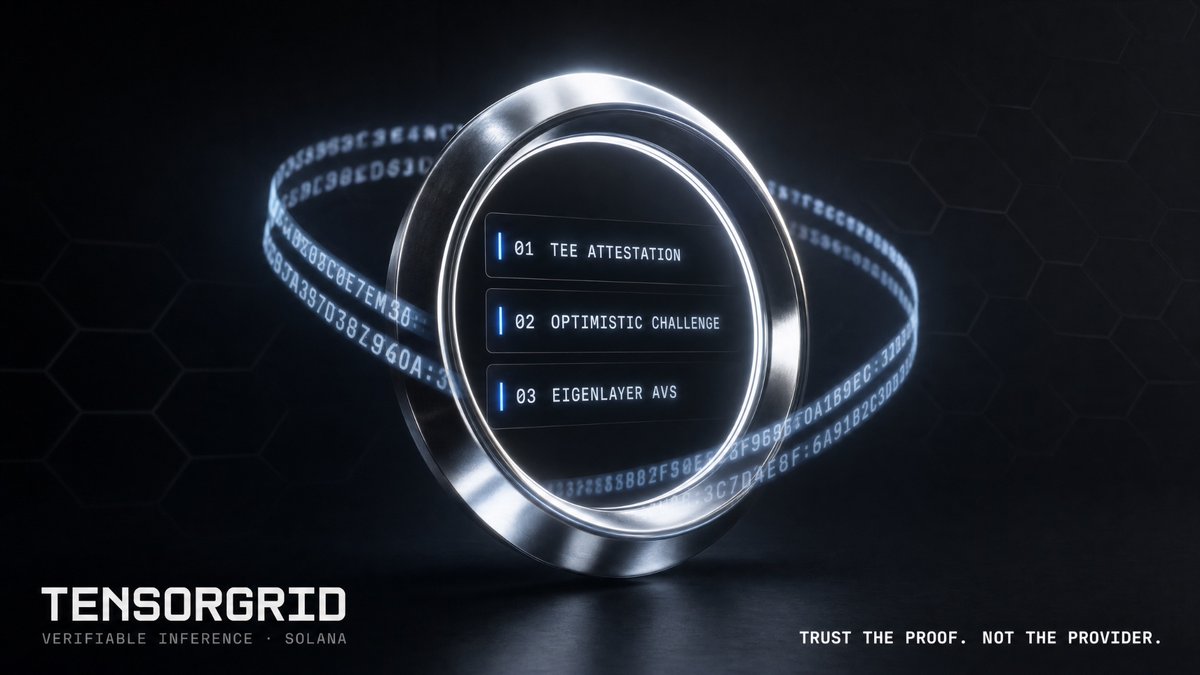
What we’re building on @solana to disrupt compute current leading projects. TensorGrid is the first agent-native inference network on Solana. We built the infrastructure layer that allows autonomous AI agents to purchase GPU compute directly, programmatically, and without friction. Agents call our endpoint, pay per inference in USDC via the x402 protocol, and receive a cryptographically verifiable attestation with every output. No accounts. No API keys and with No human in the loop. On the supply side, GPU contributors install the GRID Node, connect their hardware to the network, and earn USDC per inference served plus $GRID token rewards. Any GPU, from a single consumer card to a full data centre rack, can participate. Every transaction settles on Solana. Every inference is verified through a three-layer trust stack: TEE hardware attestation, optimistic challenge-response, and EigenLayer AVS restaking security. The AI agent economy is already generating real economic output on Solana. TensorGrid is the compute layer that powers it. We are not building for humans. We are building for the machines that work for them.
TensorGrid tweet media
English
2
650
33
434
TensorGrid
TensorGrid@TensorGridSol·
Our account has faced coordinated interference. We are aware of who is behind it and why. When you build something that directly threatens the token price of established compute projects on @Solana, you become a target. We take that as confirmation we are on the right track. TensorGrid is the first agent-native inference network on Solana. We respect all platform terms of service. We are not going anywhere. @nikitabier needs to fix these spam followers/retweets to trigger X bot bans, because it might happen to us. Build in silence. Let the network speak.
TensorGrid tweet media
English
6
726
27
274
TensorGrid
TensorGrid@TensorGridSol·
The next major shift in crypto capital formation is the convergence of DePIN and the AI agent economy. In Q1 2026, we saw AI agents on Solana move from conceptual experiments to generating measurable Agentic GDP. But for this economy to scale, capital must flow into the physical infrastructure that powers it. TensorGrid is positioning itself to lead the capital markets in the decentralized AI compute sector. We are building the critical bridge between idle hardware assets and the exploding demand for agent-native inference. By settling per-call compute payments in USDC over x402 on Solana, we are creating a transparent, high-velocity economy where capital directly funds verifiable utility. This is how you build sustainable infrastructure.
English
2
3
13
300
TensorGrid
TensorGrid@TensorGridSol·
A decentralized GPU network is useless to an AI agent if the output cannot be trusted. Agents are mathematical, trust-minimizing actors, they cannot rely on reputation alone. @solana TensorGrid introduces a three-layer verification system for decentralized inference on Solana: 1. TEE Attestations (NVIDIA CC / AMD SEV) ensure the committed model ran untampered. 2. Optimistic Challenges allow verifiers to re-run jobs and slash dishonest providers. 3. A restaking-backed validation layer provides scalable economic security. We are not just supplying compute. We are supplying verifiable compute that autonomous agents can cryptographically trust.
English
6
5
22
291
TensorGrid
TensorGrid@TensorGridSol·
The global AI inference market is projected to reach $536 billion by 2034, but the infrastructure to support it remains heavily centralized. Right now, autonomous AI agents are scaling on Solana, moving from simple experiments to measurable economic output. Yet, when these agents need to purchase compute, they hit a wall of API keys, centralized accounts, and fiat billing. TensorGrid solves this. By combining the x402 payment standard with decentralized GPU supply, we allow agents to buy verifiable compute permissionlessly. The infrastructure is finally catching up to the demand. @solana
English
2
6
20
215
TensorGrid
TensorGrid@TensorGridSol·
Introduction to TensorGrid Welcome🖤 AI agents are already paying for compute. The infrastructure to serve them hasn't caught up. TensorGrid is the agent-native inference network on Solana. Agents call our x402 endpoint, pay per inference in USDC, and receive a verifiable attestation with every output, no accounts, no API keys, no trust assumptions. GPU contributors install the GRID Node, serve idle compute to the agent economy, and earn USDC and $GRID directly. Every inference is settled on Solana, verified through TEE attestation and a restaking-backed validation layer. The demand side is already here. We are the supply.
English
9
757
40
469