Intelpoint

4K posts

Intelpoint banner
Intelpoint

Intelpoint

@TheIntelpoint

Decision-making insights, infographics, and reports for everyone! (A product of @Businessfront) 🌐https://t.co/YRxnqCIpD1

Lagos, Nigeria 参加日 Mayıs 2021
5 フォロー中5.1K フォロワー
固定されたツイート
Intelpoint
Intelpoint@TheIntelpoint·
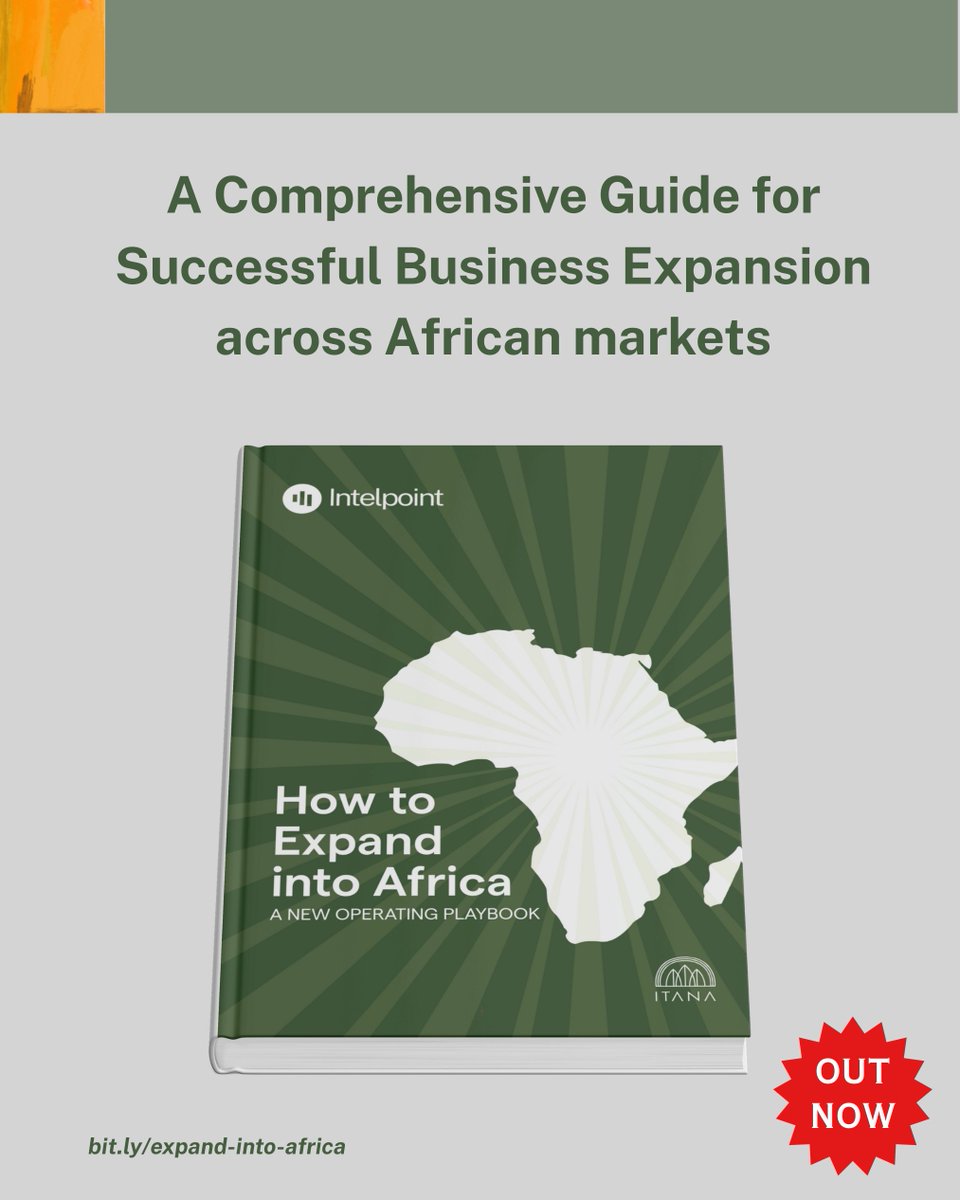
📢 New Report: How to expand into Africa Africa is a market of over 1.5 billion people, with accelerating digital adoption. In partnership with @ItanaAfrica, we've put together a practical guide for expansion in Africa. Get the guide now intelpoint.co/report/how-to-…
Intelpoint tweet media
English
1
8
14
2.4K
Intelpoint
Intelpoint@TheIntelpoint·
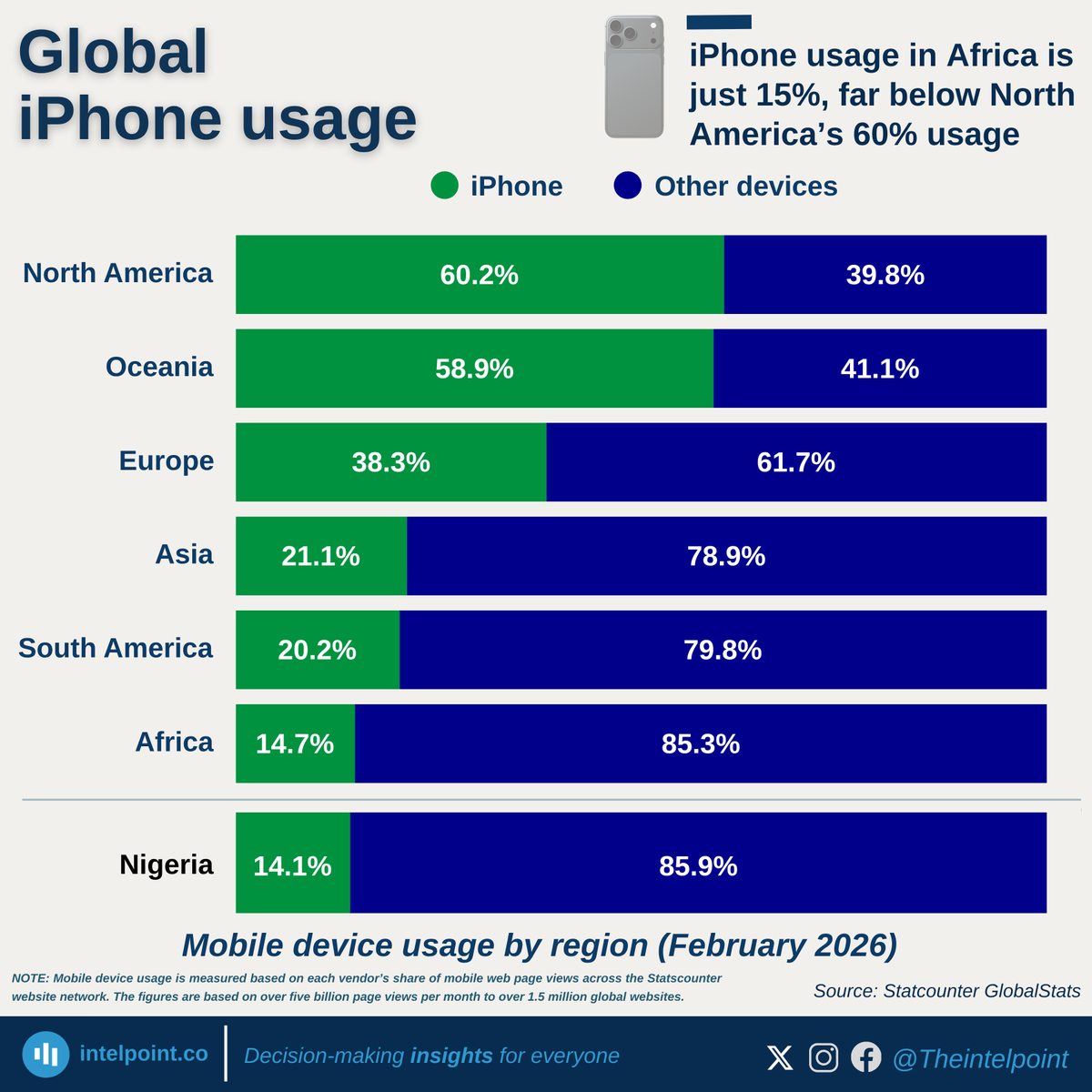
Global iPhone usage shows that adoption isn’t evenly spread. In regions like North America and Oceania, iPhones dominate the mobile experience, accounting for around 60% of usage. In Africa, that share drops dramatically to 14.7%, with Nigeria mirroring that reality closely at 14.1%. This points to a mix of affordability, market structure, and consumer priorities shaping device choices. Android devices — often more accessible and diversely priced — fill the space where iPhones remain aspirational rather than mainstream. In many African cities, new iPhone releases still dominate conversations, trends, and online engagement, as anticipation of upcoming models often spikes interest. Interestingly, ownership doesn’t follow the same pattern as attention.
Intelpoint tweet media
English
0
0
1
17
Intelpoint
Intelpoint@TheIntelpoint·
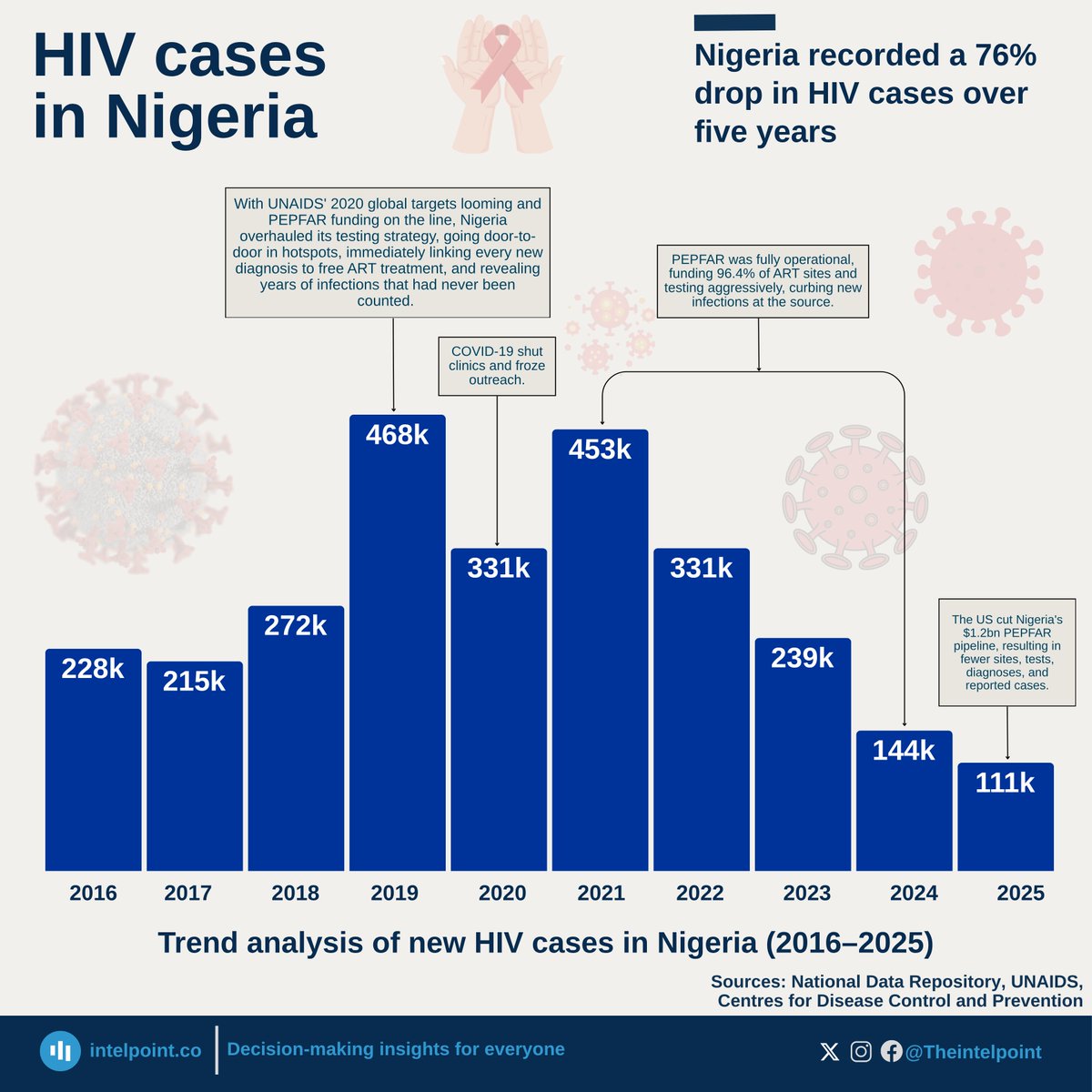
Nigeria's HIV data between 2016 and 2025 tells a story of losing the funding that made proper counting and investment in treatment possible. From 2016 to 2018, Nigeria reported between 215,000 and 272,000 new cases annually. These numbers felt stable but were largely a reflection of a weak testing system that couldn’t capture existing but undiscovered cases. In 2019, everything changed. With UNAIDS' global 90-90-90 deadline a year away and the US President's Emergency Plan for AIDS Relief (PEPFAR) —America's flagship HIV funding programme — tying its allocations to measurable progress, Nigeria overhauled its entire testing infrastructure; the result was 468,000 new diagnoses because Nigeria finally went looking properly. Then COVID hit. Cases dropped to 331,000 in 2020, when COVID hit, as clinics closed, outreach froze, and thousands of infections went undetected. The 2021 rebound to 453,000 was simply the backlog clearing. The real story began in 2022. With PEPFAR funding 96.4% of Nigeria's treatment sites, nearly two million Nigerians were placed on Antiretroviral Therapy (ART), a daily medication that suppresses HIV to undetectable levels, making transmission impossible. Cases fell every year without exception: 331,000 in 2022, 239,000 in 2023, and 144,000 in 2024 — a 70% decline in three years, driven by treatment working exactly as the science said it would. Then, in early 2025, the US froze its foreign assistance. Nigeria lost $1.2 billion in HIV funding; testing sites closed, outreach reduced, and diagnostics collapsed. Cases fell to 111,000, the lowest in the dataset. This time the fall is not a victory; with fewer people being tested, fewer cases appear on paper, while the virus spreads freely. Nigeria may be returning to 2016 levels not because HIV has retreated, but because the system monitoring it has stopped working.
Intelpoint tweet media
English
0
1
4
41
Intelpoint がリツイート
Intelpoint
Intelpoint@TheIntelpoint·
As of December 2023, Johannesburg had the highest number of millionaires (12,300) in Africa; Cape Town followed with 7,400 millionaires. South Africa dominated the list, with its cities and regions claiming top spots.
Intelpoint tweet media
English
3
16
24
11.9K
Intelpoint
Intelpoint@TheIntelpoint·
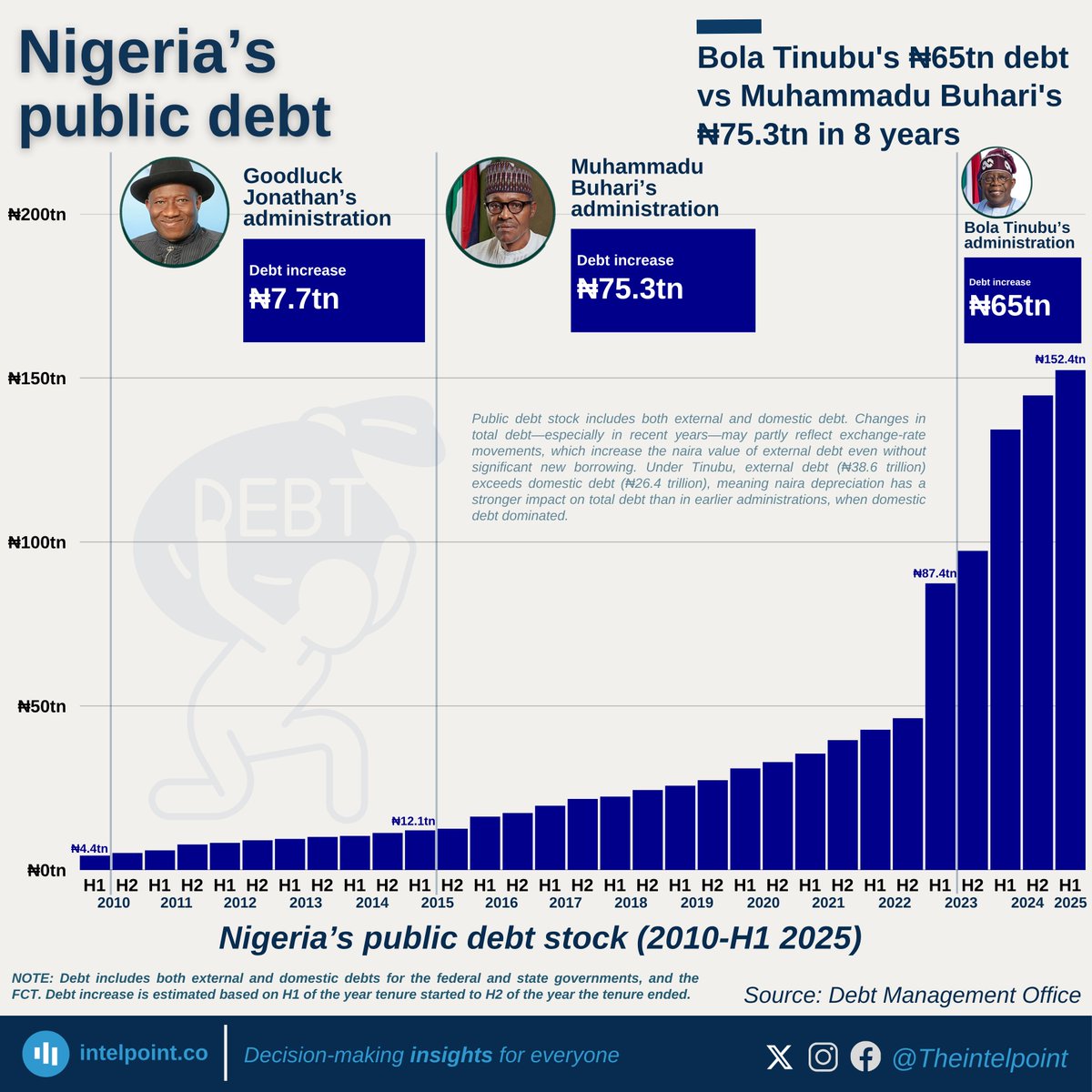
Nigeria’s debt has shifted into a phase of rapid acceleration. Debt has quickly expanded in recent years, with the total stock rising sharply to about ₦152.4 trillion by H1 2025. The pace of increase, particularly from 2022 onward, signals a change in borrowing patterns rather than a continuation of past trends. Debt is not just growing—it is compounding faster than before. A striking comparison reinforces this shift: Bola Tinubu’s administration has seen debt increase by roughly ₦65 trillion in just two years, nearly matching the ₦75.3 trillion increase over eight years under Muhammadu Buhari. During Tinubu’s latest trip to the UK, Nigeria secured a £746 million (about $1 billion) export finance deal to fund the rehabilitation of key ports in Lagos. This means new borrowing is not just high and tied to infrastructure and bilateral agreements, it is continuing in real time.
Intelpoint tweet media
English
0
0
2
149
Intelpoint がリツイート
Intelpoint
Intelpoint@TheIntelpoint·
At the end of every year from 2017 to 2023, Nigeria added between $800m and $7.5b to its external debt. After repaying $3.5 billion of its external debt in 2023, the country's external debt only increased by $800m as of December, marking the lowest increase in the past 7 years.
Intelpoint tweet media
English
0
10
17
1.3K
Intelpoint
Intelpoint@TheIntelpoint·
Nigeria's defence budget tells a tale of two metrics pulling apart. In raw naira terms, the country has never spent more on security, but as a share of national spending, defence has been in long decline, from 21.2% in 2013 to single digits by 2025. The critical question it raises is, did allocations respond to security crises? The Chibok Girls episode didn't reverse the slide, and Northwest banditry, which has been escalating since 2017, saw the share fall. The 2020 figure is the most damning: at peak insecurity, the budget response was a cut to 9%. The one clear exception is 2025, where both absolute spend and share rebounded sharply, a likely response to combined pressure from banditry, Northeast insurgency, and Niger Republic instability. But the immediate reversal to a historic low of 9.3% in 2026 confirms this was a one-year surge, not a strategic shift.
Intelpoint tweet media
English
1
3
5
261
Intelpoint
Intelpoint@TheIntelpoint·
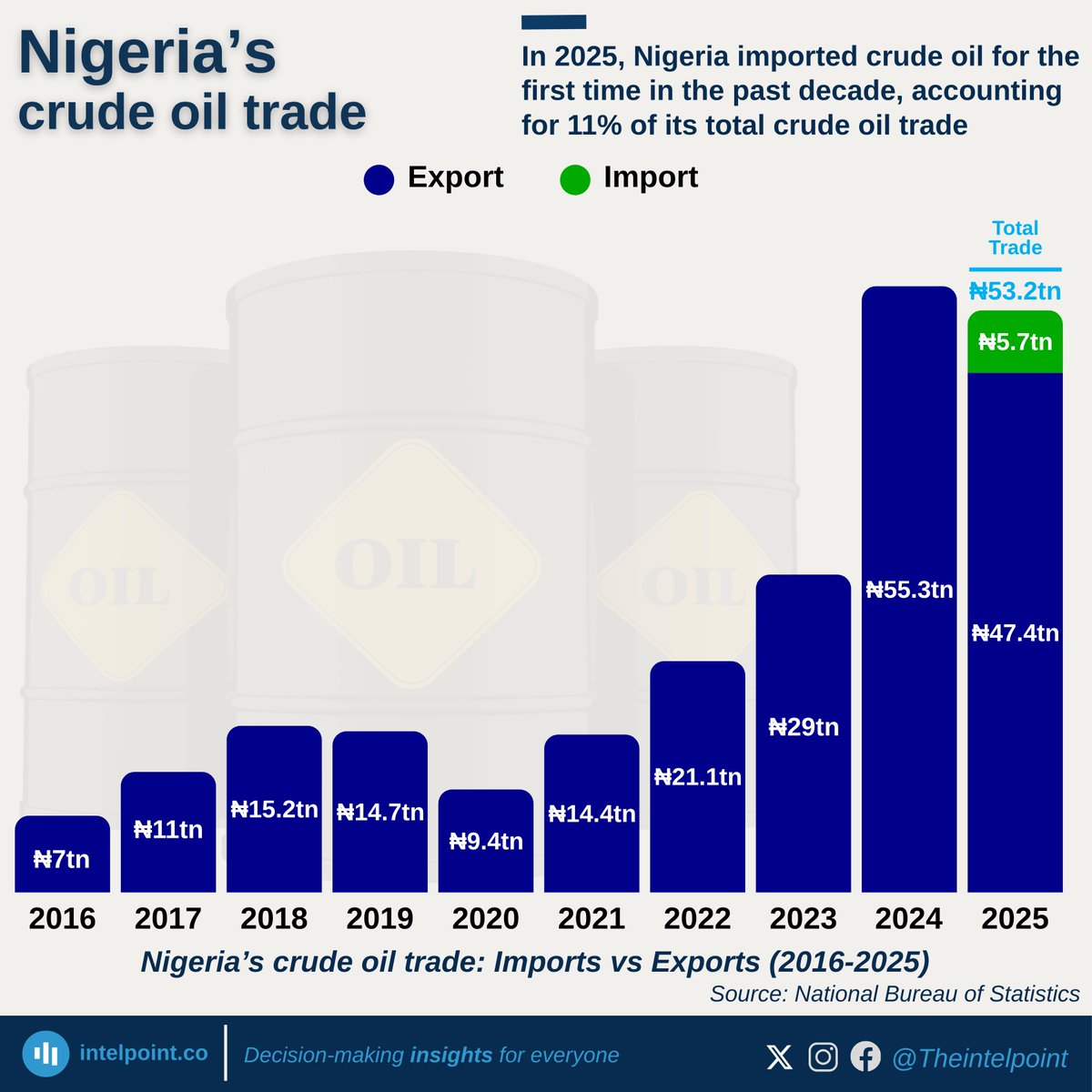
For years, Nigeria operated as a pure exporter of crude oil, consistently exporting and generating trade earnings. But the pattern broke in 2025, with Nigeria recording crude oil imports for the first time in years, accounting for 11% of total trade. It’s a small share relative to exports. Still, symbolically, it signals a structural shift in how the country participates in the global oil market, driven by the emergence of the Dangote Refinery, which imports part of its crude oil.
Intelpoint tweet media
English
0
3
6
1.5K
Intelpoint がリツイート
Intelpoint
Intelpoint@TheIntelpoint·
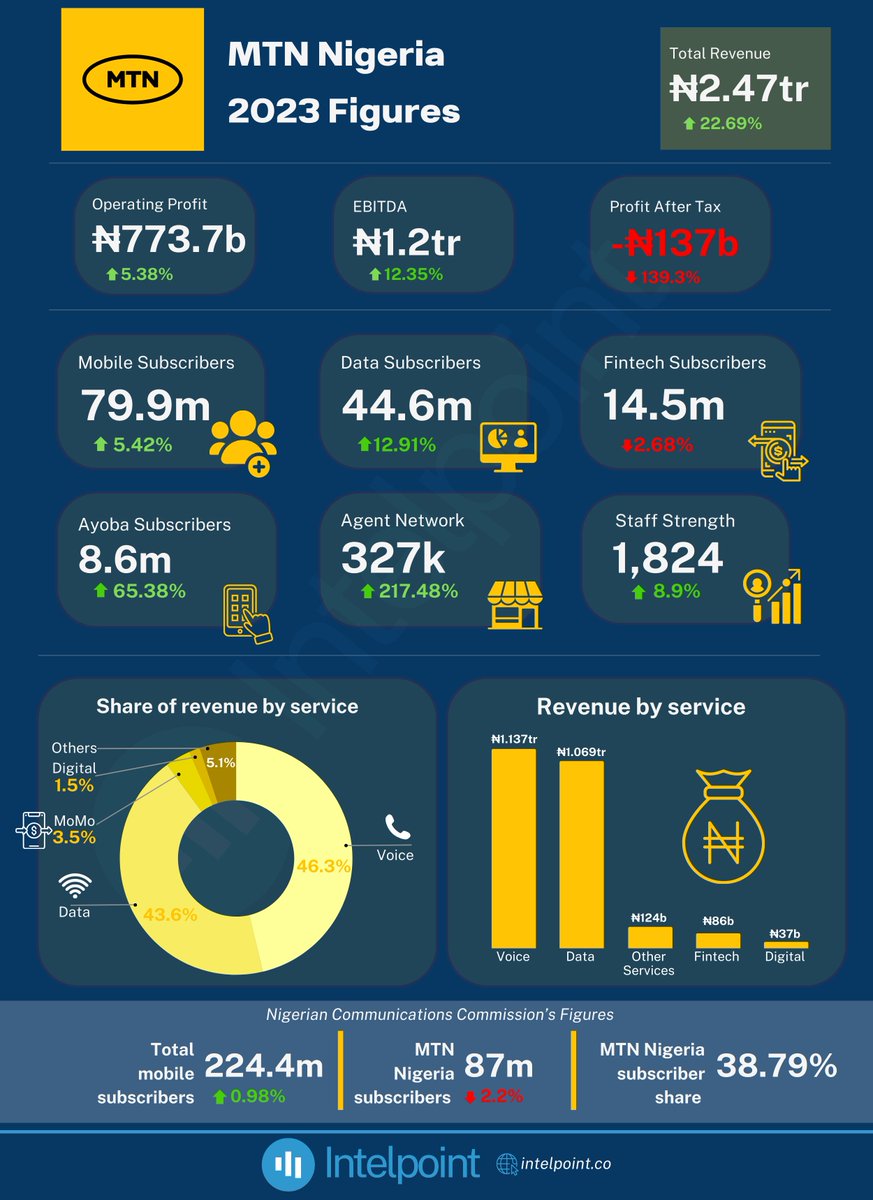
Despite a ₦2.5tr revenue in 2023, MTN Nigeria recorded a negative profit after tax of ₦137b. It will also be the first time it has recorded a loss since 2018, attributed to FX loss, as the naira has recorded a massive fall against the US$ in the past year.
Intelpoint tweet media
English
1
11
16
2.6K
Intelpoint がリツイート
Intelpoint
Intelpoint@TheIntelpoint·
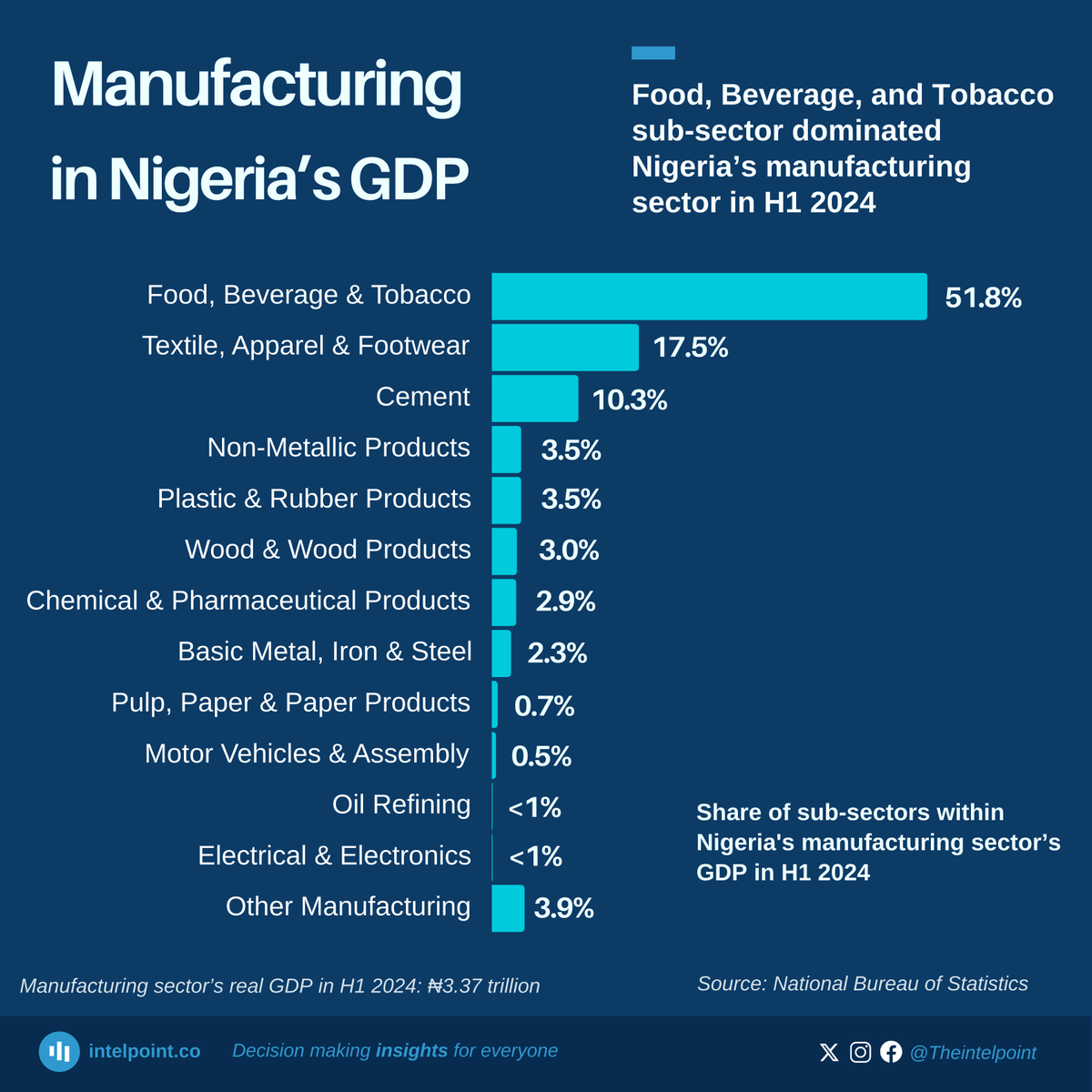
Nigeria's manufacturing sector contributed 9.2% (₦3.37 trillion) to the total GDP in H1 2024, mainly driven by food, clothing, and cement, which make up a combined 79.5% of the sector's GDP. Smaller sectors like Non-Metallic Products, Wood & Wood Products, and Motor Vehicles & Assembly could expand with targeted investments. The minimal impact of Oil Refining and Electrical & Electronics underscores the need for diversification. #Nigeria #Manufacturing #GDP #EconomicGrowth
Intelpoint tweet media
English
0
12
22
3.3K
Intelpoint がリツイート
Intelpoint
Intelpoint@TheIntelpoint·
Between 2005 and 2022, Cote d'Ivoire's natural rubber production grew at an average of 12% yearly, maintaining its continental dominance. With an estimated population of nearly 29 million, the West African country produced 1.286 million tonnes in 2022, 73% of the continent's output, and placed fourth globally. Meanwhile, Nigeria's production has grown 158% since 1961, peaking at 155 thousand tonnes in 1991.
English
1
6
5
1.1K
Intelpoint
Intelpoint@TheIntelpoint·
Contact Intelpoint for market research, analyses, industry trends, and reports. bit.ly/3vLopm5
English
0
1
0
98
Intelpoint がリツイート
Intelpoint
Intelpoint@TheIntelpoint·
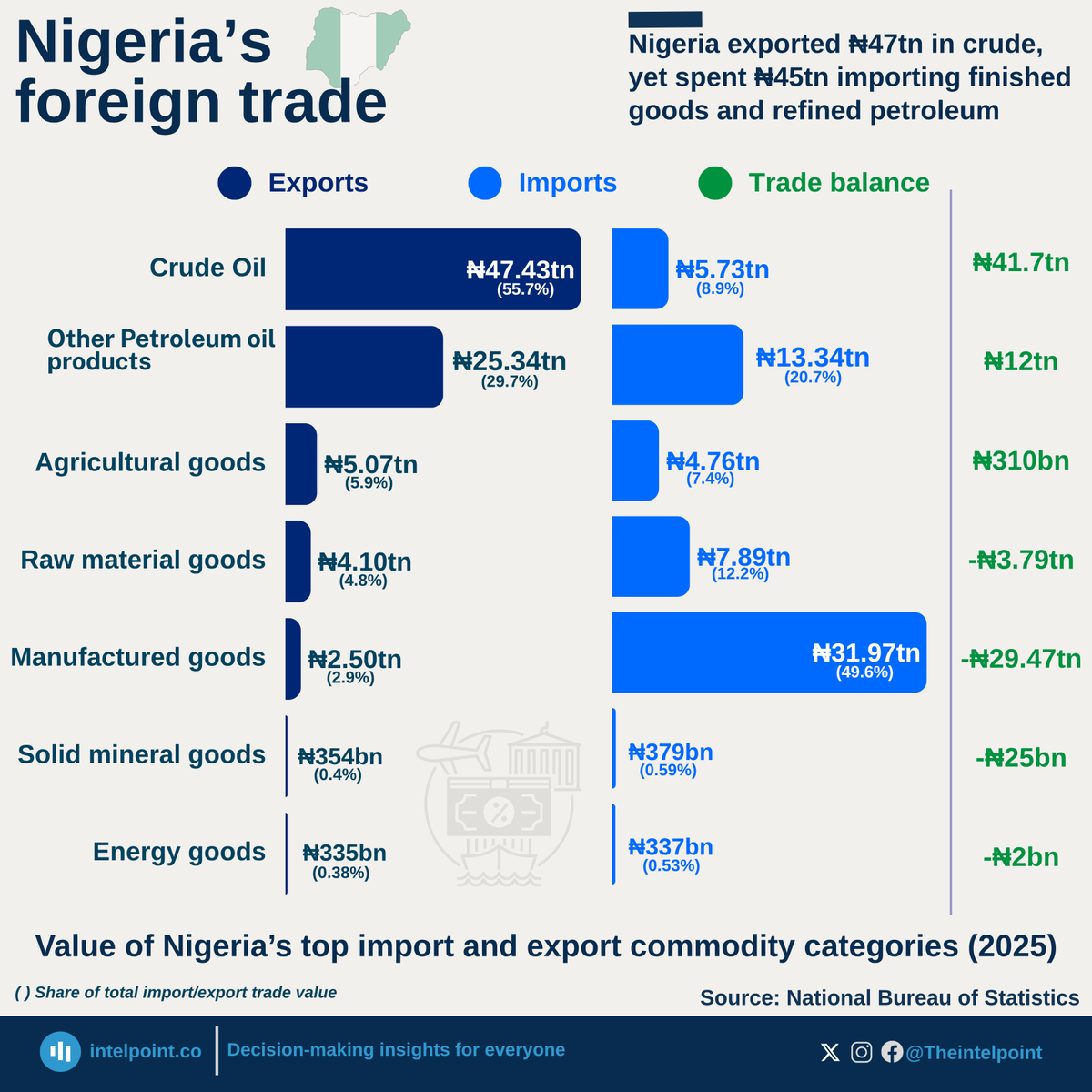
Nigeria's 2025 trade figures tell a story of an economy that has perfected the art of selling raw and buying refined. When commodities are categorised into sectors, a surplus of ₦20.71 trillion is achieved, a number that looks reassuring until you pull the crude oil thread. Crude alone contributed ₦47.43 trillion to exports, more than all other sectors combined. Strip it out, and the picture inverts sharply: a ₦26.72 trillion non-oil deficit, revealing an economy structurally reliant on a single underground resource to paper over its industrial shortfalls. The petroleum sector itself tells a contradictory story; Nigeria exported ₦25.3 trillion in petroleum products while simultaneously importing ₦13.3 trillion of refined petroleum, paying foreign refineries to process what it digs from its own ground. The manufactured goods column may be the most sobering figure in the entire dataset. At ₦31.97 trillion in imports against just ₦2.5 trillion in exports, it represents a 12-to-1 ratio that captures decades of deindustrialisation in a single line. Nigeria is not buying what it cannot make; it is buying almost everything it uses. Agriculture compounds the concern — despite being home to some of West Africa's most fertile land and a workforce with deep farming roots, the sector produced a net trade contribution of barely ₦310 billion. Energy goods and solid minerals barely register at all, each below ₦400 billion in both directions.
Intelpoint tweet media
English
3
15
25
3.4K
Intelpoint
Intelpoint@TheIntelpoint·
Contact Intelpoint for market research, analyses, industry trends, and reports. bit.ly/3vLopm5
English
0
0
0
65
Intelpoint がリツイート
Intelpoint
Intelpoint@TheIntelpoint·
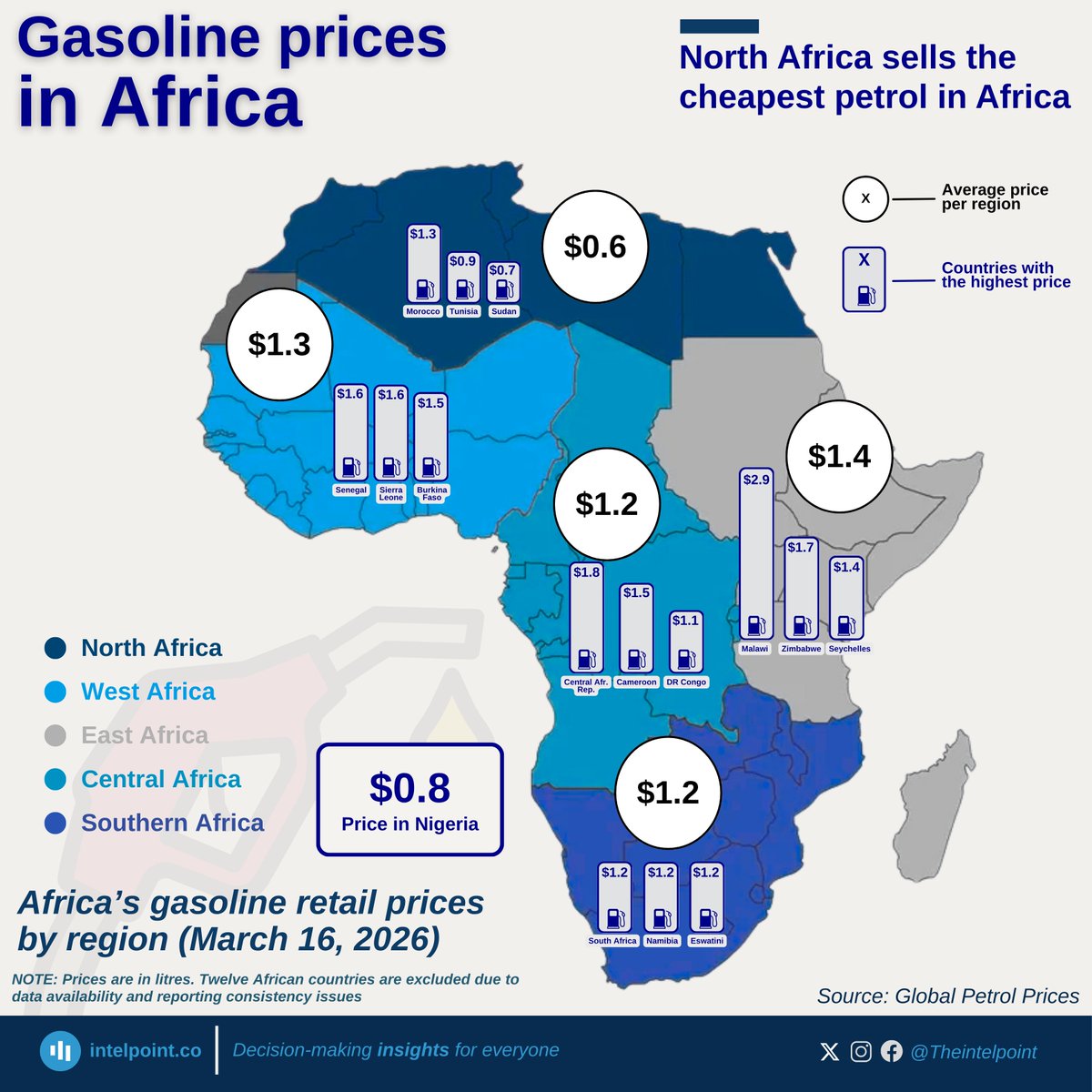
Fuel prices across Africa tell a story of sharp regional contrasts. As of March 2026, North Africa stands out for the lowest average gasoline price at about $0.6 per litre, while other regions cluster significantly higher, ranging from $1.2 to $1.4 per litre. This gap highlights how geography, energy policy, and refining capacity shape what people ultimately pay at the pump. Petrol prices in Nigeria sit at around $0.8 per litre. It is cheaper than in most of sub-Saharan Africa but still noticeably higher than in North Africa.
Intelpoint tweet media
English
2
10
18
1.8K
Intelpoint がリツイート
Intelpoint
Intelpoint@TheIntelpoint·
Since 2001, the UK has received over 1 million asylum applications. Major contributors include Iran, Afghanistan, Iraq, Pakistan, and Albania. These are the top ten nationalities in the past 23 years.
English
1
9
4
1.3K
Intelpoint がリツイート
Intelpoint
Intelpoint@TheIntelpoint·
In 2023, South Africa led Africa's exports with a value of $110.7 billion, nearly double Nigeria's $60.7 billion. Key exports include gems, vehicles, and mineral fuels. The top 15 African exporters contribute 84% to the continent's trade, with South Africa, Nigeria, Algeria, Morocco, and Egypt leading with a combined 52%. #AfricanEconomy #Exports
Intelpoint tweet media
English
5
49
176
88.8K