🚨TESLA PATENTS A ONE-PIECE COMPOSITE SEAT FRAME FOR ITS NEXT VEHICLES
The next-generation @Tesla Roadster is set for its April 1 unveil. But what will the seats look like in a $200,000 electric supercar that promises sub-2-second acceleration?
A patent published today, March 5, 2026, offers a detailed answer. Tesla has filed for a vehicle seat system built around a single continuous composite frame that replaces the dozens of metal parts found inside a conventional car seat [0023]. The seat portion, backrest, headrest, bolsters, and hinge are all formed as one monolithic structure [0028]. Instead of bolting and welding separate pieces together, Tesla thermoforms the entire frame from layered composite plies and then overmolds it with polymer features.
That structure raises a question: what exactly is wrong with how seats are built today?
⚠️ The Problem
Traditional car seats are assembled from a metal frame, a separate recliner mechanism, foam padding, bolsters, headrest supports, and dozens of brackets, screws, and rivets. A typical seat structure involves 13 or more major part groups, each with its own sub-components, tooling, and supplier [0001].
The mechanical complexity is not limited to part count. Each connection point between frame sections introduces potential play, noise, and fatigue over the vehicle's lifetime [0002]. The recliner hinge alone can contain gears, pins, bearings, and locking teeth that must be precision-matched.
Think of assembling a suit of armor from individual plates, each riveted and strapped together. Every joint is a potential failure point, every plate adds weight, and the final fit depends on how well each piece was matched to the next.
For a performance vehicle like the Roadster, these constraints hit harder. Every kilogram in the seat is a kilogram not available for battery range. Seat thickness directly translates to lost cabin space in a low-slung sports car.
🦴 Core Innovation 1: The Monolithic Composite Frame
Tesla's patent describes the entire seat skeleton as a continuous frame that integrates the seat portion, backrest portion, hinge portion, and headrest portion into a single structure [0028]. The frame can be made from fiberglass-nylon, nylon-carbon, or Kevlar-nylon composites formed through thermoforming [0029].
The result is a seat frame manufactured as one part, reducing the number of components and assembly steps required [0149]. The bolsters, which provide lateral support during cornering, are also formed as part of this continuous structure [0030]. There is no seam, no joint, and no separate bracket between the backrest and the bolster that wraps around the occupant's torso.
This is the same manufacturing logic that drove Tesla's megacasting strategy for vehicle bodies. In 2020, Tesla replaced 70 stamped steel parts in the Model Y's rear underbody with a single aluminum casting. This patent applies that consolidation principle to the seat.
For the Roadster, a Kevlar-nylon or carbon-nylon frame would deliver the strength-to-weight ratio demanded by a car targeting hypercar-level performance. The composite can be tuned during layup to be rigid where support is needed and thin where space is at a premium.
📐 Core Innovation 2: Tunable Stiffness Zones and a Material-Defined Pivot Axis
A single-piece frame creates an engineering problem: different regions of the seat need different mechanical properties. The backrest must be stiff enough to support a torso under hard braking. The seat pan must be rigid under load. But the hinge between them must flex to allow reclining.
Tesla solves this by varying the composite ply count, thickness, and material across six distinct stiffness regions within the same continuous frame [0033]. The hinge portion includes a first region, a second region, and a third region, each with different stiffness, while the backrest, seat, and headrest have their own tuned zones [0034].
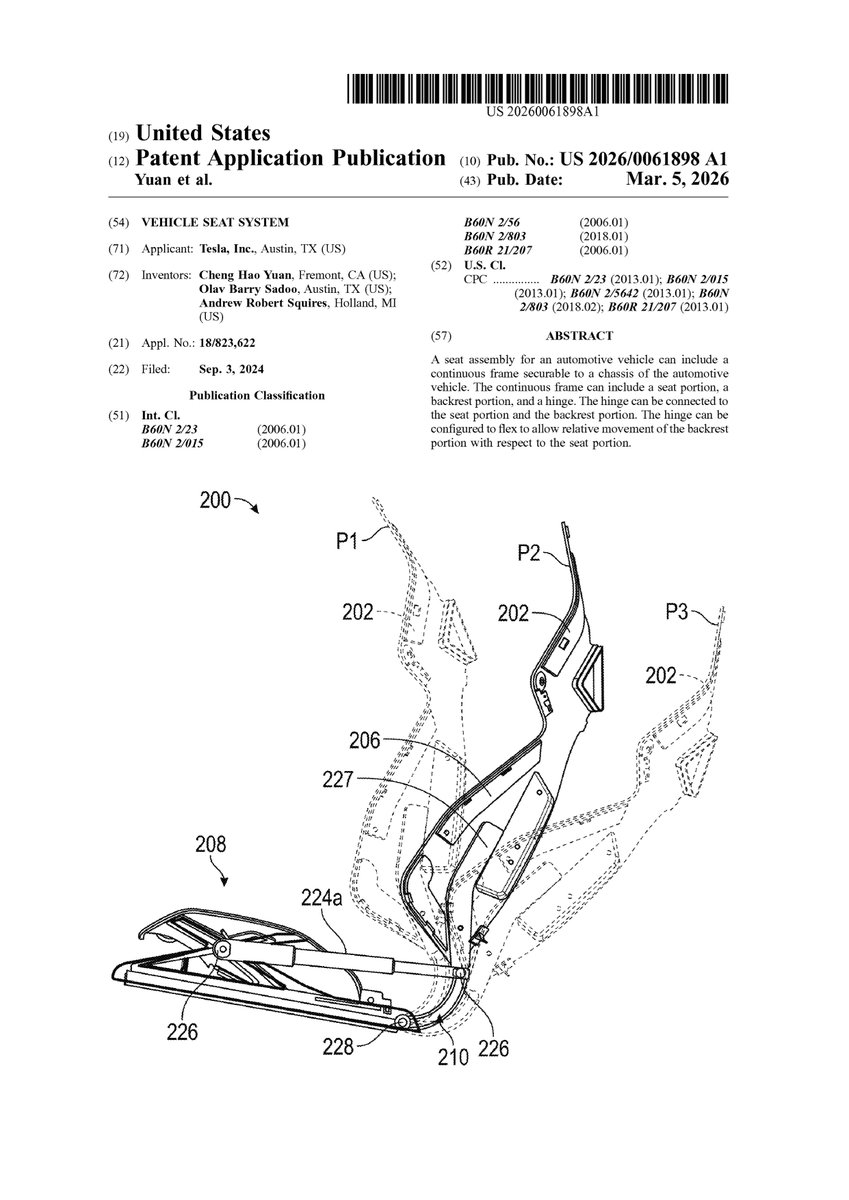
The stiffness gradient also defines where the seat bends. The patent describes an effective pivot axis located within the hinge portion, positioned to match the natural pivot point of a human skeletal structure [0042][0147]. A reinforcement link made of metal or composite can further define and stabilize the pivot location [0041].
Think of it as a living hinge on a plastic bottle cap, but engineered with aerospace composites and tuned to match the biomechanics of the human lower back.
🕹️ Core Innovation 3: Six-Degree-of-Freedom Actuator Control
Most car seats adjust in two or three ways: forward-back on rails, up-down with a pump, and recline with a lever. Each movement uses its own dedicated mechanism. Tesla's patent replaces this patchwork with four pairs of linear actuators that, working in combination, produce six distinct seat movements from a unified control system [0049].
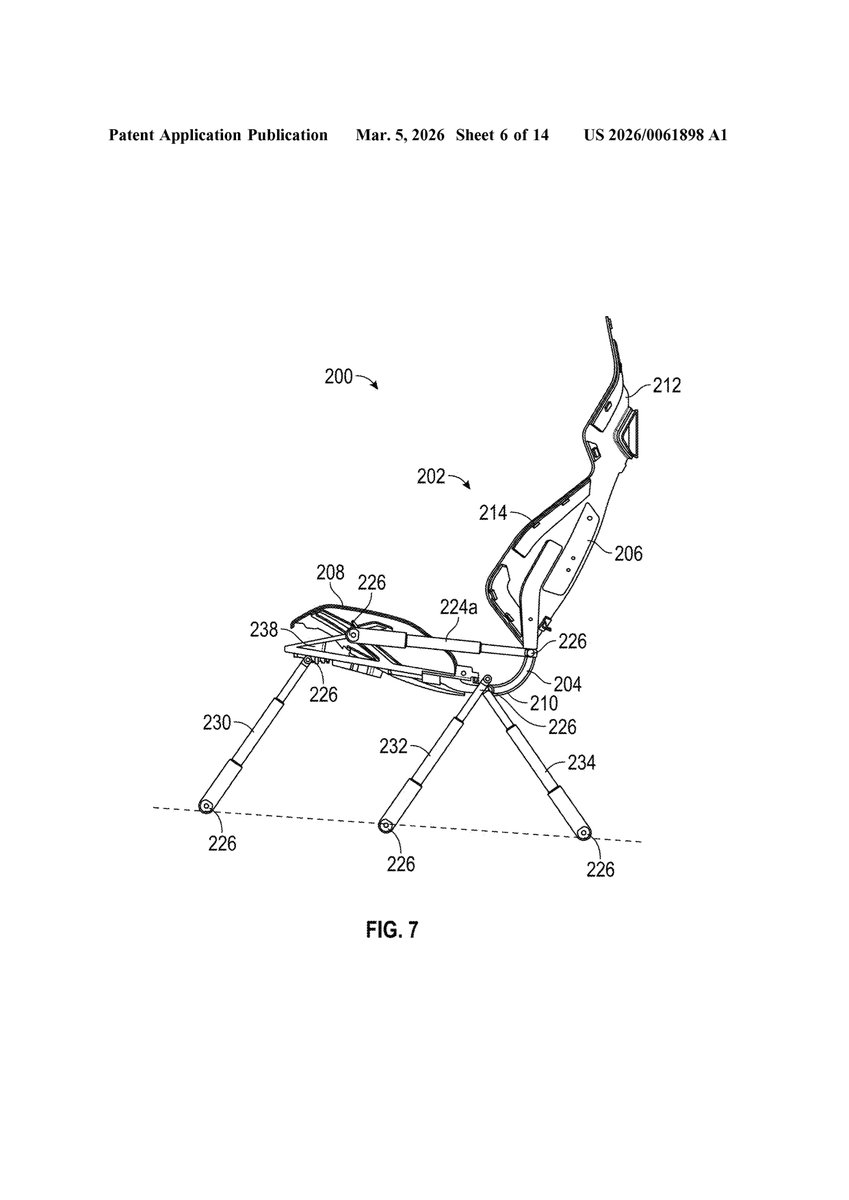
The patent names four actuator pairs: fore, middle, aft, and recline, each connecting the continuous frame to the chassis at different points [0050]. A detailed actuation table maps how specific combinations produce each movement [0059]. For example, moving the seat forward requires shortening the fore and middle actuators while lengthening the aft pair. The same logic applies to height, tilt, and recline, each as a different combination of the same four inputs.
This architecture eliminates the separate track, height pump, and tilt mechanisms that add weight and complexity to conventional seats. It also enables software-defined seat positions. A controller can store and recall precise multi-axis positions, enabling one-touch presets for different drivers or driving modes.
For the Roadster, this means a track-day position and a highway cruising position could be a single button press apart. The seat can drop low and tilt back for high-speed stability, then rise and move forward for city driving.
🎯 Why This Matters
The megacasting playbook that Tesla proved on vehicle bodies is now moving inside the cabin. This patent signals the next front of part consolidation.
The timing is significant. The Roadster unveil is weeks away, and the patent's composite material options read like a specification sheet for a performance vehicle. Kevlar-nylon and carbon-nylon composites are not cost-effective choices for a $40,000 sedan. They are exactly the materials you would select for a $200,000 supercar where weight and stiffness are non-negotiable.
But the patent is written broadly. The claims cover any automotive vehicle, and the composite options include commodity materials like fiberglass-nylon alongside the premium options [0029]. The six-degree-of-freedom actuator system is equally relevant to the Cybercab, where software-controlled seat positioning could enable automatic adjustment between riders in a robotaxi fleet. Tesla's unboxed manufacturing process for the Cybercab demands minimum part counts, and a single-piece seat frame fits that constraint precisely.
The deeper strategic play is vertical integration of the seat. Traditional automakers outsource seats to tier-one suppliers like Adient, Lear, or Magna. These suppliers assemble metal frames from stamped components, add foam, trim, and mechanisms, and deliver finished seats just in time to the assembly line. Tesla's patent describes a seat frame that can be thermoformed in-house and overmolded on-site, potentially bringing seat manufacturing inside the Gigafactory [0143].
The airbag integration adds another layer. Because the bolsters are part of the continuous frame, Tesla can shape them to guide airbag deployment along a predetermined trajectory [0035]. Left and right bolsters can be configured with different shapes to optimize protection asymmetrically. A monolithic frame makes this trajectory predictable by design.
The Roadster may be the first application, but the architecture is designed to scale across the lineup.
🖼️ Key Figures
[FIG. 4: Recline positions P1-P3 demonstrating pivot axis and range of motion]
[FIG. 7: Multi-actuator layout showing four actuator pairs connected to chassis and frame]
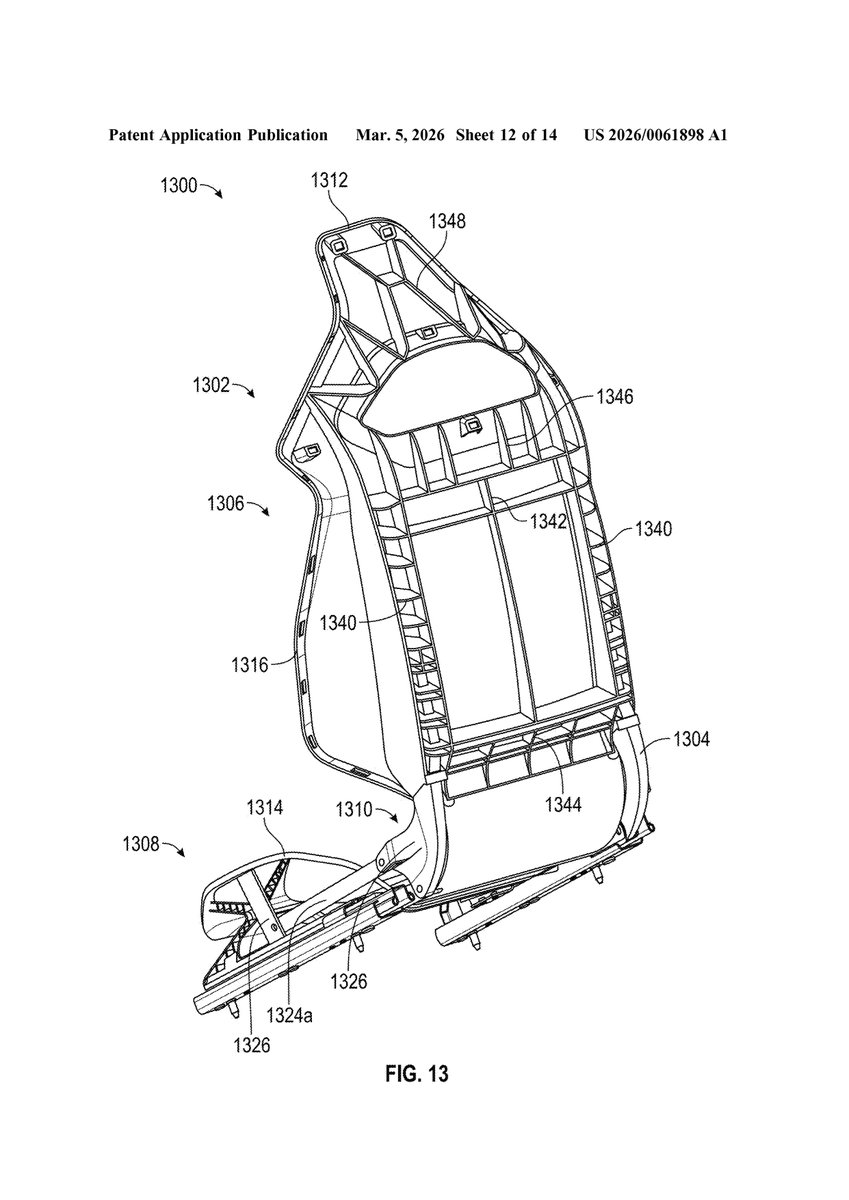
[FIG. 13: Ribbed seat assembly showing structural reinforcement integration]
🗂️ Bibliography
Patent No.: US20260061898A1
Title: VEHICLE SEAT SYSTEM
Assignee: Tesla, Inc.
Inventors: Cheng Hao Yuan, Olav Barry Sadoo, Andrew Robert Squires
Filed Date: 2024-09-03
Published Date: 2026-03-05
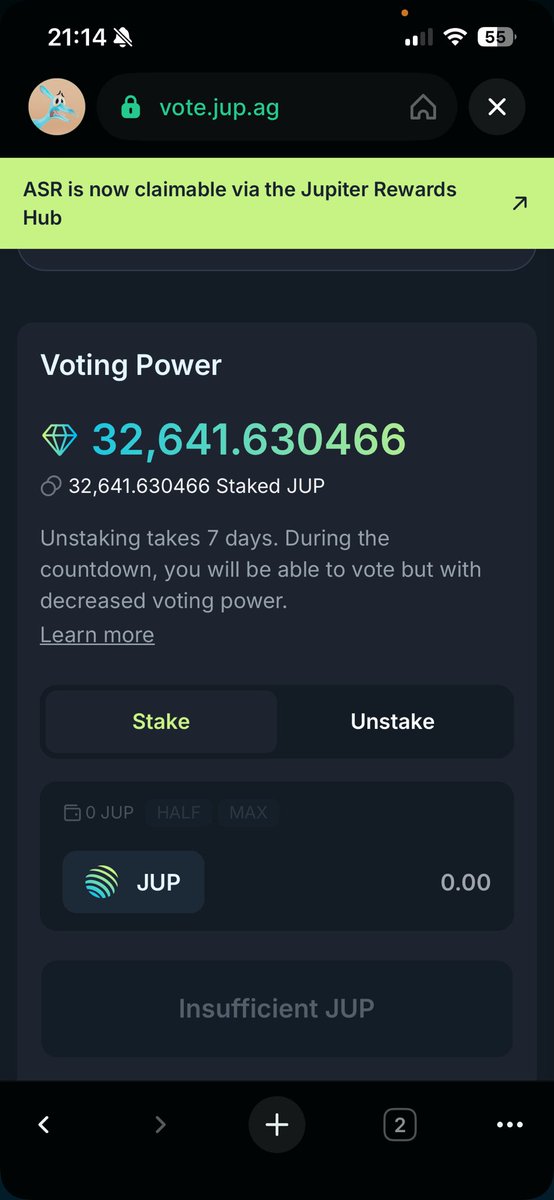
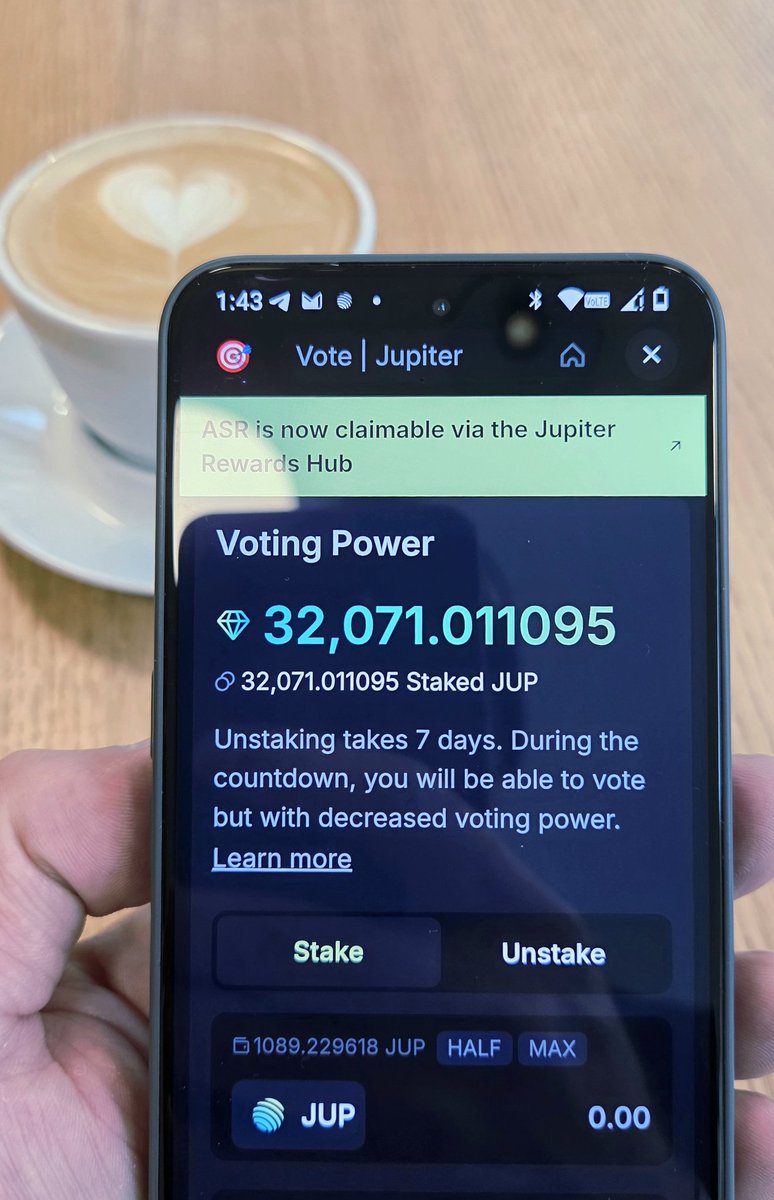
An important vote is coming up. 32k JUP and never unstaked a single one 💎
top 0.65% rank staked
top 1.77% total voting power
top 3.54% proposals participated
See us soon at the Net-Zero Emissions townhall 🪐
After months of posting about the need to curb $JUP inflation and end the monthly free token distributions to the team, we finally have the chance to vote on it.
We don't want 'free tokens'; we want a sustainable future for the Jupiter ecosystem.
I'm genuinely happy that @weremeow, @sssionggg, and the entire team share this vision for a healthier ecosystem.
Option 2 is the only logical solution. Not only will the team stop receiving monthly $JUP, but they will also be buying back tokens from Mercurial investors!
Plus, if any team member sells, the company will initiate a buyback, that’s incredible.
It’s vital that these buybacks continue. We should hold a vote before summer to push the buyback rate toward 90%.
If you care about $JUP long term, this matters.
Whenever I hear someone say they’re voting for Option 1.
I honestly just assume either you don’t want what’s best for $JUP or you don’t fully understand what Option 2 is about.
Let me briefly break it down:
If Op2 is voted in by the community, here’s what will happens.
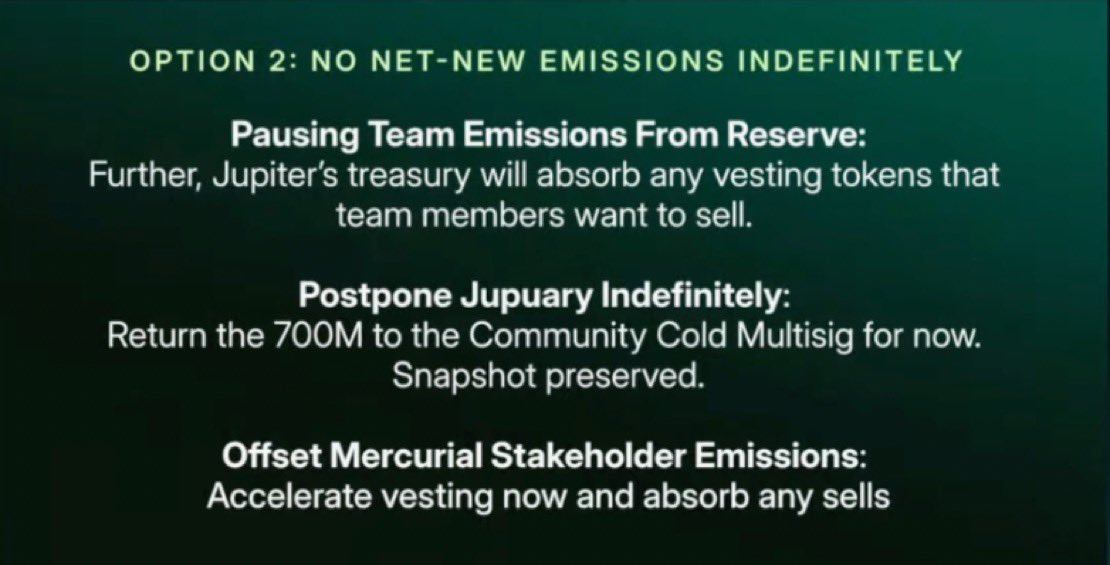
1> Pausing Team Emissions From Reserve:
Every month, around 50M $JUP tokens are distributed from the team reserve to team members, op2 will paused that.
On top of that, the Jupiter treasury will step in to buy back tokens from team members who decide to sell.
2> Postponing the Jupiter Airdrop Indefinitely:
Instead of releasing the 700M $JUP now, those tokens go back to the community reserve, where they originally came from.
Snapshots stay preserved and can be revisited in the future.
3> Offsetting Mercurial Stakeholder Emissions:
5% of total supply was allocated to Mercurial stakeholders.
Tokens will be distributed as scheduled, and all wallets will be monitored.
If any tokens are sold or moved to CEXs, Jupiter will buy back the exact same amount from the market.
A new DAO proposal is now LIVE!
This is a crucial vote that impacts all token holders.
High leverage decisions about $JUP are exactly what the DAO is built for, and so this must be decided collectively.
The vote comes down to 2 options regarding the emissions schedule for 2026:
Option 1: Proceed with Jupuary
Jupuary will continue as planned, with the airdrop checker released ~1 week after the conclusion of the vote.
In the event that option 1 passes, Jupuary emissions, Team emissions, and Mercurial emissions will proceed as per their regular vesting schedules.
Option 2: Pause Emissions
- Jupuary will be postponed, with tokens returned to the Community Cold Multisig
- Tokens will not be emitted from the team reserve for the foreseeable future, and Jupiter will absorb any team token sales
- Mercurial stakeholders will be airdropped their remaining tokens and an equivalent number will be purchased by Jupiter
The vote begins on Tuesday the 17th @ 11am UTC and will run to Saturday to give people enough time to consider each option.
You can read the full proposal and contribute your feedback here: discuss.jup.ag/t/draft-propos…
PS: Stakers will be eligible for ASR regardless of their participation in this vote.
@rektober Sounds like you don’t hold any JUP, smart, move on your part, but either way, happy that they’re doing something. Don’t trust the casino brother.
Jupiter shitshow, very cringe to watch,
I have paid in 2025 $500,000 in fees across 5 wallets, i checked this in dune volume checker, i did $900,000,000 in volume
Jupiter perps charges 3 times more fees than Hyperliquid, their system is so predatory that when margin is low they liquidate you and keep the remaining margin, they charge more than 5 times the fees Binance or ByBit charges, if you are short you don't earn funding fees (they charge you borrow rate on top) and if you are long you pay also, in other exchanges if you are short you usually get paid 0.013% hourly
Not only they have the worst and most expensive system, that extracted more than a billion dollars from liquidated Solana Perp Traders
Now after they promised and passed the DAO vote for 2 years, they decide to go back in their word and finesse all their traders and fee payers, that were heavily miss treated and paid unreal amount of fees with the promise of "Jupuary" in January of 2026
Terrible terrible look, never expected such L move, shame on you, i hope you guys reflect on this and listen to the obvious critics from your community, your users, your fee payers,
do better, @weremeow@JupiterExchange
@kashdhanda@JupiterExchange Oh yea? Well maybe you should take a look at your DMs from me because I am following up on a critical bug that exists within in @jup_lend. It's hurting your users and please address.
one of the underrated secrets to @JupiterExchange's success:
a killer support team.
we have 6 people fulltime answering thousands of tickets a month. median response time within 1 hour, 60% of tickets solved with one touch.
just use jupiter (support)
In 2026, the choices we’ve made will mean more people will begin to feel positive change.
The promise of renewal will become a reality, and Britain will turn the corner.
From my family to yours: Happy New Year.
This is what one of the best investors of the year looks like. I’m giving everyone one opportunity to apologize to @PeterSchiff.
Don’t hold back, let him know below