
True Trader
9.3K posts

True Trader
@TrueTraderNet
We focus on reversals during emotional moves. 30 Minutes per day. Base hits. We're crushing it. See for yourself https://t.co/pSpzt5rrgK
Trade Smart. Trade Safe. 参加日 Kasım 2015
2.1K フォロー中3.9K フォロワー

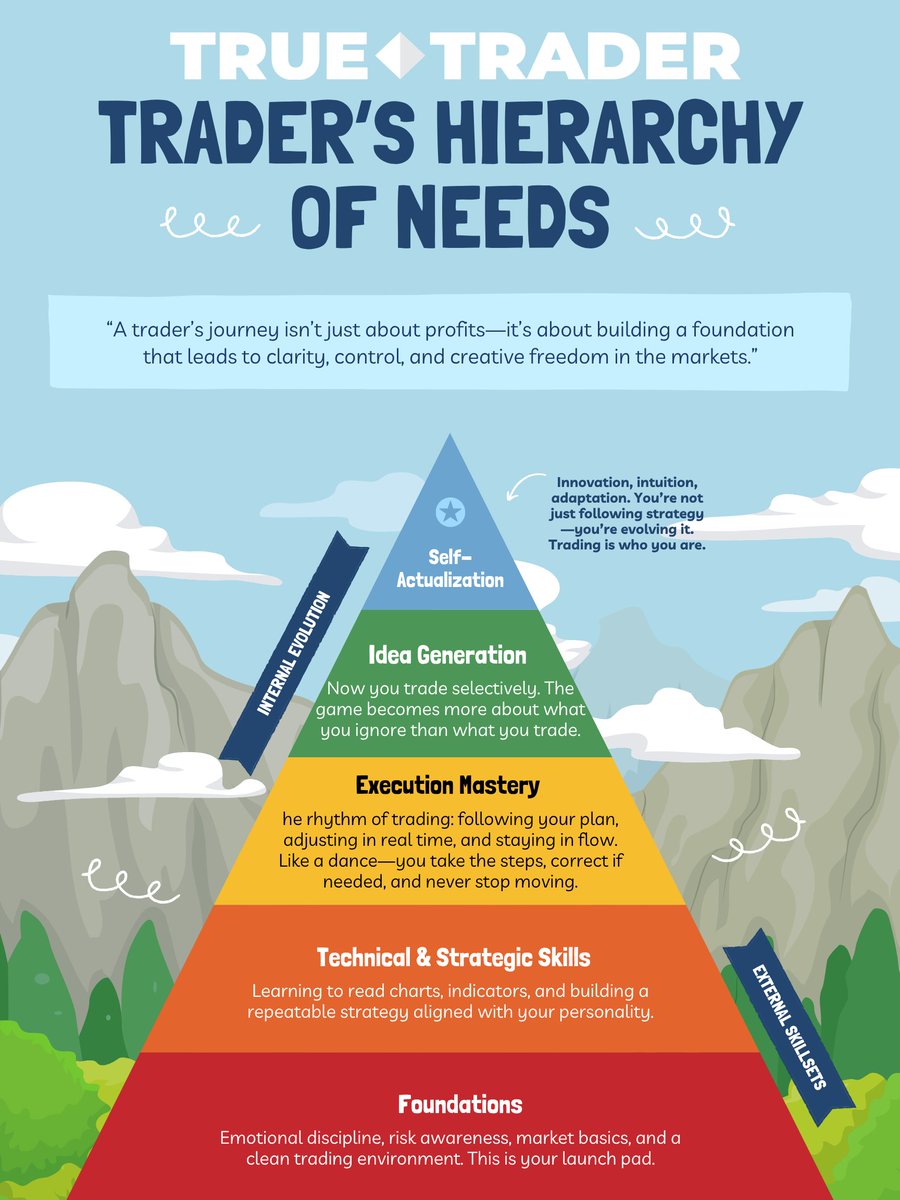
Layer 5: SELF-ACTUALIZATION
Now the game slows down.
You trust your instincts.
You adapt.
You innovate.
Your strategy evolves with the market.
You might teach others, build tools, or automate parts of your workflow.
You create new plays from experience, not guesswork.
You’ve stopped being a trader who follows systems.
You’ve become someone who thinks in edge.
There’s no rush.
No fear.
Just clarity.
English

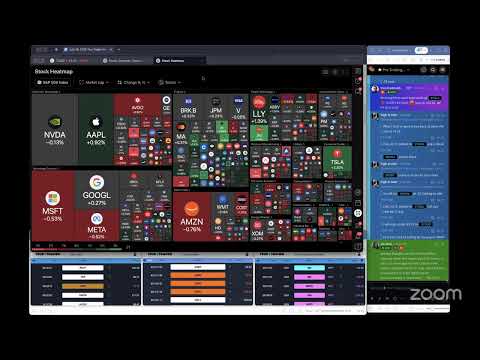
🔴 We're LIVE to go over the game plan for the day! Join us now 💪
Tune in here: youtube.com/watch?v=iy-GFx…

YouTube
English

We’ve been quiet here… but LOUD on YouTube.
📡 We’re back on YouTube live with high-probability setups, price action breakdowns, and real-time strategy.
Watching $AAPL $TSLA $HOOD $FSLR $DDOG $AMZN
#TrueTrader #ProTrading #MarketLive #TradeSmart
Join the stream — youtube.com/live/_aHB1x1kv…

YouTube
English

Massive insight into where self-sabotage may begin.
Kim Ann Curtin, The Wall Street Coach@kimanncurtin
You’re not addicted to chaos… Your nervous system just isn’t ready for stillness. Safety feels foreign when your body’s wired for survival. Stillness isn’t always peace. Sometimes it feels like danger. And that’s where the real work begins.
English

LOL they called it PELOSI act. 😂😂😂 hawley.senate.gov/hawley-announc…
@SpeakerPelosi
English
True Trader がリツイート

For the love of god, when trading make sure you know where you're wrong BEFORE entering a trade. That is where you set your stop. THEN RESPECT YOUR STOP. So many members have seen a turn around by doing this one simple step. #DayTrading
English
True Trader がリツイート

We have received Breakthrough Device Designation from the FDA for Blindsight.
Join us in our quest to bring back sight to those who have lost it. Apply to our Patient Registry and openings on our career page neuralink.com
English
True Trader がリツイート

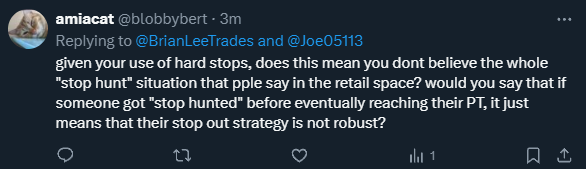
Question regarding "stop hunts" [1]
First thing's first, in my experience, I have noticed that people tend to misunderstand trading ranges and placing too much importance on the short term volatility.
Much of the time the most important points of the chart are the extremes, I'm talking about HOD/LOD depending on your bias. A lot of the volatility within is pretty much noise.
This is actually a very complex topic so I'll try to touch on some points but there are numerous examples of specific situations that are contradictory but the overall application of this mindset yields a positive trading psychology (less stress/less emotional/more grounded).
Examples of contradictions:
1. Level 2 / Tape showing clear change of character such as large/illiquid spreads
2. Outlier volume in both directions, either drying up or extreme relative volume
3. Breaking news/filings
There are definitely a few more but generally speaking you're dealing with a normal market and the market is not to blame for having poor stop placement.
Let me define poor stop placement:
Poor stop placement is when you're placing a stop at a level that has no logical basis.
People tend to generate their own logic by creating a reason or justification for their placement, a really good example would be using a swing high/low as "where I am wrong".
Well are you wrong? Most likely not, you're not accounting for the total range of the stock, the ADR or considering what type of mode the stock is in.
Mode: Range-bound market or Trending market. (There are more but these are the most common)
Range bound markets tend to oscillate between supply and demand zones. I'm talking moving averages, pivot levels, daily levels, high volume nodes or levels of high interest such as a breakout or gap.
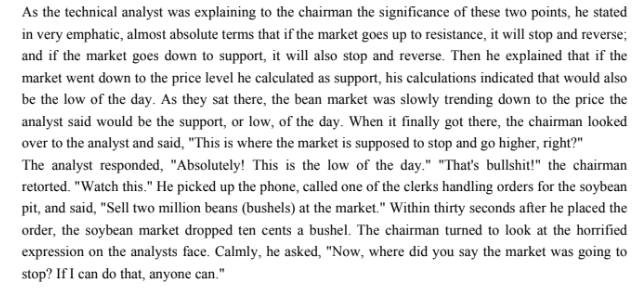
Trending markets are when you can expect supply or demand to overwhelm the other and forms structure like lower highs/higher lows. Even in these cases, however, you can still experience whiplash by anchoring to the last swing high/low because markets tend to be emotional... emotions can cause traders to panic in the short term and it only takes one trader with meaningful size or a horde of traders to create a short term move that might FEEL like a "stop hunt". (See my quoted image [3] for an excerpt regarding this)
Which brings me to my next topic, emotions.
Just like I mentioned above, emotions and how traders or market participants react to pressure can be all that matters. It only takes one trader to freak out to the penny and make a stock temporarily breakout.
It might seem like a foreign concept but it happens regularly to me, and I never really understood exactly how trading was zero-sum until I began experiencing slippage, system degradation and moving markets.
Let's say for example, a large whale trader is on vacation then you may see less volatility because orders that might move the market are not present, also in reverse, if they were present on this day.
I've seen it plenty of times that a trader will hold a market with something like a TWAP or a larger order iceberged etc and that induces panic in terms of other traders reacting to the non-movement / slight uptrend created. Same thing for inducing halts which gets a lot of attention generally as well.
Notice that traders have a lot more power in these circumstances than traditionally taught. You have to lean on my experience for this until it rightfully makes sense when you experience the same.
Other things that I speak from experience with...
In very unfortunate conditions like a very cheap stock, illiquid stock or just generally meeting these criteria, traders sometimes get flagged for something called "Large Trader" by the SEC (read more: investopedia.com/terms/l/larget…). I've had this applied to my accounts which you are obligated to disclose annually for a couple of years now and it's not been any issue.
I've had ECN's call my broker in the past asking about my orders, clearly acknowledging that it's being observed.
I've experienced market makers just doing their job by punishing my mistakes and moving markets against me but only because of either being illiquid or moving the market in an unnatural way. These are almost always my fault and easily detectable, it's easy to detect any order that isn't the usual 100 share prints or even lots that you see painted on the tape all day. Typically market makers are neutral and just capturing spreads and providing liquidity, it's not to blame, however they can react to large orders in a way that isn't beneficial to you.
Algos can pick on this and I've also witnessed plenty of algos and how they've changed throughout the years or adapted. I don't really consider it my concern as they usually can engineer these low float trades to appear thick and then blow them up on a dime, it's typically one's own fault for not reading the room or having a proper read on the setup itself (nano floats, heavily manipulated underwriting, sketchy agenda, foreign companies with unusual finances, large illiquid spreads, liquidation names etc).
Generally speaking, and sorry to preface so much detail but it is necessary, hard stops are recommended very much and are not blatantly being abused aside from people having too tight of risk, not knowing the mechanics of the stock they are trading and not having a fair view of the entire range expansion created for such an opportunity. Platforms like DAS have stops on server side, meaning they trigger once price hits and isn't on the book. Interestingly I've seen other platforms with stops on the book get better fills, it goes both ways I guess.
This is why thinking that one can scalp with huge leverage on futures or large caps can equate to massive R gains leads to denial in that each point is pretty wide and also the ATR might not agree with their stop placement. Or why you can't just used a fixed position size like 1000 shares on every single smallcap stock you trade as some will be $1, $5 or $10 and everything in between, each position will have a completely different effect based on how significant the position is relative to price/volatility/implied range.
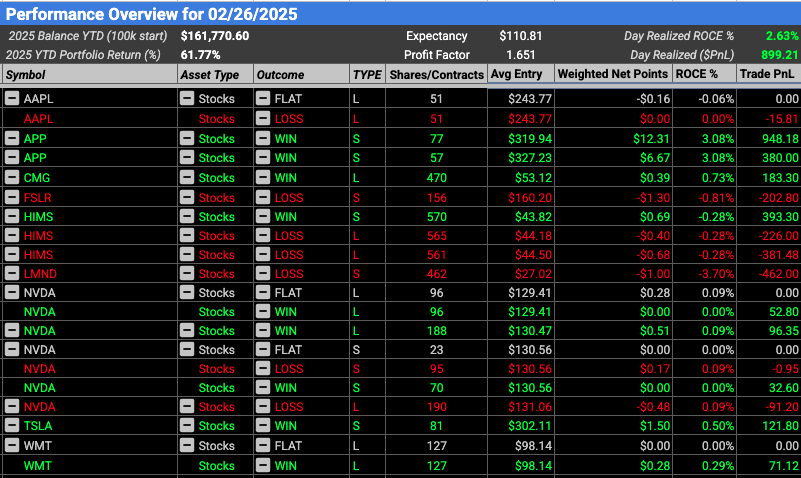
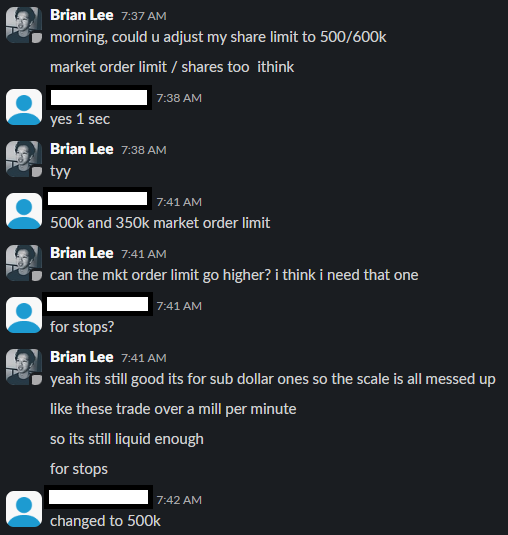
As you can see in image [2], I've thrown out market orders on pretty good size and that even had my broker confused but you need to realize that liquidity is something dynamic that you must have a good understanding of and if you do, you can account for risk in a different light. The goal is to be trading with the mentality that you might get slipped somewhat, you might even get really pissed off, but there are numerous situations where that stop loss is 1000% a better decision than your own in the moment, especially fueled by emotion (undeniable physiology).
If you're sizing correctly and growing it through a tempered compound, you should be able to experience all of the levels associated with that growth and the degradation/liquidity concerns. I can say that it really goes a long way and I don't think I've had any major issues... it also saves your ass on halts vs limits or mental (think big gap up, 10m halts etc).
There's so much to say but one of the last things I want to hit on is actual strategy vs reality.
If your trading plan implements things like adding to winners/pyramidding or trend following, then you might experience whiplash where you're not NATURALLY wrong on your initial thesis but still get stopped out. This can feel personal but it is not. If you employ such a strategy it's imperative to understand that you getting stopped was in service of a greater gain potentially but you simply got cooked by the market for trying to maximize the potential.
In a lot of ways this maximization fuels the "stop hunt' feeling, traders who seldom touch their initial position actually experience the benefits of the greatest EV trade, the one closest to their optimal risk level and thus are less likely to feel "hunted" by the market.
Coming in anywhere where the EV is decreasing as your potential entry drifts from your ideal exit point creates this mental trap. It is EXTREMELY important not to take the market personally, it could quite literally be another person or group of persons or yourself but ultimately the range the stock created during expansion is the most important objective way to view fluctuations.
Take a look into Auction Market theory. My simple way of explaining it is that the market is just in search of large demand or supply and will do what it does in between those points. As it goes between these areas the price action with bounce, spike, drop, consolidate etc... all normal market behavior. It's actually MORE weird to see a stock that goes straight up or straight down, something is not sustainable about that. Markets move in zig zags and create structure in doing so, that's just normal so understand where the stock reversed in an extreme fashion is where you should substantially more weight on.


English