Jeremy

70.7K posts

Jeremy banner
Jeremy

Jeremy

@UTDJ_

An Intelligent pass is as important as a flashy dribble

参加日 Eylül 2020
2.7K フォロー中2.4K フォロワー
固定されたツイート
Jeremy
Jeremy@UTDJ_·
Facts
English
93
34
83
2K
Jeremy がリツイート
Jeremy がリツイート
Ölele Salvador🦅🇬🇭
Ölele Salvador🦅🇬🇭@OleleSalvador·
👨🏾‍🍳🇬🇭: ORAL wasn’t just about sentencing; it was a full recovery campaign that won votes & weakened the opposition. Prosecutions were supposed to be punitive measures for assets that couldn’t be recovered. But today, plea deals recovering 60% seem to grant immunity. 1/2
Thomas OKine@ThomasOKine2

@OleleSalvador How are we thinking as a people. The past govt spent almost 7 years to prosecute him but the case is still pending. Another govt comes to retrieve 60% of what the state lost and some are peeved. In any case custodian sentence does not recover the money for us.

English
6
23
125
22.9K
Jeremy がリツイート
CURTIS A. OWUSU
CURTIS A. OWUSU@_i_am_Curtis·
Ends.
CURTIS A. OWUSU tweet media
English
21
43
231
14.4K
Jeremy がリツイート
Jeremy がリツイート
Alfred
Alfred@CallmeAlfredo·
You’re a state entity tasked with purchasing gold to generate foreign exchange in support of the cedi. Your mandate is fundamentally commercial. The more gold you buy, the better. Yet, you’re also responsible for ensuring that the gold you purchase comes from responsible sources. Now, you’re operating in a country grappling with an environmental crisis, one so severe that the President has called it a national emergency. Eventually, your commercial interest will clash with your responsible sourcing mandate. This was a fundamental flaw in the design of the Goldbod that many chose to overlook. Who would make sure it’s actually applying its responsible sourcing policy consistently? I don’t think the country is serious about ending galamsey as along as the Goldbod continues to aggregate gold from whichever source to generate forex to support the cedi
English
9
83
147
16.9K
Jeremy がリツイート
That Guy
That Guy@LordBogos·
Thank you very much for this!
Bright Simons@BBSimons

The AG has recovered 10.6% of the Unibank Liability NOT 60% 1. On 22nd July 2025, the Attorney General of Ghana (AG) announced that he had reached an agreement with the owners of the collapsed Unibank who were under prosecution commenced by the previous government for financial crimes. He also seems to suggest that parallel civil proceedings to recover lost funds shall be terminated. 2. The main owner of Unibank being the former finance minister from the same ruling party as the Attorney General, the announcement was naturally greeted with intense cynicism. If anything at all, the criminal action could have been maintained to apply pressure even as a negotiated settlement was pursued. Why then drop the state's leverage? 3. The terms of the settlement - the Unibank actors would need to pay back 60% of their estimated liability - had also proven controversial. 4. Today, the AG provided additional details. As a governance analyst, I am a huge supporter of public disclosures that shed light on government's actions. So, I am happy that I don't need to scurry around trying to find leaks to do my public interest work. 5. I have reviewed the AG's arguments very carefully. I have also gone back to my notes on the Unibank affair. On balance, I am deeply dissatisfied with the AG's analysis of the public finance element of the situation. 6. I give some credit to his legal reasoning regarding the probability of recovery if the cases were to continue. Especially in light of the strange decision by the Court of Appeal to acquit in the Beige case (I am yet to read the judgment). However, the public still deserves total honesty and rigour from its AG in a case involving such large amounts. Claiming "pragmatism" is not enough. 7. Unibank was one of Ghana's largest banks. Between 2013 and 2016, its assets grew from just about GHS GHS 825 million to GHS 2.88 billion. Its depositor accounts numbered over 400,000 by July 2017. It won many prestigious local awards. 8. Unfortunately, when the World Bank and IMF pushed Ghana to evaluate the quality of bank assets in 2015, it was discovered that many of Unibank's assets were "impaired" on prudential grounds. Its capital adequacy ratio thus dropped significantly below the legal minimum of 10%. Shareholders were then asked to inject more funds, which they did to an extent. 9. A new government came into office in early 2017. The Bank of Ghana (BoG) changed leadership. The new bosses introduced stricter scrutiny of the banks. Over a period of more than a year, multiple audits ensued during which it became clearer and clearer that the bank was bankrupt. On 1st August 2018, its license was yanked. A receiver was appointed to manage the residue of assets and liabilities. Hence began the saga. 10. The AG's position is that the GHS 5.7 billion in direct exposure (the financial loss the govt previously believed Unibank's owners should be responsible for) has been revised upon closer examination to GHS 3.3 billion. Of this amount, GHS 800 million shall be paid back by Unibank through forfeiture of landed properties and GHS 1.2 billion shall be recovered from Unibank's debtors. 11. The financial logic of the entire deal is TOTALLY MISCONCEIVED. The suggested amounts are puny, and whatever money can be recovered from any debtors was done a while back without making a dent in the liability. 12. It is instructive that two important players are so far quiet: the Bank of Ghana, a major creditor of Unibank, and the Receiver, who by law is required to safeguard the fiduciary interests of the defunct Unibank. WE MUST HEAR FROM THEM. 13. Now, let me explain why the AG's analysis is seriously porous. A. The claim that the "fictitious entries" entered in Unibank's books do not amount to liability on their own confuses the issues. I do not accept that this is an honest assessment of the situation. The fictitious entries masked the fact that monies borrowed from the public (depositors) and creditors (BoG and other banks) could not be properly accounted for. What is important is to ACCOUNT. B. On 31st July 2018, a day before the license revocation, the main shareholder of Unibank wrote an important letter which captures the liability "acceptable" to him and other shareholders. That number represents the minimum floor as one would assume that the shareholders will maximise their interests in any negotiation. C. The losses to the country emanating from the Unibank saga exceeds even the GHS 5.7 billion the previous government was pursuing. Let's delve into these matters. 14. In the July 31st 2018 letter, Unibank's owners admitted direct liability of GHS 4.9 billion. See extract from the letter attached. If so, how does the liability now get revised to GHS 3.3 billion? In fact, at that time, Unibank said it was willing for its assets to be liquidated for injection into the bank at a forced sale value of GHS 3.52 billion ($730 million). 15. The Bank of Ghana alone was owed over GHS 2.8 billion. However, Unibank had offsetting claims amounting to ~GHS 600m bringing the net liability to ~GHS 2.2 billion. The current settlement does not even cover this amount. 16. By May 2018, KPMG-validated liabilities of Unibank amounted to nearly GHS 9.2 billion. That is to say $2 billion made up of customer deposits, BoG liquidity support, and corporate borrowings, among others. Whilst Unibank owners have repeatedly argued that they were also owed a lot of money by the government, through contractors, their own claims amounted to less than $200 million. 17. Now, here is the key issue. The basic equation of finance is that liabilities must be offset by shareholder funds and assets, which in the case of banks mean good LOANS. Thus if we assume that the government's debt (DDEP notwithstanding) is prudent lending and therefore a good asset, we must account for roughly $1.8 billion more of WHERE THE UNIBANK MONEY WENT. 18. We know from KPMG's extensive work, that nearly $400 million that Unibank loaned to companies belonging to Unibank's owners never came back. 19. Of nearly $600 million loaned out to other companies, between half and 75% was deemed unrecoverable by KPMG. 20. As every reader can see, there is a big CAPITAL HOLE. Nearly $1.8 billion large. First, there is the ~$800 million of deposits by ordinary Ghanaians and companies that went to Unibank. Then over $400 million of BoG money. Plus another $600 million borrowed from various other banks and lenders. 21. The government's settlement of $80 million in cash and $120 million in as yet undisclosed properties (even using BoG exchange rates) is thus no where near accounting for the liability. 22. It is important to remember that the government assumed most of that liability. First, by way of covering for the deposits through the set up of CBG, a state-owned bank. And, second, by way of BoG absorbing the losses in its liquidity support. So far, the country has not been told whether the other debts accumulated by Unibank have been cleared or not. But those debts are losses too. 23. Even the liability that the former owners of Unibank themselves admit they are responsible for, over $1 billion, has not been covered in this "settlement". As of May 2018, the KPMG's view of the gap of money unaccounted for was $1.5 billion. 24. Thus, if we use market exchange rates, the government has "recovered" $160 million of a liability that may well exceed $1.5 billion (the receiver and BoG should update the nation). That is barely 10.6% of the total LOSSES TO GHANA's welfare! Even that $160 million is suspect because, from the AG's explanations, they are likely to be debt owed to contractors by the same government. It is important to re-emphasise that the deal cut by the government is only 21% of what Unibank's owners themselves admitted was their liability to the bank on July 31st, 2025. 25. In any serious country, the press conference of the AG today would be the BEGINNING not the end of the national debate about how Ghana tackles national financial losses involving the rich and powerful in society. The question is: is Ghana a serious country? Or a katanomic society? Judge for yourself.

English
1
5
11
1.4K
Jeremy がリツイート
CURTIS A. OWUSU
CURTIS A. OWUSU@_i_am_Curtis·
In any serious country, the press conference of the AG today would be the BEGINNING not the end of the national debate about how Ghana tackles national financial losses involving the rich and powerful in society. The question is: is Ghana a serious country? Or a katanomic society? Judge for yourself.
Bright Simons@BBSimons

The AG has recovered 10.6% of the Unibank Liability NOT 60% 1. On 22nd July 2025, the Attorney General of Ghana (AG) announced that he had reached an agreement with the owners of the collapsed Unibank who were under prosecution commenced by the previous government for financial crimes. He also seems to suggest that parallel civil proceedings to recover lost funds shall be terminated. 2. The main owner of Unibank being the former finance minister from the same ruling party as the Attorney General, the announcement was naturally greeted with intense cynicism. If anything at all, the criminal action could have been maintained to apply pressure even as a negotiated settlement was pursued. Why then drop the state's leverage? 3. The terms of the settlement - the Unibank actors would need to pay back 60% of their estimated liability - had also proven controversial. 4. Today, the AG provided additional details. As a governance analyst, I am a huge supporter of public disclosures that shed light on government's actions. So, I am happy that I don't need to scurry around trying to find leaks to do my public interest work. 5. I have reviewed the AG's arguments very carefully. I have also gone back to my notes on the Unibank affair. On balance, I am deeply dissatisfied with the AG's analysis of the public finance element of the situation. 6. I give some credit to his legal reasoning regarding the probability of recovery if the cases were to continue. Especially in light of the strange decision by the Court of Appeal to acquit in the Beige case (I am yet to read the judgment). However, the public still deserves total honesty and rigour from its AG in a case involving such large amounts. Claiming "pragmatism" is not enough. 7. Unibank was one of Ghana's largest banks. Between 2013 and 2016, its assets grew from just about GHS GHS 825 million to GHS 2.88 billion. Its depositor accounts numbered over 400,000 by July 2017. It won many prestigious local awards. 8. Unfortunately, when the World Bank and IMF pushed Ghana to evaluate the quality of bank assets in 2015, it was discovered that many of Unibank's assets were "impaired" on prudential grounds. Its capital adequacy ratio thus dropped significantly below the legal minimum of 10%. Shareholders were then asked to inject more funds, which they did to an extent. 9. A new government came into office in early 2017. The Bank of Ghana (BoG) changed leadership. The new bosses introduced stricter scrutiny of the banks. Over a period of more than a year, multiple audits ensued during which it became clearer and clearer that the bank was bankrupt. On 1st August 2018, its license was yanked. A receiver was appointed to manage the residue of assets and liabilities. Hence began the saga. 10. The AG's position is that the GHS 5.7 billion in direct exposure (the financial loss the govt previously believed Unibank's owners should be responsible for) has been revised upon closer examination to GHS 3.3 billion. Of this amount, GHS 800 million shall be paid back by Unibank through forfeiture of landed properties and GHS 1.2 billion shall be recovered from Unibank's debtors. 11. The financial logic of the entire deal is TOTALLY MISCONCEIVED. The suggested amounts are puny, and whatever money can be recovered from any debtors was done a while back without making a dent in the liability. 12. It is instructive that two important players are so far quiet: the Bank of Ghana, a major creditor of Unibank, and the Receiver, who by law is required to safeguard the fiduciary interests of the defunct Unibank. WE MUST HEAR FROM THEM. 13. Now, let me explain why the AG's analysis is seriously porous. A. The claim that the "fictitious entries" entered in Unibank's books do not amount to liability on their own confuses the issues. I do not accept that this is an honest assessment of the situation. The fictitious entries masked the fact that monies borrowed from the public (depositors) and creditors (BoG and other banks) could not be properly accounted for. What is important is to ACCOUNT. B. On 31st July 2018, a day before the license revocation, the main shareholder of Unibank wrote an important letter which captures the liability "acceptable" to him and other shareholders. That number represents the minimum floor as one would assume that the shareholders will maximise their interests in any negotiation. C. The losses to the country emanating from the Unibank saga exceeds even the GHS 5.7 billion the previous government was pursuing. Let's delve into these matters. 14. In the July 31st 2018 letter, Unibank's owners admitted direct liability of GHS 4.9 billion. See extract from the letter attached. If so, how does the liability now get revised to GHS 3.3 billion? In fact, at that time, Unibank said it was willing for its assets to be liquidated for injection into the bank at a forced sale value of GHS 3.52 billion ($730 million). 15. The Bank of Ghana alone was owed over GHS 2.8 billion. However, Unibank had offsetting claims amounting to ~GHS 600m bringing the net liability to ~GHS 2.2 billion. The current settlement does not even cover this amount. 16. By May 2018, KPMG-validated liabilities of Unibank amounted to nearly GHS 9.2 billion. That is to say $2 billion made up of customer deposits, BoG liquidity support, and corporate borrowings, among others. Whilst Unibank owners have repeatedly argued that they were also owed a lot of money by the government, through contractors, their own claims amounted to less than $200 million. 17. Now, here is the key issue. The basic equation of finance is that liabilities must be offset by shareholder funds and assets, which in the case of banks mean good LOANS. Thus if we assume that the government's debt (DDEP notwithstanding) is prudent lending and therefore a good asset, we must account for roughly $1.8 billion more of WHERE THE UNIBANK MONEY WENT. 18. We know from KPMG's extensive work, that nearly $400 million that Unibank loaned to companies belonging to Unibank's owners never came back. 19. Of nearly $600 million loaned out to other companies, between half and 75% was deemed unrecoverable by KPMG. 20. As every reader can see, there is a big CAPITAL HOLE. Nearly $1.8 billion large. First, there is the ~$800 million of deposits by ordinary Ghanaians and companies that went to Unibank. Then over $400 million of BoG money. Plus another $600 million borrowed from various other banks and lenders. 21. The government's settlement of $80 million in cash and $120 million in as yet undisclosed properties (even using BoG exchange rates) is thus no where near accounting for the liability. 22. It is important to remember that the government assumed most of that liability. First, by way of covering for the deposits through the set up of CBG, a state-owned bank. And, second, by way of BoG absorbing the losses in its liquidity support. So far, the country has not been told whether the other debts accumulated by Unibank have been cleared or not. But those debts are losses too. 23. Even the liability that the former owners of Unibank themselves admit they are responsible for, over $1 billion, has not been covered in this "settlement". As of May 2018, the KPMG's view of the gap of money unaccounted for was $1.5 billion. 24. Thus, if we use market exchange rates, the government has "recovered" $160 million of a liability that may well exceed $1.5 billion (the receiver and BoG should update the nation). That is barely 10.6% of the total LOSSES TO GHANA's welfare! Even that $160 million is suspect because, from the AG's explanations, they are likely to be debt owed to contractors by the same government. It is important to re-emphasise that the deal cut by the government is only 21% of what Unibank's owners themselves admitted was their liability to the bank on July 31st, 2025. 25. In any serious country, the press conference of the AG today would be the BEGINNING not the end of the national debate about how Ghana tackles national financial losses involving the rich and powerful in society. The question is: is Ghana a serious country? Or a katanomic society? Judge for yourself.

English
0
7
17
791
Jeremy がリツイート
Alfred
Alfred@CallmeAlfredo·
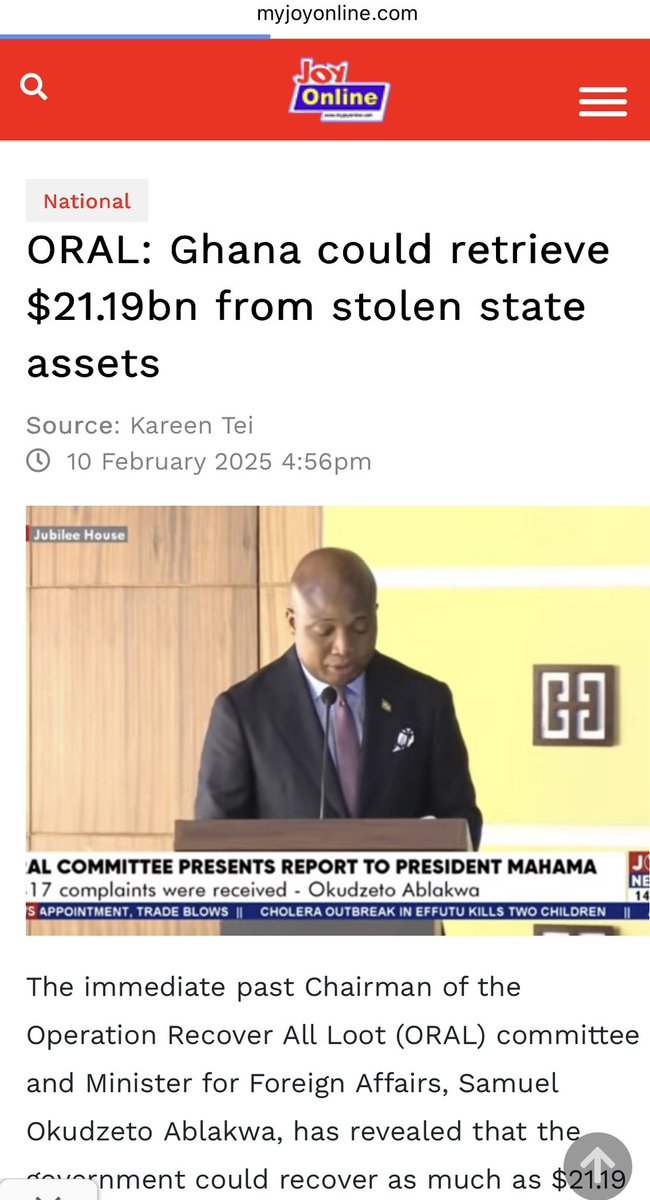
At some point, the Attorney General needs to provide an update on the current estimates for the potentially recoverable amounts through ORAL. From the NSS scandal alone, we already know the $21 billion figure isn’t accurate and grossly exaggerated. That amount also includes the “money printing” by the Bank of Ghana to support the budget. From the outset, some of us insisted that the recovery projections must be realistic. The NSS estimates, for example, were the result of poor arithmetic. It’s time we were given a credible estimate so we’re all on the same page about what’s actually recoverable.
Alfred tweet media
English
2
32
73
4.8K
Jeremy がリツイート
Alfred
Alfred@CallmeAlfredo·
Whoa, that’s a significant drop from the $841 million in oil receipts recorded during the same period last year. Beyond the significant decline in dollar terms, the rapid appreciation of the cedi also means lower revenue to the government in cedi terms than anticipated. In the mid-year review, the government indicated that oil revenues were 2.7 billion cedis below target. This has significant implications for the “Big Push,” especially considering that 64% of its funding was expected to come from oil revenue this year.
Alfred tweet media
JoyNews@JoyNewsOnTV

Ghana bags $370.62m from crude oil in first-half of 2025 #JoyNews

English
4
47
79
14.4K
Jeremy がリツイート
CURTIS A. OWUSU
CURTIS A. OWUSU@_i_am_Curtis·
The AG has recovered 10.6% of the Unibank Liability NOT 60%. ~Bright Simons
English
13
47
257
12.6K
Jeremy がリツイート
Scanty SZN
Scanty SZN@EiiScanty·
so ive Mohammed with me, @wode_maya has promised to fully pay the 30K cedis for him. but he’s been through a lot. he has 0 cattle now in his farm. any form of support is welcomed
Scanty SZN tweet media
Scanty SZN@EiiScanty

2months ago, I spoke to this guy about profiling his cattle business.. he used to have a whole cattle farm at 22years old. today, i just spoke with him - he’s lost everything - he’s in debt of 30,000 cedis & wants to take his life due to threats from his business partner.

English
181
884
5.6K
388.7K
Jeremy がリツイート
Bright Simons
Bright Simons@BBSimons·
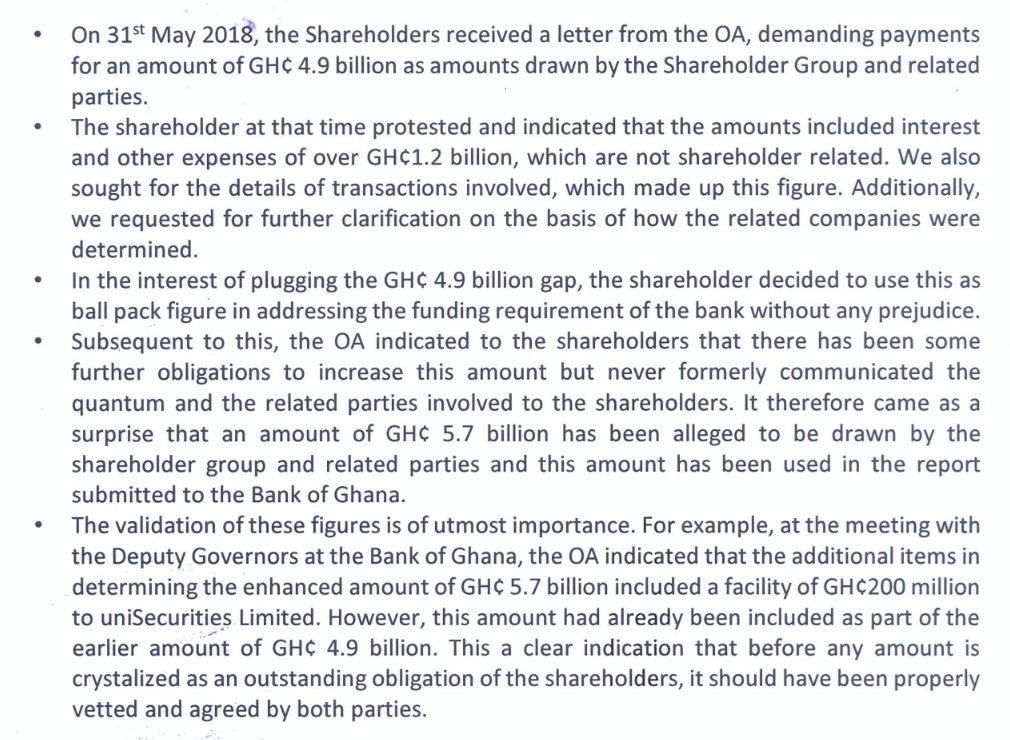
The AG has recovered 10.6% of the Unibank Liability NOT 60% 1. On 22nd July 2025, the Attorney General of Ghana (AG) announced that he had reached an agreement with the owners of the collapsed Unibank who were under prosecution commenced by the previous government for financial crimes. He also seems to suggest that parallel civil proceedings to recover lost funds shall be terminated. 2. The main owner of Unibank being the former finance minister from the same ruling party as the Attorney General, the announcement was naturally greeted with intense cynicism. If anything at all, the criminal action could have been maintained to apply pressure even as a negotiated settlement was pursued. Why then drop the state's leverage? 3. The terms of the settlement - the Unibank actors would need to pay back 60% of their estimated liability - had also proven controversial. 4. Today, the AG provided additional details. As a governance analyst, I am a huge supporter of public disclosures that shed light on government's actions. So, I am happy that I don't need to scurry around trying to find leaks to do my public interest work. 5. I have reviewed the AG's arguments very carefully. I have also gone back to my notes on the Unibank affair. On balance, I am deeply dissatisfied with the AG's analysis of the public finance element of the situation. 6. I give some credit to his legal reasoning regarding the probability of recovery if the cases were to continue. Especially in light of the strange decision by the Court of Appeal to acquit in the Beige case (I am yet to read the judgment). However, the public still deserves total honesty and rigour from its AG in a case involving such large amounts. Claiming "pragmatism" is not enough. 7. Unibank was one of Ghana's largest banks. Between 2013 and 2016, its assets grew from just about GHS GHS 825 million to GHS 2.88 billion. Its depositor accounts numbered over 400,000 by July 2017. It won many prestigious local awards. 8. Unfortunately, when the World Bank and IMF pushed Ghana to evaluate the quality of bank assets in 2015, it was discovered that many of Unibank's assets were "impaired" on prudential grounds. Its capital adequacy ratio thus dropped significantly below the legal minimum of 10%. Shareholders were then asked to inject more funds, which they did to an extent. 9. A new government came into office in early 2017. The Bank of Ghana (BoG) changed leadership. The new bosses introduced stricter scrutiny of the banks. Over a period of more than a year, multiple audits ensued during which it became clearer and clearer that the bank was bankrupt. On 1st August 2018, its license was yanked. A receiver was appointed to manage the residue of assets and liabilities. Hence began the saga. 10. The AG's position is that the GHS 5.7 billion in direct exposure (the financial loss the govt previously believed Unibank's owners should be responsible for) has been revised upon closer examination to GHS 3.3 billion. Of this amount, GHS 800 million shall be paid back by Unibank through forfeiture of landed properties and GHS 1.2 billion shall be recovered from Unibank's debtors. 11. The financial logic of the entire deal is TOTALLY MISCONCEIVED. The suggested amounts are puny, and whatever money can be recovered from any debtors was done a while back without making a dent in the liability. 12. It is instructive that two important players are so far quiet: the Bank of Ghana, a major creditor of Unibank, and the Receiver, who by law is required to safeguard the fiduciary interests of the defunct Unibank. WE MUST HEAR FROM THEM. 13. Now, let me explain why the AG's analysis is seriously porous. A. The claim that the "fictitious entries" entered in Unibank's books do not amount to liability on their own confuses the issues. I do not accept that this is an honest assessment of the situation. The fictitious entries masked the fact that monies borrowed from the public (depositors) and creditors (BoG and other banks) could not be properly accounted for. What is important is to ACCOUNT. B. On 31st July 2018, a day before the license revocation, the main shareholder of Unibank wrote an important letter which captures the liability "acceptable" to him and other shareholders. That number represents the minimum floor as one would assume that the shareholders will maximise their interests in any negotiation. C. The losses to the country emanating from the Unibank saga exceeds even the GHS 5.7 billion the previous government was pursuing. Let's delve into these matters. 14. In the July 31st 2018 letter, Unibank's owners admitted direct liability of GHS 4.9 billion. See extract from the letter attached. If so, how does the liability now get revised to GHS 3.3 billion? In fact, at that time, Unibank said it was willing for its assets to be liquidated for injection into the bank at a forced sale value of GHS 3.52 billion ($730 million). 15. The Bank of Ghana alone was owed over GHS 2.8 billion. However, Unibank had offsetting claims amounting to ~GHS 600m bringing the net liability to ~GHS 2.2 billion. The current settlement does not even cover this amount. 16. By May 2018, KPMG-validated liabilities of Unibank amounted to nearly GHS 9.2 billion. That is to say $2 billion made up of customer deposits, BoG liquidity support, and corporate borrowings, among others. Whilst Unibank owners have repeatedly argued that they were also owed a lot of money by the government, through contractors, their own claims amounted to less than $200 million. 17. Now, here is the key issue. The basic equation of finance is that liabilities must be offset by shareholder funds and assets, which in the case of banks mean good LOANS. Thus if we assume that the government's debt (DDEP notwithstanding) is prudent lending and therefore a good asset, we must account for roughly $1.8 billion more of WHERE THE UNIBANK MONEY WENT. 18. We know from KPMG's extensive work, that nearly $400 million that Unibank loaned to companies belonging to Unibank's owners never came back. 19. Of nearly $600 million loaned out to other companies, between half and 75% was deemed unrecoverable by KPMG. 20. As every reader can see, there is a big CAPITAL HOLE. Nearly $1.8 billion large. First, there is the ~$800 million of deposits by ordinary Ghanaians and companies that went to Unibank. Then over $400 million of BoG money. Plus another $600 million borrowed from various other banks and lenders. 21. The government's settlement of $80 million in cash and $120 million in as yet undisclosed properties (even using BoG exchange rates) is thus no where near accounting for the liability. 22. It is important to remember that the government assumed most of that liability. First, by way of covering for the deposits through the set up of CBG, a state-owned bank. And, second, by way of BoG absorbing the losses in its liquidity support. So far, the country has not been told whether the other debts accumulated by Unibank have been cleared or not. But those debts are losses too. 23. Even the liability that the former owners of Unibank themselves admit they are responsible for, over $1 billion, has not been covered in this "settlement". As of May 2018, the KPMG's view of the gap of money unaccounted for was $1.5 billion. 24. Thus, if we use market exchange rates, the government has "recovered" $160 million of a liability that may well exceed $1.5 billion (the receiver and BoG should update the nation). That is barely 10.6% of the total LOSSES TO GHANA's welfare! Even that $160 million is suspect because, from the AG's explanations, they are likely to be debt owed to contractors by the same government. It is important to re-emphasise that the deal cut by the government is only 21% of what Unibank's owners themselves admitted was their liability to the bank on July 31st, 2025. 25. In any serious country, the press conference of the AG today would be the BEGINNING not the end of the national debate about how Ghana tackles national financial losses involving the rich and powerful in society. The question is: is Ghana a serious country? Or a katanomic society? Judge for yourself.
Bright Simons tweet mediaBright Simons tweet mediaBright Simons tweet mediaBright Simons tweet media
English
119
434
839
112.5K
Jeremy がリツイート
That Guy
That Guy@LordBogos·
See how the argument has been misrepresented 😂 No one says recover 100%. We’re saying recovery cannot be the primary aim of CRIMINAL prosecution. The persons involved must be punished if found guilty, even if they return what was taken from the State.
Joy 99.7 FM@Joy997FM

It is illusionary for anyone to think the A-G or republic will recover 100% in every case; sometimes, recovery is only possible if the assets remain intact and accessible - Attorney-General #JoyNews

English
8
238
303
22.8K