

Ben Block
1.6K posts

Ben Block
@benjaminblock
Business lawyer and social entrepreneur using law & tech to promote social responsibility & create a better world. Founder of @GozAround. #CSR #BusinessLaw
Alberta, Canada 参加日 Mayıs 2010
442 フォロー中623 フォロワー

We ranked a B2B SaaS brand #1 on ChatGPT for their category in 7 days.
(And it's being used by marketing teams at Webflow, Chime, and Deepgram)
This platform tracks AI visibility + generates cited content automatically across ChatGPT, Perplexity, Claude, and Gemini...
→ No more 6-12 months waiting for Google rankings to move
→ No more $60K agency dashboards that only show problems
→ No more 10 different tools to track, create, and publish content
→ No more manual content gap analysis taking 20+ hours weekly
→ No more AI slop that ChatGPT refuses to cite
Just connect your data sources → autonomous visibility tracking + content generation system.
Here's how it works:
→ AI Citation Scanner (tracks mentions across ChatGPT, Perplexity, Claude, Gemini)
→ Competitive Gap Analysis (identifies where competitors get cited and you don't)
→ First-Party Data Integration (connects Zendesk, HubSpot, Drive, product docs)
→ AI Content Generator (creates authoritative content with human review checkpoints)
→ Direct CMS Publishing (publishes to Webflow, Contentful automatically)
→ Performance Measurement (tracks results across traditional + AI search)
Companies using this infrastructure:
• Webflow: 40% traffic lift + 5X content velocity
• Chime: 3X AI citations in 30 days
• Deepgram: 24X organic traffic (37K → 1.5M visitors in 60 days)
Built with AI-assisted workflows.
Runs on human + AI collaboration.
30-day results vs 6-month SEO cycles.
Want to see how you rank in AI search?
Like + comment "SEO" + repost, and I'll DM you the free scanner.
(must be following)
English

seeing a lot of very mediocre founders and ideas get term sheets from top funds this week
either 1) i don’t know what im doing
2) they don’t know what they’re doing
3) nobody knows wtf they’re doing
my 💰 is on 3)
English

not enough new tech for live entertainment
id give a team doing this 150k
English
SF loves the story of the college dropout founder.
Our last 3 deals were with founders in their 30s and 40s.
We back young founders too but it’s not the only way.
English
@Tocelot Great guidance and a mistake I learned the hard way. The feeling you must be everything on day 1 is real. That “login fatigue” means you have to replace all incumbent features AND do it in your novel way or add your new tool. A wedge is the better way to go.
English

a mistake we see many founders make is tackling too large of a vision starting off. you hear the truism that good start-ups tackle large markets, and so you start building a Maximum Viable Product that solves multiple problems or replaces an entire incumbent (ex. "Figma killer")
but the larger the vision, the longer it takes to build, and the more time and money you burn before you can tell whether your product theory is correct
instead i'm a fan of the "right size problem for the right size team" approach - what's an appropriately scoped problem so that a team with your (limited) resources can execute a first-class effort? ex. Amazon's books-only marketplace or Facebook's college photo sharing feature
early on speed is the main advantage start-ups have over large companies - you move faster, ship faster, iterate faster. by going after smaller, bite-sized problems, you can nail them quickly, establish dominant market share, and then expand to adjacent use-cases. over time, Amazon became the everything marketplace, and Facebook became a social network for everyone - but in the beginning they focused on tightly scoped problems that a small team could execute to perfection
but wait - "won't I have trouble raising VC money if my initial market is too small"? for fundraising, you want to articulate the story crisply that your initial product wedge is only the tip of the spear, and there is a much larger vision you plan to tackle over time. you should have a believable roadmap for how to get there. once you do this, most investors should understand the strategy - and if they don't, they probably just aren't the right fit!
English
@emollick Agreed. I ran into this on a long and productive conversation. It seemed obvious I should be able to scroll up and delete working artifacts or exchanges not needed to preserve the cumulative value. At least give me some room to output a summary for a new convo. Nope. Hard stop.
English

Claude's unwillingness to continue conversations after the context window is full is very frustrating. I am okay losing early context if I am working interactively on a project & making progress, I am not okay with suddenly being cut off and being forced to start a new chat.

English
@MartinGTobias AI powered, lawyer-lead Compliance SaaS for mid market companies. One client but just getting started. And hey…no email yet. How’s that sound?
English

I like to invest before the founder has established a corporate email address.
English
@MarketManiaCa I’d be curious to see the whole statement. It sounded like he was explaining a scenario and moving toward how that could be divisive. Of course it would be… some people go with some people stay home. But maybe that was his point? Do we have the whole video?
English

The World Economic Forum just laid out the future of “climate equity”:
The rich: travel the world 🌎
The rest: explore through VR goggles 🥽
Behind the smiles, it’s about CO₂ credit control — a system where you’ll trade your carbon rights back to billionaires just to exist.
English


Today, we're proud to launch Wilson to the world – your very own legal superagent.
Think Cursor for legal contracts.
To celebrate our launch, we're giving away a month of our Pro plan for free -- comment "Wilson" and we will send you a promo code.
No waitlist -- try Wilson today!
English
@JeremiahDJohns Really cool video. I love how raw his trademark sound is here. Thx for sharing!
English
One of my all-time favorite type of videos is pre-fame bands playing their extremely famous songs to a tiny room of people, because they're not yet known.
A thread of some examples:
Bastille playing Pompeii in what looks like someone's living room:
English


@russellcrowe Those are the Rockies between Alberta and BC…but I can’t tell exactly where. Come see us in Edmonton if you haven’t passed by already.
English

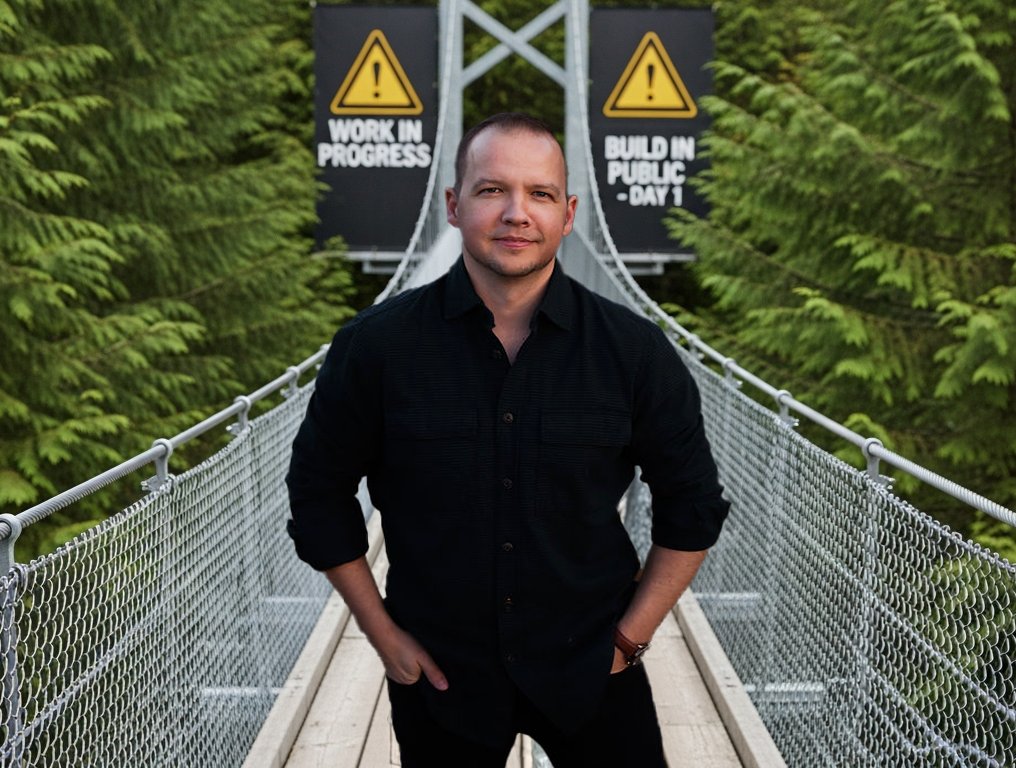
10 years building @GozAround and I've been doing it all wrong.
Mistake #1: Building in silence because I was terrified of failing publicly.
Mistake #2: Letting other people's "proven" strategies override my own vision.
The irony? We're building a platform to connect community needs with resources - literally about bringing people together - while I've been hiding in my home office.
Fear is expensive. It's cost me a decade of potential feedback, connections, and course corrections.
So here's the pivot: building in public starting now.
The messy experiments. The failed launches. The 3am "what if we tried..." moments. The pivots that make you question everything. Starting with this admission: I have no idea if we're solving corporate social impact the right way. I don't even know if the world wants what we're building! But it's time to find out for real.
Who else is building something they believe in but scared to talk about it?
English
@thejustinwelsh I’m struggling with some fear of putting myself out there. Especially video content TBH. Do you think written content is enough these days?
English

1/ Created lots of noise
When I was starting, I looked at attention as my friend.
I wrote content daily before I even had a business, just to find my voice.
I started on LinkedIn, talking about building a SaaS unicorn as the CRO.
English
Today, my little one-person business crossed $10M in total revenue.
It took 2,119 days, I ran zero ads & I operate at a ~89% margin.
Here are the 23 steps of my wild & strange journey:
Hope they are helpful to someone ↓
English
MIT’s Science paper showed false (often fear-laden) news is 70 % more likely to be retweeted. The good news is humans are trying to warn each other. The bad news is, it usually a false alarm.
pbs.org/newshour/scien…
English