@OliverLemm@orclapexworld How about a function that returns the query and adds
where 1=2
If there aren’t any query criteria. (Unless I’m missing the point.)
Using an Interactive Report which shouldn't give any results when opening this page the first time, what would be a good solution?
Using a page item inside the "where" clause doesn't help.
Do we have any attribute wich can be set that the query should be executed?
#orclapex
@plamen_9@haydenhhudson Very good but with subtle mistakes. For example, we described how to call different template components from one column but in the second summary it describes it the other way around.
Overall, it would save a lot of typing and just require a little review to straighten out.
@c2anton I've been using the PL/SQL Code feature of the DML process for a while now, love it (esp. that it works very similarly for interactive grids). The default is Region Source, and the Table/View option is useful to redirect the DML to a different table or view.
Tomorrow's APEX Instant Tip is a best practice hiding in the shadows. It should change the way most of us develop in APEX. I haven't learned something so fundamental about APEX in a long time. #orclapexyoutube.com/watch?v=W8wuld…
@c2anton Great tip! Probably just a mis-speak - when you mentioned Oracle Forms, you said it uses optimistic locking, whereas it actually uses pessimistic locking. As you correctly said, it takes a lock as soon as the user starts editing the record.
@nlitchfield@richsoule@fdernoncourt@oracleace Hmmm...wow. I'm going to have to think about this. Maybe I drank too much CoolAide while I was at Oracle in the 2000's when Larry just wanted "all of your data" in the Oracle database.
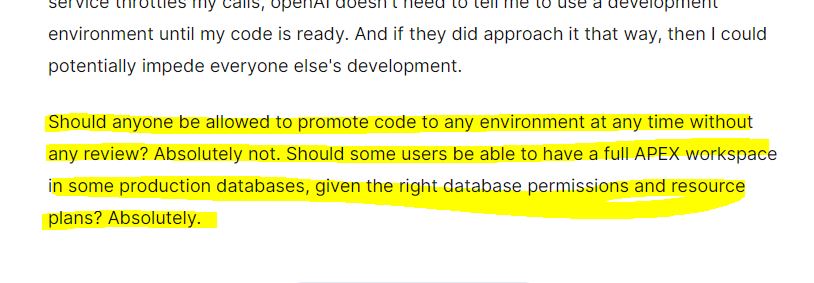
@mortenbraten@richsoule The highlighted sentences don’t attempt to answer the question of when the builder should be allowed in production. There is a huge range of how we use a database. I’m interested in discussing the vulnerabilities of having the builder in production. I’ll work on that :)
@richsoule@c2anton I appreciate the discussion, and agree with the conclusion, but his blog post is mainly about #orclapex in "production" as a sort of sandbox for "super users" (or "data scientists" or whatever). Not really comparable to what I'm talking about regarding the Runtime Only env.
@krisrice@mortenbraten I should stay off Twitter. Now I need a blog post…too long for a tweet. Perhaps I should have started here: focusing on an individual definition of “develop” will miss the broader themes of “appropriately protect the data” and “appropriately protect the computing resources.”
@c2anton@mortenbraten My line is my artisan crafted sql/code/plsql that is pipelined/tested/scanned/... should not be changed without change control/version/control/full pipeline tested before deployment
@mortenbraten Where do you draw the line? What is the most you will allow without calling it developing? It’s not so easy to answer. But if you can’t answer that, then you can’t even say if you allow development in production. For me, it’s now “if” but “how much.”
@c2anton So if I go into Gmail and customize the layout of my inbox, I’m “developing” in Google’s production environment?
I think I *do* define development differently than you 😆
@mortenbraten If you have a single IR with 15 columns that might have filters, that’s 2^15 (32,768) possible dynamically generated queries. 32K different explain plans. No way people test them all. If you haven’t tested it, then you are developing in prod.