Carolina Celis-Laverde

253 posts

Carolina Celis-Laverde banner
Carolina Celis-Laverde

Carolina Celis-Laverde

@ccelislaverde

Research Fellow @the_IDB. BA, MA Econ @EconomiaUAndes. Macro, monetary economics, and heterogeneity.

Washington, DC 参加日 Şubat 2017
286 フォロー中123 フォロワー
Carolina Celis-Laverde がリツイート
Jesús Fernández-Villaverde
Jesús Fernández-Villaverde@JesusFerna7026·
One of the great promises of LLMs is that they have reduced linguistic barriers for non-native English speakers in academia by at least an order of magnitude. Economics, my own field, is 99% in English. I have written a few papers and a book in Spanish but, for all practical purposes, these count for zero in my CV. I had to spend considerable time and effort to reach a level where I could give a 90-minute seminar in English. I could do it because economics is a math-heavy field (you can always put the equation on the slide and let the math do the work) and because Spanish is not that far from English. But I have seen incredibly brilliant students, particularly from East Asia, crash and burn in the job market because their English was below a minimum standard. I do not complain about it. As my great professor at Minnesota, Chris Phelan, loves to say: “Nobody should have told you that life is fair.” Some are born into upper-middle-class families in Hampstead, London, and some into villages in rural China. Given how different Chinese is from English, what amazes me is how smart my Chinese colleagues must be to give a 90-minute seminar in English at all. If you are a native English speaker, try to learn enough Chinese to give a five-minute talk. Then you will understand what they have accomplished. LLMs mean that an Egyptian student no longer must agonize for hours over a flowing introduction to her job market paper. Or a Korean student can prepare for interview questions without a native speaker holding her hand. We are only beginning to see the effects of this change. Native speakers (or speakers of languages close to English) have, so far, maintained a clear advantage in policy discussions. Does anyone truly believe that Paul Krugman would have become a New York Times columnist if he had been a native speaker of Japanese? Same brain, same graduate education, same contributions to economics, same academic jobs, very different impact on public opinion. Or why is economics or physics much more international than sociology, political science, or history? Because in economics or physics, you can get away with much lower linguistic skills. In history, if you cannot write English prose that meets a particular standard, you cannot publish. The resistance to LLMs in academic writing is, in many cases, the defense of the linguistic advantages of English. Let’s call a spade a spade.
Jesús Fernández-Villaverde tweet media
English
12
76
453
52.3K
Carolina Celis-Laverde がリツイート
Chris Blattman
Chris Blattman@cblatts·
This is interesting because if anything my ability to manage more projects and my research assistants’ ability to use Claude code means that I'm probably hiring more Chicago-based and international-based RAs now more than before because their productivity and mine is so much greater. Used correctly I think smart young researchers are compliments to me and AI and not substitutes. (And I'm doing this despite the fact that Mr. Trump and Mr. Musk cut about 80% of my funding in the past year so I'm hiring despite rather desperate financial constraints).
Aniket Panjwani@aniketapanjwani

most of the junior econ faculty I talk to are finding somewhere between "less" and "almost no" use for research assistants for simple tasks - data cleaning, making tables, running regressions - in the time it would take them to give instructions to the RA, they can instead just instruct CC and get the results (and done much better) so, the potential utility of an RA often depends now on the RA having high quality higher-level/architectural thoughts, being skilled at interpreting and iterating on the results of code, and/or being better at using coding agents than their prof yes, ofc RAs may have a comparative advantage despite not having an absolute advantage - but this is quite tricky a lot of the difference between mediocre and great results with agentic coding depends on having a simultaneous good mental model of the tools, how to work symbiotically with them, *AND* of the architecture of what it is you want to do (whether software or research) in the past, an RA would work slow enough - because the process of writing code was slow, so that you - as a prof - could catch them in all these small problems/mistakes they'd make along the way due to a lack of experience even so, reviewing RAs code was already a bottleneck for many profs now reviewing (tens of) thousands of lines of vibe coded RA code, esp if poorly thought out, is just untenable worth saying - the pool of junior faculty I talk to are highly selected, bc they're either coming to me for agentic coding training, or they're my friends and so have had to listen to me blather on about this stuff for the last year I do expect though that the sentiments of these junior faculty is wider spread than is implied by what economists are publicly saying about "RA replacement", because it's an unpopular/costly opinion to publicly voice that you don't need your RAs anymore

English
1
9
156
66.8K
Carolina Celis-Laverde がリツイート
NBER
NBER@nberpubs·
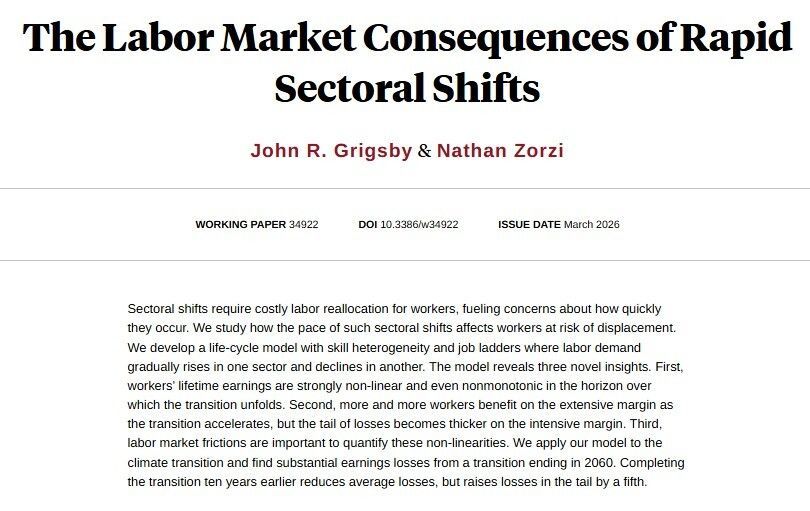
Workers' outcomes are highly non-linear, even non-monotone in the pace of sectoral shifts. More and more workers gain as a transition accelerates, but the tail of losses thickens, from @JohnRGrigsby and @Nathan_Zorzi nber.org/papers/w34922
NBER tweet media
English
1
16
69
14.2K
Carolina Celis-Laverde がリツイート
Jennifer Rincón A.
Jennifer Rincón A.@jennkathee1·
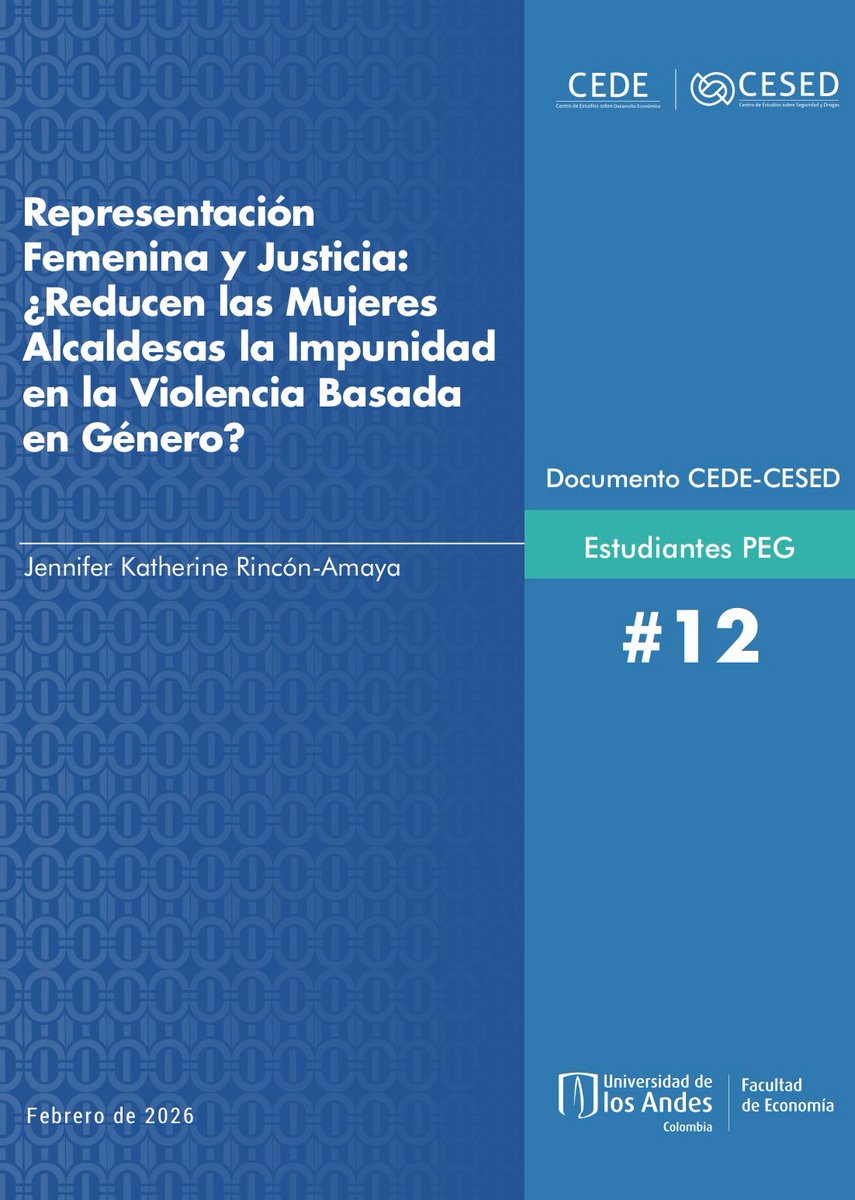
1/6🧵 ¿Qué pasa con la justicia colombiana cuando una mujer llega a la alcaldía en un contexto de alta impunidad frente a la violencia de género? Estoy muy feliz de compartir que mi tesis de maestría fue publicada como Documento CEDE-CESED en la Facultad de @EconomiaUAndes
Jennifer Rincón A. tweet media
Español
3
7
20
891
Carolina Celis-Laverde がリツイート
NBER
NBER@nberpubs·
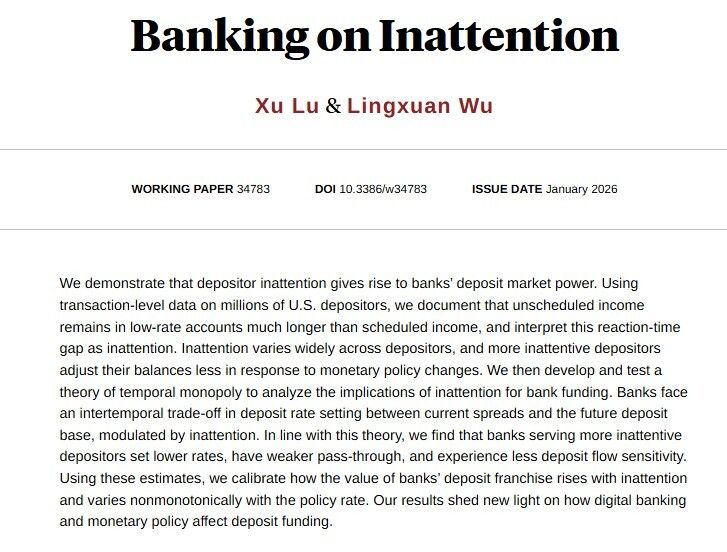
Demonstrating that depositor inattention gives rise to banks’ deposit market power, from Xu Lu and Lingxuan Wu nber.org/papers/w34783
NBER tweet media
English
0
8
45
6K
Carolina Celis-Laverde がリツイート
Economía Uniandes
Economía Uniandes@EconomiaUAndes·
Join us for the Inaugural James Robinson Annual Lecture, hosted by the #CEDE at #EconomiaUniandes. James Robinson — 2024 Nobel Prize in Economic Sciences — will present The Fundamental Disequilibrium in Latin America: bit.ly/4sFqFUd 🗓 January 27, 2026 | ⏰ 4:00 p.m. – 6:00 p.m. 📍 Mario Laserna Auditorium – @Uniandes 🔗 Register here: bit.ly/4sFqFUd
Economía Uniandes tweet media
English
3
21
61
4.3K
Carolina Celis-Laverde がリツイート
Francesco Bianchi
Francesco Bianchi@Francesco_Bia·
Why is a conflict between fiscal and monetary policy dangerous? @LeonardoMelosi and I show that when fiscal authorities ignore debt sustainability while central banks fight inflation, the economy can enter a vicious spiral of high inflation, recessions, and more debt accumulation
English
2
18
113
9.7K
Carolina Celis-Laverde がリツイート
NBER
NBER@nberpubs·
Studying whether the returns to quality upgrading get passed through to primary agricultural producers finds that in Colombian coffee, the answer is mostly no, but sometimes yes, from Rocco Macchiavello, Josepa Miquel-Florensa, @nico_de_roux, @EricVerhoogen, @BernaMario, and Patrick W. Farrell nber.org/papers/w34610
NBER tweet media
English
0
10
32
5.9K
Carolina Celis-Laverde がリツイート
NBER
NBER@nberpubs·
Constructing a new dataset of FOMC meeting transcripts from 1966 to 1990 to analyze the sources of heterogeneity in individual monetary policy preferences and how this heterogeneity shapes policy decisions, from Cooper Howes, Marc Dordal i Carreras, Olivier Coibion, and @YGorodnichenko nber.org/papers/w34632
NBER tweet media
English
0
15
65
5.3K
Carolina Celis-Laverde がリツイート
Florin Bilbiie 🇪🇺 🇺🇦
Florin Bilbiie 🇪🇺 🇺🇦@FlorinBilbiie·
🚀 Draft chapters my forthcoming MIT Press book: 𝗛𝗲𝘁𝗲𝗿𝗼𝗴𝗲𝗻𝗲𝗼𝘂𝘀 𝗔𝗴𝗲𝗻𝘁 𝗠𝗮𝗰𝗿𝗼𝗲𝗰𝗼𝗻𝗼𝗺𝗶𝗰𝘀: A Tractable New Keynesian Framework A modern, analytical roadmap to TANK & HANK models for researchers, students and policy institutions sites.google.com/site/florinbil… 👇
Florin Bilbiie 🇪🇺 🇺🇦 tweet media
English
19
144
645
121.6K
Carolina Celis-Laverde がリツイート
Hanno Lustig
Hanno Lustig@HannoLustig·
Real question. Is there any central bank in an advanced economy that has shrunk its balance sheet back to pre-2008 levels after launching large-scale asset purchases?
English
16
8
94
28.3K
Carolina Celis-Laverde がリツイート
Makoto Nakajima
Makoto Nakajima@makotonkjm·
I have to say again and again that I learned the basics of the NK model from Eric Sims' lecture notes. I still come back from time to time. For example, notes on this page: sites.nd.edu/esims/courses/…
English
3
33
251
54.4K
Carolina Celis-Laverde がリツイート
Daniel Mejia
Daniel Mejia@DanielMejiaL·
We, at @EconomiaUAndes, are hiring. We have two tenure-track positions open for assistant or associate professors in economics. Los Andes ranks among the top departments of economics in Latin America. We look forward to receiving the applications at: aeaweb.org/joe/listing.ph…
Daniel Mejia tweet mediaDaniel Mejia tweet media
English
2
62
149
14.6K
Carolina Celis-Laverde がリツイート
QJE
QJE@QJEHarvard·
Recently accepted by #QJE, “The Macroeconomic Consequences of Exchange Rate Depreciations,” by Fukui, Nakamura, and Steinsson: doi.org/10.1093/qje/qj…
English
5
45
166
18.2K
Tatiana Mojica
Tatiana Mojica@tatmoj_·
Spent two years living alone in the US — peaceful, nothing ever happened. Two weeks in Canada — a drunk man breaks into the house in the middle of the night. The math ain't mathing.
GIF
English
1
0
1
137